Cleric’s bid for beachside office on southern island draws criticism
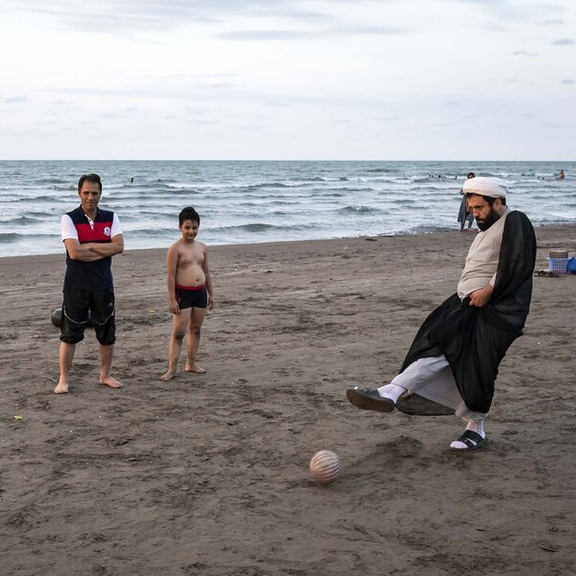
A cleric kicks a football on a shore in Iran
A state-appointed cleric's request to set aside a beachside plot on the southern holiday island of Kish for his office stoked criticism this week after the proposal appeared online.
The Asr-e Iran news outlet direct a sharp rebuke at Alireza Biniaz, the Kish Friday prayer leader in the form of a lengthy commentary. Friday prayer leaders are official positions appointed by Supreme Leader Ali Khamenei's office.
“What does a special beach for the Friday prayer leader and his friends even mean? Was wanting special treatment in other areas not enough – now a special beach too?” the outlet said.
“You go to university with special privileges, get hired with special privileges, use a privileged internet line, and then go to Kish to stay at a special beach?” Asr-e Iran wrote.
Biniaz's original letter was addressed to Mohammadjafar Kabiri, the head of the Kish Free Zone Organization. Earlier discussions with the economy minister, Biniaz wrote, had produced an understanding to build and operate a special beach for the Friday prayer institution.
He urged officials to expedite and finalize its allocation to allow access for “devout individuals, committed citizens, officials and special guests.”
Public spaces and equal access
Asr-e Iran rejected dividing society into categories of devotion. “Why insist on separating society into devout and non-devout?” it said. “It is the right of all Iranians to enjoy the island’s amenities, and the degree of anyone’s devotion is not for the Friday prayer leader of Kish – or anywhere else – to determine,” the website added.
The outlet asked President Massoud Pezeshkian to verify the letter’s authenticity and assess any role played by the economy ministry, arguing that inaction would reinforce perceptions of privileged access for clerics.
Earlier cases reflect a wider pattern
This is not the first time Friday prayer leaders and figures close to Supreme Leader Ali Khamenei have sought special advantages for themselves, with their names appearing in economic corruption files and similar cases.
In March 2024, journalist Yashar Soltani published documents revealing financial misconduct by Kazem Sedighi, then the Tehran Friday prayer leader, involving the 4,200-square-meter property valued at roughly ten trillion rials ($8.85 million).
The property, which had been under the control of a seminary managed by Sedighi, was transferred for only 66 billion rials ($58.4 thousand).
After widespread criticism and a strong public reaction, Sedighi eventually wrote to Khamenei in August seeking “to be excused from leading Friday prayers in order to focus on academic, teaching and preaching work,” a request the Supreme Leader approved.
Iranian Foreign Minister Abbas Araghchi said on Friday that the United States and three European powers have “killed” the Cairo nuclear agreement through what he called a sequence of hostile actions.
“Like the diplomacy which was assaulted by Israel and the US in June, the Cairo Agreement has been killed by the US and the E3,” Araghchi wrote on X, referring to Britain, France and Germany.
He said the chain of events began when “Iran was suddenly attacked by Israel and then the US” on the eve of a new round of indirect nuclear talks.
“When Iran later signed a deal with the IAEA in Cairo to resume inspections despite the bombings, the E3 pursued UN sanctions against our people under US pressure,” he wrote.
Araghchi said that when Iran began allowing International Atomic Energy Agency inspectors access to its facilities, “the US and the E3 ganged up to censure Iran” at the agency’s Board of Governors.
“Iran is not the party that seeks to manufacture another crisis,” he added. “The official termination of the Cairo Agreement is the direct outcome of their provocations.”
Tehran says resolution is politically driven
His comments followed Iran’s announcement that it will respond to a resolution passed on Thursday by the International Atomic Energy Agency’s Board of Governors, which Tehran called “illegal and unjustified.” The Foreign Ministry said the measure, backed by Washington and its European allies, was a “political misuse of the Agency” and had nullified the Cairo inspection accord reached in September.
Foreign Ministry spokesperson Esmail Baghaei said Tehran had officially informed the IAEA that the understanding reached in Cairo was “no longer valid.” “The so-called Cairo accord, which had been achieved through lengthy negotiations and Iran’s goodwill, is now considered void,” he told state media.
The ministry said the United States and the three European countries “ignored Iran’s responsible and good-faith conduct, disrupting the positive path that had emerged between Iran and the Agency, and forced Iran to declare the termination of the September 9 understanding.”
Resolution presses Iran for access after attacks
The IAEA Board of Governors adopted the Western-backed resolution urging Iran to provide full access and information about its nuclear program. Diplomats said the measure passed with 19 votes in favor, three against and 12 abstentions, with Russia, China and Niger voting against it.
The resolution calls on Iran to allow verification of its enriched uranium stockpile and inspections at sites damaged by US and Israeli airstrikes in June. Iran says those attacks killed several nuclear scientists and halted cooperation with the Agency because of security concerns.
Earlier this week, Araghchi said Washington’s approach amounted to “dictation, not negotiation,” accusing the US of trying to achieve through diplomacy what it failed to gain by force. “They want us to accept zero enrichment and limits on our defense capabilities,” he said. “This is not negotiation.”
Land subsidence has intensified across Iran in recent years, with excessive groundwater extraction, drought and climate change driving the sharpest declines in Khorasan Razavi, Isfahan and southern Kerman, the country’s crisis-management spokesman said on Friday.
“From the early 1970s, groundwater withdrawal increased and farmers and other users turned heavily to underground resources,” Hossein Zafari said in remarks published by ISNA. “Gradually, with this extraction and worsening droughts, land subsidence intensified in parts of the country and this trend has continued.”
Razavi Khorasan, Fars, Kerman, Khuzestan and Isfahan, Zafari said, contain Iran’s broadest subsidence zones, while Isfahan, Razavi Khorasan, Fars and Tehran have the highest number of cities exposed.
The largest affected populations live in Tehran, Razavi Khorasan and Isfahan, he added.
Officials in several ministries have raised similar alarms in recent months. Land subsidence now affects 30 provinces except Gilan, Culture Minister Reza Salehi-Amiri said on Monday, adding that conditions in several regions have reached a critical point.
Last month, Ali Beitollahi, head of earthquake engineering at Iran's Ministry of Housing research center, said 750 Iranian cities face subsidence, warning earlier this year that Iran ranks third globally for the scale of the phenomenon.
In 2023, reports emerged indicating that the Iranian government had withheld key information regarding the worsening subsidence crisis. Last year, Iranian experts classified the situation as "critical," warning that it threatens the lives of over 39 million people.
The crisis is driven by a combination of factors, including dam construction, climate change, inefficient water use in agriculture and industry, and the over-extraction of underground aquifers through illegal wells. These interrelated issues now pose a severe risk to millions across the country.
Tehran’s air reached the unhealthy for sensitive groups range on Friday as pollutant concentrations climbed and meteorologists issued an orange alert for six major cities, warning that stagnant conditions could drive indices toward the dangerous threshold in the coming days.
The 24-hour average for fine particulate matter (PM2.5) stood at 103 on Friday, placing the capital in the category affecting children, the elderly and people with heart or respiratory conditions, the Tehran Air Quality Control Company said.
Morning readings reached 133, extending the hazard to a broader segment of vulnerable residents.
The US EPA Air Quality Index uses six color-coded categories to show rising levels of pollution and health risk. It starts with Good (0–50, green), where the air poses little or no threat. Moderate (51–100, yellow) signals acceptable conditions but possible effects for a small number of sensitive people. Unhealthy for Sensitive Groups (101–150, orange) warns of heightened risk for those with respiratory or heart conditions. Unhealthy (151–200, red) means everyone may begin to feel adverse effects. Very Unhealthy (201–300, purple) marks a serious increase in health concerns. At the top of the scale, Hazardous (301+, maroon) indicates dangerous conditions where the entire population may face severe health impacts.
The stagnant pattern is likely to persist, Sadegh Ziaian, an official at the National Meteorological Organization, said on Thursday.
“An increase in pollutant concentrations in the major cities is certain,” he said, adding that only parts of Iran’s eastern belt would see winds strong enough to disperse particulates. “Tehran’s sky will remain clear with local haze, and air will reach unhealthy levels for all groups.”
Public health toll and calls for systemic reform
The health ministry has repeatedly stressed the human cost of chronic pollution. 58,975 deaths in the past Iranian year were attributable to poor air quality, an average of 161 a day, with economic losses estimated at $17.2 billion, according to Deputy Health Minister Alireza Raisi.
Meteorologists advised residents and authorities to curb non-essential travel, manage fuel consumption, restrict polluting industrial activity and avoid outdoor exercise. Environmental specialists continue to urge long-delayed measures – from retiring aging vehicles to expanding cleaner energy – warning that without structural reforms, cities such as Tehran will remain trapped in cycles of hazardous air and mounting health impacts.
The S-200 missile system is displayed during the Iranian defense week, in a street in Tehran, Iran, September 24, 2024.
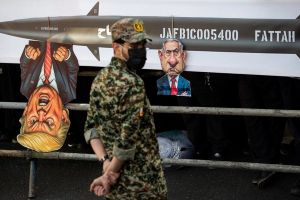
Iran has made significant investments to restore its ballistic missile capacity, increasing the likelihood of renewed war with Israel, i24 reported on Thursday, citing Western officials.
“The fear of miscalculation and renewed conflict stems, among other things, from the fact that, like Israel, Iran feels that it is under an existential threat,” one of the Western sources said.
Western officials, according to the i24 report, assess that Tehran has prioritized missile reconstruction over accelerating its nuclear program, viewing the project as more urgent for national security. They told the channel that Iran’s new missiles are expected to be less precise because Israel damaged key planetary-mixer infrastructure during the 12-day war.
Iran has concluded it would need a large volume of missiles to overwhelm Israeli defenses, the officials added. The Houthis in Yemen, they also said, may escalate drone launches at Israel.
Satellite analyses published earlier by the Associated Press showed reconstruction work at Iranian missile-production sites struck during the war, though experts told the agency they had not seen signs of large solid-fuel mixers, a crucial component of the program.
The officials also warned that mutual damage in any new confrontation would be severe. “The Iranians know that if they attack, Israel will carry out a wide range of comprehensive attacks,” one said. “The Iranians will bring down skyscrapers in Tel Aviv, and in Tehran there will be great destruction.”
Israeli officials and Western governments have repeatedly referenced the prospect of another round of fighting in recent weeks. An Israeli security official said less than two weeks ago that the military is preparing for a conflict that could last longer than 12 days.
Israel may pursue an attempt at regime change in Iran, the sources told i24, but it is not certain that it will receive American support.
Iran said on Friday it will respond to the latest resolution by the UN nuclear watchdog’s board, calling it a political misuse of the agency and saying the vote has invalidated an inspection accord reached in Cairo.
The Foreign Ministry said the measure, backed by the United States and three European powers, has further undermined the credibility of the International Atomic Energy Agency.
Foreign Ministry spokesperson Esmail Baghaei said Tehran informed the Agency in an official letter that the understanding reached in Cairo in September is now considered void. “The so-called Cairo accord, which had been achieved through lengthy negotiations and Iran’s goodwill, is no longer valid,” he told state media.
Baghaei said the resolution showed “a clear misuse of an international body to advance the interests of the United States and three European countries.” He said Tehran will take reciprocal measures but did not give details.
In a separate statement early Friday, the Foreign Ministry described the IAEA Board of Governors’ resolution as “illegal and unjustified.” It said the measure was imposed under US and European pressure and “represents another example of their irresponsible behavior and misuse of the Agency to apply political pressure on Iran.”
The statement said the resolution violated the fundamental principles of the Non-Proliferation Treaty, which guarantees every member’s right to peaceful nuclear energy. It also said the board has “no legal authority” to revive Security Council resolutions that have already expired.
According to the ministry, “The United States and three European countries ignored Iran’s responsible and good-faith conduct, disrupting the positive path that had emerged between Iran and the Agency, and forced Iran to declare the termination of the September 9 understanding.”
The statement added that under that understanding, Iran and the Agency had resumed cooperation and allowed limited inspections of some nuclear facilities.
The IAEA Board of Governors on Thursday adopted a Western-backed resolution urging Iran to grant full access and information about its nuclear program. Diplomats said the measure passed with 19 votes in favor, three against and 12 abstentions. Russia, China and Niger voted against it.
The resolution calls on Iran to allow the Agency to verify its stock of enriched uranium and inspect atomic sites damaged by US and Israeli airstrikes in June. It also asks Iran to provide “without delay” data on nuclear material and safeguarded facilities.
Foreign Minister Abbas Araghchi said on Thursday the resolution effectively nullified the Cairo accord, an interim deal reached with IAEA Director General Rafael Grossi and Egyptian mediation. The agreement had aimed to restore limited inspections at facilities hit during the June conflict.
Iran links dispute to June attacks
Tehran says the IAEA resolution ignores what it calls the illegal US and Israeli attacks on its nuclear sites, which killed scientists and halted inspections. “Neither in the resolution nor in the statements of the United States and the three European countries is there any mention of those attacks,” Baghaei said.
Iranian officials have said the attacks caused a sharp drop in cooperation with the Agency because of safety concerns and political mistrust. Araghchi said this week that Tehran continues cooperation under the Non-Proliferation Treaty for facilities such as the Bushehr power plant but will not allow inspections at bombed sites.
‘West seeks dictation, not negotiation’
Araghchi said in a separate interview that Washington and its allies are seeking to impose demands rather than hold genuine talks. “They want us to accept zero enrichment and limits on our defense capabilities,” he said. “This is not negotiation. This is dictation.”
He said the United States has offered to close the Security Council file on Iran if Tehran accepts “unacceptable” conditions. “After the war they could not achieve their goals through force. Now they want to achieve them through pressure and so-called negotiation,” he said.
Baghaei said the new resolution will make it harder for the Agency and Iran to work together. “By disregarding Iran’s goodwill and cooperation, these countries have damaged the Agency’s credibility and independence,” he said.