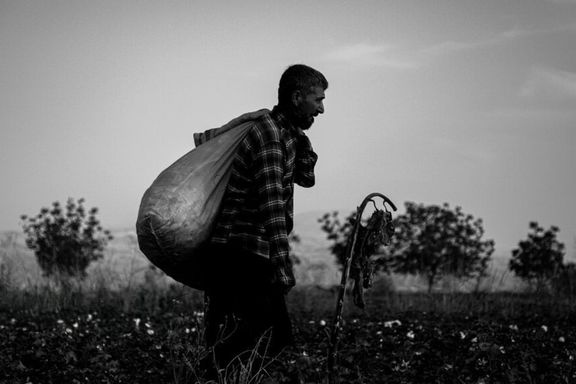
A cotton-picker walks off the field at the end of a work day in Iran's northeastern province of North Khorasan, November 6, 2025
The Iran projected on social media these days—brunch parties, rooftop concerts, fashion shows—is real, but only as a tiny fragment of the country’s reality, where most ordinary people struggle to make ends meet.
These scenes travel fast because they are rare: glimpses of a lifestyle that feels transgressive, novel and attractive. But they tell only one story: the story of a few thousand people, or tens of thousands at most.
A recent trip I took from Tehran to Arak—a central, industrial city neither wealthy nor poor—was a reminder of the other Iran, the one that almost never goes viral because nothing about it looks new.
I had travelled for a family funeral, the kind of gathering that pulls scattered relatives together every couple of years.
Silent suffering
What struck me first was how much people had aged—not in years, but in spirit.
Faces once energetic and upwardly mobile now carried a weary stillness. Conversations that used to revolve around plans and hopes now dwelt on stress, stagnation and the quiet grind of survival.
What surprised me even more was how depoliticized the atmosphere felt.
Arak is more traditional than Tehran, but that wasn’t the reason—almost no one in this family is a supporter of clerical rule, to put it mildly. The difference was energy. People simply had no energy left for arguments.
You’d hear the occasional question—“Will there be another war?”—or the familiar, bitter shorthand: “May they be damned for dragging us into this misery.” “They,” always meaning the ruling elite.
But beyond that, there was silence. Apathy so heavy you could almost taste it—bland, because the buds have been numbed by years of prolonged bitterness.
Images of fancy restaurants and increasingly bold public events often go viral
Unseen, commonplace
Driving around Arak, the contrast with the glossy clips from affluent Tehran felt almost jarring. Streets were subdued, shops half-lit, people moving with a kind of mechanical purpose.
Even those who would never describe themselves as poor are tightening in every direction: skipping leisure, postponing long-planned repairs, reducing meat consumption and silently navigating an inflation that deepens every few weeks.
And yet none of this appears online. Not because it is hidden, but because it is visually unremarkable.
Economic hardship has no aesthetics. There is no cinematic frame for the mother counting bills three times a week, or the father arguing with a bank over a loan he knows he can never repay.
There is no viral clip for a city quietly shrinking its ambitions.
Poles apart
This is the imbalance shaping Iran’s public imagination today: a tiny minority producing the country’s most visible images, and a vast majority living a reality that resists imagery. Social media magnifies the first and erases the second.
The result is two Irans: one seen, curated, exceptional; the other lived, familiar and increasingly exhausted.
What Arak revealed was simply scale.
If this is the condition of people once firmly middle class in a city that is not even among Iran’s poorest, then the unseen hardship elsewhere is almost certainly sharper.
The novelty of a few hundred affluent gatherings has captured the digital spotlight. The daily grind of millions, meanwhile, continues off-camera—too commonplace to trend, too ordinary to excite but defining the country far more than any brunch could.
Iranian Foreign Minister Abbas Araghchi said on Friday that the United States and three European powers have “killed” the Cairo nuclear agreement through what he called a sequence of hostile actions.
“Like the diplomacy which was assaulted by Israel and the US in June, the Cairo Agreement has been killed by the US and the E3,” Araghchi wrote on X, referring to Britain, France and Germany.
He said the chain of events began when “Iran was suddenly attacked by Israel and then the US” on the eve of a new round of indirect nuclear talks.
“When Iran later signed a deal with the IAEA in Cairo to resume inspections despite the bombings, the E3 pursued UN sanctions against our people under US pressure,” he wrote.
Araghchi said that when Iran began allowing International Atomic Energy Agency inspectors access to its facilities, “the US and the E3 ganged up to censure Iran” at the agency’s Board of Governors.
“Iran is not the party that seeks to manufacture another crisis,” he added. “The official termination of the Cairo Agreement is the direct outcome of their provocations.”
Tehran says resolution is politically driven
His comments followed Iran’s announcement that it will respond to a resolution passed on Thursday by the International Atomic Energy Agency’s Board of Governors, which Tehran called “illegal and unjustified.” The Foreign Ministry said the measure, backed by Washington and its European allies, was a “political misuse of the Agency” and had nullified the Cairo inspection accord reached in September.
Foreign Ministry spokesperson Esmail Baghaei said Tehran had officially informed the IAEA that the understanding reached in Cairo was “no longer valid.” “The so-called Cairo accord, which had been achieved through lengthy negotiations and Iran’s goodwill, is now considered void,” he told state media.
The ministry said the United States and the three European countries “ignored Iran’s responsible and good-faith conduct, disrupting the positive path that had emerged between Iran and the Agency, and forced Iran to declare the termination of the September 9 understanding.”
Resolution presses Iran for access after attacks
The IAEA Board of Governors adopted the Western-backed resolution urging Iran to provide full access and information about its nuclear program. Diplomats said the measure passed with 19 votes in favor, three against and 12 abstentions, with Russia, China and Niger voting against it.
The resolution calls on Iran to allow verification of its enriched uranium stockpile and inspections at sites damaged by US and Israeli airstrikes in June. Iran says those attacks killed several nuclear scientists and halted cooperation with the Agency because of security concerns.
Earlier this week, Araghchi said Washington’s approach amounted to “dictation, not negotiation,” accusing the US of trying to achieve through diplomacy what it failed to gain by force. “They want us to accept zero enrichment and limits on our defense capabilities,” he said. “This is not negotiation.”
Iran said on Friday it will respond to the latest resolution by the UN nuclear watchdog’s board, calling it a political misuse of the agency and saying the vote has invalidated an inspection accord reached in Cairo.
The Foreign Ministry said the measure, backed by the United States and three European powers, has further undermined the credibility of the International Atomic Energy Agency.
Foreign Ministry spokesperson Esmail Baghaei said Tehran informed the Agency in an official letter that the understanding reached in Cairo in September is now considered void. “The so-called Cairo accord, which had been achieved through lengthy negotiations and Iran’s goodwill, is no longer valid,” he told state media.
Baghaei said the resolution showed “a clear misuse of an international body to advance the interests of the United States and three European countries.” He said Tehran will take reciprocal measures but did not give details.
In a separate statement early Friday, the Foreign Ministry described the IAEA Board of Governors’ resolution as “illegal and unjustified.” It said the measure was imposed under US and European pressure and “represents another example of their irresponsible behavior and misuse of the Agency to apply political pressure on Iran.”
The statement said the resolution violated the fundamental principles of the Non-Proliferation Treaty, which guarantees every member’s right to peaceful nuclear energy. It also said the board has “no legal authority” to revive Security Council resolutions that have already expired.
According to the ministry, “The United States and three European countries ignored Iran’s responsible and good-faith conduct, disrupting the positive path that had emerged between Iran and the Agency, and forced Iran to declare the termination of the September 9 understanding.”
The statement added that under that understanding, Iran and the Agency had resumed cooperation and allowed limited inspections of some nuclear facilities.
The IAEA Board of Governors on Thursday adopted a Western-backed resolution urging Iran to grant full access and information about its nuclear program. Diplomats said the measure passed with 19 votes in favor, three against and 12 abstentions. Russia, China and Niger voted against it.
The resolution calls on Iran to allow the Agency to verify its stock of enriched uranium and inspect atomic sites damaged by US and Israeli airstrikes in June. It also asks Iran to provide “without delay” data on nuclear material and safeguarded facilities.
Foreign Minister Abbas Araghchi said on Thursday the resolution effectively nullified the Cairo accord, an interim deal reached with IAEA Director General Rafael Grossi and Egyptian mediation. The agreement had aimed to restore limited inspections at facilities hit during the June conflict.
Iran links dispute to June attacks
Tehran says the IAEA resolution ignores what it calls the illegal US and Israeli attacks on its nuclear sites, which killed scientists and halted inspections. “Neither in the resolution nor in the statements of the United States and the three European countries is there any mention of those attacks,” Baghaei said.
Iranian officials have said the attacks caused a sharp drop in cooperation with the Agency because of safety concerns and political mistrust. Araghchi said this week that Tehran continues cooperation under the Non-Proliferation Treaty for facilities such as the Bushehr power plant but will not allow inspections at bombed sites.
‘West seeks dictation, not negotiation’
Araghchi said in a separate interview that Washington and its allies are seeking to impose demands rather than hold genuine talks. “They want us to accept zero enrichment and limits on our defense capabilities,” he said. “This is not negotiation. This is dictation.”
He said the United States has offered to close the Security Council file on Iran if Tehran accepts “unacceptable” conditions. “After the war they could not achieve their goals through force. Now they want to achieve them through pressure and so-called negotiation,” he said.
Baghaei said the new resolution will make it harder for the Agency and Iran to work together. “By disregarding Iran’s goodwill and cooperation, these countries have damaged the Agency’s credibility and independence,” he said.
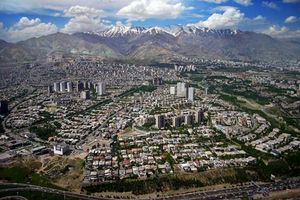
An aerial view of north Tehran under heavy fog afflicting Iran's capital during autumn in particular, November 2024
Iran’s capital must be moved because the country “no longer has a choice,” President Masoud Pezeshkian said on Thursday in remarks carried by state media, warning that severe ecological strain has made Tehran impossible to sustain.
Pezeshkian said the pressure on water, land and infrastructure had left the government with “no option” but to act. “When we said we must move the capital, we did not even have enough budget. If we had, maybe it would have been done. The reality is that we no longer have a choice; it is an obligation,” he said in a speech in Qazvin.
He said Tehran now faces “catastrophe” as land in parts of the capital sinks by up to 30 centimeters a year and water supplies shrink. “When we say the land subsides 30 centimeters each day, this means disaster,” he said. He warned that mismanagement, construction in upstream areas and cuts to downstream water flows risk irreversible damage.
Pezeshkian said officials across government must work together or “a dark future” awaits. “Protecting the environment is not a joke,” he said. “Ignoring it means signing our own destruction.”
The president said the mismatch between water resources and demand had reached a breaking point. “We can bring water from the Persian Gulf, but it will be costly,” he said, arguing that Tehran’s population and construction load can no longer expand.
Makran: potential and limits
Iran announced in January that the government was studying plans to move the capital to the southern Makran coast, a remote region overlooking the Gulf of Oman. Officials said the shift could ease Tehran’s overcrowding, energy shortages and water stress.
The idea has surfaced repeatedly since the 1979 revolution but has stalled due to political resistance and soaring costs. Past administrations explored alternatives including Semnan, Qom and Isfahan but financial constraints halted progress.
Officials have said Makran’s coastline offers access to the Indian Ocean and a base for sea-linked economic projects. The area includes Chabahar, Iran’s only oceanic port and a gateway to Central Asia.
But critics say the region is underdeveloped, exposed to security risks and far from ready to host a national capital. Opponents argue the country cannot afford the tens of billions of dollars such a move would require at a time of economic strain, high inflation and renewed UN sanctions.
People arrive for the quarterly board of governors meeting at the IAEA headquarters in Vienna, Austria, November 19, 2025.
The UN nuclear watchdog’s 35-member Board of Governors on Thursday approved a resolution calling on Iran to promptly clarify the status of its enriched uranium and the condition of atomic sites hit in June by US and Israeli strikes.
The measure renews and updates the International Atomic Energy Agency’s reporting mandate on Iran’s nuclear program. It also urges Tehran to grant inspectors immediate access to verify information about its nuclear materials and facilities, according to the diplomats cited by Reuters.
A senior European diplomat told an Iran International reporter ahead of the vote that the resolution would pass easily, saying that “the draft has the necessary support.” The diplomat added that discussions on Iran’s compliance with the Non-Proliferation Treaty began Wednesday night and resumed Thursday morning before the vote.
The resolution, submitted by the United States, Britain, France, and Germany, urges Iran to “act strictly in accordance” with the Additional Protocol, which allows for snap inspections, and to resume full cooperation with the IAEA. It follows a recent agency report that said Iran has not allowed inspectors to access damaged sites or provided a full accounting of uranium enriched up to 60 percent purity, close to weapons grade.
Iran has warned that any new resolution would damage what it described as “a positive course of cooperation” with the agency. Tehran says it has cut cooperation under a law passed by parliament and will not resume it until its demands under the Non-Proliferation Treaty are met.
The Western powers’ draft stops short of declaring Iran in breach of its obligations but increases diplomatic pressure on Tehran to restore monitoring and transparency.
Senior military commanders and officers from around the world observe Gaza from Israel as part of an international seminar hosted by the Israeli military to share lessons from the last two years of its war, in Sderot, Israel, November 18, 2025.
Hamas and Hezbollah are quietly rebuilding their military capabilities amid a tense ceasefire with Israel, the Jerusalem Post cited Israeli defense officials as saying on Thursday.
According to the officials, Hamas’s military wing “has been rebuilding its force since the ceasefire took hold, gathering intelligence, recruiting and training operatives, and preparing for escalation,” the paper said.
The assessment followed an air strike the Israeli military said killed a Hamas battalion commander in Gaza and recent air strikes in Lebanon, one of which killed 13 people in a Palestinian refugee camp this week.
The officials said US pressure is “for now, restraining a sharper Israeli response” to Hezbollah’s ceasefire violations.
Southern Command sources said Hamas is seeking “operational opportunities to launch a surprise, limited attack against IDF units inside Palestinian territory, in violation of the deal.”
Military sources told the paper that Hezbollah is acting “in clear violation of the ceasefire understandings” and is moving “in the opposite direction of demilitarizing southern Lebanon and disarming.”
They said weapons were being moved into southern Lebanon and the Bekaa Valley as part of efforts to restore infrastructure with Iranian support.
Hezbollah’s quiet revival
Western and regional intelligence reports say Iran’s Quds Force helped Hezbollah rebuild its command structure after the killing of leader Hassan Nasrallah last year.
According to Le Figaro, Iranian operatives led by Quds Force commander Esmail Ghaani reorganized the group’s military wing within days, introducing younger commanders and tighter secrecy.
Hezbollah has agreed to withdraw its forces from the southern front but continues to store weapons north of the Litani River and in the Bekaa Valley, the report said.
Iran’s strategy, it added, aims to preserve Hezbollah’s deterrent power while avoiding direct confrontation with Israel.
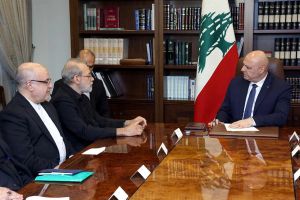
Lebanese President Joseph Aoun reportedly confronted Iran’s role in the country, breaking precedent by calling for Hezbollah’s disarmament. In a since-withdrawn interview, Aoun said he told Iran’s security chief Ali Larijani that “the Shi'ites of Lebanon are my responsibility, not yours.”
Aoun said Hezbollah’s military wing was “finished” and that he was seeking “an honorable end” to its armed role.
His comments followed a cabinet decision approving a US-backed roadmap to dismantle Hezbollah’s arsenal by the end of the year. Tehran has rejected the plan, accusing the West of trying to weaken Lebanon’s defenses.
Tension spills into Syria
Israel’s security leadership fears the growing coordination between Hamas, Hezbollah, and Tehran could extend into Syria.
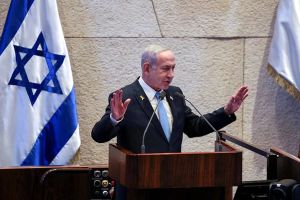
Prime Minister Benjamin Netanyahu’s visit to the country's south this week, with top defense and intelligence officials, signaled Israel’s determination to maintain its security buffer on the Golan Heights.
The visit came after Syrian President Ahmed al-Sharaa said he would normalize relations with Israel if the IDF withdrew from the Syrian Golan.
Security officials said they were not impressed by the rapprochement between the White House and Damascus and argued that al-Sharaa’s “jihadist past cannot be erased so quickly,” adding that he “does not necessarily control his own country.”