Iran president says capital move now a necessity as water crisis deepens
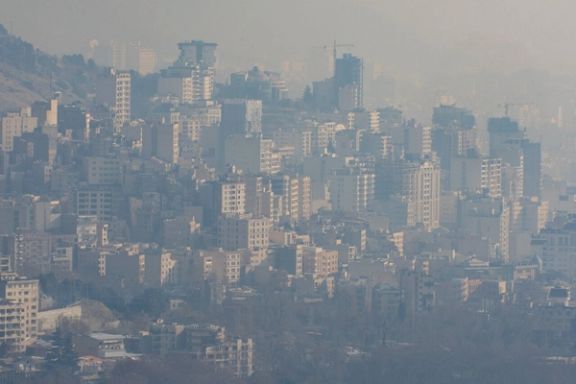
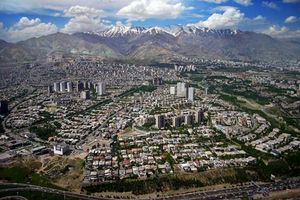
An aerial view of north Tehran under heavy fog afflicting Iran's capital during autumn in particular, November 2024
Iran’s capital must be moved because the country “no longer has a choice,” President Masoud Pezeshkian said on Thursday in remarks carried by state media, warning that severe ecological strain has made Tehran impossible to sustain.
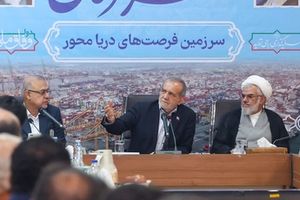
Pezeshkian said the pressure on water, land and infrastructure had left the government with “no option” but to act. “When we said we must move the capital, we did not even have enough budget. If we had, maybe it would have been done. The reality is that we no longer have a choice; it is an obligation,” he said in a speech in Qazvin.
He said Tehran now faces “catastrophe” as land in parts of the capital sinks by up to 30 centimeters a year and water supplies shrink. “When we say the land subsides 30 centimeters each day, this means disaster,” he said. He warned that mismanagement, construction in upstream areas and cuts to downstream water flows risk irreversible damage.
Pezeshkian said officials across government must work together or “a dark future” awaits. “Protecting the environment is not a joke,” he said. “Ignoring it means signing our own destruction.”
The president said the mismatch between water resources and demand had reached a breaking point. “We can bring water from the Persian Gulf, but it will be costly,” he said, arguing that Tehran’s population and construction load can no longer expand.
Makran: potential and limits
Iran announced in January that the government was studying plans to move the capital to the southern Makran coast, a remote region overlooking the Gulf of Oman. Officials said the shift could ease Tehran’s overcrowding, energy shortages and water stress.
The idea has surfaced repeatedly since the 1979 revolution but has stalled due to political resistance and soaring costs. Past administrations explored alternatives including Semnan, Qom and Isfahan but financial constraints halted progress.
Officials have said Makran’s coastline offers access to the Indian Ocean and a base for sea-linked economic projects. The area includes Chabahar, Iran’s only oceanic port and a gateway to Central Asia.
But critics say the region is underdeveloped, exposed to security risks and far from ready to host a national capital. Opponents argue the country cannot afford the tens of billions of dollars such a move would require at a time of economic strain, high inflation and renewed UN sanctions.
People arrive for the quarterly board of governors meeting at the IAEA headquarters in Vienna, Austria, November 19, 2025.
The UN nuclear watchdog’s 35-member Board of Governors on Thursday approved a resolution calling on Iran to promptly clarify the status of its enriched uranium and the condition of atomic sites hit in June by US and Israeli strikes.
The measure renews and updates the International Atomic Energy Agency’s reporting mandate on Iran’s nuclear program. It also urges Tehran to grant inspectors immediate access to verify information about its nuclear materials and facilities, according to the diplomats cited by Reuters.
A senior European diplomat told an Iran International reporter ahead of the vote that the resolution would pass easily, saying that “the draft has the necessary support.” The diplomat added that discussions on Iran’s compliance with the Non-Proliferation Treaty began Wednesday night and resumed Thursday morning before the vote.
The resolution, submitted by the United States, Britain, France, and Germany, urges Iran to “act strictly in accordance” with the Additional Protocol, which allows for snap inspections, and to resume full cooperation with the IAEA. It follows a recent agency report that said Iran has not allowed inspectors to access damaged sites or provided a full accounting of uranium enriched up to 60 percent purity, close to weapons grade.
Iran has warned that any new resolution would damage what it described as “a positive course of cooperation” with the agency. Tehran says it has cut cooperation under a law passed by parliament and will not resume it until its demands under the Non-Proliferation Treaty are met.
The Western powers’ draft stops short of declaring Iran in breach of its obligations but increases diplomatic pressure on Tehran to restore monitoring and transparency.
Senior military commanders and officers from around the world observe Gaza from Israel as part of an international seminar hosted by the Israeli military to share lessons from the last two years of its war, in Sderot, Israel, November 18, 2025.
Hamas and Hezbollah are quietly rebuilding their military capabilities amid a tense ceasefire with Israel, the Jerusalem Post cited Israeli defense officials as saying on Thursday.
According to the officials, Hamas’s military wing “has been rebuilding its force since the ceasefire took hold, gathering intelligence, recruiting and training operatives, and preparing for escalation,” the paper said.
The assessment followed an air strike the Israeli military said killed a Hamas battalion commander in Gaza and recent air strikes in Lebanon, one of which killed 13 people in a Palestinian refugee camp this week.
The officials said US pressure is “for now, restraining a sharper Israeli response” to Hezbollah’s ceasefire violations.
Southern Command sources said Hamas is seeking “operational opportunities to launch a surprise, limited attack against IDF units inside Palestinian territory, in violation of the deal.”
Military sources told the paper that Hezbollah is acting “in clear violation of the ceasefire understandings” and is moving “in the opposite direction of demilitarizing southern Lebanon and disarming.”
They said weapons were being moved into southern Lebanon and the Bekaa Valley as part of efforts to restore infrastructure with Iranian support.
Hezbollah’s quiet revival
Western and regional intelligence reports say Iran’s Quds Force helped Hezbollah rebuild its command structure after the killing of leader Hassan Nasrallah last year.
According to Le Figaro, Iranian operatives led by Quds Force commander Esmail Ghaani reorganized the group’s military wing within days, introducing younger commanders and tighter secrecy.
Hezbollah has agreed to withdraw its forces from the southern front but continues to store weapons north of the Litani River and in the Bekaa Valley, the report said.
Iran’s strategy, it added, aims to preserve Hezbollah’s deterrent power while avoiding direct confrontation with Israel.
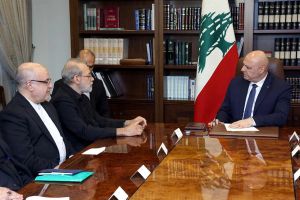
Lebanese President Joseph Aoun reportedly confronted Iran’s role in the country, breaking precedent by calling for Hezbollah’s disarmament. In a since-withdrawn interview, Aoun said he told Iran’s security chief Ali Larijani that “the Shi'ites of Lebanon are my responsibility, not yours.”
Aoun said Hezbollah’s military wing was “finished” and that he was seeking “an honorable end” to its armed role.
His comments followed a cabinet decision approving a US-backed roadmap to dismantle Hezbollah’s arsenal by the end of the year. Tehran has rejected the plan, accusing the West of trying to weaken Lebanon’s defenses.
Tension spills into Syria
Israel’s security leadership fears the growing coordination between Hamas, Hezbollah, and Tehran could extend into Syria.
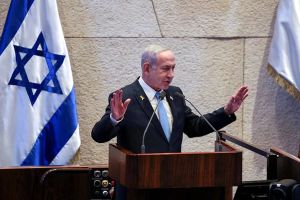
Prime Minister Benjamin Netanyahu’s visit to the country's south this week, with top defense and intelligence officials, signaled Israel’s determination to maintain its security buffer on the Golan Heights.
The visit came after Syrian President Ahmed al-Sharaa said he would normalize relations with Israel if the IDF withdrew from the Syrian Golan.
Security officials said they were not impressed by the rapprochement between the White House and Damascus and argued that al-Sharaa’s “jihadist past cannot be erased so quickly,” adding that he “does not necessarily control his own country.”
A scene of protests after fuel price hike in November 2019
Tehran is once again tiptoeing around the issue of gasoline prices under the long shadow of November 2019 protests that became one of the bloodiest crackdowns in the Islamic Republic’s history.
Fuel prices are among the most politically volatile subjects in Iran. Even the suggestion of a change triggers anxiety across the political system.
As the popular news website Bartarinha warned this week: “The country’s fragile condition … is such that even raising the possibility of price increases can trigger a wave of apprehension and unpredictable reactions.”
The memory driving those fears is never far. Six years ago, a sudden overnight hike in gasoline prices—50% for subsidized fuel and far more above quota—sparked nationwide unrest within hours.
It was one of the fastest-spreading waves of dissent since 1979 and remains a raw national trauma.
“Those who witnessed Aban 98 can never laugh from the bottom of their hearts for the rest of their lives,” an X user going by his first name Hamed wrote, referring to the unrest by its name in the Persian calendar.
“We have just stayed alive to see the day of revenge.”
Risking reform
Economists say the current model is untenable: the real cost of imported gasoline has risen to 700,000 rials (around 65 cents) per liter, while subsidized retail prices remain just over 1 cent per liter.
The burden on the government’s budget is estimated at $6 billion this year.
President Masoud Pezeshkian has vowed to overhaul Iran’s vast and costly subsidy system, but the political danger is hard to ignore.
Authorities insist the monthly quotas (60 liters at 1.3 cents and 100 liters at double that) will remain unchanged, at least for now. Every statement from officials is carefully calibrated to reassure and to avoid even the perception of a looming price hike.
Shadow of Aban
The 2019 protests were not just about fuel; they exposed deeper anger over corruption, inequality and political inertia. But it was gasoline that lit the fuse.
The shock announcement came in the early hours of 15 November, without debate or warning. Within hours, demonstrations spread across dozens of cities, many in working-class communities hit hardest by inflation and sanctions.
Protesters quickly turned to broader political slogans, including calls for the overthrow of Supreme Leader Ali Khamenei.
The state responded with speed and unprecedented force. The country was cut off from the global internet for nearly a week, making independent reporting almost impossible. Security forces used live ammunition, often aimed at heads and torsos, according to rights groups.
Amnesty International confirmed at least 321 deaths; Reuters, citing Iranian officials, reported about 1,500.
Thousands were arrested. Some—like Erfan Saberi-Movahed—disappeared and remain missing. At least two protesters, Kamran Rezaei and Hani Shahbazi, were later executed on charges of “waging war against God.”
For Iran’s political class, Aban 98 remains the ultimate cautionary tale, a potent reminder of how quickly economic frustration can ignite national revolt.
And that is why, six years later, even whispering about gasoline prices continues to terrify Tehran.
More eyewitness students have reached out to Iran International with testimonies detailing a series of aggressive acts at a Tehran school on Tuesday, leaving three girls hospitalized.
In a series of video, audio, and text messages, the students at the school recalled the events and how it started due to very aggressive body and backpack searches at the school.
“A significant number of students' mobile phones were thrown to the ground, and some were broken. A photography camera belonging to the photographic arts department was also destroyed,” an eyewitness said.
“Items such as perfume, body splash, and other personal belongings that are not legally prohibited were confiscated,” said another.
'Verbal threat'
One of the eyewitnesses said the whole ordeal had been “physically violent” and with some extreme “threatening tone.”
“They pushed students, shouted at them, and used physical force, causing intense fear and emotional distress,” one student said. “The principal even told one student: ‘We'll hang you so the others could see.’”
Another eyewitness said the aggressive behavior of the principal was not limited to the students but was directed at vice-principals and other staff at the school.
“The principal behaved inappropriately, insultingly, and aggressively toward vice principals and teachers, further escalating tension and disorder in the school.”
'Help needed'
At that point, chaos erupted and some of the girls at the school reacted differently to the chain of events.
“Several students fainted, experienced shortness of breath, heart problems, severe trembling, anxiety, and critical conditions,” one student said. “The school environment became completely chaotic, with widespread screaming, crying, and panic among the students.”
One eyewitness said that while some students were becoming unwell and fainting, crying, suffering panic attacks, loss of consciousness, and breathing difficulties—the principal refused to allow calls to parents, claiming the students were "putting on an act."
Then the students managed to call for urgent care themselves, but the school blocked entry and stopped anyone from coming in.
“When emergency services, education department representatives, and police arrived, the principal refused to open the gate, attempting to alter the situation inside the school and make the scene appear normal before allowing entry,” one student said.
There has been no official reaction to the incident that happened at “Mojtaheda Amin” girls' technical school in Shahr-e Rey, south of Tehran on Tuesday. At least three girls aged 15 -17 were hospitalized with severe injuries.
Videos shared by eyewitnesses show some angry students at the principal’s door, calling her to come out and face the students, but no one came out of the office.
The case follows earlier incidents this year, including the suicide of a 12-year-old student in Shiraz in October and the death of a 14-year-old in Zanjan in August after punishment at school, which have intensified concern about violence and a lack of accountability in Iran’s education system.
Iranian singer and songwriter Shervin Hajipour said he is facing new restrictions, including being barred from entering a gym and attending concerts.
In an Instagram video story, he said that when he asked a club security guard why he was denied entry, the guard replied: “Because you are Shervin.”
Iran's clerical rulers have eased enforcement of Islamic veiling laws, paused a draconian new hijab law and looked the other way as once-banned outdoor concerts proliferate.
But crackdowns on dissidents and political speech have sharply mounted since the conflict, according to rights groups.
Hajipour is the creator of the protest song Baraye (“For…”), which became a global anthem for Iran’s nationwide Woman, Life, Freedom movement following the 2022 death of a young woman, Mahsa Amini, in morality police custody.
He was briefly arrested in September 2022 shortly after the song went viral.
In 2023, Hajipour won the inaugural Grammy Award for Best Song for Social Change for the son.
The next year, a court sentenced him to three years and eight months in prison on charges including propaganda against the Islamic Republic and inciting and encouraging people to commit acts of violence and disturbance with the intention of harming national security.
He was also banned from leaving the country for two years.
The court ordered him to produce monthly one-page works on “the crimes of America against humanity” and compose a musical piece about “America’s crimes and its violations of human rights,” according to a copy of the verdict he shared in an Instagram post.
It also directed him to summarize books by Morteza Motahhari, a leading ideologue of the Islamic Republic whose writings on women morality and politics remain central to state doctrine, and to compile cultural and scientific “achievements of the Islamic Republic” and present them in digital form.
In September 2024, his case was dismissed under a clemency order issued by Iran’s Supreme Leader, effectively granting him a pardon.
Hajipour said in his new video that despite the restrictions, he intends to continue living in Iran.
“I did not stay in this country to sit in a corner of my house or be humiliated or be unable to work or exercise,” he said.