• العربية
  • فارسی
Brand
  • Iran Insight
  • Politics
  • Economy
  • Analysis
  • Special Report
  • Opinion
  • Podcast
  • Iran Insight
  • Politics
  • Economy
  • Analysis
  • Special Report
  • Opinion
  • Podcast
  • Theme
  • Language
    • العربية
    • فارسی
  • Iran Insight
  • Politics
  • Economy
  • Analysis
  • Special Report
  • Opinion
  • Podcast
All rights reserved for Volant Media UK Limited
volant media logo

Freed Israeli hostage recounts torture by Iran-backed militia in Iraq

Nov 5, 2025, 17:05 GMT+0Updated: 00:00 GMT+0
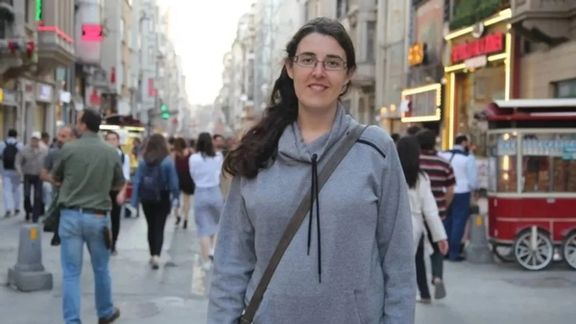
Russian-Israeli researcher and Princeton academic Elizabeth Tsurkov appears in this file photo

Israeli-Russian academic Elizabeth Tsurkov, who was freed by an Iran-backed Iraqi militia in September, told the New York Times she was tortured by her captors in her first media interview.

Tsurkov, a Princeton PhD candidate specializing in Middle East politics had traveled to Iraq using her Russian passport to study Shi'ite political movements.

She was abducted in Baghdad in March 2023, by the Iran-backed Shi'ite militia Kata'ib Hezbollah a US-designated terrorist organization.

Freed in September after a Trump administration hostage envoy traveled to Iraq in February to negotiate her freedom, she spent 903 days in captivity and now receives physical and psychological treatment in Israel and struggles to sit up due to the pain from her abuse.

Tsurkov told the US daily that she was lured into meeting a work contact who never materialized one evening before being abducted by men who threw her into a car, bound her hands and blindfolded her before taking her to an unknown location.

The militiamen initially abducted her in pursuit of a ransom, Tsurkov believes, but when they discovered from her phone that she was Israeli accused her of spying.

Tsurkov said that during the initial months of detention—and later, as captors pursued forced confessions—she endured the worst torture.

Handcuffed and hung from the ceiling, she suffered beatings, electrocution and sexual assault. “They whipped me all over,” Tsurkov said. “They basically used me as a punching bag.”

'Forced confessions'

Tsurkov shared her critical posts and writings about the Israeli government with the captors, but they were unmoved and demanded she record a confession claiming to be an Israeli and American intelligence agent.

She never fully understood her location but believed it was in a militia base near the Iranian border, as during a 12-day war in June she felt Israeli strikes apparently landing in nearby western Iran.

She told The Times she believes Israel's elimination of senior Lebanese Hezbollah, Hamas and Iranian officials prompted the group to change course.

Tsurkov was cited as saying she decided to share her story to give voice to Iraqis tortured and killed by the Shi'ite militia.

She faces a series of injuries that make sitting up difficult and most of the time must lie down or remain reclined, added the New York Times, which had reviewed her medical records.

A prolific social media analyst, she announced her return to X last month with an animation of rapper Dr. Dre captioned "Guess who's back." Her posts frequently criticize Israeli policy.

In her first description of her captors, she decried Iran and its regional allies as "brutal ignoramuses".

"I am confident that so many of the successes Israel has had vs. the Iranian axis is not due to Israeli genius but due to the stupidity of the men who make up the rank-and-file and commanders of these militias & Iranian regime," Tsurkov wrote on X.

Most Viewed

Ghalibaf defends Iran-US talks amid hardline backlash
1
INSIGHT

Ghalibaf defends Iran-US talks amid hardline backlash

2
INSIGHT

Iran diplomacy wobbles as factions compete to avoid looking soft on US

3
VOICES FROM IRAN

Bread shortages, soaring prices strain households in Iran, residents say

4
ANALYSIS

The politics of pink: how Iran uses cuteness to rebrand violence

5

War-hit homeowners feel abandoned as Iran’s reconstruction aid fades

Banner
Banner

Spotlight

  • The future has been switched off here
    TEHRAN INSIDER

    The future has been switched off here

  • Lights out, then gunfire: Witnesses recount Mashhad protest crackdown
    VOICES FROM IRAN

    Lights out, then gunfire: Witnesses recount Mashhad protest crackdown

  • Family told missing teen was alive, then received his body 60 days later
    EXCLUSIVE

    Family told missing teen was alive, then received his body 60 days later

  • Is Iran entering its Gorbachev moment?
    INSIGHT

    Is Iran entering its Gorbachev moment?

  • Iran crackdown reaches cemeteries as graves of slain protesters defaced
    EXCLUSIVE

    Iran crackdown reaches cemeteries as graves of slain protesters defaced

  • Iran diplomacy wobbles as factions compete to avoid looking soft on US
    INSIGHT

    Iran diplomacy wobbles as factions compete to avoid looking soft on US

•
•
•

More Stories

When water becomes a security threat

Nov 5, 2025, 16:08 GMT+0
•
Kambiz Hosseini

It begins with a sound. A hiss, then silence. A man in Tehran holds his phone to a dry faucet at midnight; you can hear the air whistling through the pipes. “It’s 11:40 p.m. and there’s a smell of fire,” he says.

Another caller to The Program, a Persian-language call-in show I host each week, is from a smaller town. He stands beside a trickle of wastewater coursing through the street: “We haven’t had municipal water for five days.”

The voices sound less like news than like prognosis—a country short of breath.

Iran is drying up. Not only its land, but its civic lungs. The skies over Tehran and Mashhad hang gray with smoke; taps sputter, rivers have turned to beds of dust.

Political choice

On the program, my guest was Kaveh Madani, an Iranian water scholar who briefly joined the government in 2017 to help address the crisis and left within months after being accused—without evidence—of espionage.

Madani’s view, refined over two decades of research and public warnings, is as bracing as it is simple: Iran’s environmental catastrophe is not primarily a natural disaster. It is a political choice.

The country has spent beyond its ecological income, mortgaging rivers and aquifers to service short-term promises. When scientists say so, their work is treated as a security risk. “When knowledge becomes ‘security,’ water is no longer security,” Madani said. The result is a landscape—and a society—running on a deficit.

In Iran, the term water bankruptcy describes a national ledger that no longer balances: demand far outstrips supply, aquifers are pumped down, the ground in places is subsiding, and, as Madani notes, land that sinks does not rise again.

The problem did not begin with climate change, even if warming now sharpens it. It began with governance—an edifice of big-build solutions (dams, canals, inter-basin transfers), political patronage and the reflex to appease unrest with engineering. Water is moved from province to province to quiet protests. More concrete is poured.

More rivers are chained. The political horizon, not the hydrological one, dictates the map.

By 2025, Madani’s argument is stark: environmental collapse is now braided with economic free fall and political isolation. You cannot fix the rivers without reforming the state.

Dried up

If that sounds abstract, the callers to the show provide the texture. A man from Sari, on the lush Caspian rim, described forests in retreat and soil racing to the sea.

A resident of Rasht said rivers he fished just three years ago are now lanes for cars. A Tehrani, furious and weary, ticked through familiar grievances—corruption, arbitrary arrests, a ruling class insulated from consequences—and asked whether anyone in power still believed in stewardship.

The only honest first step is to stop making things worse: tell the truth about the books, end prestige projects that burn scarce capital, align prices and incentives with reality and accept that some losses are irreversible.

After that, recovery is measured in years, not news cycles—and only if nature cooperates.

This is where Iran’s story diverges from the American impulse to frame environmental problems as consumer choices, solved by shorter showers and fewer flushes.

Individual virtue matters—especially in a crisis—but austerity at the household level cannot, by itself, balance a national water budget that is upside down by design.

The state sets the price of water and energy; it licenses (or averts its eyes from) illegal wells; it awards contracts that entrench use in the wrong places; it criminalizes data; it treats environmentalists as suspects.

In that world, scolding people for litter while subsidizing waste is a form of political theater.

The nearest analogue may be the Appalachia of extraction: places where policy, patronage and geology created a cycle of dependence and damage—then blamed the people who inhaled the dust.

'Luxury issue'

Iran’s twist is the securitization of science. If measurements are secrets and models are subversion, managers fly blind. You can’t manage what you refuse to count.

There is also a moral geometry to scarcity. For years, environmentalists were caricatured as elites obsessed with lakes and Persian cheetahs while ordinary people struggled with sanctions and inflation.

That framing has collapsed. When taps go dry in Tehran—the political capital and the country’s most privileged city—the environmental crisis stops being a “luxury issue.”

It becomes infrastructure, public health, and, in time, migration. In the program’s stray audio clips, you can hear the new rhythm: not ideology, but symptoms. Coughing. Fatigue. A neighbor’s bucket brigade. Politics is loud; dehydration is quiet.

The obvious question has two answers, and they are in tension.

The first is civic: keep attention on the crisis so politicians cannot look away. That means a culture of care (less waste, more local stewardship) but also a stubborn insistence on transparency: publish data, protect researchers, allow the press to ask hard questions without fear.

The second is structural: accept that environmental recovery is inseparable from economic and diplomatic reform.

Iran can, with humility and time, plan its way out of parts of it.

That will require a different politics: one that treats knowledge as a public good rather than a threat; one that measures success by the quiet arithmetic of aquifers; one that accepts, as a precondition for any national renewal, that nature does not negotiate.

The rain may come this year. It may not. But until knowledge flows freely, Iran’s drought will not be meteorological—it will be moral.
UN experts urge Iran to halt executions of six political prisoners

Nov 5, 2025, 15:35 GMT+0

UN human rights experts have urged Iran to halt the imminent executions of six political prisoners, citing allegations of torture, prolonged solitary confinement and unfair trials — claims Tehran denies.

Mai Sato, the UN Special Rapporteur on human rights in Iran, said on Wednesday in a post on X that she had written to the Iranian government in early September expressing “grave concern” over the cases.

The letter, co-signed by UN experts on enforced disappearances, extrajudicial executions, freedom of religion or belief and torture, cited reports of the six men's beatings, forced confessions and medical neglect in detention.

Their names are Babak Alipour, Vahid Bani Amerian, Akbar (Shahrokh) Daneshvarkar, Pouya Ghobadi, Abolhassan Montazer and Seyyed Mohammad Taghavi Sangdehi.

They were arrested between December 2023 and February 2024 for alleged links to the exiled People’s Mojahedin Organization of Iran and later sentenced to death by Tehran’s Revolutionary Court in November 2024, the experts said.

Several were allegedly held in solitary confinement for months and denied access to lawyers until trial day.

Tehran rejects report

The experts warned that “the judicial proceedings in all six cases did not fulfil the requirements for due process and a fair trial,” and that imposing the death penalty under such conditions would render the sentences arbitrary and unlawful under the International Covenant on Civil and Political Rights (ICCPR).

Iran, in its October 24 response, rejected the allegations as “unsubstantiated,” defending the convictions as based on “confessions corroborated by material evidence.”

Iran said the defendants were represented by lawyers of their choice during the proceedings and were “treated in accordance with domestic law and international standards,” adding that prison transfers were made for “security and logistical reasons.”

'Halt executions'

Sato on Wednesday reiterated her call for Iran to stay the executions and launch impartial investigations into the torture allegations.

"The death penalty for baghi (armed rebellion) is unlawful under the International Covenant on Civil and Political Rights, which limits capital punishment to only the most serious crimes involving intentional killing,” Sato said.

"I urge the authorities to halt executions in these cases and to impose a moratorium on all executions with a view to abolition," she added.

Last month, Iran executed at least 241 prisoners were executed in one month— a nearly 50% rise compared to the same month last year — marking the highest monthly toll in two decades, according the Norway-based right group Hengaw.

US-based rights group Human Rights Activists News Agency (HRANA) said at least 1,537 people were executed by hanging in Iran between October 2024 and October 2025, marking the highest figure in a decade.

Iran’s president tells Macron Iran not seeking nuclear weapons

Nov 5, 2025, 14:06 GMT+0

Iranian President Masoud Pezeshkian told French President Emmanuel Macron that Iran’s nuclear program is peaceful and that Tehran is not seeking to obtain nuclear weapons, Iranian state media said on Wednesday.

The two leaders held a phone call to discuss the future of nuclear diplomacy and regional tensions. According to Iranian reports, Pezeshkian said Iran’s defense doctrine and a religious decree by the country’s Supreme Leader forbid the pursuit of nuclear arms.

He said Tehran continues to support diplomatic dialogue but added that “Western governments must respect Iran’s rights and avoid imposing unilateral demands.” Pezeshkian also said the use of pressure and threats “only widens differences and undermines opportunities for understanding.”

The Élysée Palace said Macron spoke with Pezeshkian to call for the “full and complete release” of Cécile Kohler and Jacques Paris, who were granted conditional freedom after three years in detention. It said the French president had also spoken earlier in the day with the two nationals and urged that they be allowed to leave Iran as soon as possible.

France announced on Tuesday that Kohler and Paris had been freed from Evin prison in Tehran and were at the French Embassy but not permitted to leave the country. Iranian Foreign Minister Abbas Araghchi said they were released under Islamic clemency and remain in Iran.

Araghchi also said Mahdieh Esfandiari, an Iranian student conditionally released by France last month after being detained over anti-Israel social media posts, is now at Iran’s embassy in Paris.

UK returns Iranian migrant to France for second time

Nov 5, 2025, 13:34 GMT+0

An Iranian man who twice crossed the English Channel in a small boat has been returned to France again under the UK-France returns pact, Home Secretary Shabana Mahmood said on Wednesday.

The man was first deported to France on Sept. 19 after arriving in the UK in August, but crossed back into Britain on Oct. 18 and claimed asylum, saying he was a victim of modern slavery, according to British media. He was detected through biometric checks, detained, and placed on a return flight to France this week.

“This individual was detected by biometrics and detained instantly. His case was expedited, and now he has been removed again,” Mahmood said. “If you try to return to the UK you will be sent back. I will do whatever it takes to scale up removals of illegal migrants and secure our borders.”

Lawyers for the man argued that he was vulnerable and feared violence from smugglers in northern France, but the Home Office rejected his trafficking claim on Oct. 27 after a brief review. He had been placed under hourly welfare checks in detention because of concerns about his mental health, the Guardian reported.

He told the newspaper he had returned to Britain because he feared for his life in France. “If I thought France was a safe place for me I would never have come to the UK,” he said.

Under the “one in, one out” agreement with France, 94 people have been removed from Britain while 57 have been accepted legally from France after security and eligibility checks. Officials say the government is stepping up enforcement, though French unions have resisted at-sea interceptions, calling them unsafe.

The case comes as the number of small boat arrivals in 2025 has reached 36,886 — slightly higher than last year — despite periods of bad weather that temporarily halted crossings.

Mahmood said the government would continue to expand the returns system as part of efforts to deter Channel crossings and show that “those who come illegally will not be allowed to stay.”

Iran lawmaker says ‘VPN mafia’ blocking move to lift Telegram ban

Nov 5, 2025, 12:51 GMT+0

An Iranian lawmaker said economic interests tied to the sale of virtual private networks are working to keep internet filtering in place and that lawmakers are pursuing an inquiry into the pressure campaign, according to an interview published by Rouydad24.

Mostafa Pourdehghan, secretary of parliament’s Industries and Mines Committee, said talks with Telegram have been under way and that officials had hoped to restore access this week before differences delayed the step. 

“We have received information indicating repeated consultations with Telegram’s managers,” he told Rouydad24. “Some colleagues at the Communications Ministry have unofficially told us Telegram will be unblocked soon.”

He framed removing the filtering as a public demand and said resistance was coming from outside the legislature, what he described as "VPN mafia." 

“The financial turnover of VPNs is about 50 trillion tomans (about $450 million), and beneficiaries hide behind sacred slogans such as national security to profit from continued filtering,” he said. 

  • Iran officials demand concessions to unblock Telegram but use it themselves

    Iran officials demand concessions to unblock Telegram but use it themselves

  • Iran’s parliament speaker denies government reached deal with Telegram

    Iran’s parliament speaker denies government reached deal with Telegram

Pourdehghan added that a parliamentary “investigation and inspection into the backstory of these pressures” is being advanced with the communications minister.

The debate has intensified amid reports of negotiations over conditions for lifting the 2018 ban on Telegram, which remains widely used via VPNs. 

State-linked outlets have said Tehran wants commitments including cooperation with the judiciary on data requests, limits on content deemed to incite ethnic tensions, and measures against material considered to threaten national security.

Parliament Speaker Mohammad Bagher Ghalibaf has rejected reports that the government reached a deal with the platform. 

“If a platform does not accept internal regulations, it will not receive a license,” he told lawmakers, calling reports of an agreement false. 

President Masoud Pezeshkian campaigned on easing internet restrictions, but officials have said any change must be approved by the Supreme Council of Cyberspace and tied to compliance with domestic rules.