Trump says curbing Iran nuclear capability central to Mideast peace
US President Donald Trump speaks to members of the media on board Air Force One en route to Joint Base Andrews, US, November 2, 2025.
US President Donald Trump said his approach to Iran is central to securing broader Middle East stability, repeating that US military action had removed Tehran’s nuclear capability and hinting that an agreement with the Islamic Republic could pave the way for regional diplomacy.
“They have no nuclear capability, no,” Trump said in a CBS 60 Minutes interview aired on Sunday, adding that he had “blasted the hell out of” Iran and praising US pilots for operations he said were conducted in Iranian airspace.
Trump said progress on Arab-Israeli normalization would have been impossible “if you had a nuclear Iran,” arguing that curbing Tehran’s capabilities was a prerequisite for any agreement.
He added, “You could’ve never had any kind of a deal if you had a nuclear Iran… And I blasted the hell out of ’em,” while also saying the United States halted operations, characterizing his decisions as calibrated to deter Tehran while preserving space for diplomacy. “We stopped,” he said. “When it was time to stop, we stopped.”
The president described Iran as wanting an agreement even if they don’t say it, and cast a potential understanding with Tehran as “the key to peace in the Middle East.” He did not outline new diplomatic proposals or timelines.
Iranian officials have long rejected US accusations about nuclear ambitions, saying enrichment and related activities support power generation and medical research. The International Atomic Energy Agency has previously urged Tehran to address questions about its program.
Trump’s remarks come as Washington and regional partners weigh next steps on containment and possible talks with Tehran amid intermittent back-channel messaging.
Iranian Foreign Minister Abbas Araghchi during in an interview with Al Jazeera
Iran’s 400 kilograms of uranium enriched to 60% remain buried beneath debris from the recent US strike on nuclear facilities, and Iran has no plan to recover them until conditions permit, Foreign Minister Abbas Araghchi said in an interview with Al Jazeera published on Sunday.
“Almost all of the material lies under the rubble, and we have no plan to retrieve it until the circumstances permit,” Araghchi said. “We do not know how much of it remains intact or has been destroyed, and we will not know until we can remove it.”
Israel and the United States attacked Iranian nuclear sites in a 12-day June war, setting back the nuclear program but leaving its fate unresolved.
Tehran has since declined to allow IAEA inspectors to resume their inspections.
The strikes, Araghchi said, caused extensive structural damage but failed to destroy Iran’s nuclear know-how.
“Our facilities were hit hard, but technology cannot be bombed,” he added. “More importantly, our determination has not been lost; it has even grown stronger after the war.”
Iran denies seeking nuclear weapons and has accused Western countries of instrumentalizing a technical dispute with the IAEA to deploy onerous sanctions.
No direct talks with Washington
Responding to questions about prospects for negotiations with the United States, Araghchi said Tehran sees no need for direct talks.
“Many countries, for historical and political reasons, avoid direct negotiations,” he said. “We once held direct talks with the Americans and achieved no result. If they are serious, results can be reached even through indirect talks.”
Iran’s preference for indirect channels was based on experience and distrust, he added. “We have no confidence and no interest in direct negotiations,” he said. “Indirect talks can lead to the same outcome.”
‘Equal footing’ for future diplomacy
Discussions, according to Araghchi, could resume whenever Washington was ready to negotiate “from an equal footing and on the basis of mutual interests.” He added: “They seem in no hurry, and we are in no hurry either.”
Diplomacy, he maintained, remains Iran’s guiding principle. “War was imposed on us while we were negotiating,” he said. “For us, diplomacy is essential. We are ready to engage with the world and the West, but it is they who have betrayed diplomacy.”
Iran’s postwar policy, the minister said, would focus on strengthening regional cooperation. “Our priority is our neighbors… We began a policy of good neighborliness with determination and will expand it after the war. We negotiate with the West, but we do not take dictation.”
Limits of nuclear negotiation
Addressing renewed mediation efforts, Araghchi said Tehran remains open to restoring the framework of the 2015 nuclear deal. “The same formula can still apply -- confidence-building on our nuclear program in exchange for lifting sanctions.”
But he drew a firm line on Iran’s defense programs. “There is no reason to negotiate our own security with anyone,” he said.
“A fair nuclear agreement is possible, but the Americans have made unreasonable and excessive demands. When they are ready to negotiate fairly and as equals, we will consider resuming talks.”
Earlier this year, the United States held five rounds of negotiations with Tehran over its disputed nuclear program under a 60-day deadline set by President Donald Trump.
When no agreement was reached by the 61st day, on June 13, Israel launched a surprise military offensive, followed by US strikes on June 22 targeting key nuclear facilities in Isfahan, Natanz, and Fordow.
Araghchi’s remarks come as the International Atomic Energy Agency continues seeking access to Iranian sites to verify the status of enriched uranium stocks following the attacks.
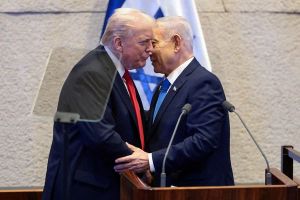
US President Donald Trump (left) and Israeli Prime Minister Benjamin Netanyahu
Iran’s foreign minister on Sunday accused Israel of misleading the United States on a fabricated Iranian nuclear threat and called on President Donald Trump to change course.
The United States held five rounds of negotiations with Tehran over its disputed nuclear program under a 60-day deadline set by President Trump earlier this year.
When no agreement was reached by the 61st day, Israel launched a surprise military offensive on June 13, followed by US strikes on June 22 targeting key nuclear facilities in Isfahan, Natanz, and Fordow.
"Israel targeted diplomacy because its real fear is the failure of its 'Iran Demonization Project,'" Iranian Foreign Minister Abbas Araghchi said in a post on his X account.
"POTUS entered office promising to put an end to Netanyahu's bamboozling of Obama and Biden. It's not too late to reverse course," he added.
The 12-day conflict ended on June 24 after a US-brokered ceasefire, but global alarm over Tehran’s nuclear program deepened as 400 kilograms of Iran’s highly enriched uranium remained unaccounted for.
Tehran says the material lies buried beneath debris from US and Israeli airstrikes, rendering it unreachable, yet it has so far refused to grant international inspectors access to the damaged sites.
Trump and Israeli Prime Minister Benjamin Netanyahu asserted that Tehran had resolved to race toward building nuclear weapons after they launched attacks on nuclear sites in a 12-day war in June.
The characterization appeared to contradict prior public US intelligence assessments. Iran denies seeking nuclear weapons.
In his Sunday remarks, Araghchi cited remarks by the UN nuclear watchdog's chief and Oman's foreign minister to reiterate Tehran's longstanding position that its nuclear program is for peaceful purposes.
"In the past 48 hours, the heinous lie that the unlawful Israeli and US bombing of Iran was motivated by an imminent nuclear threat has been thoroughly debunked by the International Atomic Energy Agency Chief, who has explicitly stated that Iran 'is not and was not' developing nuclear weapons, and my Omani counterpart, H.E. AlBusaidi, an intermediary trusted by both Iran and the US, who has made clear that there was never any Iranian "nuclear threat"."
Enough uranium for ten a-bombs
The UN atomic watchdog chief warned last week Iran holds enough uranium to build ten nuclear weapons if it chose to enrich further, but stressed that there was no sign Tehran seeks atomic arms.
In an interview with Swiss daily Le Temps, Rafael Grossi said Iran’s stockpile includes roughly 400 kilograms of uranium enriched to 60 percent, just short of weapons-grade.
“If it went further, Iran would have enough material for roughly ten nuclear bombs,” he added. “But we have no evidence that Tehran intends to build one.”
On Sunday, former advisor to Iran's Supreme Leader, Mohammad‑Javad Larijani, said Tehran has developed a new theoretical doctrine: one in which it chooses not to develop a nuclear weapon even though it is capable of building one in under two weeks.
Iranian media reported that a security officer was shot dead by unidentified gunmen in the southeastern city of Iranshahr.
According to Fars news agency, the victim, identified as Mohammad (Javad) Siahani, was killed late Saturday when assailants opened fire on his vehicle along the Bampour–Delgan road. The attackers were reportedly traveling in an unmarked Peugeot sedan.
Authorities said police and security forces have launched an investigation into the incident, which marks the latest in a series of armed attacks targeting security personnel in Sistan-Baluchestan province, a region long plagued by militant and criminal violence.
Authorities said police and security forces have launched an investigation into the incident, which marks the latest in a series of armed attacks targeting security personnel in Sistan-Baluchestan province, a region long plagued by militant and criminal violence.
On Saturday, two members of the Revolutionary Guard’s Basij paramilitary forces were killed in an armed attack on the Khash–Zahedan road.
In September, Reza Azarkish, a local Basij militia member, was shot dead in Iranshahr. Earlier in the month, Iraj Shams Askani, a member of the Revolutionary Guards, was gunned down by Jaish ul-Adl in the border town of Rask.
Last month, Parviz Kadkhodaei, a local Basij commander in Nikshahr, was killed in a separate assault. Prominent tribal leader Mullah Kamal Salahi-zehi was also killed in October when unidentified gunmen opened fire on his vehicle in Iranshahr.
The province, bordering Pakistan and Afghanistan, has long been the scene of attacks by Sunni insurgent groups that Tehran says are backed by foreign intelligence services.
Members of the Iranian delegation leave the Omani embassy, where the fifth round of US-Iran talks takes place, in Rome, Italy, May 23, 2025.
Iran’s government confirmed that the foreign ministry received messages related to possible negotiations, following reports in foreign media that Washington had conveyed a proposal to restart nuclear talks through Oman.
Tehran had received messages concerning the talks, Fatemeh Mohajerani, spokeswoman for President Masoud Pezeshkian’s administration, said on Sunday, but declined to identify the sender or disclosing any further details.
“Details about the nature and content of the messages will be provided at the appropriate time,” she told reporters.
Her remarks came after the Iraqi news outlet Baghdad Al-Youm, citing diplomatic sources in Tehran, reported on Friday that a message transmitted to Muscat expressed Washington’s willingness to resume nuclear negotiations with the Islamic Republic.
The US president Donald Trump had expressed his determination to reach a new agreement with Iran, the report said.
However, Tasnim News Agency, affiliated with Iran’s Revolutionary Guards, quoted an informed source on Saturday denying the report and saying that “no message has been sent by the United States through Oman.”
Oman’s foreign minister, Badr al-Busaidi, speaking on Saturday at Manama Dialogue conference in Bahrain, said his country hoped to return to negotiations between Iran and the United States. Oman has hosted five rounds of indirect talks between Tehran and Washington this year.
The planned sixth round in June, Al-Busaidi said, was halted after Israel’s attacks on Iran.
“Three days before the sixth round of talks was set to take place in June, Israel unleashed its bombs and missiles in an illegal and deadly act of sabotage,” he said.
The negotiations aimed at a new accord that would limit Iran’s nuclear activities in exchange for sanctions relief.
Western governments, including the United States, have accused Iran of pursuing nuclear weapons, while Tehran insists its program is solely for peaceful purposes.
Qatari prime minister and foreign minister Mohammed bin Abdulrahman Al Thani said on October 29 that Doha was working to bring both sides back to a new agreement.
“We are trying to engage with the United States and with the Iranians to make sure that the talks come back on track between the two countries, because I believe once we have the talks started, we can achieve an agreement,” Al Thani said at an event hosted by the Council on Foreign Relations think tank in New York.
“We can achieve a deal that will be better for everyone. For us in the region, for Iran, and for the United States,” Al Thani said. “Iran is my neighbor... for me, the stability of Iran is key. It’s not a luxury... it’s very important.”
Trump withdrew the United States from the 2015 nuclear deal between Iran and world powers, which had imposed strict limits on uranium enrichment in exchange for sanctions relief. In September, the United Nations reimposed its arms embargo and other sanctions on Iran over its nuclear program.
Iranian President Masoud Pezeshkian visits the Iranian Atomic Energy Organisation in Tehran, Iran, November 2, 2025.
Iran is determined to rebuild its nuclear facilities, President Masoud Pezeshkian said on Sunday, stressing that the country’s program is peaceful and not aimed at a bomb.
Speaking during a visit to the Atomic Energy Organization of Iran, Pezeshkian said Tehran’s nuclear drive is intended to “meet the essential needs of the people and enhance national welfare.”
He said that while the destructive potential of nuclear technology is well known, “only a fraction of its applications relate to weapons,” and the rest serves medicine, agriculture, and industry.
The president’s remarks come amid heightened tensions with the West over Iran’s nuclear activity following the reimposition of UN sanctions and renewed scrutiny by the International Atomic Energy Agency (IAEA).
Pezeshkian said Iran’s nuclear scientists are working on the production of radiopharmaceuticals and medical isotopes, calling their efforts “a form of scientific jihad and sincere service to the nation.”
He rejected Western accusations that Iran seeks to develop nuclear arms, saying that “building a nuclear weapon is not on our agenda and they know this well.”
Instead, he accused global powers of using false claims to block Iran’s technological independence and maintain control over high-tech industries and markets.
Pezeshkian also criticized what he called the waste of national resources through excessive fossil fuel consumption and urged scientists to focus on clean technologies and renewable energy.
“We burn millions of barrels of oil and gas daily and ignore the potential of science to create added value,” he said, adding that this neglect fuels environmental damage and economic dependency.
The president vowed full government support for advancing the country’s peaceful nuclear program, saying that Iran must strengthen its position in the global market for radiopharmaceuticals and other nuclear-related technologies.
“With careful planning and the efforts of our scientists, we can expand our share of the international market,” he said.
Iranian President Masoud Pezeshkian speaks with Mohammad Eslami, Head of the Iranian Atomic Energy Organisation, in Tehran, Iran, November 2, 2025.
Iran plans eight new reactors
Iran plans to build eight new nuclear power plants in cooperation with Russia as part of a long-term strategy to expand its nuclear energy capacity, Mohammad Eslami, the head of the Atomic Energy Organization of Iran (AEOI), said on Sunday.
Eslami said the new facilities would be located along the country’s northern and southern coasts.
He told reporters that the projects are part of a roadmap to generate 20,000 megawatts of nuclear power by 2041.
Eslami said four of the planned reactors would be built in Bushehr -- home to Iran’s existing nuclear plant -- and four elsewhere, with site details to be announced later.
He added that Iran is also pursuing domestic projects, including a power plant in Darkhoveyn and a desalination project in Bushehr, aimed at addressing electricity and water shortages.