Iran’s IRGC vows stronger ties with Houthis after death of Yemeni commander
Honour guards load a coffin onto a vehicle during a funeral procession of Houthi Chief of Staff Muhammad al-Ghamari, his son, Hussein, 13, and two bodyguards, four days after the group announced al-Ghamari's death, in Sanaa, Yemen, October 20, 2025.
The commander of Iran’s Islamic Revolutionary Guard Corps (IRGC), Major General Mohammad Pakpour, offered condolences over the killing of Yemeni Houthi military chief Mohammed Abdul Karim al-Ghamari in an Israeli strike and pledged to deepen ties with the Iran-aligned group.
In a message to Ghamari’s successor, Brigadier General Yusuf Hassan al-Madani, Pakpour hailed the slain commander’s “heroic struggle in defending Yemen’s sovereignty and confronting Zionist crimes,” saying his death had “etched a lasting chapter in the history of Yemeni resistance.”
“The IRGC renews its commitment to the lofty ideals of the resistance front and the liberation of al-Quds al-Sharif,” Pakpour said, using the Arabic name for Jerusalem.
“We declare our full readiness to strengthen spiritual and strategic bonds with Yemen’s armed forces in confronting global arrogance and international Zionism.”
He congratulated al-Madani on his appointment, calling him a “steadfast fighter” whose leadership would “continue the proud path of the martyr Ghamari and reinforce the resistance front against the enemies of the Islamic nation.”
The message followed confirmation by Yemen’s Houthi forces last week that Ghamari, their military chief of staff since 2016, was killed in an Israeli airstrike.
Israel said the attack, which also killed the Houthi-appointed prime minister, targeted senior officials involved in hundreds of missile and drone operations against Israel.
Mourners gather around the coffins on the day of a funeral procession of Houthi Chief of Staff Muhammad al-Ghamari, his son, Hussein, 13, and two bodyguards, four days after the group announced al-Ghamari's death, in Sanaa, Yemen, October 20, 2025.
The Houthis -- backed by Iran’s Revolutionary Guards and Hezbollah -- have intensified drone and missile strikes against Israel since the Gaza war erupted in October 2023. Israeli air raids in Yemen this year have killed dozens of senior Houthi figures and civilians, according to local health authorities.
Yemen remains split between the Iran-backed Houthis, who have controlled Sanaa and much of the north and west since 2014, and the internationally recognized government led by the Presidential Leadership Council (PLC) formed in April 2022. Despite a Saudi-led intervention launched in 2015, the Houthis still rule areas housing about two-thirds of Yemen’s population, while the PLC governs parts of the south and east.
Analysts say the group remains heavily dependent on Iranian support for advanced weapon systems, including ballistic missiles and precision-guided drones.
Earlier reports indicated the militia has turned increasingly to drone warfare as shipments of missile components from Iran have been disrupted by naval interceptions.
Tehran denies direct involvement in the Houthis’ attacks but continues to publicly back the group’s campaign against what it calls Zionist aggression and Western hegemony in the region.
A lawmaker warned on Sunday that Iran’s new energy plan could raise gasoline prices by up to 266%, even as officials deny any plan to hike fuel costs — a move widely seen as a potential trigger for protests amid rising poverty.
Based on a recent cabinet decision, Tehran lawmaker Hamid Rasaei wrote on X, the cost of fuel delivery and station commissions will soon be added to the pump price, raising the state-subsidized rate from 15,000 rials (about $0.014) per liter to roughly 55,000 rials ($0.05) per liter.
The administration insists no price hike is planned. However, the cabinet recently approved a comprehensive energy-allocation program, which President Masoud Pezeshkian has pledged to implement.
The measure obliges the government to fix the widening gap between Iran’s gasoline production and consumption — known as the fuel imbalance — without resorting to the sudden price shocks seen in November 2019.
A series of nationwide protests in Iran, known as Bloody November, took place in 2019. Initially triggered by a 50 to 200-percent increase in fuel prices, the demonstrations quickly turned into calls for the overthrow of the Islamic Republic and Supreme Leader Ali Khamenei.
At least 1,500 people were killed by the Islamic Republic's security forces during those protests, Reuters reported at the time.
Gradual reform and multiple pricing scenarios
Officials say the policy will unfold gradually through non-price reforms such as modernizing vehicles, expanding public transport, promoting compressed natural gas (CNG) use, and improving energy efficiency.
A step-by-step rise in prices would come only after these measures are in place and would follow annual inflation rates.
Several pricing models are under review, according to the local media. One option would introduce a tiered system: subsidized gasoline for low-income households at about 30,000 to 40,000 rials ($0.027–$0.036) per liter, semi-subsidized fuel at 60,000 to 70,000 rials ($0.054–$0.063), and a market rate near 100,000 rials ($0.09) for luxury or high-consumption vehicles.
Another plan would assign monthly fuel quotas per person rather than per car (60 liters now), letting unused portions be sold at market rates. Broader adoption of CNG and incentives for electric and hybrid cars are also being considered to cut reliance on gasoline imports.
Debate over fairness and timing
Analysts estimate that aligning prices with inflation could raise overall consumer prices by 5 to 10 percent but help reduce smuggling, energy waste, and budget deficits.
Parliament Speaker Mohammad-Bagher Ghalibaf said on Sunday that economic reform must start with fairness rather than price hikes.
“The first step is not raising prices but making these public resources truly people-centered,” he said.
The government is expected to announce its final decision before presenting the next year’s budget, amid mounting debate over how to balance fiscal needs with public tolerance.
Poland’s Deputy Prime Minister and Foreign Minister Radosław Sikorski speaks beside a Shahed-136 drone used by Russia amid its attack on Ukraine and believed to be built in Iran, during an event organised by United Against Nuclear Iran (UANI) in the Houses of Parliament in London, UK, October 14, 2025.
Western officials from Poland and Britain hit back at Iranian Foreign Minister Abbas Araghchi after he posted a tweet in Polish condemning a drone display in the UK parliament that linked Iran to Russia’s war in Ukraine.
In his post on X, Araghchi said "the exhibition in the British Parliament of a drone falsely and maliciously attributed to Iran is a pathetic scene staged by the Israeli lobby and its sponsors.”
Responding in Polish, Poland’s Deputy Prime Minister and Foreign Minister Radosław Sikorski said it was “nice that Iran’s foreign minister writes in Polish,” but added it “would have been better not to sell drones and licenses for their production to Russia while it was already waging aggression against Ukraine.”
He said Iran should instead “rebuild the Persian civilization that once amazed the world.”
British MP Tom Tugendhat accused Tehran of aiding Russia and Yemen’s Houthis “in murdering others abroad,” saying Iran’s rulers should “focus on the country they’re destroying at home” instead of interfering overseas.
Former US governor Jeb Bush, who chairs the US advocacy group United Against Nuclear Iran, also called Araghchi’s post “pathetic” and accused Iran of sponsoring “terror militias” while failing to provide its people with electricity and water.
Mark Wallace, the CEO of UANI which organized the drone display, said the exhibit “revealed the regime for what it is: the leading state sponsor of terrorism.”
Wallace accused Araghchi and Iran’s leadership of sending “murderous suicide drones around the world killing and maiming the citizens of over 80 countries.”
The display was held on Tuesday at the British parliament in London and attended by Western and Ukrainian officials.
Iran denies supplying drones for use in the war, saying it sold a limited number to Russia before the invasion began.
Western governments and Ukraine say Shahed-type drones, designed in Iran and now produced in Russia under the name Geran, have become central to Moscow’s air assaults.
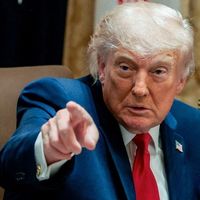
US President Donald Trump said the killing of Iranian commander Qassem Soleimani in 2020 and US strikes on Iran’s nuclear sites in June paved the way for the Gaza peace deal between Israel and Hamas.
“It started probably with Soleimani. He was a mastermind who did a lot of bad things,” Trump said in a Fox News interview, referring to the late Quds Force commander.
“He’s the father of the roadside bomb that would blow up and maim so many of our great soldiers,” he added.
Soleimani was killed in a US drone strike near Baghdad International Airport in January 2020 on Trump’s orders.
The US president said the turning point that paved the way for the Gaza peace earlier this month came in June when US B-2 bombers carried out what he called a “beautiful military operation” against Iran’s nuclear facilities.
“They flew for 37 hours, went into Iran’s airspace, and bombed the hell out of it,” he said. “When we destroyed their nuclear capability, they no longer became the bully of the Middle East.”
He said the US operation, along with Israeli strikes on Iran, made possible what he described as peace beyond Gaza.
“We wouldn’t have been able to make the deal we just made, which is basically peace in the Middle East beyond Gaza,” Trump said.
The ceasefire mediated in early October by the United States, Egypt, Turkey and Qatar put an end to over two years of Israeli attacks on Gaza, which started in response to Hamas's October 7 attack.
Photo of Sunni cleric Mullah Kamal Salahi-zehi released by Iranian media
A prominent Sunni tribal elder in Iran’s restive Sistan-Baluchestan province was shot dead on Sunday, the latest in a series of targeted killings that authorities blame on foreign-backed terrorist groups.
Mullah Kamal Salahi-zehi, a well-known community leader in the town of Sarbaz, was killed when unidentified gunmen opened fire on his vehicle in Iranshahr, according to Iranian state media. His son was wounded and taken to hospital.
Iran’s Revolutionary Guards condemned what it called a “cowardly terrorist act,” saying in a statement that “mercenary groups linked to the evil Zionist regime” were behind the attack.
It added in the statement that those killed in recent weeks included “the honorable martyrs Mullah Kamal, Reza Azarkish, Parviz Kadkhodaei, and Shams Askani,” and vowed that “the perpetrators and masterminds of these crimes will soon face punishment.”
The statement said such attacks aimed to “undermine the unity of Shia and Sunni communities” in the region but would “never shake the firm resolve of the Iranian nation.”
Tasnim News Agency, affiliated with the IRGC, described Mullah Kamal as one of the “defenders of the Islamic Republic” and wrote: “He always took firm and explicit positions against hostile movements and agents linked to Israel and global arrogance.”
However, the Baluch Activists Campaign offered a different account of Mullah Kamal’s positions, implicitly suggesting that the Islamic Republic was responsible for his killing.
The local outlet portrayed Mullah Kamal as a respected community leader, peace-seeking social activist, and a prominent figure “opposed to the Islamic Republic” in the 1980s and 1990s, who had repeatedly clashed with military forces. However, he stopped his struggle against the Islamic Republic after mediation by local elders.
According to the report, the Islamic Republic had made several attempts to assassinate Mullah Kamal both before and after granting him a guarantee of safety.
The killing follows several similar incidents in recent months.
In September, Reza Azarkish, a local Basij militia member, was shot dead in Iranshahr. Earlier in the month, Iraj Shams Askani, a member of the Revolutionary Guards, was gunned down in the border town of Rask, in an attack claimed by the Sunni militant group Jaish al-Adl.
Earlier this month, Parviz Kadkhodaei, a local Basij commander in Nikshahr, was killed in a separate assault.
The province, bordering Pakistan and Afghanistan, has long been the scene of attacks by Sunni insurgent groups that Tehran says are backed by foreign intelligence services.
Iran executed a man on Saturday convicted of spying for Israel’s Mossad intelligence service, the judiciary said on Sunday, the second such execution reported in less than a month.
Kazem Mousavi, head of the judiciary in Qom province, said the unnamed man was executed on Saturday morning after the Supreme Court upheld his death sentence and rejected a clemency request.
“The spy’s sentence was carried out after being found guilty of moharebeh (enmity against God) and corruption on earth,” Mousavi told the judiciary’s news agency Mizan.
He said the man began cooperating with Israeli intelligence in October 2023 and was arrested four months later after sending classified information through online channels.
According to Mizan, the defendant confessed to meeting a Mossad officer, transmitting sensitive data, and receiving payment for his work.
The execution follows the late September hanging of Bahman Choubi-asl, a database specialist accused of providing information to Mossad in meetings abroad, including in India and Ireland.
Last month, the UN special rapporteur on human rights in Iran said the country had executed 11 individuals on espionage charges this year, with at least nine carried out after Israel's military strike on Iran on June 13. Saturday's execution brings the total to at least 12.