• العربية
  • فارسی
Brand
  • Iran Insight
  • Politics
  • Economy
  • Analysis
  • Special Report
  • Opinion
  • Podcast
  • Iran Insight
  • Politics
  • Economy
  • Analysis
  • Special Report
  • Opinion
  • Podcast
  • Theme
  • Language
    • العربية
    • فارسی
  • Iran Insight
  • Politics
  • Economy
  • Analysis
  • Special Report
  • Opinion
  • Podcast
All rights reserved for Volant Media UK Limited
volant media logo

Iran accuses US of harassing diplomats at UN with new restrictions

Sep 24, 2025, 07:28 GMT+1Updated: 00:36 GMT+0
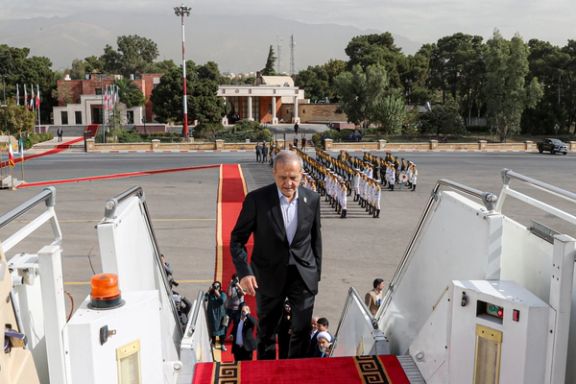
Iranian President Masoud Pezeshkian boards a plane in Tehran before departing for New York, September 23, 2025.

Iran accused the United States on Wednesday of using new restrictions on its delegation to the United Nations as a tool of political pressure, after Washington limited Iranian diplomats’ movements in New York and denied visas to much of President Masoud Pezeshkian’s media team.

Foreign Ministry spokesman Esmail Baghaei said the curbs, which include restrictions on daily activities such as grocery shopping, were aimed at “disrupting Iran's diplomatic performance” during the UN General Assembly.

He described them as “a blatant violation” of US obligations under the 1947 UN Headquarters Agreement.

“The systematic harassment of Iranian diplomats has obstructed delegates from attending several multilateral events outside the so-called ‘permitted parameters’ this week alone,” Baghaei wrote on social media, calling the measures “a new low” in US hostility toward Iranians.

The US State Department said Monday that the restrictions were intended to prevent Iran’s delegation from “lavish shopping” in New York while ordinary Iranians face economic hardship, and to limit Tehran’s ability to “promote its terrorist agenda.”

It confined delegates to the area between UN headquarters and their hotel, with transit allowances for official meetings.

Iran’s semi-official Fars news agency reported separately that most of Pezeshkian’s media staff were denied visas, leaving only two aides -- his press chief and deputy -- to cover what it called a large number of events during the trip.

It noted that under the new rules, even the purchase of fountain pens is classified as a “luxury” requiring special permits.

The dispute comes as Pezeshkian prepare to address the 80th UNGA amid heightened tensions over Iran’s nuclear program, the looming reimposition of UN “snapback” sanctions later this month, and the fallout from a 12-day war with Israel in June.

Most Viewed

Ghalibaf defends Iran-US talks amid hardline backlash
1
INSIGHT

Ghalibaf defends Iran-US talks amid hardline backlash

2
INSIGHT

Iran diplomacy wobbles as factions compete to avoid looking soft on US

3
VOICES FROM IRAN

Bread shortages, soaring prices strain households in Iran, residents say

4
ANALYSIS

The politics of pink: how Iran uses cuteness to rebrand violence

5

Scam messages seek crypto for ships’ safe passage through Hormuz, firm warns

Banner
Banner

Spotlight

  • Opposition to US talks grows in Tehran as ceasefire deadline nears
    INSIGHT

    Opposition to US talks grows in Tehran as ceasefire deadline nears

  • Tehran moderates see ‘no deal–no war’ limbo as worst outcome
    INSIGHT

    Tehran moderates see ‘no deal–no war’ limbo as worst outcome

  • The future has been switched off here
    TEHRAN INSIDER

    The future has been switched off here

  • Lights out, then gunfire: Witnesses recount Mashhad protest crackdown
    VOICES FROM IRAN

    Lights out, then gunfire: Witnesses recount Mashhad protest crackdown

  • Family told missing teen was alive, then received his body 60 days later
    EXCLUSIVE

    Family told missing teen was alive, then received his body 60 days later

  • Is Iran entering its Gorbachev moment?
    INSIGHT

    Is Iran entering its Gorbachev moment?

•
•
•

More Stories

Israel’s UN ambassador rules out fresh war with Iran

Sep 24, 2025, 02:06 GMT+1
•
Negar Mojtahedi

Israel’s ambassador to the United Nations Danny Danon told Iran International on Tuesday there is no prospect of renewed war with Tehran in the near future after US and Israeli strikes on Iran’s nuclear facilities earlier this year.

Danon said US and Israeli strikes in June delivered a major setback to Iran’s nuclear program and that it would take Tehran years to rebuild.

Asked whether Israel might carry out more attacks on Iran, Danon said it was unlikely.

“I don't think we're moving toward war, you know, Israel is a peaceful nation. And I think Iran should focus its energy supporting the Iranian people, not to spend billions on the proxies, on Hezbollah, on the Houthis.”

“They should support their own people in Iran. They deserve better than that,” he told Iran International at UN headquarters in New York,.

Still, he framed the strikes as a chance to rally the world to action, not the start of an open conflict.

Danon urged the international community to seize the moment not for escalation, but for pressure — through tougher sanctions and inspections.

“As of now, I see now is the time for the international community to step in and to apply more pressure,” he said.

He also voiced skepticism about Tehran’s alleged offer to Europeans to dilute its highly enriched uranium without intrusive verification.

His comments came hours after Iran’s Supreme Leader Ali Khamenei categorically rejected negotiations with Washington, dismissing President Donald Trump’s demand that Iran end all uranium enrichment as “dictation, not negotiation.”

In a televised speech, Khamenei said Iran would never bow to threats and vowed enrichment would continue, declaring that “a proud nation like the Iranian people will slap the mouth of the one who says this.”

In New York, Iran’s foreign minister met with his British, French, and German counterparts in last-ditch talks aimed at preventing the automatic reimposition of UN sanctions on September 28.

Diplomats warned that the chances of success remain slim, saying Tehran has yet to take the concrete steps needed to avert snapback. “The ball is in Iran’s court,” one European envoy said.

IAEA chief Rafael Grossi told The Times Tehran could resume enrichment “within weeks.”

But Danon said the strikes had bought valuable time — and that Israel’s priority now is to use that time to build international pressure on Tehran, not to move toward war.

Former deputy director Olli Heinonen told Iran International's podcast Eye for Iran that roughly 400 kilograms of uranium enriched to 60 percent remains unaccounted for — enough material for several nuclear weapons if further refined.

History repeating itself? Khamenei risks another 'poison chalice' moment

Sep 24, 2025, 01:00 GMT+1
•
Behrouz Turani

In Tehran today, debate over Supreme Leader Ali Khamenei’s hardline stance on nuclear negotiations carries an unmistakable echo of the end of Iran’s eight-year war with Iraq in 1988.

Then, as now, Iran faced a grinding impasse: Supreme Leader Ruhollah Khomeini resisted UN Resolution 598 which called for an end to hostilities until the cost of defiance became unbearable.

The resolution, passed on July 20, 1987, demanded a ceasefire, prisoner exchanges and a return to recognized borders.

Saddam Hussein accepted immediately. Khomeini refused, vowing that “the war should continue until the end of all seditions in the world.”

Washington warned of sanctions, and then-President Ali Khamenei told the UN General Assembly Iran was “determined to punish the aggressor.”

‘Poison chalice’

The war dragged on another year, draining finances and costing thousands more lives.

By August 1988, even then-Revolutionary Guards commander Mohsen Rezai conceded it was unsustainable. Morale had collapsed, tens of thousands were dead and Iran’s military capabilities shattered.

Khomeini finally relented, confessing that accepting Resolution 598 was “more deadly than drinking from a poisoned chalice.”

The phrase became a metaphor for concessions made too late, when pride collides with reality.

That poisoned chalice haunts Iran again.

No turning back

After the 12-day war with Israel, many in Tehran urged the leadership to abandon uranium enrichment and open direct talks with Washington, arguing only such a step can relieve Iran’s economic misery.

Yet Khamenei remains unmoved, caught between hardliners demanding defiance and moderates pleading for pragmatism.

Fond of channeling his predecessor, Khamenei had likened agreeing to a 2015 nuclear deal as drinking from that same poison chalice.

The IAEA continues to demand answers on uranium reserves. The Trump administration insists Iran’s nuclear program has been dismantled and warns against escalation.

Israel, emboldened by its strikes on Tehran and regional proxies, demands not only an end to Iran’s missile program but at times even regime change. Europe has its own conditions for halting or delaying the snapback of sanctions.

'Slap in the face'

On Tuesday, on the eve of President Masoud Pezeshkian’s address to the UN General Assembly, Khamenei poured cold water on any hope of reconciliation, effectively torpedoing the president’s diplomatic message before it was delivered.

Doubling down on a red line, he declared: “Negotiating with the United States under the current conditions carries harms for Iran, some of which are irreparable ... This is not negotiation, this is dictation.”

Hours earlier, Trump had mocked him at the UN as Iran’s “so-called” Supreme Leader. Khamenei shot back that Iranians would “give a slap in the face to the person" making arrogant demands of Iran.

Inside Iran, moderates call for dialogue, while hardliners close to Khamenei, including the editor of the state-funded Kayhan newspaper, deride them as “kissing Trump's bottom.”

The result is paralysis.

For Khamenei, the options appear stark: war or negotiation. A years-old quote of his "neither war nor negotiation" was not long ago plastered as a mural on a Tehran high-rise. But history suggests delay carries its own cost.

In 1988, the poisoned chalice was forced upon Khomeini only after Iran’s military was exhausted, its economy shattered, and its people demoralized.

Today, the risk is that Khamenei repeats the same mistake—clinging to defiance until the only choice left is abject humiliation.
Trump says Iran's 'so-called' Supreme Leader spurned full cooperation offer

Sep 23, 2025, 20:30 GMT+1

Iran rejected a US offer of full cooperation in exchange for suspending its nuclear program, US President Donald Trump told the UN General Assembly on Tuesday, adding his letter to Iran's "so-called" Supreme Leader was met with threats.

Below are excerpts from Trump's speech:

"I've made containing these threats a top priority, starting with the nation of Iran. My position is very simple: the world's number one sponsor of terror can never be allowed to possess the most dangerous weapon."

"That's why, shortly after taking office, I sent the so-called Supreme Leader a letter making a generous offer. I extended a pledge of full cooperation in exchange for a suspension of Iran's nuclear program."

"The regime's answer was to continue their constant threats to their neighbors and US interests throughout the region and some great countries nearby."

"Today, many of Iran's former military commanders—in fact, I can say almost all of them—are no longer with us; they're dead. Three months ago, in Operation Midnight Hammer, seven American B-2 bombers dropped 14 30,000-pound bombs on Iran's key nuclear facility, totally obliterating everything."

"No other country on earth could have done what we did. No other country has the equipment to do what we did. We have the greatest weapons on earth. We hate to use them, but we did something that for 22 years people wanted to do."

"With Iran's nuclear enrichment capacity demolished, I immediately brokered an end to the 12-day war, as it's called, between Israel and Iran, with both sides agreeing to fight no longer."

Khamenei pours cold water on US talks, doubles down on enrichment

Sep 23, 2025, 18:50 GMT+1

Iran's Supreme Leader Ali Khamenei on Tuesday ruled out talks with United States, saying President Donald Trump's demand Tehran end domestic enrichment of uranium was an insult which had earned him a "slap in the face" from the Iranian people.

Below are excerpts from Khamenei's televised speech:

"In the current situation, negotiating with the US government would, first and foremost, do nothing to help our national interests — it would bring us no benefit and would not avert any harm."

"Negotiations with the US under present conditions also entail serious harms for the country, some of which may even be irreparable."

"When we say it is not to our benefit, it is because the American side has already predetermined the outcome of negotiations. They have declared that the only talks they accept are those that end with Iran shutting down its nuclear activities and enrichment."

"That is not negotiation; that is dictation, it is imposition. To sit down and negotiate with a party that insists the result must necessarily be exactly what they want and say—is that negotiation?"

"They say: let us negotiate, and the result should be that Iran has no enrichment. And just days ago, one of their deputies declared that Iran must not have missiles either—not long-range, not medium-range, not even short-range. They are saying Iran must be left empty-handed, unable even to respond, if attacked, at an American base in Iraq or elsewhere."

"Such words are bigger than the mouth that utters them and are not worthy of attention. We have not and will not give in to pressure in enrichment or in any other matter."

Uranium enrichment

"Now this man, the American side, is insisting that Iran must have no enrichment at all. In the past, others said we should not have high-level enrichment, or that our enriched material should not be kept inside the country—things we did not accept. But now they are saying: no enrichment whatsoever, absolutely none at all. What does that mean?"

"Well, clearly, a proud nation like the Iranian people will slap the mouth of the one who says this and will not accept it. We will not submit to pressure in this matter (uranium enrichment) or in any other."

"The other side has threatened that if you do not negotiate, such and such will happen—whether it be bombing or other threats, sometimes vague, sometimes explicit. That is a threat. Accepting such negotiations would signal that Iran is vulnerable to threats. It would mean that whenever we face a threat, we immediately become afraid, tremble, and submit. That is what it would mean."

"And if such susceptibility to threats were to emerge, it would never end. Today they say: if you enrich, we will do this. Tomorrow they will say: if you have missiles, we will do that. Then they will say: if you maintain ties with such-and-such a country, we will act; if you do not maintain ties with another, we will act. It will all be threats, and we would be forced to retreat at every step."

"No honorable nation accepts negotiations under threat, and no wise politician endorses it."

"Ten years ago, we signed an agreement with the Americans, under which they were supposed to lift sanctions and normalize Iran’s nuclear file at the IAEA. The other side may now say, 'in exchange, we will give you such-and-such a concession.' They are lying. Whatever they claim to offer as a concession is false."

Iran executed at least 1,000 people so far this year, rights group says

Sep 23, 2025, 17:25 GMT+1

Iran has executed at least 1,000 people so far this year or the most in over three decades, according to Norway-based Iran Human Rights (IHR), which called for a United Nations investigation into what it described as crimes against humanity.

“This is the highest number of recorded executions in more than 30 years,” IHR said in a statement. Iran executed at least 5,000 political prisoners in 1988, according to Amnesty International.

From Jan. 1 to Sept. 23, IHR said it had verified 1,000 executions, including 64 in the past week alone — an average of more than nine a day.

The group said the figures represented a minimum, as many cases went unreported.

“In recent months the Islamic Republic has begun a mass killing campaign in Iran’s prisons, the dimensions of which, in the absence of serious international reactions, are expanding every day,” IHR Director Mahmood Amiry-Moghaddam said in a statement.

“The widespread, arbitrary executions of prisoners without due process and fair trial rights amount to crimes against humanity and must be placed at the top of the international community’s agenda.”

IHR said most executions were for drug-related and other non-lethal offences, which do not meet the “most serious crimes” threshold under international law.

According to its data, 50% were for drug charges, 43% for murder, 3% for security-related charges such as baghy (armed rebellion) and moharebeh (waging war against God), 3% for rape and 1% for espionage for Israel.

Only 11% of executions were announced by official sources, with none of the drug-related cases disclosed publicly, the group added.

The organization urged the UN Human Rights Council’s Fact-Finding Mission on Iran to investigate the executions, citing their “scale, systematic nature and political function to intimidate and create societal fear.”

At least 975 people were executed in Iran in 2024, a 17% increase from the previous year, making it one of the world’s leading users of the death penalty, according to rights monitors.