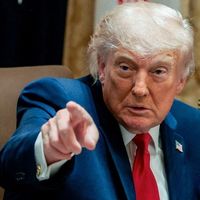
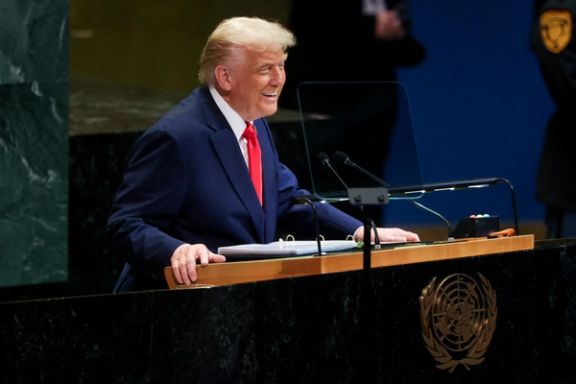
Iran rejected a US offer of full cooperation in exchange for suspending its nuclear program, US President Donald Trump told the UN General Assembly on Tuesday, adding his letter to Iran's "so-called" Supreme Leader was met with threats.
Below are excerpts from Trump's speech:
"I've made containing these threats a top priority, starting with the nation of Iran. My position is very simple: the world's number one sponsor of terror can never be allowed to possess the most dangerous weapon."
"That's why, shortly after taking office, I sent the so-called Supreme Leader a letter making a generous offer. I extended a pledge of full cooperation in exchange for a suspension of Iran's nuclear program."
"The regime's answer was to continue their constant threats to their neighbors and US interests throughout the region and some great countries nearby."
"Today, many of Iran's former military commanders—in fact, I can say almost all of them—are no longer with us; they're dead. Three months ago, in Operation Midnight Hammer, seven American B-2 bombers dropped 14 30,000-pound bombs on Iran's key nuclear facility, totally obliterating everything."
"No other country on earth could have done what we did. No other country has the equipment to do what we did. We have the greatest weapons on earth. We hate to use them, but we did something that for 22 years people wanted to do."
"With Iran's nuclear enrichment capacity demolished, I immediately brokered an end to the 12-day war, as it's called, between Israel and Iran, with both sides agreeing to fight no longer."


Iran's Supreme Leader Ali Khamenei on Tuesday ruled out talks with United States, saying President Donald Trump's demand Tehran end domestic enrichment of uranium was an insult which had earned him a "slap in the face" from the Iranian people.
Below are excerpts from Khamenei's televised speech:
"In the current situation, negotiating with the US government would, first and foremost, do nothing to help our national interests — it would bring us no benefit and would not avert any harm."
"Negotiations with the US under present conditions also entail serious harms for the country, some of which may even be irreparable."
"When we say it is not to our benefit, it is because the American side has already predetermined the outcome of negotiations. They have declared that the only talks they accept are those that end with Iran shutting down its nuclear activities and enrichment."
"That is not negotiation; that is dictation, it is imposition. To sit down and negotiate with a party that insists the result must necessarily be exactly what they want and say—is that negotiation?"
"They say: let us negotiate, and the result should be that Iran has no enrichment. And just days ago, one of their deputies declared that Iran must not have missiles either—not long-range, not medium-range, not even short-range. They are saying Iran must be left empty-handed, unable even to respond, if attacked, at an American base in Iraq or elsewhere."
"Such words are bigger than the mouth that utters them and are not worthy of attention. We have not and will not give in to pressure in enrichment or in any other matter."
Uranium enrichment
"Now this man, the American side, is insisting that Iran must have no enrichment at all. In the past, others said we should not have high-level enrichment, or that our enriched material should not be kept inside the country—things we did not accept. But now they are saying: no enrichment whatsoever, absolutely none at all. What does that mean?"
"Well, clearly, a proud nation like the Iranian people will slap the mouth of the one who says this and will not accept it. We will not submit to pressure in this matter (uranium enrichment) or in any other."
"The other side has threatened that if you do not negotiate, such and such will happen—whether it be bombing or other threats, sometimes vague, sometimes explicit. That is a threat. Accepting such negotiations would signal that Iran is vulnerable to threats. It would mean that whenever we face a threat, we immediately become afraid, tremble, and submit. That is what it would mean."
"And if such susceptibility to threats were to emerge, it would never end. Today they say: if you enrich, we will do this. Tomorrow they will say: if you have missiles, we will do that. Then they will say: if you maintain ties with such-and-such a country, we will act; if you do not maintain ties with another, we will act. It will all be threats, and we would be forced to retreat at every step."
"No honorable nation accepts negotiations under threat, and no wise politician endorses it."
"Ten years ago, we signed an agreement with the Americans, under which they were supposed to lift sanctions and normalize Iran’s nuclear file at the IAEA. The other side may now say, 'in exchange, we will give you such-and-such a concession.' They are lying. Whatever they claim to offer as a concession is false."
Iran and European powers held last-ditch talks in New York on Tuesday to try to prevent the revival of UN sanctions on Tehran, though diplomats on both sides cautioned that chances of success remain slim.
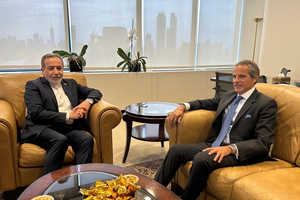
Foreign ministers of Iran, Britain, France and Germany – the so-called E3 – met on the sidelines of the UN General Assembly, joined by EU foreign policy chief Kaja Kallas, amid warnings that a 30-day “snapback” process to reimpose sanctions will expire on September 27.
In the meeting between Iranian and European top diplomats in New York, "some ideas and proposals for continuing diplomacy were raised, and it was decided that consultations with all involved parties would continue," according to Iran's Foreign Ministry.
"The course of discussions over the past month aimed at finding diplomatic solutions regarding Iran’s nuclear issue and preventing an escalation of tensions was reviewed in the meeting," according to the Foreign Ministry statement.
The E3 triggered the process on August 28, accusing Iran of failing to comply with a 2015 nuclear deal designed to prevent it from developing nuclear weapons. Tehran denies it seeks such arms, insisting its nuclear program is for peaceful purposes.
“Iran has been in contact with E3/EU officials and (the UN nuclear chief Rafael) Grossi since this morning at the UN Different ideas have been raised and discussed,” a senior Iranian official told Reuters on Tuesday.
Another Iranian official said “everyone seems to be trying” to find a resolution.


Iranian Foreign Minister Abbas Araghchi warned European states to choose “cooperation or confrontation.”
Speaking on state TV, he said: “They have tested Iran repeatedly and know we do not respond to the language of pressure and threat ... I hope we can find a diplomatic solution in the coming days, otherwise Tehran will take appropriate measures.”
According to diplomats, the E3 have offered to delay reinstating sanctions for up to six months if Iran restores access for UN inspectors, addresses concerns over its stockpile of enriched uranium and agrees to talks with the United States.
But two European envoys said Iran’s leaders have yet to meet these conditions. “The ball is in Iran’s camp,” one diplomat said. “It is up to it to quickly take the concrete steps in the coming days to avert snapback. If not, then sanctions will be reimposed.”
Another diplomat added, “The minimum would be for Iranians to present the special report and allow some token visit of inspectors to some sites, but even then that probably won’t fly – and chances are the US would veto.”
If no extension is agreed, all pre-2015 UN sanctions will automatically return on September 28, compounding economic pressures from US and European measures already in place.
President Masoud Pezeshkian said on Saturday that Iran would “overcome” any reimposition of sanctions. According to an insider cited by Reuters, growing discontent over the economy was rattling Iran’s leadership, with little sign of answers.
In June, following US and Israeli strikes on Iranian nuclear sites, Iran’s parliament passed a law suspending cooperation with the International Atomic Energy Agency. A deal with the IAEA was reached on September 9 to resume some inspections, though diplomats say its scope remains limited.
“I am in New York to use these remaining days for diplomatic consultations that might lead to a solution,” Araghchi said. “If it is not found, we will continue our path.”
Iran’s security chief Ali Larijani said on Tuesday that Tehran had accepted European and Russian proposals to avert the co-called snapback of UN sanctions, but the West triggered international sanctions on Iran nonetheless.
Larijani, who leads Iran's Supreme National Security Council, accused France of reneging on a pledge to hold back on the sanctions push if Iran made a deal with the International Atomic Energy Agency (IAEA).
“France, via the IAEA chief, promised to withdraw snapback demands if Iran agreed with the agency. Iran’s foreign minister signed this in Egypt, under security concerns and parliamentary mandates following bombed nuclear sites. France did not honor this,” official media quoted him as saying.
France, Britain and Germany triggered UN sanctions on August 28 through the so-called snapback mechanism of a 2015 international nuclear deal with Tehran.
On September 9, Iran and the IAEA signed a technical agreement in Cairo, mediated by Egypt, to pave the way for resuming nuclear inspections halted in June.
Ten days later, the UN Security Council rejected a resolution to keep sanctions lifted in a 4–9 vote, paving the way for sanctions to resume on September 28.
“European and Russian proposals, accepted by Iran with conditions, set a six-month negotiation period, but the West pursued snapback at the UN Security Council instead,” Larijani said.
Iran has warned that new attacks or sanctions would void the agreement, though it still sees the deal as a step toward de-escalation.
US missile demands ‘unacceptable’
Larijani also appeared to reveal details of a US proposal, saying Washington had demanded Iran reduce its missile range to under 500 km (310 miles) - “a condition no honorable person could accept,” he said.
For years, Iran has voluntarily limited its missile range, suggesting that 2,000 kilometers is sufficient to reach its main regional target, Israel.
However, a senior advisor to Iran's Supreme Leader suggested last year that the country might abandon its self-imposed missile range limit and could even pursue intercontinental capabilities if it faced an "existential threat".
Larijani made the remarks at the Tehran Chamber of Commerce, signaling preparations for the return of UN sanctions on September 28.
Iran’s Ministry of Intelligence had already issued secret guidance in August instructing ministries and major companies to prepare for the resumption of punitive UN measures.
Debate has erupted in Iran over President Masoud Pezeshkian’s upcoming trip to the UN General Assembly in New York, with politicians, clerics and commentators split on whether he should meet Donald Trump or avoid the risk.
Here are ten of the sharpest takes.
1. Make history
Former Tehran mayor Gholamhossein Karbaschi:
“If Pezeshkian wishes to be remembered honorably by history, this is the time for it.”One reader commented: “Should he seek authorization to negotiate—or permission to surrender?”
2. Last chance for diplomacy
Political commentator Ali Bigdeli:
“Pezeshkian’s presence in New York is Iran’s last chance for diplomacy. If he goes empty-handed, he would be better off staying home than attending the UNGA.”
3. Only if Trump asks
Former lawmaker Ali Motahari:
“If Trump asks for a meeting with Pezeshkian, our president should accept for the sake of national interests, despite Trump’s hypocrisy and lies. Perhaps Trump’s ambition to take credit for everything could work in Iran’s favor.”
4. Negotiation is fantasy
Mohammad Mehdi Imanipour, head of the Islamic Culture and Communication Organization:
“Holding talks with Trump and similar ideas are fantasy. This is a precious opportunity to tell the world about the 12-day war with Israel and to make clear that Iran was attacked while pursuing peaceful negotiations.”
5. Don’t count on China, Russia
Political commentator Qasem Mohebali:
“It is wise to reach an agreement with the West now. We can renegotiate later from a position of strength. The most China and Russia would do for us is preserve the status quo.”
6. Seek the Leader’s backing
Reformist figure Mohammad Atrianfar:
“If Pezeshkian wants to change the current trajectory of negotiations, he must create a turning point by doing something new. If he secures Khamenei’s backing, he could even hold direct talks with Trump and seize the opportunity to serve the country’s interests.”
7. Don’t meet E3 leaders
Conservative commentator Nasser Imani:
“Pezeshkian should strictly avoid meetings with the leaders of the three countries that activated the trigger mechanism against Iran … The US and European leaders undermined not only international law but also the very organizations they themselves created.”
8. Avert UN sanctions
An editorial in the moderate daily Ham Mihan:
“(We should) not take the risky path toward sanctions. It is not true that it can do no further harm … We are masters of wasting time and missing opportunities.”
9. Do what you believe is right
Another Ham Mihan editorial:
“Do what you honestly believe is essential for the public good and the country’s survival. Never think in terms of personal interests. Do not fear criticism, and avoid later saying you wanted to act differently but were not allowed.”
10. For a picture only
Hardline figure Abdollah Ganji, former editor of the IRGC’s Javan daily:
“Two countries that have fought each other—and one of them has imposed over 3,000 sanctions on the other—cannot negotiate like this.”
Ganji branded moderates “shameless,” accusing them of seeking to put Pezeshkian “in the same picture with Trump for a moment regardless of the result.”
The US state department on Monday announced it would limit the movement of Iran's delegation to the UN General Assembly annual meeting this week to prevent lavish shopping and the promotion of Tehran's "terrorist agenda."
"The United States took action this week to impose maximum pressure on the Iranian regime by restricting their UNGA delegation’s movement and access to wholesale club stores and luxury goods," the state department said in a statement.
"We will not allow the Iranian regime to allow its clerical elites to have a shopping spree in New York while the Iranian people endure poverty, crumbling infrastructure, and dire shortages of water and electricity."
Iran’s President Masoud Pezeshkian and Foreign Minister Abbas Araghchi are set to attend high-level meetings at the UN starting September 22 in New York.
The 80th session of the UN General Assembly opened on September 9, with world leaders due to arrive in New York this week.
"Secretary Rubio is also restricting the Iranian delegation to the areas strictly necessary to transit to and from the UN headquarters district to conduct their official UN business," the state department added. "The security of Americans is always our priority," it said, vowing to bar Iran the ability "to promote its terrorist agenda".
The 1947 UN Headquarters Agreement requires the United States to grant visas to UN representatives, including world leaders, for UN-related activities in New York, with exceptions only for proven security threats.
Washington earlier this month revoked or denied visas for most Palestinian officials to attend the UNGA, in a move seen as a protest about Western allies' looming move to recognize a Palestinian state.
The state department said its move was made in solidarity with the Iranian people.
"When the United States says it stands with the people of Iran, we mean it. Today’s actions affirm the United States’ unwavering commitment to supporting the Iranian people in their pursuit of accountability for the regime and for a better life."