UN vote clears path for Iran sanctions to kick in at month's end
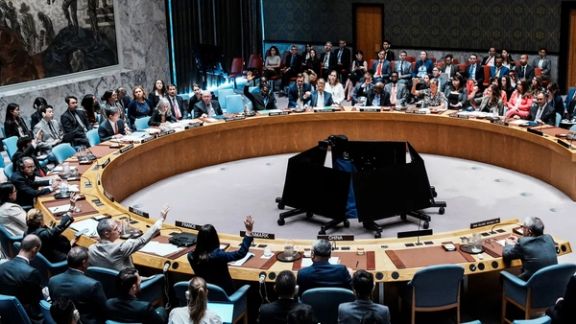
Members of the UN Security Council vote against a resolution that would permanently lift UN sanctions on Iran at the UN headquarters in New York City, US, September 19, 2025
A UN Security Council resolution on whether to permanently lift UN sanctions on Iran was voted down on Friday, dealing a win for a European-led bid to reimpose them on September 28 over Iran's alleged nuclear non-compliance.
The resolution, tabled by South Korea in its role as Security Council president, was a procedural part of a process launched last month after Britain, France, and Germany triggered the so-called snapback mechanism, declaring Iran in “significant non-performance” of the 2015 nuclear deal.
The decision not to lift Iran sanctions means all pre-2015 UN sanctions on Iran will automatically return once the 30-day snapback period ends on September 28, unless the Security Council takes further action.
Iran along with permanent Security Council members Russia and China lambasted the vote on Friday as a blow to diplomacy.
Algeria, China, Pakistan, and Russia voted to lift Iran sanctions. Denmark, France, Greece, Panama, Sierra Leone, Slovenia, Somalia, Britain, and the United States voted against the resolution while Guyana and South Korea abstained.
Acting US Representative to the United Nations Dorothy Shea said the European troika was right to pursue sanctions given what she called Iran's clear violations.
“In July, the E3 offered to extend the snapback mechanism if Iran were to take steps to address concerns regarding its highly enriched uranium stockpile, comply with its IAEA obligations, and resume direct diplomacy with the United States," Shea said. "Despite suggestions to the contrary from Iran and others, Tehran has not yet fulfilled those conditions."
The resolution outcome does "not impede the possibility of real diplomacy,” Shea added, without elaborating.
Members of the UN Security Council vote against a resolution that would permanently lift UN sanctions on Iran at the UN headquarters in New York City, US, September 19, 2025
'Unlawful'
Iran blasted the move, calling it “hasty, unnecessary, and unlawful”.
“Iran's safeguarded nuclear facilities have been attacked not in secret, but openly by Israel, the rogue regime, and by the United States,” Iran's ambassador to the UN, Amir Saeid Iravani, said.
He was referring to a 12-day surprise military campaign by Israel which was capped off by US strikes on Iranian nuclear sites. “This reckless step undermines dialogue without aggression and sets a dangerous precedent,” Iravani added.
The Iranian envoy said Tehran never rejected diplomacy, presenting the recent agreement with the International Atomic Energy Agency (IAEA) to advance resumed international inspections of nuclear sites as evidence.
In a phone call with IAEA chief Rafael Grossi, Iran’s Foreign Minister Abbas Araghchi criticized what he called a politicized move that ignored Tehran's good faith approach.
“Araghchi stressed that Iran, as a responsible country, has always pursued the path of diplomacy and technical cooperation to resolve issues related to its nuclear program and rejects any political measures or unfair pressure that could escalate tensions,” his ministry added in a statement.
Britain's permanent representative to the United Nations, Barbara Woodward, questioned Iran's nuclear motives but said it was open to talks.
“The United Kingdom is committed to pursuing a diplomatic solution to ensure that Iran shall never seek, acquire or develop a nuclear weapon,” Woodward said.
“That is why, on August 28, the United Kingdom, France, and Germany notified this Council of Iran's clear and deliberate non-compliance,” she added.
Iran’s Ambassador to the United Nations, Amir-Saeid Iravani, is seen on a screen as he addresses members of the UN Security Council after a vote on a resolution that would permanently lift UN sanctions on Iran, at UN headquarters in New York City, US, September 19, 2025
Russia and China opposed
Moscow and Beijing have grown closer to Tehran as their relations with Washington have frayed in recent years. Their envoys castigated the Western position.
Fu Cong, China's permanent representative to the UN, raised doubts about the move by the three European countries, warning it might inflame the long standoff
“China maintains that under such circumstances, hastily pushing for a vote on the draft resolution might exacerbate confrontation further and is not conducive to the resolution of the issue,” Fu Cong said.
Despite defense and economic agreements with Iran, Russia and China offered little substantive support to Iran as it confronted Israel and the United States over the summer.
More willing to exert pressure on Iran at the time of the 2015 nuclear deal, the two superpowers have broken with Western countries by mending fences with another international atomic pariah, North Korea.
Russia's Permanent Representative to the UN Security Council, Vasily Nebenzya, said the sanctions bid violated a 2015 nuclear deal.
“Britain, France, and Germany grossly violated the procedure for the consideration of disputed situations we have under the JCPOA in particular,” Nebenzya said. “Here you have a very good illustration of the fact that our European colleagues do, in essence, reject diplomacy. They prefer the language of blackmail and intimidation.”
Long an advocate of more international pressure on Iran at the United Nations, Israel celebrated a diplomatic win.
Israel's Ambassador to the UN hailed the Security Council's decision, calling it “another step forward towards imposing sanctions on the Iranian regime.”
“It is good that the world has woken up and joined the fight against Tehran’s violence and terrorism toward the Western world. The State of Israel will not allow a nuclear threat from Iran,” Danny Danon said.
Smoke rises following an Israeli attack on the IRIB building, the country's state broadcaster, in Tehran, Iran, June 16, 2025
The Israeli military's Persian spokesperson hit back at Iran's assertion that the world was beginning to understand Israel's crimes, countering that the Islamic Republic has carried out crimes daily since its inception.
The social media spat comes as Israel steps up its Persian language rhetoric, in an apparent bid to communicate with Iranians it views as disaffected and sympathetic to its stated preference for regime change in Tehran.
In a video posted Friday on X, IDF spokesperson Kamal Penhasi responded to remarks by Iranian Foreign Minister Abbas Araghchi, who had said the world was coming to understand “the crimes of the Zionist regime.”
“The biggest criminal entity is the Islamic Republic. A regime that, from the first day of the revolution, executed the best commanders and officers of the army,” Penhasi said. “It has killed elderly, youth, and children during civil protests in the streets.”
“It has sentenced thousands of innocent Iranians to the gallows or imprisoned them in its dungeons for absurd charges,” he added. “A government that exports its destructive policies through proxy groups across the world no longer has any credibility.”
Over 900 executions occurred in 2024, the highest since 2015, with August 2025 witnessing an unprecedented wave, including political prisoners and public hangings.
Rights monitors report that political prisoners and protesters have also been executed, while arbitrary arrests, torture, forced confessions and unfair trials continue, particularly against activists and journalists associated with the 2022 “Woman, Life, Freedom” movement.
Gaza health authorities said this week that Israel's incursion into Gaza over nearly two years of war with Iran-backed Hamas fighters has killed over 65,000 Palestinians.
Israel accused of seeking regime change
The head of Iran’s Army Strategic Studies and Research Center, Ahmad-Reza Pourdastan, alleged on Friday that Israel is intent on overthrowing the Islamic Republic.
“In the 12-day war, the enemy was caught off guard. I tell you with evidence, they had come to celebrate victory; they had prepared a victory anthem for Tehran to broadcast on July 1,” Ahmad Reza Pourdastan said, as cited by Iranian state media.
Pourdastan claimed the United States supported Israel during the conflict by providing missile intercept coordinates from its Central Command.
“Upon launch, the missile gained initial altitude and was immediately detected by CENTCOM radars in Qatar. The missile’s path was tracked, and they quickly informed the Israelis,” he said.
Israel launched a surprise military campaign on June 13, 2025, striking military and nuclear facilities in Iran. Air attacks killed nuclear scientists along with hundreds of military personnel and civilians. Iran retaliated with drone and missile attacks which killed 31 Israeli civilians and one off-duty soldier.
The United States joined the conflict on June 22, conducting strikes on major nuclear sites including Fordow, Natanz and Isfahan, before brokering a ceasefire on June 24.
Pourdastan insisted that Iran’s retaliatory missile strikes forced Washington to seek an end to the fighting.
“Even Trump requested a ceasefire. By God, they were scared. After Iran’s missile response, Witkoff called Mr. Araghchi and said, ‘Stop, don’t strike anymore,’” he said.
Police officers clash visitors during a hijab-related dispute in Ramsar, northern Iran.
A video circulating on social media shows security guards clashing with visitors at the Marble Palace in Ramsar, after a hijab warning escalated into physical confrontation and police intervention.
The palace is a historic Pahlavi-era building built in 1937 by Reza Shah Pahlavi as a royal summer residence.
Iranian outlets reported the incident took place about a week ago. In the footage, a man with blood on his face lies on the ground while a guard holds a pepper spray canister. Eyewitnesses said guards used pepper spray against young women, creating panic among visitors.
The visitors were from the religious city of Mashhad, according to Entekhab News, citing a local journalist. A guard confronted one of the women at the entrance, and when her headscarf slipped inside the museum, he pushed her, sparking a fight that drew in police, the report said.
Social media users noted the recording date as September 11, days before the third anniversary of the death in custody of Mahsa Amini, detained in 2022 for alleged hijab violations.
Journalist and activist Masih Alinejad reacted on Instagram, writing: “This is the same government that stages concerts at night, executes by day, and assaults women over a few strands of hair.”
Wider crackdown
The video has renewed focus on violent enforcement of compulsory hijab, with calls for accountability and protection of women in public spaces. Confrontations have been documented before, with security forces, plainclothes agents, and civilians policing women’s dress. Rights advocates warn such practices intrude on privacy and fuel social violence.
Recent weeks have seen a wave of closures targeting businesses, cafés, hotels, and bookstores over alleged defiance of hijab rules. Rights group HRANA previously reported more than 30,000 women were stopped last year for non-compliance, and at least 536 commercial units were sealed.
Despite intensified state pressure, women’s acts of defiance persist. A video obtained by Iran International on September 16 showed a woman in Karaj standing unveiled atop a garbage container and shouting, “You have turned Iran into a prison.”
A poster from a protest in support of Ahmadreza Djalali
The Foreign Policy Committee of the Flemish Parliament in Belgium has called on Iran’s ambassador to clarify the fate of Ahmadreza Djalali, the jailed Iranian-Swedish academic whose whereabouts have been unknown since June.
“After three months without any news, concern about the condition of Prof. Ahmadreza Djalali is greater than ever. The MPs therefore want to obtain more information from the Iranian ambassador,” parliament chair Freya Van den Bossche and committee chair Bogdan Vanden Berghe said in a joint statement on Thursday.
Djalali, a disaster medicine specialist affiliated with the Free University of Brussels, was detained in April 2016 during a professional visit to Iran. In 2017 he was sentenced to death on charges of espionage and complicity in the killing of two Iranian nuclear scientists, accusations he and his family have consistently denied.
Earlier this year, he suffered a heart attack while held in Tehran’s Evin prison. After the Israeli bombing of that facility, he was transferred with other detainees to the Greater Tehran Penitentiary. From there, according to accounts shared by his family, he was taken away separately. Since June 23, there has been no trace of him.
Pressure builds in Belgium
Last week, the committee and parliament speaker Van den Bossche met Djalali’s wife, Vida Mehrannia, to discuss his situation. Following that meeting, MPs unanimously agreed to summon the Iranian envoy.
Djalali’s case has drawn international concern, with European institutions and human rights organizations urging Tehran to halt his death sentence and release him on humanitarian grounds.
For Belgian lawmakers, his disappearance has heightened alarm not only about his health but also about the Iranian authorities’ treatment of dual nationals, many of whom remain imprisoned under contested charges.
A member of Iranian healthcare professional community
Almost 29 percent of registered general practitioners in Iran are not practicing medicine, according to figures cited by local media, which said the trend highlights waste in training costs and ongoing shortages of medical specialists.
More than 104,000 general practitioners are officially registered, but at least 30,000 are not active in the field, Nour News, an Iranian outlet affiliated with Supreme National Security Council, reported Thursday.
“The number alone demonstrates the loss of educational, financial and human capacity in a country that constantly faces shortages of specialists and unequal access to health services,” the outlet wrote.
It criticized authorities for repeatedly expanding medical school admissions as a response to shortages, arguing this has produced “a surplus of manpower without efficiency.”
Concerns about the lack of specialists have grown in recent years.
Interest in six key specialty fields has declined to the point that “the absence of applicants in these core disciplines will confront Iran’s healthcare system with serious challenges,” Abbasali Reis-Karami, head of Tehran University of Medical Sciences warned in July.
Training each general practitioner, according to Nour News, costs the government “tens of thousands of dollars,” yet many leave medicine altogether or turn to unrelated jobs.
No effective strategy has addressed the shortage of specialists, the outlet added, citing the most recent residency exam where only 10 percent of emergency medicine slots were filled, alongside 32 percent in anesthesiology, 22 percent in pediatrics, and 15 percent in infectious diseases.
An increasing number of Iranian doctors and nurses are leaving the profession or emigrating, mainly due to very low wages, raising concerns about a serious shortage of healthcare workers.
Iranian medical and government officials have repeatedly warned in the past few years about the inevitable deterioration of the healthcare system and its possible collapse if the same trends continue.
An International Atomic Energy Agency (IAEA) sign at the opening of the IAEA General Conference at the agency's headquarters in Vienna, Austria, September 15, 2025.
Iran pulled a resolution at the UN nuclear watchdog’s annual conference that sought to prohibit attacks on nuclear facilities.
The draft resolution—co-sponsored by China, Russia, and a group of nations including Cuba and Venezuela—condemned the June 2025 Israeli and US strikes on Iranian nuclear facilities.
“Guided by the spirit of goodwill and constructive engagement, and at the request of several member states,” Tehran had deferred action until next year, Iran’s Ambassador to the UN Reza Najafi told the General Conference on Thursday.
Iran and the other sponsors of the resolution do not wish to place member states in a position of endorsing an unrealistic decision, he said.
The issue will be raised again at the next session of the IAEA General Conference, according to the Permanent Mission of the of Iran.
The withdrawal also comes as France, Germany and the UK have invoked the snapback mechanism to reimpose UN sanctions on Iran under resolution 2231. That process is expected to conclude by September 28 unless the Security Council adopts a resolution to preserve sanctions relief.
This comes against a backdrop of escalating tensions, triggered by Israeli strikes on Iranian nuclear and military sites in June, followed by US attacks on three additional facilities.
However, Tehran says its nuclear program is peaceful.
French President Emmanuel Macron said on Thursday that the sanctions process was “a done deal,” adding that “The latest news we had from the Iranians is not serious.”