Tehran closes public restrooms as water crisis deepens
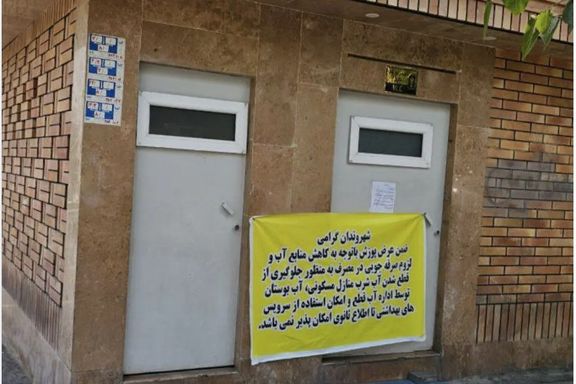
Toilet services in Tehran are closed due to water shortage
Tehran authorities closed public restroom services amid a deepening drought and water shortage, local media reported on Friday, depriving the capital's homeless and needy of badly needed facilities.
The decision deepens hardship as many residents including seniors, women and those with special needs keenly depend on the services, the Didban Website reported.
Iran is currently grappling with water shortages and widespread power outages amid high summer temperatures, while also dealing with recovery efforts following a 12-day war with Israel and its aftermath.
The reports highlight the urgent needs of people with kidney and prostate problems and note significant issues for parents with small children.
The government previously considered adding an extra day off during the week or introducing long weekends to reduce demand but ultimately did not pursue the plan.
Kids holding Iranian flags in an event to commemorate those killed in Israeli airstrikes, Tehran, Iran, July 31, 2025
Calls for systemic reform and restructuring of Iran’s political and security institutions have intensified after a 12-day war with Israel in June, accompanied by some signs of change but also many signs of continuity.
The Supreme National Security Council (SNSC) is already undergoing structural changes, according to semi-official Fars News, which reported on Friday that former hardline ex-nuclear negotiator Ali Larijani could be appointed as the SNSC’s new chief.
The report also suggested that a new Defense Council may be formed to guide the country’s strategic defense agenda.
Larijani, a longtime conservative figure with moderate tendencies, was closely associated with former president Akbar Hashemi Rafsanjani—widely recognized as the architect of pragmatism in Iranian politics.
His return to a senior security role could signal a shift toward a more flexible approach to domestic and foreign policy, though his recent postwar remarks have closely aligned with Supreme Leader Ali Khamenei’s positions.
Establishment hints at change
Nour News, closely linked to the SNSC, also signaled these impending changes in a July 30 post. More notably, it criticized the state broadcaster for airing interviews with individuals hostile to Western values, warning that such programming “may even lead to undesirable outcomes.”
The call for reform—long associated with Iran’s reformist factions—is now being echoed by conservative figures, reflecting shifting perceptions within the political establishment. Some have warned that failure to adapt after the war could lead to public unrest and new security challenges.
Ayatollah Mohsen Gharavian, a lecturer at the Qom Seminary, said in a July 31 interview with Khabar Online that “the Islamic Republic must revise its mode of governance in light of the war.” He specifically urged an end to government pressure on Iranian women regarding compulsory hijab rules.
He also called for major reforms in both domestic and foreign policy, asserting that Iran’s leadership now recognizes “the tremendous power of patriotism” and is exploring ways to ease the pressure on the weary citizenry.
‘Making up with people’
Ali Akbar Velayati, a former foreign minister and senior advisor to Khamenei, likewise advocated “some social changes to meet public demands,” drawing harsh backlash from ultraconservative media outlets.
Amid rising pressure, President Massoud Pezeshkian withdrew a controversial bill he had previously submitted to parliament that would have further restricted media freedom and access to information.
The conservative daily Farhikhtegan published a July 31 commentary titled “The Next Steps After the War,” urging a deeper understanding of Iran’s sociopolitical conditions to better anticipate future challenges.
While acknowledging Iranian claims of victory, the commentary emphasized credible counterarguments and criticized state television’s complacency.
It called for an assessment of public resilience amid postwar challenges—including energy shortages and the potential return of UN sanctions—which the editorial warned could provoke industrial action or even widespread protests.
Iranian officials say Tehran could run out of water within weeks, but climatologist Dr. Nasser Karami tells Eye for Iran the crisis transcends drought and is a product of government mismanagement, militarized agriculture and deliberate manipulation.
Karami calls it an “engineered drought”—a manufactured emergency that lets authorities avoid long-overdue reforms while shifting the financial burden to citizens.
“There is water,” he said. “But it costs the government more to deliver it in the summer—so they shift the burden to the public instead.”
Only 20–30% of Iran’s water shortage, Karami argues, is due to climate change. The rest is policy-driven—and reversible.
But instead of investing in infrastructure or reforming water use, the government relies on fear to suppress demand, while consumer prices remain unchanged.
“If people reduce their consumption just a little, it saves the government a lot of money,” he explained. “The price they pay for water stays the same, but the state spends less.”
The consequences are devastating.
Across the country, families are going days without water. Residents are hoarding bottles, installing rooftop tanks and depending on tanker trucks—some of which deliver polluted or undrinkable supplies.
Satellite imagery obtained by Iran International shows Tehran’s main reservoirs—Amir Kabir, Lar, and Latyan—at historic lows, holding less than 10% of their usable capacity.
Meanwhile, the capital is literally sinking. Over-pumping aquifers has caused parts of Tehran to subside by more than 10 inches a year.
The crisis is fixable, Karami says, yet the system profits from public panic as ordinary Iranians are left to suffer.
“This is not the first time they’ve said Tehran would run out of water in two weeks,” Karami said. “And yet, the water keeps flowing.”
Beyond drought
"The solution is: you have to take part of the water from agriculture and give it to the people. That is very easy," Karami said.
Agriculture, he said, consumes more than 90% of Iran’s freshwater annually, yet contributes just 9-12% of GDP and employs only about 17% of the workforce. In contrast, households use just 4-5%, and industry only 1%.
Despite its relatively small economic footprint, agriculture’s massive water consumption places unsustainable pressure on Iran’s finite freshwater supplies.
But Karami says this isn’t conventional agriculture but in large part state-guided enterprise aimed at provisioning Iran's sprawling military.
"They’re using all water resources for agriculture to make enough food for the soldiers," he said.
Wells proliferation
The numbers tell the story: Iran’s cultivated land has more than doubled since 1979. Deep wells have exploded from 40,000 to over one million. Roughly 40% of agricultural water is wasted in transport or lost to outdated irrigation methods.
Karami says just a 5% cut in agricultural water use would free up enough water—4 to 5 billion cubic meters—to supply Iran’s entire urban population.
He believes efficiency is possible: through irrigation upgrades, reduced waste, and mechanizing half of Iran’s farmland. But he doubts the political will exists to pursue it.
“We’re the first in the world for soil erosion. First in desertification,” Karami warned.
"The main legacy of the Islamic Republic won’t just be executions or war. It will be this: environmental collapse."
Despite the scale of the suffering, Karami doubts the current crisis will trigger mass protests. He believes the authorities will likely resolve the immediate shortages in the coming weeks—just enough to defuse tension and avoid unrest.
A screengrab from the viral video of Trump's mock arrest
A video shared on social media by the supporters of the Islamic Republic purportedly depicts Iranian military forces bundling figures resembling Donald Trump and Benjamin Netanyahu onto the back of a pickup truck labeled Trash Bin of History.
A figure in the video wearing a yellow wig likely portraying Trump was shown being thrown to the ground before the mock abduction.
The display features a parade of motorcyclists and individuals in military attire carrying weapons and the vehicle's license plate and surroundings suggest it was filmed in Mazandaran province, north of Tehran.
“The clip was part of a spontaneous public theater performance held last week as a prelude to a memorial ceremony for martyrs," IRGC affiliated Fars News reported on Friday, "without any affiliation to official institutions or organizations."
A rare note of official caution from the hardline outlet, the remarks appeared aimed at distancing Tehran from any threat to the US President.
Over 2,000 Iranian clerics including several senior officials called the shedding of Donald Trump’s blood religiously permissible, essentially endorsing his assassination, in a sharp escalation of official rhetoric in the theocracy against the US president.
“The era of revolutionary restraint and patience has ended and henceforth, Trump's blood and wealth are halal and avenging Soleimani's blood is obligatory for every Muslim and freedom-loving man and woman,” according to a statement released Friday by the Qom seminary’s press office.
Trump authorized the 2020 killing of senior Iranian commander Qassem Soleimani in a Baghdad drone strike.
Signatories ranged from junior seminarians to among the most prominent clerics in the country.
“The blood and property of this savage criminal are halal,” the statement said. “The nations will not remain silent. Retaliation is coming.”
The signatories include Tehran’s Friday prayer leader Ahmad Khatami, Expediency Council member Mohsen Araki, and Guardian Council member Mehdi Shabzendedar — all appointed by Supreme Leader Ali Khamenei — as well as Alireza Arafi, the vice-president of Iran's Assembly of Experts and also a member of the Guardian Council.
During a 12-day war with Israel in June, several senior clerics in Iran called for the killing of Trump and Israeli Prime Minister Benjamin Netanyahu, citing their threats to assassinate Khamenei during the conflict.
“Any regime or individual threatening the leaders of the Islamic Ummah (nation) and acting on those threats qualifies as a mohareb (warrior against God)," Ayatollah Naser Makarem Shirazi said.
Under Shi'ite jurisprudence, the declaration of mohareb and the issuance of a fatwa make it religiously obligatory for devout Shiite Muslims to act.
An anti-US graffiti on the former US embassy in Tehran
The United States has advised citizens against traveling to Iran citing what it called escalating paranoia and an unprecedented crackdown on alleged spies and opponents following a 12-day war with Israel.
"The Iranian regime, following the 12-day war with Israel, is in the midst of unprecedented paranoia and a crackdown on spies and regime opponents," the State Department said in a post on its Persian X account USA Beh Farsi.
"Anyone considering travel to Iran should reconsider their decision. We repeat: US citizens should not travel to Iran!" the post reads.
Iran recently arrested two American Jewish citizens on suspicion of spying for Israel in the aftermath of the recent 12-day war, Israel's Channel 11 reported.
One of the two detainees, identified by HRANA as 70-year-old Yehuda Hekmati, remains in detention.
Hekmati, a jeweler with ties to New York, allegedly drew the attention of the Islamic Republic due to a trip he made to Israel seven years ago.
The second detainee, an Iranian-American resident of Los Angeles, has been released on bail.
US State Department spokesperson Tammy Bruce declined to comment on the case Tuesday, saying only that she hopes she would be able to speak about it soon.
The State Department has repeatedly warned that Americans, including dual nationals, risk wrongful detention in Iran.
The department's website says: "Americans, including Iranian-Americans and other dual nationals, have been wrongfully detained, taken hostage by the Iranian government for months, and years."
Israel’s Channel 11 quoted a source involved in the American detainees’ case as saying, “These two Americans were in the wrong place at the wrong time.”