Khamenei threatens harsher blows to US, Israel in first post-war speech
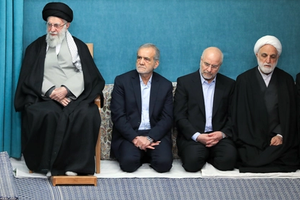
Supreme Leader Ali Khamenei addresses senior judiciary officials at the Imam Khomeini Hussainiyah on July 16, 2025.
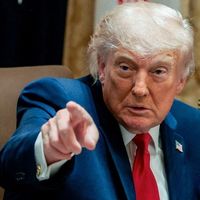
Iran could strike Israel and the United States even harder than it did during last month’s conflict, Supreme Leader Ali Khamenei said on Wednesday in his first public speech since a June 24 ceasefire.
Speaking before judiciary officials in Tehran, Khamenei said the extent of the damage inflicted—on a US base in Qatar—would become clear once media restrictions were lifted.
“The center targeted by Iran was an extremely sensitive American facility,” he said. “Once the news blackout is lifted, it will become clear what a heavy blow was delivered. And a blow even greater than this can be struck against the US and others.”
President Trump said last month that Iran provided early notice before launching missile strikes at the US Al Udeid Air Base in Qatar, downplaying Tehran’s response to US airstrikes on three Iranian nuclear sites as "very weak."
Khamenei, who had only made recorded remarks from an undisclosed location during the 12-day US-Israeli campaign, briefly appeared at a July 5 mourning ceremony without speaking.
The 86-year-old veteran theocrat said the attacks aimed at regime change but failed.
“The aggressors assumed that by targeting certain key individuals and centers in Iran, they would weaken the system. They planned to then unleash their dormant proxies — from hypocrites and monarchists to thugs — stirring unrest and dragging people into the streets to overthrow the Islamic system.”
“God Almighty nullified their scheme ... He brought the people into the field in support of the government and the system."
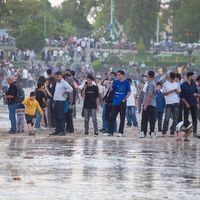
Amid wartime Israeli bombardments, residents of major cities fled their homes seeking safety.
Khamenei went on to say that Israel’s dependence on the United States exposed its weakness.
“If the Zionist regime could defend itself, it wouldn’t have turned to America,” he said. “It saw that it couldn’t handle the Islamic Republic.”
Israeli air strikes and drone attacks during the 12-day war killed hundreds of Iranian military personnel and nuclear scientists, along with with hundreds of civilians. Iranian missile salvos killed 27 Israeli civilians.
Turning to internal matters, Khamenei ordered the judiciary to pursue what he called “recent crimes” through all legal channels. “We must not release the collar of the criminal,” he said.
“Even if it takes twenty years, it must be pursued.” He dismissed concerns about international courts, saying they may one day act fairly “if an independent judge appears.”
The Supreme Leader also warned against public criticism of Iran’s armed forces or diplomatic corps, insisting that objections be expressed only “with an acceptable tone and after proper knowledge.” National unity, he said, must be preserved at all costs.
Photo of the seized tanker as released by Iranian state media.
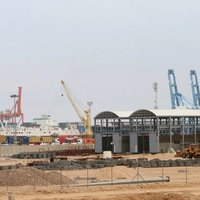
Iran has seized a foreign oil tanker in the Gulf of Oman for allegedly smuggling 2 million liters of fuel, the chief justice of Hormozgan province said on Wednesday, according to state-linked media.
“In the course of monitoring suspicious fuel smuggling activity in the country's maritime borders in the Sea of Oman, a foreign oil tanker was inspected and seized due to incomplete legal documents related to its cargo,” Mojtaba Ghahremani said, according to a statement carried by the judiciary’s public relations office.
Ghahremani said a criminal case has been opened in the public and revolutionary prosecutor’s office in Jask and legal proceedings are ongoing. “Based on the report of the authorities, a case has been filed, and judicial investigation into the charges continues,” he said.
He added that 17 people, including the ship’s captain and crew, were arrested. “Seventeen suspects, including the captain and crew of this foreign tanker, are currently in detention for further investigation and legal procedures,” Ghahremani said.
Authorities are now collecting evidence to verify the total volume and nature of the cargo. “Sampling and relevant testing of the tanker’s fuel cargo, and inquiries into the authenticity of its documents, are underway,” he said. Results will be announced by the judiciary when the investigation concludes, he added.
Iran has not named the ship or its country of origin.
Iran has stepped up maritime enforcement in recent months, especially in waters near the Strait of Hormuz and the Persian Gulf, where fuel smuggling remains a persistent issue. In April, Iran’s Revolutionary Guard Corps (IRGC) Navy said it had seized a tanker carrying 100,000 liters of smuggled fuel and detained six people, according to Fars News Agency. That followed a separate operation in which two tankers allegedly transporting more than 3 million liters of diesel were intercepted and taken to the port of Bushehr.
The IRGC regularly announces such seizures as part of what it calls efforts to curb fuel trafficking in the region, a key route for global oil shipments. Iran has also seized tankers over maritime disputes or in response to international sanctions enforcement.
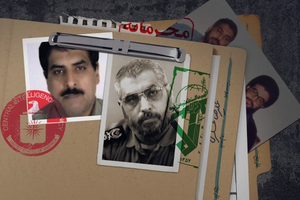
The FBI on Tuesday added three alleged Iranian intelligence officials including Tehran's current ambassador to Pakistan to its Most Wanted list over their alleged role in the disappearance of retired FBI agent Robert Levinson, who is believed to be dead.
The FBI’s Washington Field Office identified the three individuals as Reza Amiri Moghadam, Taghi Daneshvar and Gholamhossein Mohammadnia.
All three are linked to Iran’s Ministry of Intelligence and Security (MOIS), according to the FBI, which the United States has labeled a key player in hostage-taking operations and plots targeting Americans abroad.
The individuals were already under US sanctions and listed in connection with cases of alleged hostage-taking and the wrongful detention of American nationals in Iran.
“The FBI is leading the way in holding Iran accountable for the abduction of Bob Levinson, a devoted father and patriotic American,” Senator Jim Risch wrote on X.
“These new posters are seeking information related to his kidnapping. We will never forget Bob and his family, and we will hold those responsible to account for their crimes.”
Levinson disappeared in 2007 while on an unauthorized CIA mission to Iran’s Kish Island. US officials believe he died in Iranian custody, although Tehran has never acknowledged detaining him and continues to deny any involvement.
In 2020, Levinson’s family released a statement saying they had concluded, based on information from US officials, that he had died while in Iranian custody.
A member of Iran's Islamic Revolutionary Guard Corps (IRGC)
Defection from within Iran’s armed forces could become a serious threat to the Islamic Republic—but only if defectors are given protection, a clear pathway to safety, and a structure they can trust, experts told Iran International.
“There was a moment—those 12 days of Israeli and US military strikes—where the regime was on the run,” said Michael Pregent, a former US intelligence officer.
“People were watching closely. There was momentum.” But in the absence of a safe haven or real backing, Pregent said, “those who might have defected were left with nowhere to go.”
This renewed focus on potential defections comes amid a social media statement by exiled Prince Reza Pahlavi, who says that more than 20,000 members of Iran’s military have contacted his office through a digital registration platform expressing interest in defecting.
While the figure has not been independently verified, it has intensified questions about the loyalty of Iran’s security forces and the conditions under which they might break ranks.
Iran’s track record of retaliation remains one of the most significant obstacles to defection.
“The biggest problem usually” is “how are the defectors going to get their families out and their friends out?” said Patrick Clawson of the Washington Institute.
“The Islamic Republic has a long history of taking hostages who are quite unrelated to the offenses... I think we can assume that in the case of defectors, the Islamic Republic would go out to family and friends," Clawson told Iran International.
Defections are unlikely to gain momentum unless members of the security apparatus believe they have a viable future outside the regime, noted Alireza Nader, a senior Iran analyst.
'Safe zones'
What could shift that equation, according to Pregent, is the creation of safe zones—physical or operational—where defectors can seek protection and regroup.
Drawing on his experience in Iraq, where he worked with tribal leaders and defectors during the US counterinsurgency campaign, he described how trust was built by offering defectors equipment, radio support and armed backing.
That model, he argued, could be adapted to support Iranians who are ready to break with the ruling system.
Trust, he added, depends on action—not words—and on the presence of those “willing to sacrifice their own skin in the game.”
“We’ve seen that with the Israelis... the underground inside of Iran," Pregent added, referring to armed cells who have carried out assassinations and nuclear sabotage in league with Israel. "That’s where the trust is—people that were willing to fight for this, willing to put their lives on the line," Pregent told Iran International.
Insiders helping Israel
Israel’s assassinations of IRGC commander Ali Shadmani and Hamas leader Ismail Haniyeh in Tehran make one thing clear: Iranians inside the country are cooperating with Israel. These operations would be impossible without human assets on the ground.
Haniyeh was killed on July 31, 2024, along with his bodyguard, inside a military-run guesthouse in Tehran shortly after attending the inauguration of President Masoud Pezeshkian. The strike, like others before it, demonstrated not only Israel’s superior intelligence-gathering capabilities but also the existence of local informants within sensitive Iranian security and political circles.
When asked how Israel managed to target individuals in their bedrooms in remote parts of Tehran, he replied: "I mean, what would you guess? I think the answer is in the question, and I think it goes back to the original question about how to overcome fear. There are many, many Iranians that are overcoming fear right now. They've overcome fear in the past. They've worked in, in close tandem with forces of good, and they will continue to do so," Yechiel Leiter told Iran International.
Leiter's language—deliberately indirect—nonetheless strongly implies collaboration between Israeli intelligence and Iranian dissidents or insiders.
Legal and diplomatic ambiguity is another deterrent. Potential asylum countries must make clear that not only the defectors, but also their families, would be protected and welcomed. That clarity is missing, both in law and in practice, according to Clawson.
In many cases, intelligence agencies view double agents as more practical and valuable than outright defectors. Rather than extract a source, agencies often persuade them to remain in place and feed intelligence from within, Clawson added.
Nader added that exiled political figures must be judged by action, not intention. Those hoping to gain the trust of Iranians must show they’ve delivered meaningful results—particularly during this moment of regional and domestic upheaval.
Without external support and a clear exit plan, a viable counter-insurgency from within Iran remains unlikely. The regime will continue to maintain its grip so long as those within its ranks see no path out. “That cannot happen if it doesn’t have a safe haven,” said Pregent.
Pictures of Iranian military commanders, nuclear scientists and others killed in Israeli strikes are displayed in Behesht Zahra Cemetery in southern Tehran, Iran, July 11, 2025.
Iran could boost its uranium enrichment to 90%, weapons-grade level, and consider exiting the Nuclear Non-Proliferation Treaty (NPT) if European powers move to trigger the UN snapback sanctions mechanism, Tasnim News reported on Tuesday.
The report came as France said it would trigger the UN snapback mechanism against Iran by the end of August if no tangible progress is made on a nuclear deal.
French Foreign Minister Jean-Noel Barrot said Tuesday that Iran has violated its commitments under the 2015 agreement and that France, the United Kingdom, and Germany, known as the E3, are justified in reapplying global embargoes on arms, banks, and nuclear equipment. “Without a firm, tangible, and verifiable commitment from Iran, we will do so by the end of August at the latest,” Barrot told reporters in Brussels.
In response, Tasnim warned that Iran could raise uranium enrichment from 60% to 90%, and may use its enriched uranium stockpile for what it called “non-prohibited military purposes.”
The outlet also said that while exiting the Nuclear Non-Proliferation Treaty (NPT) would be a major step, it remains one of several options Iran is considering.
Snapback seen as 'military aggression' by Iranian officials
Foreign Minister Abbas Araghchi last week warned that triggering the snapback would be viewed by Iran as equivalent to a military strike. “This move would mark the end of Europe’s role in Iran’s peaceful nuclear file,” he said, calling it a “historic mistake” that could irreversibly damage ties.
Tasnim echoed that view, saying that the US strikes on Iran’s nuclear infrastructure, combined with European inaction, have shifted Tehran’s strategy from "political patience to strategic deterrence".
Iran may expand nuclear activity, restrict IAEA oversight
In its report, Tasnim said Iran "should halt dilution of 60% enriched uranium, accelerate advanced centrifuge deployment, expand research into uranium metal production, and scale back cooperation with the International Atomic Energy Agency (IAEA)."
“These responses are lawful and proportionate,” the outlet said, while warning that Tehran would not accept any further Western pressure without consequences.
French Foreign Minister Jean-Noel Barrot in London, July 9, 2025.
France, Britain, and Germany will activate the United Nations snapback mechanism against Iran by the end of August if no tangible progress is made on a nuclear deal by then, French Foreign Minister Jean-Noel Barrot said on Tuesday.
"France and its partners are... justified in reapplying global embargoes on arms, banks, and nuclear equipment that were lifted 10 years ago. Without a firm, tangible, and verifiable commitment from Iran, we will do so by the end of August at the latest," Barrot told reporters ahead of a meeting with EU Foreign Ministers in Brussels.
The snapback mechanism is part of UN Security Council Resolution 2231, which endorsed the 2015 Joint Comprehensive Plan of Action, or JCPOA. It allows any participant in the nuclear agreement to reimpose sanctions if Iran is deemed non-compliant. If no resolution to maintain sanctions relief is passed within 30 days, all previous UN measures return automatically.
Barrot said earlier in June that France and its European partners can reinstate a global embargo on weapons, nuclear equipment, and key financial sectors in Iran through a simple letter.
France announces EU sanctions on Iranians tied to killings, demands hostage release
As part of a broader EU action, the European Council has sanctioned nine Iranian individuals and entities accused of carrying out assassinations and transnational repression on European soil. Barrot announced the measures on Tuesday, saying the listed individuals were responsible for “violating the interests of France and Europe.”
“We are freezing the assets and banning the entry into Europe of nine Iranian individuals and entities responsible for assassinations on European territory,” Barrot said. “This is the result of efforts I personally led, and I welcome their outcome.”
Barrot also called for the “immediate and unconditional release” of French nationals held in Iran and demanded Iran resume cooperation with UN nuclear inspectors. He said Tehran’s “destabilizing activities” would not go unanswered.
Iran warns of ‘appropriate response’ if Europe triggers sanctions
Iran will respond proportionately if the European parties re-activate the snapback mechanism, Foreign Ministry spokesman Esmail Baghaei said on Monday.
He dismissed the legal basis of the measure and accused the European parties of violating their own JCPOA obligations. “They have no standing to invoke the mechanism,” he said at a weekly briefing. “The so-called snapback has no legal, political, or ethical justification.”
Baghaei reiterated that Iran still considers itself a JCPOA signatory, despite scaling back commitments after the US withdrawal in 2018 and what he called Europe’s failure to uphold its end of the deal.
Iran accuses Germany and IAEA of double standards
Baghaei also criticized Germany for hosting US nuclear weapons and backing Israeli military operations, calling its position a violation of the Non-Proliferation Treaty (NPT). He accused Berlin of “supporting violations of international law” while taking a hard line on Iran’s nuclear activity.
He further accused the International Atomic Energy Agency (IAEA) of “instrumental and selective behavior,” alleging that information provided by the agency had been used in recent military strikes against Iran’s nuclear sites. He condemned the IAEA’s silence over those attacks, including the US bombing of the Fordow facility, whose damage he said is still being assessed.
No new nuclear talks planned, Iran says
Baghaei said no date or venue has been set for nuclear talks, though consultations with China and Russia are ongoing. He called recent reports of new intermediaries “speculative” and stressed that Iran makes independent decisions on its nuclear policy.
He also said Iran remains open to diplomacy but will not re-enter talks until there is “confidence in the effectiveness of diplomacy.” He cited a coordinated Israeli-US military strike just before the sixth round of negotiations as a key turning point.