Tehran attacks targeted senior leaders not civilians, Israeli official says
People walk past an anti-U.S. mural on a street in Tehran, Iran, May 11, 2025.
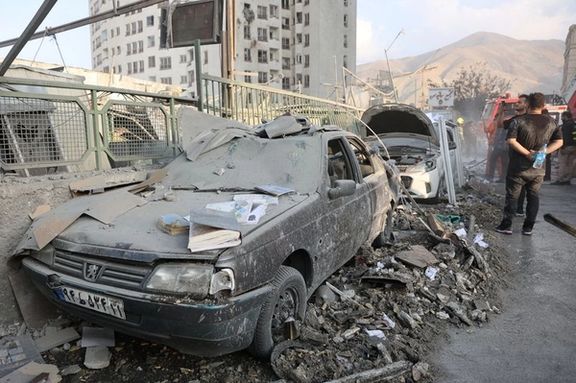
A senior Israeli official told Iran International that leaders' homes and not civilians were targeted in airstrikes in Tehran, as Iranian state media announced the death of the Revolutionary Guards chief Hossein Salami.
"Homes of senior military and political officials were targeted in Israeli airstrikes in Tehran," a senior Israeli political official told Iran International, speaking on condition of anonymity.
"Civilians are not the intended targets," the official added.
Iran International was the first media outlet to publish official confirmation of the Israeli attack on Iran and its targets.
State news outlet IRNA reported that Hossein Salami, the head of Iran's Islamic Revolutionary Guard Corps, along with another top commander and two senior nuclear officials were killed.
Ali Shamkhani, an advisor to Supreme Leader Ali Khamenei, was seriously wounded during an attack on his residence and has been transferred to a hospital in Tehran in critical condition, Nour News, a media outlet close to the Supreme National Security Council reported.
Khamenei is alive and being briefed on the situation following Israel's attack on Iran, Reuters reported citing a security source.
"Homes of senior military and political officials were targeted in Israeli airstrikes in Tehran," a senior Israeli political official told Iran International, speaking on condition of anonymity.
"Civilians are not the intended targets," the official added.
A Boeing AH-64 Apache attack helicopter to be used in the U.S. Army's 250th Birthday Celebration and Parade, prepares to land on the National Mall near the U.S. Capitol in Washington, D.C., June 11, 2025.
US President Donald Trump on Thursday said he did not want Israel to attack its arch-foe Iran while there was still hope for a nuclear deal with Washington but warned a 'massive conflict' in the region was possible.
Speaking at White House press conference, Trump said an Israeli attack on Iran was possible but that he hoped for a negotiated solution to the nuclear impasse.
Responding to reporter's question, Trump said, "Well I don't want to say imminent, but it looks like it's something that could very well happen."
"I'd love to avoid a conflict. Iran's going to have to ... give us some things that they're not willing to give us right now," Trump said. Tehran and Washington remain at loggerheads over whether Iran can keep enriching uranium on its own soil.
Trump added the two sides are "fairly close to a pretty good agreement," but struck an ambivalent note about the impact of a potential Israeli strike.
"As long as I think there is an agreement, I don't want them (Israel) going in, because I think that would blow it. Might help it actually, but it also could blow it."
Israel is weighing a potential attack on Iran within days, ABC News reported on Thursday citing three sources familiar with the situation.
The network cited the sources as saying they were unaware of any specific US role but added it was possible the United States could share intelligence or support logistics.
A sixth round of US-Iran nuclear talks is due to convene in the Omani capital Muscat on Sunday, in what could be a decisive moment for the war-weary region.
Trump on Thursday cited the possibility of a potential "massive conflict" in the region for drawing down US personnel from the Middle East, a day after US officials said the embassy in Baghdad would be partially evacuated.
"There's a chance of massive conflict. We have a lot of American people in this area, and I said we've got to tell them to get out, because something could happen soon," Trump said. "I don't want to be the one that didn't give any warning and missiles are flying into their buildings."
"He's going to drag us into a war"
Iranian rhetoric had ratcheted up on Wednesday as Defense Minister Aziz Nassirzadeh said Tehran would strike American bases in the region if nuclear negotiations fail and conflict breaks out.
"Some officials on the other side threaten conflict if negotiations don't come to fruition. If a conflict is imposed on us... all US bases are within our reach and we will boldly target them in host countries," Nassirzadeh said during a press conference.
Iranian officials also bristled at a resolution passed against it at the International Atomic Energy Agency (IAEA) on Thursday finding Tehran non-compliant with proliferation obligations.
The move put the Islamic Republic further at odds with the United Nations nuclear watchdog which inspects its nuclear facilities and would be a key player in any deal.
Meanwhile a prominent Democratic lawmaker urged the US Defense Secretary not to allow Israel to embroil the United States in a conflict and unsuccessfully sought to extract a pledge from Pete Hegseth not to strike Iran unless attacked.
"Will you commit to us not bombing (Iran) ... unless we're directly hit?" California representative Ro Khanna asked at a House hearing on Thursday.
"Would you agree ... that Netanyahu is itching for a fight? If Netanyahu uses American missiles to hit Iran, he's going to drag us into a war there," Khanna added.
The remarks were a rare public intervention by a Democratic lawmaker on Trump's Iran policy.
Hegseth said Trump sought peace but understood what he called the Iranian threat.
"The President has been earnestly and completely committed to a peace process. He's given Iran every opportunity, those talks are ongoing, but he also fully recognizes the threat that Iran poses."
Iranian state media began releasing images of what it said were documents related to Israel's nuclear program obtained by Tehran and said they demonstrated collusion between the United Nations nuclear agency and arch-foe Israel.
"The first set of documents obtained from the Israeli regime shows that Grossi, the Secretary General of the International Atomic Energy Agency, had full cooperation and close coordination with this regime and fully implemented its orders," the Tasneem news agency wrote on X.
The outlet, which is affiliated with Iran's Revolutionary Guards, included images of email exchanges in Hebrew and and what appeared to be a printed letter from Meirav Zafary-Odiz, Israel's ambassador to the IAEA, to its now chief Raphael Grossi.
Dated 2016, the alleged letter requests a meeting.
Other documents appeared to be email exchanges between Zafary-Odiz and an Israeli academic using an University of Washington email address and focused on panel discussions on nuclear topics.
Iran's intelligence ministry said last week it had obtained a trove of sensitive material from Israel, including documents it says are related to the Jewish state's nuclear and strategic facilities.
Israeli security experts cast doubt on the assertion, saying it was likely part of a state attempt to sway opinion as US-Iran nuclear talks enter a critical phase.
Amir Rashidi, director of cyber security and digital rights of the Iran-focused human rights NGO the Miaan Group, said the documents released on Thursday appeared dubious.
"There are several red flags that raise questions about the authenticity and origin of these materials," he wrote in a post on LinkedIn.
Their presentation as screenshots impairs verification through metadata and timestamps, pages are numbered in Persian-Arabic script and Iranian hackers' past compromising of academic accounts makes the university email address suspect, Rashidi said.
Iranian President Masoud Pezeshkian during a meeting in Ilam province on June 12, 2025
Iranian President Masoud Pezeshkian on Thursday criticized a resolution passed by the UN nuclear watchdog’s board of governors against Tehran’s nuclear activities, saying that Iran will continue its uranium enrichment and remain defiant in the face of Western pressure.
"Today, the United Kingdom, France, and Germany passed a resolution against Iran. I truly do not understand how we are supposed to cooperate with a world that keeps provoking us and refuses to let the people of this nation stand on their own and live independently," Pezeshkian said during a meeting with teachers, academics, and cultural figures in the western province of Ilam.
The remarks came a few hours after the International Atomic Energy Agency’s (IAEA) board adopted a non-compliance resolution criticizing Iran for lack of cooperation with inspectors and its ongoing expansion of nuclear activities, which Western powers say could pose proliferation risks.
Reaffirming Tehran’s nuclear posture, Pezeshkian said, “We will continue on our path. We will carry on with enrichment and we will not back down from the current course. This is a national right, and we will not compromise.”
"We will build this country with our youth. Even if they destroy our facilities with bombs, the knowledge and capability remain in our minds, and we will rebuild everything no matter what they do.”
Iran maintains that its nuclear program is solely for peaceful purposes, but its rapid expansion of enrichment activities and restrictions on international oversight have raised alarms in Washington and European capitals.
The resolution by the IAEA’s policy-making 35-nation board declaring Iran in breach of its non-proliferation obligations marked the first in almost 20 years, raising the prospect of reporting it to the UN Security Council.
The decision follows years of escalating tensions between Iran and the Vienna-based agency, particularly after the United States withdrew from the 2015 nuclear deal in 2018 under President Donald Trump, prompting the gradual collapse of the accord.
In response to the censure, an IAEA official said Iran had notified the agency of its intention of countermeasures such as establishing a new uranium enrichment facility.
Following the announcement, Israel’s Foreign Ministry condemned Iran’s move, accusing Tehran of undermining the global Non-Proliferation Treaty (NPT) and posing a serious threat to regional and international security.
Iran remains a signatory to the NPT, while Israel is not. Israel is widely believed to possess the Middle East’s only nuclear arsenal.
Withdrawal from the NPT is now under consideration at the Iranian parliament, the spokesman for the National Security and Foreign Policy Committee said after the resolution was passed.
Earlier in the day, a senior Israeli told Iran International that Israel is ready to launch a military strike on Iran if the next round of nuclear talks between Tehran and Washington, set for Sunday in Oman, fails to yield results.
An Israeli F15 Fighter Jet on its way to conduct air strikes in Yemen is seen at an unidentified location in this handout photo released July 20, 2024
A senior Israeli official has warned that Israel is ready to launch a military strike on Iran if the next round of nuclear talks between Tehran and Washington, set for Sunday in Oman, fail to yield results.
The official, speaking to Iran International, said Israel is closely monitoring developments and could act unilaterally if necessary.
“The United States would require approximately three days to evacuate non-essential diplomatic personnel and their families from the region,” the source said. “That evacuation process reportedly began on Wednesday and is expected to be completed by Sunday, aligning with the timeline for the talks.”
According to multiple sources, the United States has already begun evacuating non-essential diplomatic personnel and their families from the region.
Israeli media reported Thursday that Strategic Affairs Minister Ron Dermer and Mossad Director David Barnea are set to meet US Special Envoy Steve Witkoff ahead of the talks in Oman.
Witkoff, speaking at an event for the Israeli medical charity United Hatzalah in New York on Wednesday, stressed that Iran must be permanently denied the ability to develop nuclear or missile capabilities.
“We must stand resolute and united against this danger and ensure that Iran never obtains the means to achieve its deadly ambitions no matter what the cost,” he said.
A senior Iranian official told Reuters that a regional ally had informed Tehran of the potential for an Israeli strike. "The tensions are intended to influence Tehran to change its position about its nuclear rights," the official said, but emphasized that Iran would not compromise on its right to uranium enrichment.
US President Donald Trump said Wednesday that American personnel were being withdrawn due to increasing threats in what he described as a “dangerous place.” He added that Washington remains committed to preventing Iran from acquiring a nuclear weapon.
Iran's Islamic Revolutionary Guard Corps (IRGC) issued a warning Thursday. “If our hands are untied, we will win victories that will make the enemy regret its actions,” IRGC commander-in-chief Hossein Salami said, signaling Iran’s readiness for any military confrontation.
An IRGC-affiliated outlet, Javan, warned that Tehran was prepared to walk away from negotiations if its national demands were not met, saying that Iran was negotiating “from a position of strength” and possessed sufficient nuclear expertise to act as a deterrent.
The New York Times, citing a senior Iranian official, reported Wednesday that Iranian military and government leaders had already held high-level meetings to discuss their response to any possible Israeli military strike.
Attacking Iran without US help
NBC News reported Thursday that while Israel would prefer to coordinate with the US, including intelligence or logistical support for strikes on Iranian nuclear facilities, it is prepared to act alone.
“While Israel would most likely prefer US military and intelligence support... it showed in October that it can do a lot alone,” the report said.
The same report cited five sources saying that Israel’s considerations of unilateral military action have intensified as the US inches closer to a preliminary deal with Tehran—one that reportedly includes provisions on uranium enrichment that Israel finds unacceptable.
US evacuating Baghdad embassy
Tensions have also led to regional security measures with the US embassy in Baghdad set to be evacuated partially.
Iraq’s state news agency also reported that steps to evacuate US personnel were underway not only in Iraq but across several Middle Eastern countries.
The UK Maritime Trade Operations (UKMTO) issued a security advisory on Wednesday, warning that increased regional tensions could impact maritime safety.
“UKMTO has been made aware of increased tensions within the region which could lead to an escalation of military activity having a direct impact on mariners,” the alert read.
The Washington Post reported Wednesday that the nuclear talks might not proceed as planned, citing two US officials who described the diplomatic environment as rapidly deteriorating.
Iran’s Defense Minister Aziz Nassirzadeh warned on Wednesday that Tehran would target American bases in the region if negotiations collapse and hostilities break out. “If a conflict is imposed on us... all US bases are within our reach and we will boldly target them in host countries,” he said.
Despite the rising tensions, Oman’s Foreign Minister Badr al-Busaidi confirmed Thursday that the sixth round of US-Iran nuclear negotiations will proceed as scheduled on June 15.