UN nuclear chief Rafael Grossi says any deal between Iran and the US should include "very robust" inspections by the International Atomic Energy Agency (IAEA).
"My impression is that if you have that type of agreement, a solid, very robust inspection by the IAEA ... should be a prerequisite, and I'm sure it will be, because it would imply a very, very serious commitment on the part of Iran, which must be verified," Grossi told reporters on Wednesday.
When asked about the differences between Tehran and Washington, especially on the matter of Iran's domestic enrichment program, he said: ""I think there's always a way ... It's not impossible to reconcile the two points of view."
A top Iranian military official said on Wednesday that Iran’s armed forces remain united and capable of defeating any adversary, drawing on lessons from a key battle in the 1980s Iran-Iraq war.
“With lessons from Operation Beit-ol-Moqaddas, we will rub the nose of any enemy in the dirt,” said Rear Admiral Habibollah Sayyari, deputy coordinator and chief of staff of Iran’s army, in remarks carried by Iranian media.
Speaking at a ceremony marking the anniversary of Iran’s recapture of the city of Khorramshahr during the war, Sayyari said unity among Iran’s armed forces had repeatedly foiled enemy strategies.
He said the 1982 Beit-ol-Moqaddas operation showed the world Iran’s military capability, adding that “no expert believed Iran could retake Khorramshahr under those conditions.”

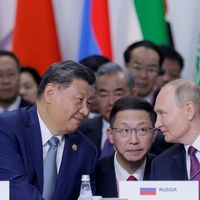
Iran welcomes dialogue but remains firm on maintaining its nuclear independence and fuel enrichment capabilities, the country’s top security official said on Wednesday at a high-level international security summit in Moscow.
Ali Akbar Ahmadian, Secretary of Iran’s Supreme National Security Council, told delegates at the 13th International Meeting of High Representatives for Security Issues that Tehran insists on preserving its nuclear fuel cycle and enrichment as an inalienable right.
“The Islamic Republic of Iran supports negotiations but will not compromise on its nuclear sovereignty,” Ahmadian said.

Iran’s foreign minister said on Wednesday that Tehran will not compromise on uranium enrichment and warned that there will be no further discussions with European powers if their position remains a demand for “zero enrichment.”
“We are not joking with anyone about enrichment,” Foreign Minister Abbas Araghchi told reporters during a visit to Oman with President Masoud Pezeshkian.
He added that the date for a new round of indirect talks with the United States could be announced in the coming days.
In a post on X on Tuesday, Araghchi said, “Iran has maintained multilateral engagement with the UK and other European JCPOA participants in good faith, even as the US continues to show no interest in getting them involved in the ongoing negotiation process.
“If the UK position is ‘zero enrichment’ in Iran—in violation of the NPT and UK commitments as a remaining JCPOA participant —there is nothing left for us to discuss on the nuclear issue.”
While Araghchi said the Oman visit was not focused on negotiations, he acknowledged that some informal consultations had taken place. He also praised Iran’s relationship with Oman, calling it “very positive” and based on mutual respect and shared interests.


Three Indian nationals who traveled to Iran earlier this month are missing, India’s embassy in Tehran said on Wednesday, adding that urgent rescue efforts are underway.
“Family members of 3 Indian citizens have informed the Embassy of India that their relatives are missing after having travelled to Iran,” the embassy said in a statement.
“The Embassy has strongly taken up this matter with the Iranian authorities, and requested that the missing Indians should be urgently traced and their safety should be ensured.”
The missing men — Hushanpreet Singh, Jaspal Singh, and Amritpal Singh — are all from the northern Indian state of Punjab and reportedly lost contact with their families shortly after landing in Tehran on May 1.
According to Indian media, they had planned to travel to Australia via Dubai and Iran, reportedly with the help of an agent based in Hoshiarpur who is now also missing.
Relatives said the men were kidnapped and that a ransom was demanded.
The embassy said it is in regular contact with the families. There was no immediate comment from Iranian authorities.
The head of the UN nuclear watchdog said on Wednesday that the gap between the United States and Iran over uranium enrichment is not insurmountable, and called for strong international inspections to be a central element of any potential agreement.
International Atomic Energy Agency (IAEA) Director General Rafael Grossi said that while there are clear differences between Tehran and Washington on enrichment levels, the dispute could be resolved with diplomatic effort.
“It’s not impossible to reconcile the two points of view,” Grossi said. “Robust IAEA inspections should be part of any agreement between Iran and the US.”
About the talks, he said, “For the moment, the jury is still out. The fact that they continue to meet … that is an indication of a willingness to come to an agreement.”