Iran insists on nuclear independence, security chief says in Moscow
Iran welcomes dialogue but remains firm on maintaining its nuclear independence and fuel enrichment capabilities, the country’s top security official said on Wednesday at a high-level international security summit in Moscow.
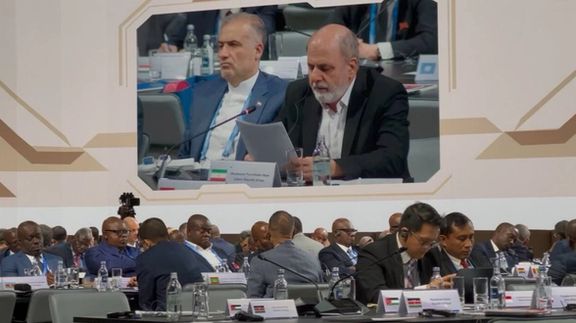
Ali Akbar Ahmadian, Secretary of Iran’s Supreme National Security Council, told delegates at the 13th International Meeting of High Representatives for Security Issues that Tehran insists on preserving its nuclear fuel cycle and enrichment as an inalienable right.
“The Islamic Republic of Iran supports negotiations but will not compromise on its nuclear sovereignty,” Ahmadian said.
Ali Akbar Ahmadian, Secretary of Iran’s Supreme National Security Council, speaking at a conference in Moscow, May 28, 2025
Iran’s foreign minister said on Wednesday that Tehran will not compromise on uranium enrichment and warned that there will be no further discussions with European powers if their position remains a demand for “zero enrichment.”
“We are not joking with anyone about enrichment,” Foreign Minister Abbas Araghchi told reporters during a visit to Oman with President Masoud Pezeshkian.
He added that the date for a new round of indirect talks with the United States could be announced in the coming days.
In a post on X on Tuesday, Araghchi said, “Iran has maintained multilateral engagement with the UK and other European JCPOA participants in good faith, even as the US continues to show no interest in getting them involved in the ongoing negotiation process.
“If the UK position is ‘zero enrichment’ in Iran—in violation of the NPT and UK commitments as a remaining JCPOA participant —there is nothing left for us to discuss on the nuclear issue.”
While Araghchi said the Oman visit was not focused on negotiations, he acknowledged that some informal consultations had taken place. He also praised Iran’s relationship with Oman, calling it “very positive” and based on mutual respect and shared interests.
Three Indian nationals who traveled to Iran earlier this month are missing, India’s embassy in Tehran said on Wednesday, adding that urgent rescue efforts are underway.
“Family members of 3 Indian citizens have informed the Embassy of India that their relatives are missing after having travelled to Iran,” the embassy said in a statement.
“The Embassy has strongly taken up this matter with the Iranian authorities, and requested that the missing Indians should be urgently traced and their safety should be ensured.”
The missing men — Hushanpreet Singh, Jaspal Singh, and Amritpal Singh — are all from the northern Indian state of Punjab and reportedly lost contact with their families shortly after landing in Tehran on May 1.
According to Indian media, they had planned to travel to Australia via Dubai and Iran, reportedly with the help of an agent based in Hoshiarpur who is now also missing.
Relatives said the men were kidnapped and that a ransom was demanded.
The embassy said it is in regular contact with the families. There was no immediate comment from Iranian authorities.
The head of the UN nuclear watchdog said on Wednesday that the gap between the United States and Iran over uranium enrichment is not insurmountable, and called for strong international inspections to be a central element of any potential agreement.
International Atomic Energy Agency (IAEA) Director General Rafael Grossi said that while there are clear differences between Tehran and Washington on enrichment levels, the dispute could be resolved with diplomatic effort.
“It’s not impossible to reconcile the two points of view,” Grossi said. “Robust IAEA inspections should be part of any agreement between Iran and the US.”
About the talks, he said, “For the moment, the jury is still out. The fact that they continue to meet … that is an indication of a willingness to come to an agreement.”
Iran’s foreign ministry said on Wednesday that ongoing indirect negotiations with the United States are strictly limited to Tehran’s nuclear program and the lifting of sanctions.
Foreign Ministry spokesperson Esmail Baghaei also told reporters that consultations over the timing and venue of the next round of talks are still underway and will be officially announced by Oman once finalized.
“As has been repeatedly said, the only subjects of discussion between Iran and the United States are the nuclear issue and sanctions relief. No other topics have been, or will be, addressed in these negotiations,” Baghaei said.
“The continuation of enrichment in Iran is a fundamental principle of the Islamic Republic’s nuclear policy,” he said. “Any proposal or initiative that would undermine this right will not be accepted.”
Iran may reconsider its longstanding ban on US nuclear inspectors if ongoing negotiations with Washington result in a successful agreement, the head of Iran’s Atomic Energy Organization said on Wednesday.
Nuclear chief Mohammad Eslami told reporters in Tehran that inspectors from the United States — currently excluded due to what Tehran views as hostile policies — could be allowed access to Iranian nuclear sites under the auspices of the UN nuclear watchdog, the International Atomic Energy Agency (IAEA), if a deal is finalized.
“It is normal that inspectors from hostile countries are not allowed, but if a nuclear deal is reached, we might allow American inspectors working for the International Atomic Energy Agency to visit our nuclear sites,” Eslami said.
The remarks come as Iran and the United States are expected to enter a sixth round of talks aimed at reviving diplomacy over Tehran’s nuclear program. US President Donald Trump, who withdrew from the 2015 nuclear agreement during his first term, said earlier this month that he expects “good news” from the negotiations.
Enrichment still a red line
Eslami said that uranium enrichment remains a red line for Tehran, speaking of its significance to the country’s nuclear infrastructure.
“Enrichment is the foundation and pillar of the country's nuclear industry,” he said, comparing Western proposals to allowing a country access to a power grid while denying it the ability to generate electricity.
Daily electricity consumption in Iran can vary, with peaks reaching over 72,000 megawatt (MW), exceeding the actual power generation capacity of 60,000 MW during the summer. The capacity of Bushehr nuclear power plant, Iran’s biggest, is currently 1,000MW.
Western powers, led by Washington, have demanded Iran halt uranium enrichment over fears it could lead to nuclear weapons development. Tehran says its program is purely civilian and that it has no plans to build a nuclear bomb.
Iran’s nuclear chief also expressed hopes for what he called greater professionalism from the IAEA and urged the agency to resist outside political pressures, particularly from what he described as “Zionist influence.”
IAEA deputy director allowed to visit sites
He said IAEA Deputy Director General Massimo Aparo is currently in Tehran to inspect two remaining sites as part of an earlier agreement signed in March 2023.
“We hope the agency will act professionally and reduce the influence of the Zionist current,” Eslami said, adding that Iran is fully transparent and operates under full IAEA oversight.
No official proposal on consortium
Addressing reports of a potential nuclear fuel enrichment consortium involving Persian Gulf states, Eslami said Iran has not yet received an official proposal on the matter.
“Our position is legal and based on our rights. Enrichment is the essence of our nuclear industry. We are committed not to pursue nuclear weapons,” he said.
Eslami also dismissed recent allegations from opposition groups and Israeli intelligence about secret nuclear activities, calling them recycled accusations aimed at undermining Iran’s nuclear program.
“Such claims have always been made, but they are baseless. Whenever inspections occur, the truth emerges,” he said.
Oversight of Iran's nuclear facilities has been increasingly challenging for the IAEA. In 2022, Iran removed IAEA cameras and in September 2023, Iran banned a third of the IAEA's inspectors.