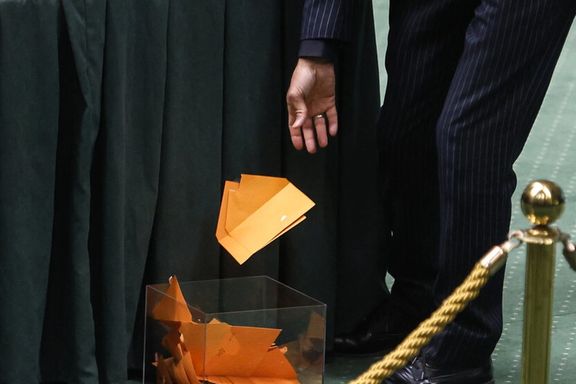
Ballot papers are being dropped in an open box during the vote to elect the parliament's presidium, Tehran, Iran, May 27, 2025
Nearly all members of Iran’s parliamentary presidium were re-elected on Tuesday with no real competition or surprise, in an uneventful session that mirrored the widespread apathy outside.
Despite weeks of speculation that the ultraconservative Paydari Party would mount a serious challenge to Speaker Mohammad Bagher Ghalibaf, no meaningful competition materialized.
Even Iran’s tightly controlled state media struggled to hide the stagnation.
“The political atmosphere in Iran has never been as banal as it is today,” the conservative daily Farhikhtegan wrote in its editorial on Tuesday. “Public trust in both politics and politicians is at its lowest point.”
During the session, lawmakers barely addressed the parliament’s performance. Instead, they praised Ghalibaf’s military service during the Iran-Iraq War, deflecting attention from governance failures.
Farhikhtegan warned that many lawmakers appear unwilling or unable to manage even basic parliamentary affairs—raising concerns about the legislature’s capacity to provide oversight or hold the cabinet accountable.It also alleged that some figures outside parliament had attempted to influence the internal vote.
Ghalibaf, a former Revolutionary Guards commander, won comfortably after one of his two rivals, Ahmad Ghavami, withdrew just before the vote. The only remaining contender, Ahmad Rastineh, posed little threat.
Rastineh had claimed he was running to end what he called Ghalibaf’s undemocratic control of the legislature. However, his interventions appear to have focused more on silencing radical voices than asserting a distinct policy direction.
Legislative paralysis
In the past year, the parliament (or Majles) advanced only two major initiatives: one to enforce compulsory hijab and another to restrict social media.
The former was blocked by President Massoud Pezeshkian and the Supreme National Security Council, who feared backlash from Iran’s politically active women.
The latter also met resistance from the public and the executive. Under pressure from youth in particular, Pezeshkian overturned a ban on WhatsApp and is reportedly working to lift other platform restrictions.
Yet the parliament’s most glaring failure remains economic reform. Lawmakers have made little progress in combating corruption, reducing inequality, or improving living standards.
Some political commentators—including prominent reform advocate Abbas Abdi and former vice president and presidential candidate Mostafa Hashemi Taba—argue that legislative efforts alone cannot solve Iran’s economic crisis.
The Majles, they assert, has lost much of its relevance, and only systemic reform—especially the redistribution of financial resources—can address the country’s deeply rooted structural challenges.
A police motorcycle burns during popular protests in Iran, September 19, 2022.
Warnings of unrest are growing louder in Iran, with the hardline daily Kayhan the latest to raise the alarm—pointedly avoiding Tehran’s governance failures and instead pinning potential protests on Washington and its alleged scheming.
Warnings of unrest are growing louder in Iran, with the hardline daily Kayhan the latest to raise the alarm—pointedly avoiding Tehran’s governance failures and instead pinning potential protests on Washington and its alleged scheming.
“All evidence suggests that, contrary to its public posture, America is not genuinely focused on Iran’s nuclear issue or enrichment levels,” wrote Kayhan editor Hossein Shariatmadari, who is appointed by Supreme Leader Ali Khamenei.
“From America’s perspective, the final destination of the negotiations is inciting sedition and creating unrest inside the country,” Shariatmadari said, suggesting that Washington aims to drag out the talks until protests erupt.
The tone is notable. While Kayhan routinely blames foreign actors for domestic troubles, its explicit anticipation of unrest places it—at least on the outcome—in rare alignment with more moderate voices warning of a volatile summer.
“Chaos is imminent,” former vice president Eshaq Jahangiri told the reformist daily Arman Melli on Monday, “not just because of sanctions, but because public trust in the state has collapsed.”
Jahangiri blamed successive governments for failing to implement the 20-year development plan launched in 2005 to position Iran as the region’s leading economic and technological power.
“Not a single administration has carried out the vision set in the five-year strategies,” he said. “Iran was once on par with Saudi Arabia and Turkey… now we lag behind them—and behind smaller Persian Gulf states.”
Such warnings have intensified in recent weeks, as Iran’s energy crisis deepens. The country faces a 25-gigawatt electricity shortfall this summer, according to the influential economic daily Donya-ye Eqtesad, which on Monday warned of a looming “socio-economic explosion.”
The paper—typically technocratic in tone—now says the power shortage has escalated from a solvable issue to a full-blown national crisis.
In recent days, poultry farmers, bakers, and produce vendors have voiced their frustration in interviews with foreign-based Persian media. Meanwhile, truck drivers in over a hundred towns and cities continue their strike despite a police crackdown and arrests.
Touching on the broader climate of discontent, Jahangiri warned that the Islamic Republic’s social capital has been steadily eroding for two decades.
“This level of regression will not be easily remedied,” he concluded.
Iranian President Masoud Pezeshkian said on Monday that Iran can survive without engaging in negotiations with the United States and even withstand increased sanctions as Tehran stands firm amid tough nuclear talks and US demands to cease uranium enrichment.
“It’s not like we will die of hunger if they refuse to negotiate with us or impose sanctions. We will find a way to survive,” Pezeshkian said referring to indirect nuclear negotiations with the US.
Speaking at a ceremony marking the anniversary of the founding of Islamic Azad University, Pezeshkian emphasized self-reliance, unity, and the mobilization of Iran’s domestic talent. “If we reach agreement internally with our people and elites, we will not need anyone else,” he said.
Pezeshkian, a moderate politician elected last year, expressed optimism about Iran’s ability to overcome economic and political challenges, including sanctions. “There are hundreds of ways to overcome problems. We must unite and let our experts act,” he added.
Iran and the United States have engaged in indirect nuclear talks through intermediaries in recent months. While no formal deal has been announced, US officials have hinted at progress toward de-escalation.
Iran has been under heavy US sanctions since Washington withdrew from the 2015 nuclear deal in 2018. Those have since increased since 2022 with the Woman, Life, Freedom protests leading to further global sanctions for rights abuses and Iran's support of Russia's war on Ukraine garnering others.
Pezeshkian’s administration has signaled a willingness to resolve domestic and international challenges through a combination of dialogue, resilience, and national unity. “Whether the enemy wants it or not, we will bring our country to the place it deserves,” he said.
US President Donald Trump has warned Iran that if a new nuclear deal is not reached, the US will 'bomb' Iran.
However, talks are sticking over the issue of Iran's uranium enrichment which the US wants Iran to stop completely, but which Iran says is its red line.
File photo of women without mandatory hijab in Tehran
Iran's Parliament Speaker Mohammad-Bagher Ghalibaf said on Sunday that the Supreme National Security Council (SNSC) has instructed the legislature not to enforce a contentious law mandating stricter hijab regulations.
“Although I had no intention of publicly declaring this in such explicit terms, the SNSC has formally written to the Parliament, directing us not to promulgate the hijab and chastity law for now," Ghalibaf told lawmakers.
His remarks came in response to a demand from hardline MP Mohammad-Taghi Naghdali, who urged the Speaker to forward the bill for executive enforcement.
The legislation—officially titled The Law to Support the Family by Promoting Chastity and Hijab—was passed by Parliament in December 2023 but has remained unenforced amid internal disagreements and widespread public opposition at home and abroad. The United Nations said the proposal amounted to "gender apartheid".
Ghalibaf emphasized that, under Article 176 of Iran’s Constitution, the SNSC has overriding authority on matters of national security.
“When the Council issues a directive of this nature, the Speaker has no legal authority to proceed with enforcement,” he said.
Behind-the-scenes power struggles
The decision underscores an intensifying struggle between Iran’s ultra-conservative factions, who demand immediate enforcement, and state institutions seeking to avoid further social unrest.
In recent months, hardliners and religious vigilante groups have mounted increasing pressure on authorities to enforce the law, even staging sit-ins outside Parliament that were eventually broken up by police.
Mohammad-Mannan Raisi, a firebrand MP closely aligned with the ultraconservative Paydari (Steadfastness) Front, recently accused the SNSC of betraying the Islamic Republic’s core supporters by halting enforcement of what he called “God’s commandments.”
The SNSC’s September 2024 decision to quietly shelve the law followed a wave of public backlash, echoing the protests that erupted in 2022 after the death of 22-year-old Mahsa Amini in morality police custody. The unrest marked one of the most significant challenges to the Islamic Republic in decades.
Surveillance without legislation
While the law itself remains suspended, authorities have pursued enforcement by other means.
Since late March, women in Tehran, Shiraz, and Isfahan have reported receiving text-message warnings for alleged hijab violations detected via surveillance footage.
Activists and digital rights experts say the messages are powered by AI-enabled facial recognition systems, cross-referenced with government ID databases and mobile phone data.
Critics have condemned the approach as unconstitutional and ethically fraught.
“Does the Headquarters for the Promotion of Virtue and Prevention of Vice even have legal access to people’s personal data?” asked Abdollah Ramezanzadeh, a former government spokesman and law professor, in a popular post on X.
In March, the UN's Fact Finding Mission on Iran said, "surveillance online was a critical tool for State repression," including against those rejecting the mandatory hijab.
"This enforcement increasingly relies on technology, surveillance and even State-sponsored vigilantism," the investigators said, with methods including dedicated apps to report violators and the monitoring of social media.
Despite government denials, the crackdown has continued.
In April, Iran’s police signed a cooperation agreement with the Education Ministry allowing enforcement measures in schools, sparking backlash from teachers’ unions who warned of “militarizing education.”
The standoff over hijab enforcement highlights deeper political dilemmas which continue to challenge Iran’s clerical leadership.
Public defiance continues to rise. Across major cities, women are increasingly seen without headscarves in public spaces, often posting videos online in acts of civil disobedience.
Tensions are mounting among Iran's conservative factions as supporters of the Parliament speaker Mohammad-Bagher Ghalibaf and his ultra-hardline rivals engage in an escalating war of words ahead of a key leadership vote.
A vote for the parliament's presidium is due to be held on May 27 to chose the speaker, his two deputies and six secretaries. The officials are key to running parliament, managing its sessions and deciding what to put on its agenda.
In a social media post on Tuesday, pro-Ghalibaf journalist Mahdi Yamini accused lawmakers from the Paydari (Steadfastness) Party and its allies of plotting against Ghalibaf ahead of the vote.
“A group of Paydari Party lawmakers … have started moves and meetings to lay the groundwork and make preparations for a coup against Mohammad Baqer Qalibaf ... Power struggle to the very gates of hell...!!!” he declared.
Ultra-hardliners’ criticism of Ghalibaf has intensified following his transmission of the controversial Palermo legislation to President Masoud Pezeshkian’s administration for enforcement on Wednesday.
The law, conditionally approved by the Expediency Council on May 14 after years of delay, enables Iran to join the Palermo Convention—a key step toward removing the country from the Financial Action Task Force’s (FATF) black list.
Ultra-hardliners, often referred to as super-revolutionaries, oppose the move, arguing that compliance with FATF requirements would undermine Iran’s ability to support regional allies and bypass international sanctions.
“Signing off on the Palermo Act means exposing all the financial networks we've used to circumvent sanctions,” wrote hardline activist Hadi Naseh in a post on X.
They accuse Ghalibaf—who opposed the Palermo and Counter-Terrorism Financing (CTF) conventions in 2019—of hypocrisy and betraying the national interest.
“What do you think happened that (the Palermo legislation) is now considered to benefit (Iran)?” ultra-hardliner politician Ali-Akbar Raefipour asked in a post on X citing Ghalibaf’s previous objection to joining these conventions.
Ghalibaf’s supporters argue that he was legally obliged to send the legislation to the administration for enforcement regardless of his personal stance.
“Understanding this doesn’t require any special genius as it is an established fact, Ghalibaf supporter and a former ally of former president Mahmoud Ahmadinejad posted on X.
'Law of Satan'
Despite the Supreme National Security Council's decision to temporarily postpone its implementation to avoid public backlash, ultra-hardliners have also condemned Ghalibaf for failing to forward a controversial new hijab enforcement law to the administration.
The legislation imposes harsh penalties—including fines and prison sentences—on women who fail to observe strict hijab rules and on businesses that do not enforce them.
Some Iranian media outlets such as Donya-ye Eghtesad predict another term as speaker for Ghalibaf despite the ultra-hardliners’ campaign against him.
Defeating ultra-hardliner Mojtaba Zolnouri, he won last year’s presidium vote with 198 out of 287 ballots. This was down from 234 in 2022 and 210 in 2023.
A hardliner who occasionally adopts pragmatic positions, Ghalibaf has served as speaker for five years but his grip on parliamentary leadership weakened after he fell behind three ultra-hardliner candidates in the March 2023 elections.
The former IRGC-commander won 447,000 votes in an elections marked by voter apathy, particularly in Tehran, where Mahmoud Nabavian became first with 597,000 votes out of a possible 7.7 miilon eligibles---the least for a Tehran frontrunner in all elections since the Islamic Revolution of 1979.
Iran’s Supreme Leader Ali Khamenei believes Iran’s population needs to increase to 150 million
An ad displayed in Tehran’s metro cars that many perceived as a bizarre attempt to criticize birth control has stirred controversy over Iran's official measures to combat shrinking population growth.
“The nurse who healed my mother’s wounds, you are a great lady,” read the caption over an image that many observers at first interpreted as a condom crinkled over a phallic shape.
Below was written: “The nurse who was never born” and “Giving an opportunity to future heroes to be born.”
Social media posts suggested the ad was understood as an anti-condom message promoted by the hardline-dominated municthey have
“Looks like they have seriously used an image of a broken condom in the metro to campaign for childbirth. Since when have they become so open-minded,” user @nah__r asked on X.
The controversial ad in Tehran metro cars
“This ad is dangerously misleading! Condom use is not just for preventing pregnancy, it plays a much more vital role in maintaining sexual health and preventing sexually transmitted diseases,” London-based Iranian hemato-oncologist Dr. Shahram Kordasti weighed in in a post on X.
“Incomplete information is harmful and a sign of the utter irresponsibility of its publishers.”
Design misfire
But the apparent message was due to a misfire in design. Some social media users later clarified that the graphic was intended to show a hospital bed with a bedsheet—not a condom.
The ad, other images bore out, was part of a broader campaign to warn about a future shortage of critical workforce—such as firefighters, emergency responders, and border guards—if Iran’s birth rate continues to fall.
Other versions showed the same shape variously pocked with bullet holes, burnt and frozen, praising the heroism of 'unborn' border patrols, firefighters and rescue workers.
“I realized that that (the opaque covering) was supposed to represent hospital sheets, not condoms after I investigated the ad,” @adameaval posted on X, blaming the campaign’s designers for the confusion.
Towards a pro-birth policy
Iran’s first condom factory was launched in 1987 by the Ministry of Health, part of a wider effort to curb explosive population growth that had exceeded five percent in the early 1980s.
In the 1990s, Iran’s family planning program was considered among the most effective globally, providing free contraceptives through public health services and promoting smaller families.
But over the past decade, authorities have reversed that approach in response to a steep drop in birth rates. According to the latest official statistics, the population growth rate is now just 0.7 percent.
In 2022, the Health Ministry banned free distribution of contraceptives and required a prescription for purchases. Yet demand continues, and illegally imported condoms and contraceptives are still available—sold discreetly through online shops and some pharmacies.
At the same time, abortion crackdowns have intensified. Abortions in Iran are only allowed during the first four months of pregnancy and only in cases of severe fetal abnormalities or when the mother’s life is at risk. Screening kits for congenital anomalies that may encourage abortions have also been banned.
Babies with benefits
The government is now offering financial and other incentives to encourage childbearing, including bonuses for childbirth, free land and extended maternity leave.
In a bid to support infertile couples, the government recently expanded insurance coverage. On April 27, Iran’s Health Insurance Organization announced it would cover 90% of costs for IVF and ICSI in public hospitals, and 70% in private ones.
Speaking at a National Population Day event on May 19, Mohammad-Jafar Ghaempanah, executive deputy to President Masoud Pezeshkian, warned that the recent 7.4 percent drop in births compared to the previous year is a “serious alarm.”
He added that reversing the trend would require “economic stability, improved livelihoods, and job security.”
However, Iran’s struggling economy complicates these ambitions. The Misery Index—defined as the combined rate of unemployment and inflation—has jumped from 19.3 percent in 2016 to 40.3 percent in 2024, with inflation hovering above 32.5 percent for years.
“A government that hasn’t been able to provide welfare or at least the minimum of it for its current population is not well-positioned ethically to tell its people to have more children,” sociologist Saeed Payvandi told Iran International TV from Paris.