Strong winds and lightning across Iran claim nine lives, injure 86
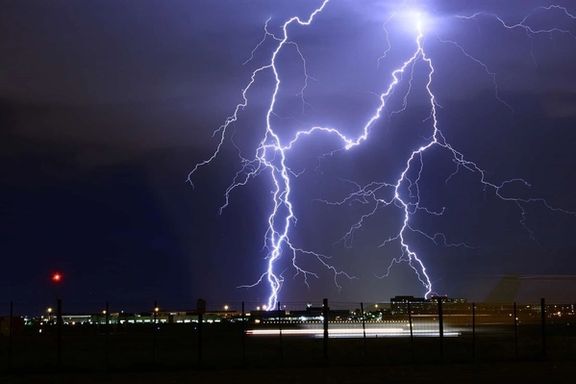
Severe weather events, including strong winds and lightning, have resulted in the deaths of nine people and injuries to 86 others across Iran over the past week, the national emergency services said on Tuesday.
Babak Yektaparast, a spokesperson for the country's emergency services, told Tasnim news agency that the casualties occurred between April 27th and May 5th. He specified that four deaths were due to strong winds and falling objects, while five people were killed by lightning strikes.
Iranian authorities have ordered the closure of the country's sole national Water Museum to accommodate the relocation of the Quran Museum, a move that has sparked strong criticism from museum experts and staff, according to an Iranian daily.
The report in Payam-e Ma said that the decision, approved by President Masoud Pezeshkian, directs the Water Museum in Tehran’s historic Sa’dabad Palace complex to vacate its building so that the National Quran Museum—currently located in central Tehran—can be moved in.
The order came without public notice and was issued after the Iranian New Year holidays in early April, according to the report.
Museum workers were caught off guard as government officials suddenly removed signage and sealed the building.
Shahrokh Karimi, head of the National Water Treasure Institute that manages the museum, told the paper: “We worked hard for 30 years. It is heartbreaking to see it dismantled overnight.”
He warned that the move would erase a rare cultural institution dedicated to Iran’s water engineering and environmental heritage.
The Water Museum, established in 1996 through a government partnership between Iran’s energy ministry and cultural heritage authorities, showcased ancient irrigation techniques, historical engineering documents, and educational displays.
It has been part of a broader effort to preserve the country’s “water memory” amid growing environmental concerns.
Ahmad Mohit-Tabatabai, head of the International Council of Museums (ICOM) in Iran, criticized the relocation.
“Closing or moving a national museum is among the worst things that can happen in museology,” he said, warning that the Quran Museum’s needs are not compatible with the Water Museum’s small facilities.
In recent years, Iran has been selling off ancient heritage sites amid the country's financial crisis with historians accusing the government of abandoning the country's rich history.
Last year there was public outcry when the government announced the construction of mosques in public parks, as the Islamic Republic's agenda is seen as eroding the country's environmental heritage.
Iranian officials are sounding alarms over a deepening water crisis that has already affected nearly four dozen major dams, threatened electricity production, and forced Tehran into rolling blackouts.
Somayeh Rafiei, the head of the environment faction in Iran’s Parliament, warned on Tuesday that “the water situation in 44 of the country’s dams is critical,” adding that this has directly impacted hydroelectric power generation, putting spring and summer electricity supply under serious strain.
According to Rafiei, water inflow to dam reservoirs from the beginning of the current hydrological year (which began in September) has dropped by 37% compared to the same period last year. The total volume of water in reservoirs is also down 18% from a year ago and 15% below the five-year average.
“The situation of five dams in Tehran province is especially alarming,” Rafiei said. “Only 24% of their capacity is filled, and upstream snow reserves – a crucial source for replenishment – have declined between 47% and 54% year-on-year.”
She also raised concerns over the Urmia Lake basin in northwestern Iran, where dam fill levels have declined 36% from last year. “We are looking at hard days ahead for Lake Urmia,” she warned.
A view from Lake Urmia
The crisis is exacerbated by climate change, mismanagement in agriculture, outdated irrigation techniques, and a failure to invest in water recycling or secure regional water diplomacy, Rafiei said.
She painted a dire picture of groundwater depletion, noting that 30 of Iran’s 31 provinces are experiencing land subsidence due to unchecked groundwater extraction. “This is a systemic failure of regulation,” she said.
Rafiei also pointed to environmental degradation, saying that 66% of the country’s wetlands have dried up and become new sources of dust storms.
The hydropower sector is reeling, with over 12,500 megawatts of capacity affected. “As temperatures rise, electricity production becomes increasingly unstable due to the country’s energy imbalance and lack of investment in renewable infrastructure,” she said. “There is no solution right now except widespread compliance with consumption guidelines.”
Rafiei said the situation requires the Ministry of Energy and provincial governors to immediately implement real-time monitoring across all public institutions and government-affiliated companies, including mandatory installation of smart meters and online tracking systems.
“We cannot demand conservation from ordinary citizens while leaving high-consumption government bodies unchecked,” she said.
Blackouts return to Tehran
The capital began scheduled power outages again this week, according to a notice issued by the Tehran Electricity Distribution Company, following unannounced outages in neighboring towns.
The return of outages coincides with a heatwave that has sharply driven up water usage.
Energy Minister Abbas Aliabadi confirmed that annual renewable water resources have dropped by 37%, from 103 billion to 66 billion cubic meters – a drastic fall from the historical high of 130 billion.
Speaking at a national meeting with water and wastewater officials, Aliabadi said: “We are facing a global water crisis. The Middle East is at its epicenter, and Iran’s situation is increasingly concerning.”
He warned that rising urban populations in Tehran and other large cities are intensifying pressure on water supplies, and stressed the need for urgent investments in water recycling and desalination technologies.
“In many cities, treated drinking water is still used for irrigating green spaces. That is no longer acceptable,” he said.
Aliabadi cited a 7°C increase in Iran’s average temperature over the past two years – a result of a 4.5°C rise this year on top of 2.5°C last year. This spike has further fueled water consumption, particularly through evaporative coolers.
Meanwhile, many of Iran’s authorized wells have dried up, including those with depths of as much as 150 meters.
“Water is an intergenerational asset, and its management demands strategic decisions,” Aliabadi said.
A hard water year ahead
Deputy Energy Minister Mohammad Javanbakht echoed the warnings, saying: “After years of consecutive droughts, this will be one of the toughest years for Iran’s water sector.”
He cited over 40% drought conditions nationwide, declining reservoir levels, and the drying of key water bodies, including many reservoirs at or below critical thresholds.
“The drinking water situation in cities like Tehran is already difficult, and agricultural restrictions may spark social tensions,” he warned.
While acknowledging some prior attempts at groundwater rebalancing and drought adaptation, Javanbakht admitted the measures had limited impact.
Javanbakht also highlighted the economic strain on the water sector. “There are nearly 5,670 water projects across the country, and securing funds for them in the current economic climate is incredibly challenging,” he said.
He called for tariff reforms, public education, and stronger integration of social and environmental concerns into water infrastructure planning.
Tehran’s water use surges
Recent data from the Tehran Water and Wastewater Company shows a worrying trend with the capital experiencing one of its driest years in recent decades, annual rainfall now below 140 millimeters.
Despite this, water consumption surged past 3.1 million cubic meters per day in early May – largely attributed to the use of swamp coolers, which consume up to 30 liters of water per hour per unit.
Officials have called on citizens to reduce their cooling system usage and improve efficiency, including installing shades and conducting regular maintenance.
Water authorities have threatened punitive measures will follow what they consider to be overuse, warning that persistent heavy users may even face 12-hour service cuts.
As Iran braces for a long, hot summer, officials agree: behavioral change is not optional.
“Without a significant shift in how we consume and manage water, this crisis will only deepen,” Minister Aliabadi warned.
Turkey's state-owned Halkbank has asked the US Supreme Court to review a lower court decision that allows it to be prosecuted for allegedly helping Iran evade American sanctions, a lawyer for the bank said on Monday.
The Supreme Court had set a Monday deadline for Halkbank to file a petition appealing the October 2024 ruling by the 2nd US Circuit Court of Appeals in Manhattan, which cleared the way for the prosecution.
In a letter to the appeals court, Halkbank's lawyer Robert Cary confirmed the petition had been filed, though it was not immediately available on the Supreme Court's website.
Halkbank has pleaded not guilty to charges of fraud, money laundering, and conspiracy, accused of using money servicers and front companies in Iran, Turkey, and the United Arab Emirates to circumvent US sanctions.
US prosecutors allege that Halkbank facilitated the secret transfer of $20 billion in restricted Iranian funds, converted oil revenue into gold and cash for Iranian interests, and fabricated documentation for food shipments to justify oil proceeds transfers.
The case, initiated in 2019, has strained relations between the US and Turkey, with Turkish President Tayyip Erdogan denouncing it as an "unlawful, ugly" step.
However, both Erdogan and US President Donald Trump reported a productive phone call on Monday, with mutual invitations to visit their respective countries.
It is Halkbank's second appeal to the Supreme Court. In 2023, the court ruled that while the Foreign Sovereign Immunities Act of 1976 shields foreign countries from civil liability, it does not extend to criminal cases.
The Supreme Court then instructed the 2nd Circuit to further examine whether common law immunity protected Halkbank, leading to the October ruling that the bank could be prosecuted.
Trump maintains his so-called maximum pressure campaign against Iran, threatening secondary sanctions and targeting those aiding sanctions evasion, while indirect nuclear talks between the US and Iran continue.
Iran’s escalating water crisis is not only draining its aquifers but also laying the groundwork for potentially devastating earthquakes, a leading geology expert warns.
Mehdi Zare says human responses to prolonged drought—particularly rampant groundwater extraction—are altering underground stresses and could trigger seismic activity in cities like Tehran, Isfahan, and Mashhad.
“Droughts can indirectly influence seismicity through human activities, particularly over-extraction of groundwater, which alters subsurface conditions,” Zare wrote on Rokna news Saturday.
These shifts may activate critically stressed faults, he added, especially in tectonically sensitive regions.
As aquifers are depleted, the earth’s crust begins to rebound, redistributing pressure and modifying fault dynamics. This process, compounded by reductions in pore pressure, brings fault lines closer to rupture.
In some areas of Tehran, groundwater levels are falling by up to two meters a year. Land subsidence has reached 31 centimeters annually in parts of southwest Tehran, according to government data released in March.
The 2017 Malard earthquake near Tehran, which measured magnitude 5.0, occurred near one such subsiding zone. Zare notes that similar patterns have been observed in California, India, and Spain, where changes in groundwater levels preceded swarms of small but revealing earthquakes.
Ali Beitollahi, head of earthquake engineering at Iran’s Ministry of Housing research center, warned of a destructive cycle. “Population grows, water becomes scarce, more dams and wells are built—and so we drill again,” he said.
He criticized the government’s approach, which focuses on securing more water rather than managing demand. “We are now hearing plans to drill deep wells in Tehran this summer,” Beitollahi said. “Our mismanagement is taking us to a dangerous place.”
Iran’s water reserves have fallen to critical levels, accelerating the risk of shortages and forcing officials to consider rationing months before peak summer demand.
Tehran's water supply is critically strained as key dams plummet to record lows, worsening a nationwide drought. Latian and Mamlou dams are at 12% capacity, Lar at 1%, and Karaj at 7%.
Nationwide rainfall is 82.9% of normal, and dam inflow is only 42%. Officials urge a 20% reduction in water use, as 19 provinces face water stress.
With 40 percent of Tehran’s aquifer already depleted and critical urban centers still expanding, experts say the time to act is rapidly closing. Without structural water governance reform and population redistribution, Iran risks turning drought into disaster—both above ground and below.
Iran’s currency fell sharply on Saturday after a planned fourth round of indirect talks with the United States was postponed, as sharp disagreements over uranium enrichment and inspections cast doubt on prospects for a breakthrough.
The rial dropped past 870,000 to the US dollar in Tehran’s open market, reversing gains made earlier last month during previous rounds of diplomacy in Oman. The currency had recovered to around 795,000 following the third round but slid again amid rising uncertainty.
US Secretary of State Marco Rubio said Thursday that Iran must end all uranium enrichment and open all nuclear facilities, including military sites, to American inspectors if it wants to avoid “serious consequences, including potential military action.”
“There’s no reason for enrichment unless you want a weapon,” Rubio told Fox News, adding that Iran must also abandon support for proxy groups and halt long-range missile development.
Iranian Foreign Minister Abbas Araghchi on Friday dismissed Rubio’s demands, warning that such “maximalist positioning and incendiary rhetoric achieve nothing except eroding the chances of success.” He said Iran has “every right to possess the full nuclear fuel cycle as a founding signatory to the NPT.”
“A credible and durable agreement is within reach,” Araghchi said. “All it takes is firm political will and a fair attitude.”
The International Atomic Energy Agency (IAEA) has confirmed Iran is the only non-nuclear-armed country enriching uranium to 60%.
No official reason has been given for the postponement of this weekend’s round. Iranian officials have acknowledged lingering disagreements over both general principles and technical details.
The rial had plunged to a record low of around 1,058,000 per dollar in early April before stabilizing during earlier rounds of talks.