Turkish bank takes Iran sanctions case to US Supreme Court
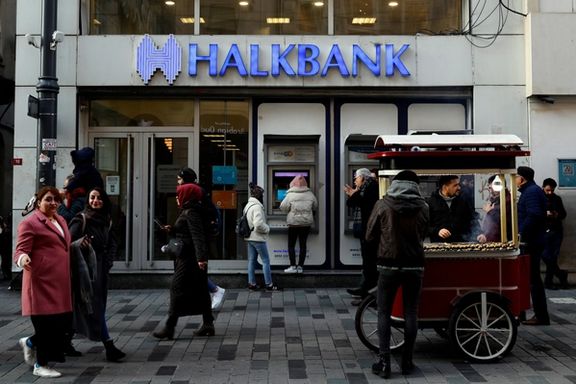
People walk past a branch of Halkbank in central Istanbul, Turkey, January 22, 2020.
Turkey's state-owned Halkbank has asked the US Supreme Court to review a lower court decision that allows it to be prosecuted for allegedly helping Iran evade American sanctions, a lawyer for the bank said on Monday.
The Supreme Court had set a Monday deadline for Halkbank to file a petition appealing the October 2024 ruling by the 2nd US Circuit Court of Appeals in Manhattan, which cleared the way for the prosecution.
In a letter to the appeals court, Halkbank's lawyer Robert Cary confirmed the petition had been filed, though it was not immediately available on the Supreme Court's website.
Halkbank has pleaded not guilty to charges of fraud, money laundering, and conspiracy, accused of using money servicers and front companies in Iran, Turkey, and the United Arab Emirates to circumvent US sanctions.
US prosecutors allege that Halkbank facilitated the secret transfer of $20 billion in restricted Iranian funds, converted oil revenue into gold and cash for Iranian interests, and fabricated documentation for food shipments to justify oil proceeds transfers.
The case, initiated in 2019, has strained relations between the US and Turkey, with Turkish President Tayyip Erdogan denouncing it as an "unlawful, ugly" step.
However, both Erdogan and US President Donald Trump reported a productive phone call on Monday, with mutual invitations to visit their respective countries.
It is Halkbank's second appeal to the Supreme Court. In 2023, the court ruled that while the Foreign Sovereign Immunities Act of 1976 shields foreign countries from civil liability, it does not extend to criminal cases.
The Supreme Court then instructed the 2nd Circuit to further examine whether common law immunity protected Halkbank, leading to the October ruling that the bank could be prosecuted.
Trump maintains his so-called maximum pressure campaign against Iran, threatening secondary sanctions and targeting those aiding sanctions evasion, while indirect nuclear talks between the US and Iran continue.
Iranian methanol exports to China could come under US scrutiny after Washington warned of secondary sanctions on Iranian oil and petrochemicals buyers while nuclear talks continue, Bloomberg reported on Tuesday.
About 40% of China’s methanol imports — some 5.2 million tons in 2024 — came from Iran, data from shipping analytics firm Kpler shows.
Methanol, used to produce plastics, is a key feedstock for China’s methanol-to-olefin (MTO) plants, which are major buyers of Iranian cargoes, according to ICIS, a global market intelligence firm.
"Iranian methanol is almost the only efficient way for coastal MTO units to get enough supply," said Ann Sun, senior analyst at ICIS.
US President Donald Trump last week said countries or firms that buy Iranian oil or petrochemicals could face immediate sanctions. The US has already targeted Iranian energy exports and Chinese refineries allegedly involved in such trade.
Although some Iranian methanol reaches China via third countries like the UAE or Oman, further sanctions could disrupt flows.
The latest move by Trump comes as he is squeezing Iran amid ongoing indirect nuclear talks between the US and Iran. They have now passed the third stage and are awaiting the fourth round in Oman.
Iran says that lifting sanctions is a priority in the nuclear talks.
Iran’s Foreign Minister Abbas Araghchi is set to visit New Delhi on Thursday amid rising tensions between India and Pakistan after last month’s attack on tourists in disputed Kashmir.
Araghchi is currently in Pakistan, where he met with his counterpart Ishaq Dar. He is also scheduled to hold talks with President Asif Ali Zardari and Prime Minister Shehbaz Sharif.
Last month, five armed militants attacked tourists in the Baisaran Valley near Pahalgam, in Indian-administered Jammu and Kashmir, killing 26 civilians, including 25 Indian tourists and one local Muslim pony ride operator.
In the aftermath, India accused Pakistan of supporting cross-border terrorism, an allegation Pakistan denied.
Iran offered to mediate between India and Pakistan, though New Delhi has rejected any third-party mediation, according to The Times of India, citing government sources.
The report said that Araghchi’s visit on Thursday was organized before the attack in Kashmir and is focused on co-chairing the Iran-India Joint Commission meeting alongside Indian External Affairs Minister S. Jaishankar.
Discussions are expected to center on trade, energy, and infrastructure cooperation.
American bases and interests will be targeted if a war is imposed on the Islamic Republic, Iran's defense minister warned on Sunday, after unveiling a new solid-fuel ballistic missile named Qassem Bassir.
"The Islamic Republic has never initiated a war in recent years and will not initiate any war in the future either, but if we are attacked or war is imposed on us, we will respond with strength," Defense Minister Aziz Nassirzadeh told the state TV when asked about US threats to attack Iran.
"If this war is initiated by the United States or Israel, the Islamic Republic will attack their interests, bases, and forces wherever they may be and whenever it deems necessary."
"We have no hostility toward neighboring countries—they are our brothers—but US bases are our targets," he said, referring to American bases in Arab countries neighboring Iran.
He also threatened to "employ weapons that have not been used until now" if a war is imposed on Iran.
The defense minister's remarks came after he unveiled Qassem Bassir, an upgraded ballistic missile that has a range of 1,200 km.
Nassirzadeh said the new missile can "easily overcome THAAD and Patriot missile defense systems thanks to its upgraded maneuverability.
He said the missile was upgraded after Israel intercepted Iranian ballistic missiles during the April and October 2024 attacks.
With the new upgrade, he said, Israel won't be able to intercept more than five missiles in 200.
Nassirzadeh said the latest upgraded missile has been added to all Iranian underground missile bases.
Police officers stand outside New Scotland Yard, the headquarters of the Metropolitan Police, in London, Britain March 21, 2023.
British counter-terrorism police have arrested seven Iranian nationals in two separate investigations, one of which involved an alleged plot to carry out a terrorist act targeting a specific location in England.
The first operation on Saturday led to the arrest of five men—aged between 29 and 46— in coordinated raids across Swindon, west London, Stockport, Rochdale, and Manchester, according to the Metropolitan Police.
Four of the men were identified as Iranian nationals and detained under the Terrorism Act of 2006. A fifth man, whose nationality was not disclosed, was arrested under the Police and Criminal Evidence Act. All remain in custody as searches continue at multiple addresses across England.
“We are working closely with those at the affected site to keep them updated. We are exploring various lines of enquiry to establish any potential motivation as well as to identify whether there may be any further risk to the public,” said Commander Dominic Murphy, head of the Met’s Counter Terrorism Command.
Officials have not disclosed the nature of the suspected target or whether any weapons or materials were seized, citing operational sensitivity.
In a separate investigation, police arrested three more Iranian nationals in London on the same day as part of a counter terror investigation. The men were detained under Section 27 of the National Security Act 2023, which authorizes arrests based on suspected “foreign power threat activity.”
The two operations were not connected to each other, police said.
In October, MI5 Director General Ken McCallum said authorities had disrupted 20 “potentially deadly” plots tied to Tehran since January 2022.
“Iranian state actors make extensive use of criminals as proxies—from international drug traffickers to low-level crooks,” McCallum said in a public statement.
Iran’s escalating water crisis is not only draining its aquifers but also laying the groundwork for potentially devastating earthquakes, a leading geology expert warns.
Mehdi Zare says human responses to prolonged drought—particularly rampant groundwater extraction—are altering underground stresses and could trigger seismic activity in cities like Tehran, Isfahan, and Mashhad.
“Droughts can indirectly influence seismicity through human activities, particularly over-extraction of groundwater, which alters subsurface conditions,” Zare wrote on Rokna news Saturday.
These shifts may activate critically stressed faults, he added, especially in tectonically sensitive regions.
As aquifers are depleted, the earth’s crust begins to rebound, redistributing pressure and modifying fault dynamics. This process, compounded by reductions in pore pressure, brings fault lines closer to rupture.
In some areas of Tehran, groundwater levels are falling by up to two meters a year. Land subsidence has reached 31 centimeters annually in parts of southwest Tehran, according to government data released in March.
The 2017 Malard earthquake near Tehran, which measured magnitude 5.0, occurred near one such subsiding zone. Zare notes that similar patterns have been observed in California, India, and Spain, where changes in groundwater levels preceded swarms of small but revealing earthquakes.
Ali Beitollahi, head of earthquake engineering at Iran’s Ministry of Housing research center, warned of a destructive cycle. “Population grows, water becomes scarce, more dams and wells are built—and so we drill again,” he said.
He criticized the government’s approach, which focuses on securing more water rather than managing demand. “We are now hearing plans to drill deep wells in Tehran this summer,” Beitollahi said. “Our mismanagement is taking us to a dangerous place.”
Iran’s water reserves have fallen to critical levels, accelerating the risk of shortages and forcing officials to consider rationing months before peak summer demand.
Tehran's water supply is critically strained as key dams plummet to record lows, worsening a nationwide drought. Latian and Mamlou dams are at 12% capacity, Lar at 1%, and Karaj at 7%.
Nationwide rainfall is 82.9% of normal, and dam inflow is only 42%. Officials urge a 20% reduction in water use, as 19 provinces face water stress.
With 40 percent of Tehran’s aquifer already depleted and critical urban centers still expanding, experts say the time to act is rapidly closing. Without structural water governance reform and population redistribution, Iran risks turning drought into disaster—both above ground and below.