Khamenei renews call for Muslim unity against US, Israel
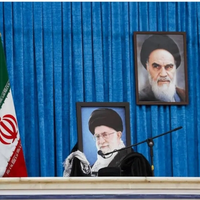
Iran’s Supreme Leader Ali Khamenei during a meeting with Iranian Hajj officials in Tehran on May 4, 2025
Iran’s Supreme Leader has said the Islamic pilgrimage of Hajj is a fundamentally political act and urged Muslim nations to unite against the United States and Israel, in remarks likely to revive tensions with Saudi Arabia ahead of the annual pilgrimage season.
“Hajj is a duty whose very structure is political,” Ali Khamenei said during a meeting with Hajj officials in Tehran. “It brings people together at a specific time and place, and this gathering has an inherently political nature.”
He added that the pilgrimage should serve the interests of Muslims, with the greatest benefit being unity among Islamic nations. “If Muslims were united, Gaza and Palestine would not suffer like this.”
While calling for Muslim solidarity, Khamenei implicitly warned Riyadh against rapprochement with Israel, saying that cooperation with Washington and Tel Aviv amounted to “oppression.”
His remarks follow reports of renewed Saudi-Israeli contacts brokered by US officials following the Gaza war.
The speech comes just weeks after Khamenei told visiting Saudi Defense Minister Prince Khalid bin Salman that closer ties between Iran and Saudi Arabia would be mutually beneficial and should overcome hostile interference.
However, the tone of his latest address contrasts with that message, returning to the combative rhetoric that has historically strained Iran-Saudi ties—especially over the politicization of Hajj.
Saudi Arabia has repeatedly warned against using the pilgrimage for sectarian or political activity, implementing strict rules to prevent disruptions.
Since the Gaza war, multiple pilgrims wearing the Palestinian flag have been removed from the holy site.
According to regulations released by the Saudi Ministry of Hajj and Umrah in August, pilgrims are forbidden from bringing any prohibited items, such as pictures, books, flags, slogans, political publications, or other banned materials, into Saudi Arabia, according to the Saudi Gazette.
The kingdom’s 1987 clash with Iranian demonstrators during Hajj led to hundreds of deaths and a long diplomatic rift, which only began to heal with a China-brokered rapprochement in 2023.
Iranian President Masoud Pezeshkian on Sunday voiced concern over the country’s brain drain, calling for a cultural shift that encourages youth to invest their talents in developing Iran rather than seeking opportunities abroad.
“We are raising children whose minds are set on leaving the country,” Pezeshkian said in a public address. “We must raise children whose thoughts are rooted in their land and who devote their efforts to building this nation.”
“The goal is not to hand our science and art to the Americans,” he added. “True achievement is when this knowledge serves our own country.”
Iran is grappling with a growing exodus of professionals and students, particularly from the medical sector, amid mounting economic hardship.
Authorities have recently empowered the passport and immigration police to monitor elite migration in coordination with the National Elites Foundation, which operates under the presidency.
A 19-year-old man was killed after being shot twice in the head by police during a confrontation at a beach in northern Iran, the Norway-based Hengaw rights group reported.
Sahel Nasiri and his friend Benyamin Gholami were approached by police for a body search and an attempt to confiscate their motorcycle on Friday evening at Zibakenar Beach in Iran’s Gilan province, Hengaw’s report said, according to local sources.
When Nasiri resisted and tried to mount the vehicle, officers shot him twice in the head at close range, killing him.
Nasiri’s body was transferred to the local police station that night, and his friend Gholami was taken into custody, the report said.
Gilan province police said Nasiri and another motorcyclist had been carrying crystal meth, marijuana, and hashish. They said he tried to disarm officers and was “neutralized” after a warning shot failed to stop him.
Nasiri’s death triggered protests by residents of Zibakenar, who set fire to banners on the local police station, according to Hengaw.
The rights group said the demonstrations ended after security forces stormed the area and clashed with protesters.
Nasiri’s body was handed over to his family following hours of protests and threats from authorities and was buried in his hometown on Saturday, the group added.
Police officers stand outside New Scotland Yard, the headquarters of the Metropolitan Police, in London, Britain March 21, 2023.
British counter-terrorism police have arrested seven Iranian nationals in two separate investigations, one of which involved an alleged plot to carry out a terrorist act targeting a specific location in England.
The first operation on Saturday led to the arrest of five men—aged between 29 and 46— in coordinated raids across Swindon, west London, Stockport, Rochdale, and Manchester, according to the Metropolitan Police.
Four of the men were identified as Iranian nationals and detained under the Terrorism Act of 2006. A fifth man, whose nationality was not disclosed, was arrested under the Police and Criminal Evidence Act. All remain in custody as searches continue at multiple addresses across England.
“We are working closely with those at the affected site to keep them updated. We are exploring various lines of enquiry to establish any potential motivation as well as to identify whether there may be any further risk to the public,” said Commander Dominic Murphy, head of the Met’s Counter Terrorism Command.
Officials have not disclosed the nature of the suspected target or whether any weapons or materials were seized, citing operational sensitivity.
In a separate investigation, police arrested three more Iranian nationals in London on the same day as part of a counter terror investigation. The men were detained under Section 27 of the National Security Act 2023, which authorizes arrests based on suspected “foreign power threat activity.”
The two operations were not connected to each other, police said.
In October, MI5 Director General Ken McCallum said authorities had disrupted 20 “potentially deadly” plots tied to Tehran since January 2022.
“Iranian state actors make extensive use of criminals as proxies—from international drug traffickers to low-level crooks,” McCallum said in a public statement.
A series of incidents unfolded in Alborz Province, west of Tehran, on Saturday evening, including two fires, reports of an explosion, and a magnitude 4.0 earthquake, according to official statements and eyewitness accounts.
One major blaze broke out at a cardboard manufacturing factory in the city of Nazarabad.
Stormy weather in the area caused the fire to spread to 12 nearby units, a local governor said, adding that efforts are underway to bring the blaze under control.
The cause of the fire is not yet known, and there have been no reports of casualties.
Around the same time, another fire was reported near the Montazer Ghaem power plant in the city of Fardis.
The state-run YJC news agency initially released a video that purportedly showed no fire at the facility.
However, Iranian officials later confirmed the report. Hossein Ashouri, head of the Fardis fire department, said the fire began around 8:41 p.m. in a portable cabin next to a waste platform near the power station.
Strong winds caused the flames to spread over approximately 2,000 square meters. Nine additional fire trucks were deployed, and the blaze was brought under control.
Preliminary findings suggest the fire was caused by negligence on the part of the person stationed in the cabin.
Reports of explosion
Iranian officials have denied any link between the fire and the power plant's operation. However, widespread power outages were reported in several areas of the province.
Residents across Alborz Province told Iran International they heard an explosion shortly before 9 p.m., moments before experiencing an earthquake.
Iran’s Seismological Center confirmed that the 4.0-magnitude quake struck at a depth of 8 kilometers near Mahdasht, on the border of Alborz and Tehran provinces.
Iran’s escalating water crisis is not only draining its aquifers but also laying the groundwork for potentially devastating earthquakes, a leading geology expert warns.
Mehdi Zare says human responses to prolonged drought—particularly rampant groundwater extraction—are altering underground stresses and could trigger seismic activity in cities like Tehran, Isfahan, and Mashhad.
“Droughts can indirectly influence seismicity through human activities, particularly over-extraction of groundwater, which alters subsurface conditions,” Zare wrote on Rokna news Saturday.
These shifts may activate critically stressed faults, he added, especially in tectonically sensitive regions.
As aquifers are depleted, the earth’s crust begins to rebound, redistributing pressure and modifying fault dynamics. This process, compounded by reductions in pore pressure, brings fault lines closer to rupture.
In some areas of Tehran, groundwater levels are falling by up to two meters a year. Land subsidence has reached 31 centimeters annually in parts of southwest Tehran, according to government data released in March.
The 2017 Malard earthquake near Tehran, which measured magnitude 5.0, occurred near one such subsiding zone. Zare notes that similar patterns have been observed in California, India, and Spain, where changes in groundwater levels preceded swarms of small but revealing earthquakes.
Ali Beitollahi, head of earthquake engineering at Iran’s Ministry of Housing research center, warned of a destructive cycle. “Population grows, water becomes scarce, more dams and wells are built—and so we drill again,” he said.
He criticized the government’s approach, which focuses on securing more water rather than managing demand. “We are now hearing plans to drill deep wells in Tehran this summer,” Beitollahi said. “Our mismanagement is taking us to a dangerous place.”
Iran’s water reserves have fallen to critical levels, accelerating the risk of shortages and forcing officials to consider rationing months before peak summer demand.
Tehran's water supply is critically strained as key dams plummet to record lows, worsening a nationwide drought. Latian and Mamlou dams are at 12% capacity, Lar at 1%, and Karaj at 7%.
Nationwide rainfall is 82.9% of normal, and dam inflow is only 42%. Officials urge a 20% reduction in water use, as 19 provinces face water stress.
With 40 percent of Tehran’s aquifer already depleted and critical urban centers still expanding, experts say the time to act is rapidly closing. Without structural water governance reform and population redistribution, Iran risks turning drought into disaster—both above ground and below.