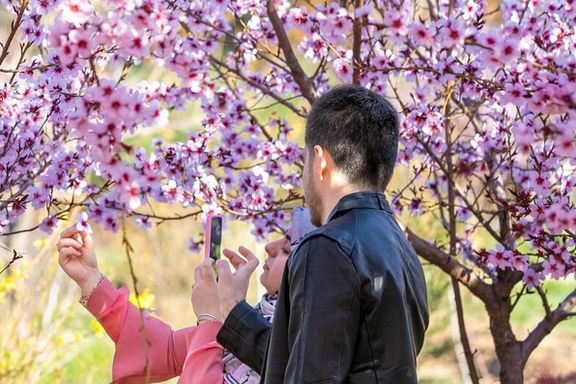
A couple take pictures with blossoms, Tehran, Iran, April 2025
I’ve grown the habit of checking the dollar exchange rate every few hours, even though I sold all that I had a few months ago—or perhaps because I sold all that I had a few months ago.
Late last year, when I did that, the dollar was 68,000 tomans. Two weeks ago, it hit an all-time high of 102,000. Then it started dropping sharply when Tehran and Washington began negotiating.
It’s now an almost masochistic exercise, calculating how much my partner and I could have gained had I waited a little bit longer.
Over the last six-seven years, we converted whatever we had and could save into dollars. It stood at around $20,000 in the fall of 2024.
We kept the cash at home, living in constant fear of a break-in. But we didn’t trust the banks either. People’s foreign currency deposits were once forcibly converted to rials during a currency collapse in the early 2010s. Public trust was shattered.
Our savings weren’t enough to buy a home in Tehran. Renting here, with inflation this brutal, is terrifying. Prices climb relentlessly. Our income doesn’t. Half of what we earn goes straight to rent.
Then the war drums began to beat louder. The Israeli-Iranian cold war heated up with missile attacks and airstrikes. War felt closer than ever. We went to bed each night bracing for the worst.
That’s when we made our decision: we’d buy a home outside Tehran—somewhere to safeguard our money, and ourselves, if war came. A property in the capital was out of reach anyway. A small 600 sq ft apartment in a modest neighborhood would cost about 5 billion tomans. We had less than two.
Even ChatGPT approved our thinking.
“If you're buying as a refuge, stay away from military centers and major cities, and prepare for wartime shortages,” it said.
We found an old 2000 sq ft house in a small town in Iran’s northern province of Gilan, far from military sites and with clean air. We sold our dollars overnight, sold the little jewelry that we had, and borrowed 600 million tomans to close the deal at 2.5 billion.
We couldn’t move. We’re both job-bound to Tehran. But now we had a place to escape to. A safe investment. A backup life.
Almost immediately, as if waiting for us to get rid of our assets, the dollar and gold surged. We couldn’t help calculating what we’d lost. It was dreadful. And all the more so because we had been advised against it by our family. “Why sell when the dollar is rising?” they said.
The stress and the anxiety boiled over into a fight. My partner kept saying “I told you so.” He hadn’t. Eventually, we decided and promised not to revisit the issue, but privately, we both still do. We check the rates. We run the numbers in our heads.
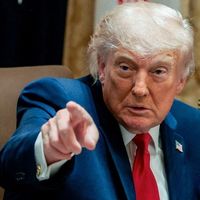
Since these US-Iran talks began, I’ve been torn. A deal with Donald Trump could bring much-needed cash to the government’s coffers. Would it ease the people’s hardship? Most likely not. It would only benefit Iran’s bloated IRGC-led oligarchy and its loyal forces inside and abroad.
Still—for now at least—the threat of war feels more distant. That offers a fragile peace of mind.
But Many are not even torn. In a recent poll on Telegram, seven in ten of over 5,000 participants said they’d rather the deal fell apart and the Islamic Republic was attacked. I can’t say this reflects society as a whole, but I know more than a few who oppose a deal because they believe it prolongs the theocratic rule in Iran.
Even the dip in the exchange rate hasn’t brought joy. Prices haven’t dropped. Inflation hasn’t eased. And the rule still holds: we earn in rials, we spend in dollars.
For me, personally, the falling dollar has brought a strange feeling of comfort. It makes the choice we made feel a little less like a loss.
Workers during operations at Iran’s South Pars field
Iran hopes to revive offshore oil and gas exploration after a six-year hiatus as regional rivals Saudi Arabia and the United Arab Emirates have made significant recent discoveries and deals on their own patches.
The director of exploration at the National Iranian Oil Company said earlier this month that offshore oil and gas exploration in Iranian waters will resume after a six-year halt.
"For the first time in five years, we’ve signed a contract for an offshore exploration rig," Mohiyeddin Jafari said, according to the oil ministry's news website Shana. "We hope to begin operations in shared maritime border zones by 2025."
Jafari cited a “shortage of rigs” as the reason for the suspension of offshore oil and gas exploration.
However, reports from OPEC and Iran’s Ministry of Petroleum indicate that the number of drilling rigs in the country has remained stable over the past years, hovering around 160 units, with about 20 of them dedicated to offshore drilling.
Nonetheless, it remains unclear how many of Iran’s drilling rigs—most of which were built by Western companies decades ago—are still operational. In 2020, Reuters reported that Iran was struggling to obtain spare parts for Western-made rigs, and that a quarter of its drilling platforms were out of service, with many others operating only partially.
That same year, the state-run IRNA news agency quoted oil officials as saying that 85% of Iranian rigs required repairs and parts replacement.
Another major challenge for Iran is the lack of financial resources. The Iranian Parliament’s Research Center previously reported that annual investment in the country’s upstream oil and gas sector (exploration and production) has halved following US sanctions imposed in 2018, dropping to around $3 billion, compared to the previous years.
For comparison on a larger scale, annual investment was around $19 billion in the 2000s during the peak of Western companies’ involvement in Iran’s oil and gas projects.
Exploration and drilling costs are significantly higher offshore than onshore and given the government's financial constraints, developing offshore fields has not been a priority.
Belal joint oil field in southern Iran
Caspian Sea Iran is the only Caspian littoral state with no offshore oil or gas production, and Iran’s only seismic vessel in the Caspian Sea, named Pajvak, was destroyed in a fire in 2005.
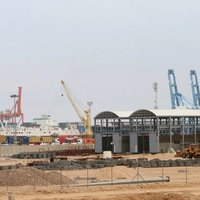
The country’s only offshore drilling platform in the Caspian, named Amirkabir, was moved to Iran’s Caspian coast a decade ago for maintenance and remains inactive, just a few kilometers from shore. As such, the discovery of new gas fields in the Caspian waters appears impossible for Iran.
Ilham Shaban, head of the Caspian Oil Studies Center in Azerbaijan, told Iran International that last year Azerbaijan produced 580,000 barrels per day (bpd), Kazakhstan 350,000 bpd, Turkmenistan and Russia both than 100,000 bpd from their respective offshore Caspian fields.
Azerbaijan also produced around 50 billion cubic meters of gas from the Caspian Sea, half of which was exported—mainly to Europe. Russia produces annually 1.5 bcm gas from the Caspian fields.
Meanwhile, Arab countries south of Iran have increasingly participated in developing the Caspian offshore projects of the three Turkic states. Over the past two decades, the UAE’s Dragon Oil has invested $10 billion in Turkmenistan’s offshore sector and extended its investment agreement until 2035.
In 2023, Abu Dhabi National Oil Company (ADNOC) purchased a 30% stake in the Absheron gas field—Caspian’s second-largest offshore gas field—in Azerbaijani waters, becoming a partner with France’s TotalEnergies in the project.
Just last month, Kazakhstan’s national oil company KazMunayGas officially invited ADNOC to invest in its offshore fields.
Southern waters of Iran
Unlike the Caspian Sea, where Iran has no joint fields with neighbors, all of Iran’s southern neighbors share offshore oil and gas fields with Iran. Not only do they produce several times more than Iran, but they are also rapidly developing these joint projects.
Iran currently extracts only 35,000 bpd from the joint Forouzan (Marjan) field with Saudi Arabia. In contrast, Saudi Arabia produces 18 times more than Iran from this field and has signed contracts worth $12 billion with foreign companies to increase daily oil output to 800,000 barrels and gas production to 70 million cubic meters within the next four years.
Another joint field between Iran and Saudi Arabia is Farzad (Hasbah), from which Iran has no production. Saudi Arabia began producing 30 million cubic meters of gas daily from this field in 2013 and plans to increase it to 75 million cubic meters in coming years.
Saudi Arabia and Kuwait also share two other fields with Iran: Esfandiar (Lulu) and Arash (Dorra). They have already developed the former and signed agreements to develop the latter. While Iran claims a share in these fields, both Arab nations have rejected that claim.
Moreover, Saudi Arabia and Kuwait have developed two more shared fields—Khafji and Wafra—with a combined production capacity of 500,000 bpd over the past decade. The mentioned fields are not joint with Iran.
Iran and the United Arab Emirates share the Salman and Nosrat fields. Each country produces around 50,000 bpd from Salman, but the UAE extracts 20 times more than Iran from Nosrat—about 65,000 bpd.
Iran also shares the Hengam field with Oman, with both countries producing around 10,000 bpd each.
However, the most important offshore field for Iran is South Pars—the largest gas field in the world—which it shares with Qatar. Qatar began gas production from the field a decade earlier than Iran and has so far extracted 2.5 times more gas than Iran from what it calls the North Dome.
While the Iranian portion of the field entered its second half of life last year—meaning production will decline by 10 billion cubic meters each year—Qatar has signed $29 billion in new contracts with international companies to boost its gas production from the field by 65% by the end of this decade.
Iran's financial markets reacted with a mix of caution and optimism in the wake of the latest round of nuclear talks with the US in Rome, a stark contrast to the dramatic response witnessed after the first round of negotiations in Muscat.
Both Tehran and Washington described Saturday's Rome talks as constructive, agreeing to resume technical-level discussions in Oman, a key mediator between the two sides, starting Wednesday, ahead of a planned high-level meeting in Muscat next week.
Speaking on Sunday, Iranian government spokeswoman Fatemeh Mohajerani said the ongoing indirect negotiations had been positive. Referring to the crippling sanctions that have paralyzed Iran’s economy, she said that Tehran would welcome any practical initiative aimed at their removal.
Rial strengthens, gold retreats
Amid growing anticipation of a potential breakthrough, the Iranian rial appreciated modestly on Monday, trading at around 830,000 per US dollar on the open market. This follows a rebound from a record low of 1,050,000 in late March and early April, with the rial rising to around 850,000 after the initial talks in Muscat.
However, gold coin prices, a popular hedge against economic uncertainty for Iranian households, fell over the weekend, though the decline was less pronounced compared to the previous week.
Iranian media has reported that unlike the wave of currency selling seen after the Muscat talks—when long lines of sellers formed and exchange rates plummeted—Iranians have responded more cautiously this time, adopting a “wait-and-see” approach to selling their dollar bills and gold coins.
Sohrab Ashrafi, a forex and gold market analyst, told Shargh there is a sense of hope, but not enough confidence to trigger a full market reversal.
Stock market rebounds after months of lull
The Tehran Stock Exchange (TSE) showed greater enthusiasm, with significant gains on Sunday.
The main index, TEDPIX, surged past 3 million points on Saturday and closed at 3,077,925 on Sunday— with a 2.16% increase day on day — marking one of its strongest performances in recent months.
“Continued positive momentum in the talks could sustain this rally,” a commentary in Donya-ye Eghtesad, a leading economic daily, said. “Even in the absence of an immediate agreement, reduced geopolitical tensions alone can buoy market sentiment.”
Public skepticism persists despite market gains
Despite cautious optimism in financial markets, many ordinary Iranians remain skeptical about whether the negotiations will improve their everyday lives.
“There is little hope that prices will fall or living conditions will improve,” said one viewer in a message to Iran International TV. “Even if sanctions are lifted, it will be the children of the elite who benefit, not ordinary people,” he added.
Iran’s economy has been at its worst since the founding of the Islamic Republic in 1979, at least one-third of Iranians now live below the poverty line, and trust in the government is at an all-time low, as was seen in the record low voter turnout to elections last year.
Some other viewers voiced broader discontent with the political system, saying the nuclear talks are more about preserving the government’s grip on power than delivering economic relief.
One citizen said: “The Islamic Republic has ruined the economy. Prices are high, imports are of poor quality, and corruption is rampant,” adding that real change would only come if the Islamic Republic was overthrown.
Iran has indicated a willingness to open its markets to American investors if a nuclear deal is reached, but some experts argue that expecting not only US investment but any significant foreign investment is highly unrealistic.
“Speaking of a trillion-dollar investment from the United States is nothing but a dream and fantasy,” said Ferial Mostofi, head of the Investment Services Center at the Tehran Chamber of Commerce, in an interview with Shargh daily. “How can we expect foreign investors to come to Iran when domestic investors move their capital out of the country?”
In its article titled “Foreign Investment: Mirage or Reality?”, Shargh referred to a claim circulating in Iranian circles that Tehran is seeking an agreement with the United States to guarantee $1 trillion in US investment over twenty years. “This claim means the United States would have to invest $50 billion in Iran annually.”
Shargh also recalled past official claims that China had pledged $400 billion in investments in Iran’s oil, gas, petrochemical, and transport sectors, while Russia’s Gazprom was expected to invest $40 billion in Iran’s gas industry. The article pointed out that none of those promised investments ever materialized.
“[A trillion-dollar US investment] is exactly like the much-discussed $400 billion investment from China [over twenty-five years],” the article said, arguing that China has not—and likely will not—invest such a large sum in Iran due to several factors, including inadequate hard infrastructure in transportation and energy, lack of transparency, and political risks.
Iran is in urgent need of foreign investment to revitalize its aging oil and gas infrastructure and to support other key sectors, including its large but struggling automotive industry.
According to the 2024 report of the UN Trade and Development (UNCTAD), Iran attracted $1.4 billion in foreign direct investment (FDI) in 2023. The meager figures stood at $1.5 billion in 2022 and $1.4 billion in 2021. The highest recorded FDI level was over $5 billion in 2017, following the implementation of the 2015 JCPOA nuclear deal which lifted UN economic sanctions against Iran.
President Masoud Pezeshkian said recently that Supreme Leader Ali Khamenei has no objection to American investment in Iran. Foreign minister Abbas Araghchi, writing in a Washington Post op-ed, put the onus on Washington to allow American companies to access what he described as a “trillion-dollar opportunity” in Iran. Neither Pezeshkian nor Araghchi provided specific details.
The Revolutionary Guards (IRGC) linked Javan newspaper appeared to support the idea of American investment in Iran in an article it published one day before the first round of Tehran-Washington talks in Muscat on April 8. “It is possible that we accept that some American companies have the opportunity to invest or sell their products, if Iran's economic interests are met. If sanctions are lifted, these companies will be eager to invest, and Iran will be unlikely to object.”
While Khamenei has not officially banned American or other foreign investment, he has consistently advocated for stronger economic ties with Eastern countries such as Russia and China, expressing deep mistrust toward the West.
Despite publicly distancing himself from economic policymaking, Khamenei is widely believed to exert substantial control over Iran’s economy through political influence, economic entities under his authority, and the IRGC’s involvement. In one notable instance, he banned imports of South Korean electronics brands LG and Samsung in August 2021 to pressure Seoul over Iran's frozen funds.
A gas production platform in Iran's South Pars field in the Persian Gulf.
Iran needs $200-250 billion dollars in investments to bring stability to its oil and gas sectors, an official in the chamber of commerce said, reiterating previous comments by the oil minister.
Arash Najafi, head of the energy commission at Iran’s Chamber of Commerce told local media, "In recent years, due to sanctions, we have been deprived or had limited access to many of the world’s latest technologies. At present, we need modern technology, up-to-date equipment, and serious investment to tap into the country’s underground resources, increase gas reservoir pressure, and revive oil fields."
While Iran struggles to increase oil production, its gas output is steadily declining due to loss of pressure in its main South Pars gas field in the Persian Gulf. Only multinational Western energy companies have the technology to install very large gas platforms to boost production.
"We need more than $200 to $250 billion in investment to bring the country’s oil and gas sector to a stable state. Investment is essential for energy transmission to refineries and petrochemical plants, as well as for infrastructure and related facilities,” Najafi added.
Iran's oil minister Javad Owji has also said in the past that Iran needs a minimum of $200 billion investment in its energy sector.
Tehran and Washington are currently negotiating over Iran’s nuclear program and other issues with the hope of reaching an agreement that can gradually reduce or eliminate tough US sanctions. Only then Iran can freely export oil and receive the proceeds through normal banking channels. Currently 95% of shipments go to China and it is not clear how much cash Tehran receives.
Najafi expressed hope that if relations improve with the US Iran can benefit in the energy sector. "The United States is currently a leader in the oil sector, and if we engage in economic cooperation with the US and establish an economic corridor between the two countries, we could benefit not only from its technologies but also from its investment to help develop our oil and gas fields.”
He added that Iran could also attract capital from multinational companies and move toward a stable position in the oil and gas sector.
While sovereign wealth funds tied to oil revenues in Iran’s neighboring countries have surpassed $3.6 trillion, a new report by the Iranian Parliament Research Center reveals the extensive depletion and misuse of Iran’s National Development Fund (NDF).
According to data from the Parliament Research Center, between the establishment of the National Development Fund (NDF) in 2011 and March 2024, about 82% of its $161 billion in revenue has been spent. Notably, 88% of the loans disbursed by the fund went to the government and public institutions, including the Islamic Revolutionary Guard Corps (IRGC). In effect, a fund intended as a savings mechanism for oil revenues has instead served as a financial lifeline for inefficient state entities.
Of the $132 billion in loans disbursed over the past 13 years, only $8 billion has been repaid, while $18 billion is past due and classified as non-performing.
The report also reveals that as of March 2024, the fund’s foreign exchange reserves had fallen to just $26.5 billion. After accounting for $6.5 billion in outstanding obligations, only $20 billion remains in accessible assets.
The NDF has yet to release its financial report for the past fiscal year, which ended on March 20, but investigations by Iran International indicate that the government borrowed at least $10 billion from the fund last year. This borrowing occurred either directly through authorization from Supreme Leader Ali Khamenei, or by seizing a portion of the fund’s share from oil export revenues as permitted by the national budget law.
Under the current fiscal year’s budget, the government is also set to borrow at least $9.4 billion out of the fund’s projected $16 billion in oil revenue.
The fund was established 14 years ago to save a portion of Iran’s oil revenues and provide loans to the private sector, replacing the former Foreign Exchange Reserve Account. However, in practice, the government and military forces took control of most of its financial resources. Only $14 billion—less than 10% of the fund’s assets—was allocated to the private sector. Given the extent of corruption and cronyism, it is unlikely that these resources reached the true private sector.
If no further unexpected withdrawals are made by the government this year, the total state debt to the fund, or spent money, will reach $125 billion by the end of the year.
The critical issue is that the Iranian government lacks the financial resources to repay its debts, and the NDF is now attempting to offset part of the government’s liabilities by investing in oil fields and selling crude oil directly. This approach not only contradicts the fund’s original purpose, but it could effectively cut the government off from its own oil export revenues.
In the past few months, the government has projected daily oil exports of 1.5-1.8 million barrels, one-third of which is to be handed over directly to military institutions. If the NDFI also becomes a direct oil exporter, the government’s role in oil exports will be further marginalized.
Situation in Neighboring Countries
While the NDF’s manageable assets have fallen below $20 billion, data from the Global SWF Institute indicates that the total reserves of oil-related sovereign wealth funds in the Persian Gulf countries and Azerbaijan have surpassed $3.6 trillion. In addition to this, these states also possess a similar amount in other sovereign wealth funds.
For example, the United Arab Emirates manages eight sovereign wealth funds with total assets of $2.3 trillion. Among them, only the Abu Dhabi Investment Authority (ADIA) is oil-funded, with more than $1.1 trillion in assets.
Beyond the $6.7 trillion in sovereign wealth fund assets—whether linked to oil or not—public pension funds in these oil-rich neighboring states also hold around $650 billion in capital. In contrast, Iran’s public pension funds have been effectively bankrupt for years, surviving only through annual government budget allocations.
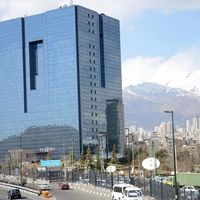
Moreover, the foreign currency reserves of the central banks in the Persian Gulf Arab countries exceed $850 billion, whereas, according to the Global SWF Institute, Iran’s Central Bank holds just $25 billion in reserves—most of which has been lent to the government and domestic banks in the form of loans and credits.
While the National Development Fund accounts for less than 0.5% of the region’s sovereign wealth fund assets, Iran possesses the second-largest oil reserves in the region after Saudi Arabia and ranks first in natural gas reserves.
Iran also has the third-highest oil production in the region after Saudi Arabia and Iraq, and it is the largest producer of natural gas in the Middle East.
Decades of flawed policymaking, rampant corruption, and the plundering of national wealth—combined with the impact of international sanctions—have steadily crippled Iran’s financial institutions.