• العربية
  • فارسی
BrandBrand
  • Iran Insight
  • Politics
  • Economy
  • Analysis
  • Special Report
  • Opinion
  • Podcast
  • Live TV
  • Iran Insight
  • Politics
  • Economy
  • Analysis
  • Special Report
  • Opinion
  • Podcast
  • Live TV
  • Theme
  • Language
    • العربية
    • فارسی
  • Iran Insight
  • Politics
  • Economy
  • Analysis
  • Special Report
  • Opinion
  • Podcast
  • Live TV
All rights reserved for Volant Media UK Limited
volant media logo

Could a US deal bring American investors to Iran?

Maryam Sinaiee
Maryam Sinaiee

Iran International

Apr 18, 2025, 09:31 GMT+1Updated: 08:38 GMT+0

Iran has indicated a willingness to open its markets to American investors if a nuclear deal is reached, but some experts argue that expecting not only US investment but any significant foreign investment is highly unrealistic.

“Speaking of a trillion-dollar investment from the United States is nothing but a dream and fantasy,” said Ferial Mostofi, head of the Investment Services Center at the Tehran Chamber of Commerce, in an interview with Shargh daily. “How can we expect foreign investors to come to Iran when domestic investors move their capital out of the country?”

In its article titled “Foreign Investment: Mirage or Reality?”, Shargh referred to a claim circulating in Iranian circles that Tehran is seeking an agreement with the United States to guarantee $1 trillion in US investment over twenty years. “This claim means the United States would have to invest $50 billion in Iran annually.”

Shargh also recalled past official claims that China had pledged $400 billion in investments in Iran’s oil, gas, petrochemical, and transport sectors, while Russia’s Gazprom was expected to invest $40 billion in Iran’s gas industry. The article pointed out that none of those promised investments ever materialized.

“[A trillion-dollar US investment] is exactly like the much-discussed $400 billion investment from China [over twenty-five years],” the article said, arguing that China has not—and likely will not—invest such a large sum in Iran due to several factors, including inadequate hard infrastructure in transportation and energy, lack of transparency, and political risks.

Iran is in urgent need of foreign investment to revitalize its aging oil and gas infrastructure and to support other key sectors, including its large but struggling automotive industry.

According to the 2024 report of the UN Trade and Development (UNCTAD), Iran attracted $1.4 billion in foreign direct investment (FDI) in 2023. The meager figures stood at $1.5 billion in 2022 and $1.4 billion in 2021. The highest recorded FDI level was over $5 billion in 2017, following the implementation of the 2015 JCPOA nuclear deal which lifted UN economic sanctions against Iran.

President Masoud Pezeshkian said recently that Supreme Leader Ali Khamenei has no objection to American investment in Iran. Foreign minister Abbas Araghchi, writing in a Washington Post op-ed, put the onus on Washington to allow American companies to access what he described as a “trillion-dollar opportunity” in Iran. Neither Pezeshkian nor Araghchi provided specific details.

The Revolutionary Guards (IRGC) linked Javan newspaper appeared to support the idea of American investment in Iran in an article it published one day before the first round of Tehran-Washington talks in Muscat on April 8. “It is possible that we accept that some American companies have the opportunity to invest or sell their products, if Iran's economic interests are met. If sanctions are lifted, these companies will be eager to invest, and Iran will be unlikely to object.”

However, any American investment in Iran would require the removal of at least some of the primary US sanctions, many of which predate the nuclear-related sanctions.

While Khamenei has not officially banned American or other foreign investment, he has consistently advocated for stronger economic ties with Eastern countries such as Russia and China, expressing deep mistrust toward the West.

Despite publicly distancing himself from economic policymaking, Khamenei is widely believed to exert substantial control over Iran’s economy through political influence, economic entities under his authority, and the IRGC’s involvement. In one notable instance, he banned imports of South Korean electronics brands LG and Samsung in August 2021 to pressure Seoul over Iran's frozen funds.

Most Viewed

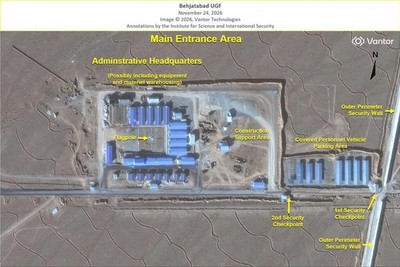
Iran rapidly builds underground complex near nuclear sites – US institute
1

Iran rapidly builds underground complex near nuclear sites – US institute

2
INSIGHT

Iran’s efforts to offset US naval blockade fall short, economists warn

3

Trump deploys extra aircraft carrier, says Iran is making ‘big mistakes’

4

Iran faces global condemnation over Kuwait attack that killed two Italians

5

Iranian truckers’ strike spreads to more cities on fifth day, union says

Banner

Spotlight

  • Who flogs a singer? The ‘public decency’ case against Parastoo Ahmadi
    PODCAST

    Who flogs a singer? The ‘public decency’ case against Parastoo Ahmadi

  • A dark, cold office: Pezeshkian's austerity gesture backfires

    A dark, cold office: Pezeshkian's austerity gesture backfires

  • Iranian women break silence on a lifetime of violence
    VOICES FROM IRAN

    Iranian women break silence on a lifetime of violence

  • Too poor to marry, young Iranians are offered religious workarounds
    INSIGHT

    Too poor to marry, young Iranians are offered religious workarounds

  • Iran faces year-end cash squeeze if US blockade holds
    INSIGHT

    Iran faces year-end cash squeeze if US blockade holds

  • A broken leg and broken trust: Violence in Iran’s schools
    VOICES FROM IRAN

    A broken leg and broken trust: Violence in Iran’s schools

Banner
Banner
Banner
Banner
Banner
Banner