• العربية
  • فارسی
Brand
  • Iran Insight
  • Politics
  • Economy
  • Analysis
  • Special Report
  • Opinion
  • Podcast
  • Iran Insight
  • Politics
  • Economy
  • Analysis
  • Special Report
  • Opinion
  • Podcast
  • Theme
  • Language
    • العربية
    • فارسی
  • Iran Insight
  • Politics
  • Economy
  • Analysis
  • Special Report
  • Opinion
  • Podcast
All rights reserved for Volant Media UK Limited
volant media logo

Iran says 240,000 cryptocurrency mining rigs seized in crackdown

Mar 9, 2025, 13:17 GMT+0

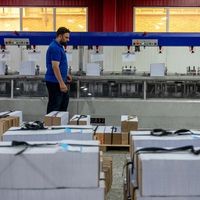
Iranian authorities have seized over 240,000 cryptocurrency mining devices in the past three years, the state electricity company Tavanir said on Sunday, as the country grapples with power shortages and network instability.

Mostafa Rajabi Mashhadi, Tavanir's CEO, told state media that the confiscated mining rigs consumed an estimated 800 megawatts of electricity.

He compared this to the 1,000-megawatt capacity of the Bushehr nuclear power plant, highlighting the significant strain the mining operations place on the national grid.

"Unfortunately, illegal use of the electricity network still occurs in the country," Mashhadi said, calling for increased cooperation with the Economic Security Police to identify and confiscate remaining illegal miners.

Under Iranian law, possession of unregistered cryptocurrency mining equipment can result in confiscation of the devices and fines of up to three times their value.

Tavanir's deputy for transmission and foreign trade estimated that approximately 700,000 illegal mining rigs are still operating in Iran, consuming around 2,000 megawatts of electricity.

The crackdown comes as Iran faces increasing pressure on its electricity grid, exacerbated by factors such as rising temperatures and increased industrial activity. It has led to mass closures of government offices, banks, and schools across most of Iran.

Earlier in the day, Iran's Power Plants Trade Association Chairman Ali Nikbakht predicted a 25,000-megawatt electricity deficit for next year, representing one-third of national consumption.

Most Viewed

Iran diplomacy wobbles as factions compete to avoid looking soft on US
1
INSIGHT

Iran diplomacy wobbles as factions compete to avoid looking soft on US

2
VOICES FROM IRAN

Bread shortages, soaring prices strain households in Iran, residents say

3
ANALYSIS

The politics of pink: how Iran uses cuteness to rebrand violence

4

Scam messages seek crypto for ships’ safe passage through Hormuz, firm warns

5
EXCLUSIVE

Family told missing teen was alive, then received his body 60 days later

Banner
Banner

Spotlight

  • Diplomacy tolls at Hormuz as conflict returns to its doorstep
    OPINION

    Diplomacy tolls at Hormuz as conflict returns to its doorstep

  • Opposition to US talks grows in Tehran as ceasefire deadline nears
    INSIGHT

    Opposition to US talks grows in Tehran as ceasefire deadline nears

  • Tehran moderates see ‘no deal–no war’ limbo as worst outcome
    INSIGHT

    Tehran moderates see ‘no deal–no war’ limbo as worst outcome

  • The future has been switched off here
    TEHRAN INSIDER

    The future has been switched off here

  • Lights out, then gunfire: Witnesses recount Mashhad protest crackdown
    VOICES FROM IRAN

    Lights out, then gunfire: Witnesses recount Mashhad protest crackdown

  • Is Iran entering its Gorbachev moment?
    INSIGHT

    Is Iran entering its Gorbachev moment?

•
•
•

More Stories

Rationing looms as Iran’s water reserves dwindle

Mar 9, 2025, 11:33 GMT+0

Iran’s water reserves have fallen to critical levels, accelerating the risk of shortages and forcing officials to consider rationing months before peak summer demand.

The capital Tehran’s water supply is particularly strained, with reservoirs at their lowest levels in years.

“The situation at key dams is concerning,” said Mohammad Javanbakht, deputy energy minister and head of Iran’s water resources management company.

“With a 47 percent drop in rainfall in Tehran province, the Lar, Latian, Mamloo, and Karaj dams, which supply much of the city’s drinking water, have seen significant declines," he added.

In recent weeks, images and videos of receding water levels at Tehran’s reservoirs have circulated widely, fueling public concern over worsening shortages.

In a report on the state of stored water behind dams, the Ham-Mihan newspaper wrote on Sunday: "The situation of the country's dams is so critical that water shortages and rationing will occur earlier than summer, and the state of Tehran's water resources has reached a crisis level unprecedented in recent years."

On Friday, Tehran’s water and wastewater company, Abfa, announced that water consumption had spiked 20 percent, reaching a record 48,000 liters per second. Officials attributed the surge to Iranian New Year preparations.

According to Abfa, rainfall since the start of the current water year has been the lowest in 57 years. “Without additional rainfall, current reserves should meet demand for at least the next three months,” it said.

The energy crisis, marked by widespread electricity shortages and gas deficits, has also disrupted industries across the country. Ageing infrastructure, international sanctions, and poor management have compounded the problem, leading to the shutdown of approximately 80 power plants and closure of businesses.

During the winter, Iran faces a daily shortfall of at least 260 million cubic meters of gas, further straining the electricity supply.

Iran has vast oil and gas reserves, much of which it cannot tap due to US-led sanctions which stall investment and technology improvement.

US sanctions disrupt but not halt Iran's oil to China - Bloomberg

Mar 9, 2025, 10:46 GMT+0

Successive rounds of US sanctions on tankers and companies involved in Iran's oil trade are slowing shipments to China but trade with one of Iran's most important allies continues in 'dark mode' in spite of maximum pressure, according to Bloomberg.

Sanctions are having an impact on the trade link by increasing costs and logistical hurdles, Bloomberg reported, citing Chinese refinery executives and shipping analysts.

Private Chinese refineries, which are the primary buyers of Iranian crude, have faced supply disruptions in recent weeks due to seller defaults, Bloomberg reported, citing industry sources.

While no specific reason was given, refinery executives attributed the issues to rising expenses and logistical challenges caused by US sanctions.

Washington has blacklisted more than two-thirds of the 150 vessels that transported Iranian crude last year.

The sanctions announced on February 24 followed similar measures by the US Treasury in late 2024, targeting ultra-large crude carriers in Iran's shadow fleet.

More than half of the tankers sanctioned by the United States have ceased operations outside Chinese or Iranian terminals, an investigation by Iran International revealed last month.

The increased restrictions have led to record-high freight costs, with the chartering rate for a non-sanctioned supertanker moving Iranian oil from Malaysia to China reaching up to $6 million—an increase of 50% from last year, Bloomberg reported, citing traders.

Some Chinese port authorities are also taking precautions. Shandong Port Group, which operates in a key refining hub, recently advised against handling blacklisted tankers, Bloomberg's report said.

Despite these obstacles, flows surged to a four-month high last month, partly due to a backlog of delayed cargoes, Bloomberg said.

However, an increasing number of ship-to-ship oil transfers are being conducted in "dark" mode, where vessels switch off their transponders to avoid detection, Bloomberg reported, citing satellite images and analysts.

In the waters off Malaysia, a key hub for Iranian crude shipments, up to seven such transfers were observed in a single day last month. Analysts noted that most of these operations were entirely "dark," indicating that shippers are taking greater precautions as Washington signals increased enforcement efforts.

On Wednesday, Reuters reported that the Trump administration is considering a plan to inspect Iranian oil tankers under an international accord designed to curb the spread of weapons of mass destruction.

Anoop Singh, the global head of shipping research at Oil Brokerage Ltd, told Bloomberg that financial institutions working with private Chinese refiners importing Iranian oil may come under fresh scrutiny. He added that Washington could choose to pressure countries such as India and the United Arab Emirates, where key shipowners and dark fleet operators are based.

He said that so far, the US has focused its sanctions on ships and owners, but the market has managed to create workarounds. “However, there are more critical parts of the network to target, from banks to governments to flag states and insurers — and regulatory avenues to explore,” Singh told Bloomberg.

Iraq struggles as US ends waiver for Iranian energy, official says

Mar 9, 2025, 09:01 GMT+0

The expiration of a US sanctions waiver permitting Iraq to purchase Iranian energy poses short-term operational difficulties, the Iraqi prime minister's foreign affairs adviser told Reuters on Sunday.

Farhad Alaaeldin said that the expiration of the waiver “presents temporary operational challenges,” adding that “Iraq was committed to its strategic goal of achieving energy self-sufficiency".

The Trump administration revoked Iraq’s sanctions waiver to pay Iran for electricity on Saturday as part of President Donald Trump's so-called campaign of maximum pressure against Tehran.

"The government is actively working on alternatives to sustain electricity supply and mitigate any potential disruptions," Alaaeldin said.

"Strengthening energy security remains a national priority, and efforts to enhance domestic production, improve grid efficiency and invest in new technologies will continue at full pace," he added.

A State Department spokesperson said that the decision "ensures we do not allow Iran any degree of economic or financial relief,” adding that Trump's campaign on Iran aims "to end its nuclear threat, curtail its ballistic missile program and stop it from supporting terrorist groups."

The spokesperson said: "We urge the Iraqi government to eliminate its dependence on Iranian sources of energy as soon as possible ... Iran is an unreliable energy supplier."

The spokesperson played down the impact of Iranian electricity imports on Iraq's power grid, saying, "In 2023, electricity imports from Iran were only 4% of electricity consumption in Iraq."

Washington seeks to isolate Iran economically and cut its oil revenues to hinder nuclear development—claims Tehran denies, insisting its program is peaceful.

"President Trump has been clear that the Iranian Regime must cease its ambitions for a nuclear weapon or face Maximum Pressure," said National Security spokesperson James Hewitt. "We hope the regime will put the interests of its people and the region ahead of its destabilizing policies."

The US has long urged Iraq to reduce reliance on Iranian energy. The waiver’s removal is also seen as part of Washington’s push for Baghdad to resume Kurdish oil exports via Turkey to help stabilize global prices.

"Iraq’s energy transition provides opportunities for US companies, which are world-leading experts in increasing the productivity of power plants, improving electricity grids, and developing electricity interconnections with reliable partners," the State Department spokesperson noted.

Khamenei rejects negotiation with US in first speech after Trump's letter

Mar 8, 2025, 14:54 GMT+0

Iran's Supreme Leader Ali Khamenei on Saturday ruled out the possibility of negotiation with the United States, in his first public speech after President Donald Trump said he sent a letter to him.

"The insistence of some bullying governments on negotiations is not aimed at resolving issues but rather at asserting dominance and imposing their demands," Khamenei said in a meeting with Iranian officials in Tehran.

"The Islamic Republic of Iran will certainly not accept their demands," he added.

His comments followed Trump’s revelation that he had sent Khamenei a letter offering negotiations on Iran's nuclear program while warning that military intervention was the alternative.

Iran's Foreign Minister Abbas Araghchi said on Saturday Tehran has not yet received Trump's letter to Khamenei.

Responding to Khamenei's rejection of Trump's call to negotiate a nuclear agreement, the White House on Saturday reiterated the US president's assertion that Tehran can be dealt with either militarily or by making a deal.

"We hope the Iran regime puts its people and best interests ahead of terror," White House National Security Council spokesman Brian Hughes said in a statement.

Lebanese pro-Iranian TV channel Al Mayadeen reported Saturday Tehran had refused to enter nuclear negotiations with the United States under the conditions set by the current US administration.

No talks on missile capabilities, regional influence

Khamenei said the West's issue is not just Tehran's nuclear program. "Rather, for them, negotiations are a means to raise new demands, including restrictions on defense capabilities and international influence."

"They set expectations such as 'Do not do this,' 'Do not meet with that person,' or 'Do not extend missile range beyond a certain limit.' These demands will certainly not be accepted or fulfilled by Iran."

While Tehran maintains that its ballistic missile program is purely defensive, the West considers it a destabilizing factor in a volatile, conflict-ridden Middle East.

'Shameless Europeans'

In his Saturday remarks, Khamenei also lashed out at European countries for criticizing Tehran's non-compliance with the 2015 nuclear deal, calling them shameless.

"Those three European countries are issuing statements, claiming that Iran has not fulfilled its nuclear commitments under the JCPOA! Someone should ask them: Have you fulfilled yours? You never did from the very beginning!"

Khamenei said the E3 (France, Britain and Germany) promised to compensate after Donald Trump withdrew Washington from the nuclear deal in 2018, but they broke their promise.

"Then you made another claim and broke that second promise as well. There should be a limit to shamelessness! How can someone fail to uphold their own commitments and then turn around and accuse the other side of non-compliance?"

Iran's Supreme Leader said the Rouhani administration at the time tolerated for a year, then the Parliament stepped in and passed a bill that effectively blocked the revival of the deal.

"There was no other way. And now, the same holds true: There is no other way to stand against coercion and bullying," he added.

Holocaust denial

Khamenei further criticized what he called the Western double standards on the free flow of information, saying that no one can mention slain IRGC Quds Force Commander Qassem Soleimani, Hezbollah leader Hassan Nasrallah, or Hamas leader Ismail Haniyeh, "protest the crimes committed in Palestine and Lebanon, or deny what Hitler is claimed to have done to the Jews on Western-run social media."

The leaders of the Islamic Republic have a long history of Holocaust denial and Holocaust revisionism.

Iran's former president Mahmoud Ahmadinejad issued a number of statements claiming The Holocaust as is commonly accepted is "a myth" and "a lie".

Former President Ebrahim Raisi also cast doubt on whether the Holocaust happened in a 2022 interview with CBS News.

On January 20, 2022, the United Nations General Assembly passed a resolution that condemned the denial and distortion of the Holocaust. Iran was the only country in the world that condemned and rejected the resolution.

Tehran shoots down nuclear talks under US conditions - Al Mayadeen

Mar 8, 2025, 13:05 GMT+0

Iran has refused to enter nuclear negotiations with the United States under the conditions set by the current US administration, Lebanese pro-Iranian TV channel Al Mayadeen reported Saturday.

Although the report was published a day after President Donald Trump announced he had sent a letter to Supreme Leader Ali Khamenei, it makes no mention of the message.

The outlet cited an unnamed high-ranking Iranian diplomatic source who said that during his visit to Tehran last month, Russian Foreign Minister Sergey Lavrov expressed Moscow’s willingness to facilitate nuclear negotiations with Washington through diplomatic channels.

Tehran told Lavrov that it would never engage in talks with Washington under the conditions imposed by the Trump administration.

President Trump revealed on Friday that he had sent a letter to Khamenei, offering negotiations while warning of military consequences if talks failed. Speaking to Fox Business Network, Trump said, “There are two ways Iran can be handled: militarily or through a deal. I would prefer to make a deal.”

Iran swiftly dismissed the letter, with an official outlet of the Islamic Revolutionary Guard Corps (IRGC) calling it a psychological operation. Iran’s UN mission in New York also denied receiving any such communication.

Meanwhile, on Thursday, Russian Deputy Foreign Minister Sergei Ryabkov met with Iranian Ambassador Kazem Jalali to discuss international efforts to resolve issues surrounding Iran’s nuclear program, the Russian Foreign Ministry announced on Friday.

According to a Bloomberg report on Tuesday, later confirmed by the Kremlin, Russia has agreed to assist the US in communicating with Iran on various matters, including its nuclear program and support for regional anti-US proxies.

Kremlin spokesman Dmitry Peskov said, "Russia believes that the United States and Iran should resolve all problems through negotiations" and that Moscow "is ready to do everything in its power to achieve this." The report was subsequently picked up by Russian state media.

Last month, prior to Russia's official offer of mediation, Russian Foreign Minister Sergei Lavrov met with Iranian President Masoud Pezeshkian and Foreign Minister Abbas Araghchi in Tehran, where both sides reportedly "aligned their positions" on the 2015 Joint Comprehensive Plan of Action (JCPOA), the nuclear deal that unraveled following the US withdrawal in 2018.