An aerial view shows a crude oil tanker at an oil terminal off Waidiao island in Zhoushan, Zhejiang province, China January 4, 2023.
More than half of the tankers sanctioned three days ago by the United States for carrying Iran's oil have ceased operations outside Chinese or Iranians terminals, an investigation by Iran International reveals.
The sanctions announced on February 24 followed similar measures by the US Treasury in late 2024, targeting ultra-large crude carriers in Iran's shadow fleet.
Such vessels, widely referred to as VLCCs, or very large crude carriers, can carry up to 2 million barrels of oil, far more than what a normal or large tanker can carry.
The VLCCs are essential for Iran's oil shipment, hence their targeting by the US Treasury since October last year.
With the latest US sanctions imposed by the Trump administration, nearly two-thirds of the 126 VLCCs shipping Iranian oil have now been blacklisted, according to oil tanker tracking data, forcing a significant number to abandon Iran and turn to transporting Russian oil.
Trump administration’s long road
Although stricter sanctions have complicated oil transportation for Iran’s VLCCs, claiming that Iran’s oil exports will face severe disruption and a catastrophic decline would be an exaggeration.
United Against Nuclear Iran (UANI) has identified 503 tankers with a combined capacity of 61 million tons of oil (over 350 million barrels), but sanctions currently cover less than 45% of this total capacity.
An investigation by Iran International shows that to maintain an average daily oil transit of 1.3 million barrels, as observed in recent months, Iran needs 45 VLCCs. Currently, 47 VLCCs linked to Iranian oil smuggling remain unsanctioned.
Meanwhile, dozens of VLCCs worldwide have surpassed 20 years of age in the past year, with each valued at an average of $25 million. Operators of the shadow fleet could potentially purchase some of these aging vessels. Notably, the number of foreign tankers involved in smuggling Iranian oil has surged sevenfold over the past five years.
In January 2024, China banned sanctioned tankers from docking at Shandong Port, its largest terminal for Iranian crude imports, causing Iranian oil offloading to drop to 850,000 barrels per day. However, a recent policy shift privatized part of the port, facilitating the reception of sanctioned crude cargoes. As a result, Iranian oil discharges in China surged to over 1.7 million barrels per day in February, according to industry intelligence firm Kpler.
Thus, it appears that the US still has a long road ahead to achieve what Treasury Secretary Scott Bessent described as a “90% reduction goal” in Iran’s oil exports.
Previously, several oil tanker tracking companies, in interviews with Iran International, estimated that Iran’s daily oil exports could drop by one-third in the coming months. However, they all agreed that such a scenario depends entirely on China's cooperation with the US.
Iran’s Difficult Situation
While foreign energy analysts and media mostly focus on Iran’s oil export volumes, the most critical issue for Iran—and especially for the US—is its oil export revenue.
Oil tanker tracking data from recent months indicate that Iran’s export volume has declined by around 25%. However, Iran’s domestic financial data suggests that its oil revenue has been cut in half, dropping below $1.8 billion per month.
This clearly highlights the soaring costs Iran has incurred to bypass US sanctions in recent months.
Meanwhile, Masoumeh Aghapour, an economic advisor to Iran’s president, acknowledged the country’s severe foreign currency shortages on February 25, just a day after the latest US sanctions targeted oil-related companies and tankers.
“We have a currency problem. Let’s be frank. Trump has played a major role in our forex market. The situation has become exponentially more difficult for us in the past two weeks,” she said.
Since early September, Iran’s national currency, the rial, has lost half of its value due to setbacks in the region and Trump’s election, as he has pledged to significantly cut Tehran’s oil exports.
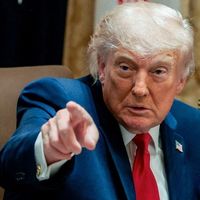
US President Donald Trump hosts his first cabinet meeting, Washington, D.C., U.S., February 26, 2025.
Iran will persevere in its defiance of US President Trump's bossy orders, a top foreign policy advisor to Supreme Leader Ali Khamenei said on Wednesday, adding Iran is ready for talks based on mutual respect.
The remarks by former foreign minister Kamal Kharrazi appear to signal some flexibility in Iran's position vis-à-vis talks with the United States that Khamenei this month expressly rejected.
"We don’t run away from negotiation; after all, we have negotiated many times before," state media outlet IRNA quoted Kharrazi as saying on Wednesday. "However, it is not compatible with our revolutionary and Iranian spirit to yield to the excessive demands and diktats of others.
"At present, there is no choice but to exercise maximum patience, unless a situation arises where the other side also shows a willingness for genuine negotiation rather than dictation," he added.
Trump reinstated the "maximum pressure" campaign of sanctions from his first term and has mooted military action on Iran's disputed nuclear program, prompting foreign minister Abbas Araghchi to say Tehran would not talk amid threats and pressure.
"Mr. Trump’s way is to unilaterally impose his will and expect others to simply obey his orders. We are witnessing this approach today even with regard to Europe," Khamenei's advisor said.
"We must resist until they approach us not with bossiness, pressure, and sanctions, but based on the principle of equality and mutual respect."
Kharrazi heads the Strategic Council on Foreign Relations and has hinted before that Iran could ditch its stated opposition to acquiring nuclear weapons.
Members of the body he leads are by handpicked by Khamenei and its reports and advisories have often presaged major policy shifts by the ruling system.
Iran is capable of producing nuclear weapons and an existential threat could cause a rethink of Khamenei's injunction against them, he said last year.
A security person stands in front of the Mahshahr petrochemical plant in Khuzestan province, September 28, 2011.
Iran’s former communications minister has sharply criticized the government-controlled economy, arguing that a system favoring insiders stifles creativity and productivity.
“The reality is that in an economy built on rent-seeking, where wealth depends on political connections, creativity has no place,” Mohammad-Javad Azari-Jahromi, who served as telecommunications minister under the Rouhani administration, told a gathering of fintech experts in Tehran.
As Iran’s oil-dependent economy has plunged into crisis over the past five years, local economists, some media outlets, and politicians have increasingly criticized the underlying system while also attributing the downturn to US sanctions.
The term “rent-seeking economy” is increasingly used in Iran to describe a system where politically influential individuals and entities secure economic privileges—such as government subsidies, lack of oversight, and market monopolies—to generate profits without contributing significantly to productivity.
A clear example is the Revolutionary Guard receiving over 30% of Iran’s crude oil for export, rather than relying solely on government budget allocations.
Jahromi implicitly referred to that when he said, “Certain entities can obtain oil under the pretext of bypassing sanctions and then decide whether or not to bring the revenue back. This approach is far easier than putting in the effort to create markets and provide services.”
The former minister explained that “In this rent-seeking environment, there is no incentive for individuals to pursue creativity. Ultimately, the system operates through intermediaries.”
Nearly all of Iran’s banks, automakers, petrochemical plants, steel producers, and various other industries are either government-owned or quasi-public, managed by a politically connected elite. Despite their inefficiency and mounting debts, these industries are deemed essential and remain heavily reliant on continuous government support.
Jahromi noted that banks use their capital to engage in the real estate sector instead of helping new industries. They also own many companies and lend money to their own enterprises instead of others.
“The economy is facing fundamental and obvious obstacles. In this situation, the workforce is migrating, and investment is scarce due to the high level of risk involved,” Jahromi said.
The five-year-old Baloch child Yusef Shahli-Bar who was killed by security forces in Iranshahr on February 25, 2025.
A five-year-old was killed and his mother lost her unborn child when Iran's security forces opened fire on the family's vehicle in the country's turbulent province of Sistan and Baluchestan.
Halvash, a local news website, reported that the child, Yousef Shahli-Bar, who had sustained five gunshot wounds, died after a prolonged wait for medical attention due to the absence of a surgeon.
The mother, Maryam Shahli-Bar, remains in the Intensive Care Unit (ICU) at Khatam al-Anbiya Hospital in Iranshahr.
Halvash reported that after firing on the vehicle, tactical unit forces transported the injured to a hospital before leaving the scene.
The driver of the vehicle, Ramin Shahli-Bar, was arrested by security forces in plain clothes and taken to an undisclosed location, the report added.
No official explanation has been provided regarding the reason for the shooting.
Security forces in Iran have previously been accused of unjustified shootings at vehicles. According to statistics compiled by the Human Rights Activists News Agency (HRANA), 484 civilians were shot by military personnel in Iran in 2024, with 163 killed and 321 injured.
HRANA reported that in 2023, 402 civilians were targeted, and in 2022, the number was 845.
The shooting comes amid heightened tensions in the Sistan and Baluchestan region following armed clashes between Iranian military forces and Jaish al-Adl, a militant group operating in the region.
A video showing drones flying over Jakigour, a district in Rask County, caused concern among residents.
In Chabahar port, Iranian security forces on Tuesday launched a raid on a residential building using light and semi-heavy weapons, including rocket propelled grenade.
According to Halvash, the house was completely destroyed, and surrounding buildings were damaged. Iranian authorities confirmed that two members of Jaish al-Adl were killed and six arrested. However, in a statement, Jaish al-Adl disputed this, saying no members were detained.
The recent escalation follows a series of attacks attributed to the group. On Saturday, a sound bomb explosion damaged the Chabahar Rural Development Organization headquarters.
In a separate incident, gunmen attacked the Housing Foundation of Sistan and Baluchestan, injuring one staff member. Jaish al-Adl claimed responsibility, saying the attacks were in response to government actions against Baloch communities. The minority group is among the most persecuted in Iran, according to rights groups.
The 2025 report from Human Rights Watch said: "The Iranian government also discriminates against some religious minorities, including Sunni Muslims, and restricts cultural and political activities among the country’s Azeri, Kurdish, Arab, and Baluch ethnic minorities.
Jaish al-Adl has been designated as a terrorist organization by both the Iranian government and the United States.
The group has carried out multiple attacks against Iranian security forces in Sistan and Baluchestan in recent years, the region a hotbed of clashes.
Countries such as the UK sanctioned individuals and entities in Iran following the violent crackdown on protests in the 2022 uprising, including in Sistan and Baluchestan, where in one day, over 80 people were killed by security forces in Zahedan.
US Secretary of State Marco Rubio and Iraqi Prime Minister Mohammed Shiaa al-Sudani discussed Iran’s regional influence, Iraq’s energy independence, and US business investments during a call on Tuesday, the US State Department said.
According to spokesperson Tammy Bruce, both sides emphasized the need for Iraq to reduce reliance on external energy sources, swiftly reopen the Iraq-Turkey Pipeline, and uphold contractual commitments to U.S. companies to attract further investment.
Bruce added that "the two sides also discussed reducing Iran’s malign influence and continuing efforts to prevent ISIS from resurging and destabilizing the broader region."
US Senator Lindsey Graham said Washington was not interested in negotiating with Tehran anyway after Iran said it would not hold talks as long as President Donald Trump's so-called maximum pressure campaign remains in place.
"I don't want to negotiate with Iran either," Graham told Iran International, when asked about foreign minister Abbas Araghchi's comments on the subject.
In a press conference with Russian foreign minister Sergei Lavrov in Tehran, Araghchi ruled out direct negotiations with the United States over the country’s disputed nuclear program as long as the sanctions persisted.
"Iran's position in the nuclear talks is completely clear, and we will not negotiate under pressure and sanctions," he said. "There is no possibility of direct negotiations between us and the US as long as maximum pressure is being applied in this manner."
The South Carolina Republican is a foreign policy hawk who maintains a close relationship with Trump. Graham co-sponsored a bill this month calling for denying Iran a nuclear bomb by any means necessary, days after US President Trump appeared to downplay a military option.
Iran denies seeking a nuclear weapon but the United States assesses that it has stepped up enrichment in order to quickly attain the capability should it wish.
Trump this month reimposed the policy of tough sanctions on Iran from his first term, aimed at driving Iran's oil exports down to zero.
Still, Trump called any reports that a US-Israeli strike would deal Iran a devastating blow "greatly exaggerated" and said he much preferred a deal.
Republican lawmakers appeared less charitable, with West Virginia Senator Shelley Moore Capito telling Iran International that Tehran cannot be believed.
"The way I see it, Iran is a country of terrorism that foments terror certainly acrpss the the Mideast and around the world. I can't imagine that I would trust anything they would say."
Florida Senator Rick Scott said denying Iran a bomb was a main priority.
"I don't think we can allow Iran to have nuclear weapons, and so I think we've got to do everything under our power to make sure they don't have nuclear weapons."