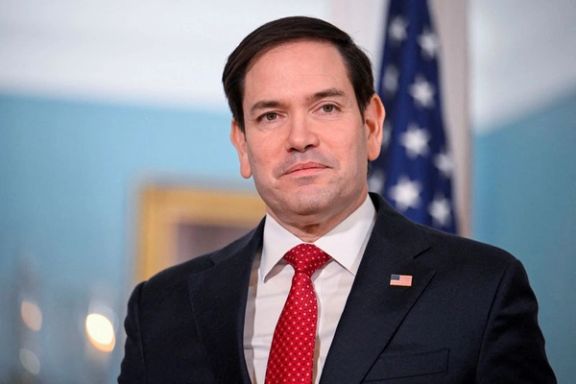
US Secretary of State Marco Rubio and Iraqi Prime Minister Mohammed Shiaa al-Sudani discussed Iran’s regional influence, Iraq’s energy independence, and US business investments during a call on Tuesday, the US State Department said.
According to spokesperson Tammy Bruce, both sides emphasized the need for Iraq to reduce reliance on external energy sources, swiftly reopen the Iraq-Turkey Pipeline, and uphold contractual commitments to U.S. companies to attract further investment.
Bruce added that "the two sides also discussed reducing Iran’s malign influence and continuing efforts to prevent ISIS from resurging and destabilizing the broader region."
US Senator Lindsey Graham said Washington was not interested in negotiating with Tehran anyway after Iran said it would not hold talks as long as President Donald Trump's so-called maximum pressure campaign remains in place.
"I don't want to negotiate with Iran either," Graham told Iran International, when asked about foreign minister Abbas Araghchi's comments on the subject.
In a press conference with Russian foreign minister Sergei Lavrov in Tehran, Araghchi ruled out direct negotiations with the United States over the country’s disputed nuclear program as long as the sanctions persisted.
"Iran's position in the nuclear talks is completely clear, and we will not negotiate under pressure and sanctions," he said. "There is no possibility of direct negotiations between us and the US as long as maximum pressure is being applied in this manner."
The South Carolina Republican is a foreign policy hawk who maintains a close relationship with Trump. Graham co-sponsored a bill this month calling for denying Iran a nuclear bomb by any means necessary, days after US President Trump appeared to downplay a military option.
Iran denies seeking a nuclear weapon but the United States assesses that it has stepped up enrichment in order to quickly attain the capability should it wish.
Trump this month reimposed the policy of tough sanctions on Iran from his first term, aimed at driving Iran's oil exports down to zero.
Still, Trump called any reports that a US-Israeli strike would deal Iran a devastating blow "greatly exaggerated" and said he much preferred a deal.
Republican lawmakers appeared less charitable, with West Virginia Senator Shelley Moore Capito telling Iran International that Tehran cannot be believed.
"The way I see it, Iran is a country of terrorism that foments terror certainly acrpss the the Mideast and around the world. I can't imagine that I would trust anything they would say."
Florida Senator Rick Scott said denying Iran a bomb was a main priority.
"I don't think we can allow Iran to have nuclear weapons, and so I think we've got to do everything under our power to make sure they don't have nuclear weapons."
A screengrab from a video showing the residential house in Chabahar attacked by Iranian forces on February 25, 2025.
Security forces carrying out a raid on a house in Iran's restive southeastern province of Sistan and Baluchestan became embroiled in an ongoing gunbattle involving rocket-propelled grenades on Tuesday.
Outlets affiliated with the Islamic Republic’s security forces published videos of the attack in the town of Chabahar, saying the forces were targeting individuals linked to Jaish al-Adl, a militant group that has previously carried out attacks in the region.
Videos published on Tuesday show government forces firing RPG rounds at the house as clashes continued.
According to reports from Halvash, a local news website, people inside the house returned fire, leading to an armed standoff.
Surveillance and combat drones were also seen in the area, as security forces in nearby buildings deployed heavy weapons in a bid to end the confrontation.
The site remained surrounded at around noon Eastern Standard Time, and the nature the gunmen and any casualties remained unclear.
Jaish al-Adl, a Sunni Islamist militant organization hailing from the Baloch ethnic minority, has not officially commented on the incident.
The raid follows a series of incidents in Chabahar. On February 22, a bomb blast destroyed the headquarters for the coordination of eastern Chabahar villages.
Around the same time, an armed attack on the Housing Foundation building in the province left one employee injured.
Jaish al-Adl claimed responsibility for the attacks, saying hey were in retaliation for government policies to displace local Baloch communities.
The group has been designated a terrorist organization by both the Islamic Republic and the United States. The group has carried out several attacks on Iranian military and IRGC positions in recent years.
An Iranian Shahed Drone is displayed by the United Against Nuclear Iran at the Conservative Political Action Conference (CPAC) annual meeting in National Harbor, Maryland, US, February 22, 2025.
Poland helped put an Iranian Shahed-136 drone on display in Washington and the United Nations to expose Tehran's destabilizing activities, Polish Foreign Minister Radek Sikorski told Iran International, dismissing the Islamic Republic's objections.
"The first credit for bringing this evidence here goes to the brave soldiers of Ukraine, who shot down this missile," Sikorski said, standing next to the drone on the sidelines of a UN Security Council meeting on Ukraine.
Iran’s foreign ministry on Monday said it has summoned Poland’s chargé d'affaires in Tehran following Sikorski's criticism of Iran and Russia's military cooperation amid the latter's full-scale invasion of Ukraine.
Semi-official IMNA news agency reported that the summons followed Sikorski’s role in facilitating the transfer of an Iranian-made drone from Ukraine to the US for display at the Conservative Political Action Conference (CPAC).
"We just helped Ukraine to get it out of Ukraine and to bring it here, for the world to see that Iran is still exporting its destabilization, it's trying to export its ideology," Sikorski added.
Despite evidence to the contrary, Tehran has repeatedly denied its provision of drones to Russia for its war on Ukraine, which has seen Iran levied with heavy sanctions from countries such as the UK, US and EU.
Following the exhibition, Iran’s Mission in the United Nations said, “There is no legal prohibition on its sale.”
Addressing Iranian authorities, Sikorski added, "This is a warning. We know what you're doing. It is cruel against the principles of the UN Charter.
"Stop doing it now."
Sikorski made the remarks during an exhibition organized by United Against Nuclear Iran (UANI). UANI first unveiled the drone during the CPAC meeting last week.
"Many, many hundreds of people have already died from the use of this imprecise, indiscriminate weapon. We believe over 7,000 have already been launched against Ukraine," Sikorski said.
According to the Wall Street Journal, the Shahed-136 drone is considered the most widely used military drone in the world, manufactured in Iran's military industries under the supervision of the IRGC, which designated as a terrorist organization by the United States.
Russian forces have used thousands of these drones—rebranded as Geran-2—in Ukraine, with one striking Chernobyl’s radiation containment shelter earlier this month.
Iranian-backed militants also launched a Shahed that killed three US service members in Jordan in January.
UANI CEO Mark D. Wallace unveiled the Shahed-136 drone alongside CPAC Chairman Matt Schlapp.
Speaking to Iran International, Wallace described the drone as "the most ubiquitous WMD terror weapon of our time," citing its extensive use across the Middle East.
"This system has been fired at and killed American troops and service members across the Middle East," Wallace said. "It's been fired on Israel from Iran. It's been fired against Saudi Arabia's oil facilities. It's been fired against the Arab Emirates, including the iconic skyscraper, the Burj Khalifa."
The United States first warned in July 2022 that Iran was preparing to supply Russia with battlefield drones, and September 13 marked the anniversary of the first Shahed drone being shot down by Ukraine.
Russia soon began large scale use of the Iranian drones in attacks on Ukraine’s infrastructure and civilian targets. The Shahed 136 drones have been used alongside cruise and ballistic missile attacks to overwhelm Ukrainian air defenses.
‘CPAC for Iranians in Exile’
Following the drone unveiling, CPAC and UANI announced the formation of "CPAC for Iranians in Exile," a platform designed to unite the Iranian diaspora against the Islamic Republic.
Wallace emphasized the need for unity, saying, "The civil and collegial discussion amongst Iranian diaspora members of diverse views, backgrounds and heritage is the Ayatollah’s greatest fear."
According to UANI, the group aims to provide a space for dialogue and engagement with US policymakers, focusing on ending the "Ayatollah's despotic rule."
Wallace expressed hope that the event would mark "the beginning of a new era" for the Iranian diaspora, fostering unity and cooperation in their fight for a free and democratic Iran.
Christian Democratic Union (CDU) party leader Friedrich Merz speaks at the party headquarters, after the exit poll results are announced for the 2025 general election, in Berlin, Germany, February 23, 2025.
Germany's likely next Chancellor Friedrich Merz is likely to promulgate a tougher stance on Iran by Europe's top economy after inviting Tehran's arch-enemy Israeli premier Benjamin Netanyahu to Berlin and previous pointed statements.
After his conservative bloc won the most votes of any party in elections on Sunday, Merz hopes to quickly form a government with reluctant social democrats.
Should he emerge as Germany's leader, the top European economy and trading partner with the largely sanctioned and shunned Islamic Republic could be set to take a stronger tack against Tehran.
Merz told Israel's Netanyahu in a phone conversation following his strong showing at polls that he would invite him to Germany despite of an arrest warrant from the International Criminal Court (ICC), Netanyahu's office said on Monday.
The previous coalition government led by social democrat Olaf Schultz had taken a more measured line toward Netanyahu as war has gripped the Mideast for over a year, incurring criticism by some Iranian dissidents.
Iran this month repatriated the body of German-Iranian citizen Jamshid Sharmahd after his death in an Iranian prison while awaiting execution.
German-Iranian citizen Jamshid Sharmahd during his trial in Iran
Sharmahd was convicted of heading a pro-monarchist group accused of a deadly 2008 bombing at a religious center in Shiraz, which killed 14 people - charges he denied.
Late last year, Merz decried Sharmahd's death as a "horrible crime," writing on X: "The trial was a mockery of the international standards for due process of law. The Iranian regime is once again showing its inhuman character."
"The approach of 'quiet diplomacy' with #Iran has failed ... Germany #Iran policy in recent years has been characterized by the idea of a cooperative government in Tehran – this illusion was to be abandoned," he said.
Merz advocated heavier sanctions, downgrading relations and expelling Tehran's ambassador.
Iran's highest-ranking military officer has publicly advocated for privatization as the nation faces chronic energy shortages and rampant inflation.
“The model for the country's salvation is to turn to the people. If we want to solve the economy, the solution is to turn to the private sector and entrust work to the people," Major General Mohammad Bagheri said.
Iran's armed forces, the Islamic Revolution Guard Corps (IRGC) in particular, have benefited from previous waves of privatisation, taking over fully or in part the companies and businesses that the government puts up for sale.
Bagheri's call comes amid reports that the Iranian Armed Forces, including the IRGC, will receive a substantial 51% (approximately €12 billion) of the government's €24 billion oil and gas export revenues in the upcoming budget.
The budget bill for the next Iranian year (starting March 21) details that while 37.5% of oil and gas revenue goes to the government, over half of that portion funds the military.
Last year, a Reuters report indicated that the IRGC already controls up to half of Iran's oil exports, funding military operations and allies.
Recent Central Bank statistics also show a significant decline in private sector involvement in foreign trade, replaced by government entities that receive the majority of foreign currency.
Customs data further shows that government-controlled petrochemical, steel, oil, and gas products dominate exports.
The country’s new budget allows the Oil Ministry to contract with third parties for oil and gas field operations to settle debts, raising fears that these contracts will fall into the hands of the so-called "Khosoulati" entities—quasi-state organizations controlled by insiders of the ruling system, rather than genuine private sector businesses.
HamMihan newspaper warned last year that such a policy risks transferring national resources to entities lacking the necessary capacity and resources, further entrenching government-linked organizations in the economy.