Iranian woman arrested for 'death to dictator' protest, eyewitness says
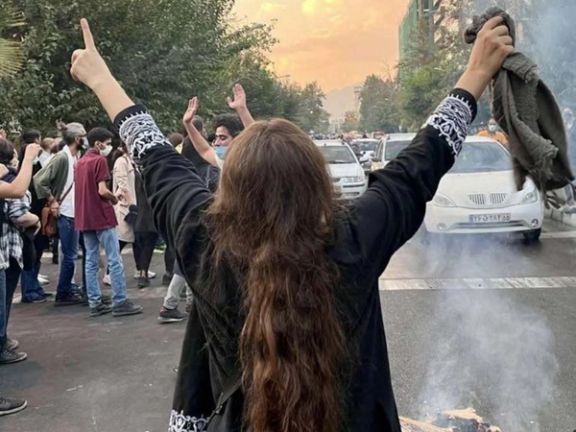
A young Iranian woman was arrested for appearing without a mandatory head covering and chanting "death to the dictator" in a public square in southwestern Iran on Monday, an eyewitness told Iran International.
The protest points to smoldering discontent even after authorities quashed by force a nationwide protest movement against clerical rule which began in 2022.
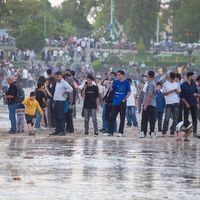
At the central clocktower square in the city of Yasuj, a young woman who appeared to be in her late 20s removed her headscarf and outer layer of clothes in the midst of a crowd according to the eyewitness, who declined to be identified for security reasons.
Dressed in a tank top and trousers, she chanted “Death to the dictator!” the source added. The slogan is a common refrain among dissidents against 85-year-old Supreme Leader and theocrat Ali Khamenei.
Iran International later obtained a video showing the woman chanting "Long Live the King".
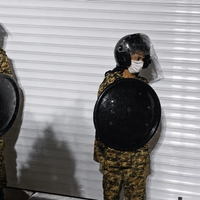
Security forces promptly descended on the woman, wrapping her in a blanket and forcibly bundling her into a departing car.
A source, speaking to Iran International on condition of anonymity for security reasons, said two men were also arrested after attempting to defend her during the arrest.
The Woman, Life, Freedom movement in Iran was sparked by the death of a young woman, Mahsa Amini, in September 2022 while in police custody over hijab violations.
Hardliners have intensified efforts to enforce strict dress codes for women even as a new law on hijab enforcement appears to have lapsed and Javad Zarif, a relative moderate Iranian vice president, said the government aimed not to pressure women.
Despite the official statements and widespread public defiance, government measures to reinforce mandatory hijab laws have persisted, resulting in the closure of businesses and the impoundment of vehicles associated with hijab offenses.
A crackdown on the Iranian Baha'is in Isfahan has prompted German-Iranians to urge the mayor of the southwestern German city of Freiburg to pull the plug on its municipal partnership with Isfahan.
“Two days before the United Nations reviews Iran’s human rights record, it commits yet another senseless act against women who are completely innocent. Their so-called 'crime' was to serve their local communities, and now the Iranian government has detained them in violent home raids,” said Simin Fahandej, Representative of the Baha’i International Community to the United Nations in Geneva.
Iran International obtained a January 30 letter from Behrouz Asadi, the head of the Democratic Forum of Iranians in Mainz, to Freiburg’s mayor Martin Horn.
Asadi wrote “The municipal administration in Isfahan has actively cooperated with the security and intelligence forces to repress the Baha'is .” Asadi added that “You are setting an example that you are tolerating and overlooking the regime’s course of action and the human rights violations that are taking place there.”
Horn did not respond to requests by Iran International for comment. Freiburg is the only German city that has a twin city partnership with an Iranian city.
The German city of Weimar ended its attempted partnership with Shiraz in 2010 because Iranian officials on a trip to Germany refused to visit the Buchenwald concentration camp memorial in Weimar.
Freiburg launched its partnership with Isfahan in 2000.
Dr. Wahied Wahdat-Hagh, a German-Iranian political scientist, criticized Freiburg's partnership with Isfahan as hypocritical.
Iran, he said, has been oppressing women, crushing secular opposition, persecuting religious minorities and carrying out one of the highest execution rates globally.
“No one wanted to acknowledge at the time that Iran had already been a totalitarian dictatorship.”
Wahdat-Hagh, who is a Baha'i, is one of the world’s leading experts on the Baha'is in Iran. “The Freiburg Initiative did not want to know that Iran has wanted to destroy Israel since 1979 and had waged a war against Israel with the help of its proxies,” he added.
Assadi also noted in his letter to Horn that “Your partner city Isfahan is one of the places where the regime produces rockets, drones and bombs.” He noted that “the partnership is a status symbol of the regime with which it attempts to publicly whitewash its crimes.”
Iran’s military fired projectiles from Isfahan into Israel last year.
Michael Blume, the state commissioner tasked with fighting antisemitism, including Iranian government Holocaust denial, in the state of Baden-Württemberg, where Freiburg is located, has lashed out at Iranian dissidents opposed to Ali Khamenei’s government and has not called on Horn to end the partnership. Blume called Iranian dissidents “corrupt exiled nationalists.”
Ronai Chaker, a prominent activist from Germany’s Yazidi community who combats Islamism in the federal republic, told Iran International ”I find Freiburg's twin city partnership with Isfahan to be a scandalous betrayal of the values of democracy, human rights and Germany's historical responsibility toward the Jewish people."
"The systematic persecution of Baha'is, women, LGBTQ+ people and dissidents there is a clear human rights violation.”
In 2017, the Iranian authorities arrested more than 30 men suspected of being homosexuals at a private party last week in the Isfahan province.
Chaker said “The city of Freiburg must end this partnership immediately. Anyone who continues to cling to the relationship with Isfahan is complicit in the crimes of the mullahs' regime.”
She also took Blume to task for his reported enabling of the partnership. “Due to his silence and his lack of a critical attitude towards this twin city partnership, Blume has lost all credibility as an antisemitism representative. His resignation would be a logical step. Freiburg must clearly distance itself from Isfahan instead of giving the Iranian regime legitimacy through such partnerships.”
The Iranian dissident Sheina Vojoudi, who lives in Germany, previously said “Blume called people like me ‘corrupt exiled nationalists’ after I showed him leaked footage of Evin prison.”
An Iranian court has sentenced a protester arrested during the 2022 Women, Life, Freedom protest uprising to death and two others to lengthy prison terms, France-based Kurdistan Human Rights Network (KHRN) reported on Monday.
Pezhman Soltani, 32, was convicted of premeditated murder and sentenced to death under qisas, retribution-in-kind, which allows the victim’s family to demand execution under Islamic law, KHRN said.
Two other men, Rizgar Beygzadeh Baba-Miri, 47, and Ali Soran Ghassemi, 28, were sentenced to 15 years and 10 years and one day in prison, respectively, for "complicity in murder." A fourth defendant, Kaveh Salehi, 42, was acquitted.
The verdicts were issued in December last year by a criminal court in Iran's West Azerbaijan Province and delivered to the defendants in prison on January 15, KHRN added.
A separate case against the four men and a fifth prisoner, Javanmard Mam-Khosravi, remains open at the Islamic Revolutionary Court of Orumiyeh in northwestern Iran on charges including enmity against God or moharebeh, armed insurrection or baghi and collaboration with hostile states.
KHRN said the case has been delayed due to complaints by the men that Ministry of Intelligence interrogators used torture to extract forced confessions.
On July 14, 2024, the IRGC-affiliated Tasnim News Agency broadcast what KHRN described as forced confessions from four of the prisoners.
The group said the men had been subjected to months of physical and psychological torture at an intelligence detention center in Orumiyeh before being moved to Orumiyeh Central Prison. During this time, they were denied access to lawyers and family visits.
The five were arrested in April and May 2023 after taking part in the nationwide protests in Bukan, West Azerbaijan Province, and Baneh, Kurdistan Province.
Last December, Amnesty International warned that at least 10 individuals in Iran remain on death row in connection with the Woman, Life, Freedom protests of 2022 sparked by the death in custody of Mahsa Amini over an alleged hijab law violation.
The rights group said Iranian authorities had arbitrarily executed 10 others after "grossly unfair sham trials" and subjected many detainees to torture, including beatings, electric shocks, and sexual violence.
Amnesty raised concerns over further executions amid what it described as an "ongoing execution spree."
A scene from the rallies to mark the anniversary of the Islamic Revolution in Tehran, February 10, 2024
On Monday, the Iranian state marked the 46th anniversary of the Islamic Revolution, set against the backdrop of controversies surrounding potential talks with the United States, mounting public discontent and a deepening economic crisis.
The event typically features state-sponsored rallies across the country, a speech by the president at Tehran’s Azadi Square, and a participants’ resolution issued by the Islamic Propaganda Coordination Council, which is read at the conclusion of events in Tehran and other cities.
High-ranking officials, such as the heads of the executive, legislative, and judiciary branches, as well as military leaders, take part in these rallies.
This year, state-run television channels aired fewer aerial shots of the rallies, which in previous years had been used to showcase large crowds. The coverage appeared more restrained, reflecting the multiple international, political, and economic challenges facing Tehran.
The national currency, the rial, has been in freefall, losing over 10 percent of its value against the US dollar in four days, since Supreme Leader Ali Khamenei’s speech on February 7, in which he strongly rejected the prospect of talks with the US.
Many Iranians fear further depreciation of the rial before the Iranian New Year (March 20), unless there is a breakthrough in negotiations to revive the 2015 nuclear deal—abandoned by former US President Donald Trump in 2018—or to secure a new agreement. The potential reinstatement of UN sanctions in October through the snapback mechanism has only intensified these concerns.
Public protest amid state celebrations
On Sunday evening, as state-organized fireworks lit up Tehran, citizens in several neighborhoods across the east, west, and south of the capital, as well as in other major cities, chanted slogans from their windows and rooftops.
These included "Death to the Islamic Republic," "Death to Khamenei the Murderer," and "Death to the Dictator."
The chants echoed the widespread protests of 2022-2023, sparked by the death of 22-year-old Mahsa Jina Amini in the custody of the so-called morality police. Those protests, carried out under the banner "Woman, Life, Freedom," were brutally suppressed by state forces.
While the state-run television channels, as always, provided extensive coverage of the anniversary marches and speeches, claiming millions of participants, photos and videos shared on social media suggested a significantly smaller turnout compared to previous years.
Pezeshkian’s speech fails to inspire
Some social media users expressed disappointment with President Masoud Pezeshkian’s speech, criticizing it for failing to address pressing public concerns. Many suggested that, had his ultra-hardline rival Saeed Jalili been elected president, his remarks might have closely resembled Pezeshkian’s.
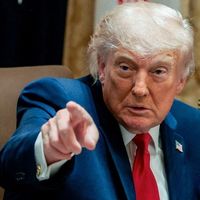
In his address, the president reiterated allegiance to Supreme Leader Khamenei’s leadership, accusing "enemies" of attempting to create divisions among Iranians and portraying the country as weak. He also strongly criticized the US President Donald Trump and accused him of hypocrisy, claiming Trump simultaneously increased pressure on Iran while offering to negotiate and trying to "bring the Islamic Revolution down to its knees."
“Trump says, ‘Let’s negotiate,’ but signs [a document containing] all possible schemes against Iran, then claims he is ready to talk,” Pezeshkian said.
The president also criticized the US for supporting Israeli Prime Minister Benjamin Netanyahu, whom he referred to as “a criminal indicted by international organizations,” referencing the International Criminal Court’s arrest warrant issued for Netanyahu in November 2024.
The British government has not funded Iran's influence network in Western countries, the UK Foreign Office told Iran International, rejecting remarks by a Swedish-Iranian scholar who said his involvement in the scheme was backed by the UK government.
"We have no record of funding for the IEI or any departmental work with them," the UK Foreign Office said in response to an inquiry about funding for the Iran Experts Initiative (IEI), a network linked to Iran’s Ministry of Foreign Affairs.
In late January, a report by Sweden’s TV4 revealed Roozbeh Parsi, the director of the Swedish Institute for International Affairs’ Middle East program, was involved in the IEI, a network formed by Tehran to expand its influence in the West.
Parsi denied any cooperation with the Iranian government, saying his participation in the Iran-led initiative was backed up by the UK government.
"I was doing this on behalf of the British Foreign Office," he wrote in a response published by Expressen, one of Sweden's most prominent dailies, on January 31. "For the British Foreign Office, which financed our participation, and other governments in the West, it was about strengthening their positions ahead of the negotiations on [Iran's] nuclear program."
The Swedish media's investigation, which cited emails provided by Iran International, followed a 2023 joint exposé by Iran International and Semafor that detailed Tehran’s efforts to cultivate relationships with academics and analysts abroad to expand its soft power.
Inquiry into allegations
In 2023, a spokesman for the European Council of Foreign Relations (ECFR) also told Iran International that "the Iran Expert Initiative was a European-government backed initiative that ECFR staff sometimes took part in but did not lead on."
The ECFR spokesman declined to name the European government.
Sweden's Foreign minister Maria Malmer Stenergard saidon Thursday the country had launched an inquiry into allegations that Parsi was involved in the Tehran-led influence network aimed at shaping Western policy.
The top diplomat said the government had contacted the Swedish Institute of International Affairs for more information, calling the allegations “very serious.”
She warned that Iran, along with Russia and China, is conducting extensive intelligence operations in Sweden.
People wearing masks of US President Donald Trump and Israeli Prime Minister Benjamin Netanyahu behind bars during rallies marking the anniversary of the 1979 Islamic Revolution in Iran, February 10, 2024.
Iran's president was among the country's top leaders voicing opposition to dialogue with the United States during events marking the 46th anniversary of the 1979 Islamic Revolution.
Amid celebratory gatherings attended by state officials, President Masoud Pezeshkian said on Monday: “If the US were sincere about negotiations, why did they sanction us?”
Reflecting Tehran's concerns about returning to the negotiating table with President Donald Trump who, during his first term, pulled out of the 2015 nuclear accord and imposed crippling sanctions on Iran, Pezeshkian said: “He says, ‘Let’s have a dialogue,’ and at the same moment, he signs memos for all possible conspiracies against Iran.”
Iranian President Masoud Pezeshkian during rallies marking the anniversary of the 1979 Islamic Revolution in Iran, February 10, 2024
Further casting doubt on recent hopes for rapprochement amid a mood of mistrust, Pezeshkian accused Washington of orchestrating conspiracies against Iran while proposing talks and claimed it was Tehran's archenemy Israel, not Iran, that destabilized the Middle East.
The comments followed Supreme Leader Ayatollah Ali Khamenei’s recent statement that negotiations with the US are “unwise and dishonorable.”
Foreign Minister Abbas Araghchi echoed similar sentiments, saying, “What they mean by negotiation is surrender. Iran negotiated in good faith, but the other side failed to fulfill its commitments and withdrew from the [2015 nuclear] agreement. Why should we trust them?”
Donkeys draped with US, Israeli, and UK flags are displayed at a state-sponsored rally marking the anniversary of the 1979 Islamic Revolution in Iran, February 10, 2024
Defense Minister Aziz Nasirzadeh also rejected talks under current conditions, saying, “We will not negotiate under sanctions and threats, and we do not recognize the new US administration.”
IRGC Aerospace Commander Amir Ali Hajizadeh mocked Trump’s threats, saying, “He does not have such courage. A powerful Iran does not submit to coercion.”
Like previous years, a statement was released by the government after the ceremony stressing that as the Supreme Leader said it is not wise or honorable to hold negotiations with the US.
“The government must strengthen security and intelligence structures to prevent the infiltration of enemy agents and divisive movements within the country’s institutions,” added the statement
The document also called for a stronger military. "We expect national officials to take decisive action against those disrupting the nation’s psychological security," it continued, "who, by aligning with the enemy, attempt to distort the truth.”
As officials rallied in support of the Islamic Republic, protests erupted in Tehran and other cities on Sunday night, where citizens chanted slogans such as “Death to the dictator” and showed anger at Supreme Leader Khamenei during state-organized fireworks displays.
The ongoing public unrest underscores the tensions within Iran as it faces mounting international and domestic challenges in the midst of its crushing economic crisis.
People carrying banners mocking (from left) Turkish President Recep Tayyip Erdoğan, Israeli Prime Minister Benjamin Netanyahu, Saudi Prime Minister Mohammed bin Salman Al Saud and Syria's interim leader Ahmed al-Sharaa during rallies to mark the anniversary of the 1979 Islamic Revolution in Iran, February 10, 2024