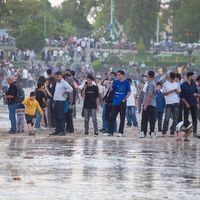
A scene from the rallies to mark the anniversary of the Islamic Revolution in Tehran, February 10, 2024
On Monday, the Iranian state marked the 46th anniversary of the Islamic Revolution, set against the backdrop of controversies surrounding potential talks with the United States, mounting public discontent and a deepening economic crisis.
The event typically features state-sponsored rallies across the country, a speech by the president at Tehran’s Azadi Square, and a participants’ resolution issued by the Islamic Propaganda Coordination Council, which is read at the conclusion of events in Tehran and other cities.
High-ranking officials, such as the heads of the executive, legislative, and judiciary branches, as well as military leaders, take part in these rallies.
This year, state-run television channels aired fewer aerial shots of the rallies, which in previous years had been used to showcase large crowds. The coverage appeared more restrained, reflecting the multiple international, political, and economic challenges facing Tehran.
The national currency, the rial, has been in freefall, losing over 10 percent of its value against the US dollar in four days, since Supreme Leader Ali Khamenei’s speech on February 7, in which he strongly rejected the prospect of talks with the US.
Many Iranians fear further depreciation of the rial before the Iranian New Year (March 20), unless there is a breakthrough in negotiations to revive the 2015 nuclear deal—abandoned by former US President Donald Trump in 2018—or to secure a new agreement. The potential reinstatement of UN sanctions in October through the snapback mechanism has only intensified these concerns.
Public protest amid state celebrations
On Sunday evening, as state-organized fireworks lit up Tehran, citizens in several neighborhoods across the east, west, and south of the capital, as well as in other major cities, chanted slogans from their windows and rooftops.
These included "Death to the Islamic Republic," "Death to Khamenei the Murderer," and "Death to the Dictator."
The chants echoed the widespread protests of 2022-2023, sparked by the death of 22-year-old Mahsa Jina Amini in the custody of the so-called morality police. Those protests, carried out under the banner "Woman, Life, Freedom," were brutally suppressed by state forces.
While the state-run television channels, as always, provided extensive coverage of the anniversary marches and speeches, claiming millions of participants, photos and videos shared on social media suggested a significantly smaller turnout compared to previous years.
Pezeshkian’s speech fails to inspire
Some social media users expressed disappointment with President Masoud Pezeshkian’s speech, criticizing it for failing to address pressing public concerns. Many suggested that, had his ultra-hardline rival Saeed Jalili been elected president, his remarks might have closely resembled Pezeshkian’s.
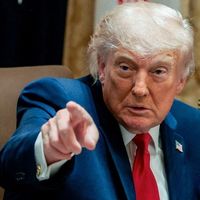
In his address, the president reiterated allegiance to Supreme Leader Khamenei’s leadership, accusing "enemies" of attempting to create divisions among Iranians and portraying the country as weak. He also strongly criticized the US President Donald Trump and accused him of hypocrisy, claiming Trump simultaneously increased pressure on Iran while offering to negotiate and trying to "bring the Islamic Revolution down to its knees."
“Trump says, ‘Let’s negotiate,’ but signs [a document containing] all possible schemes against Iran, then claims he is ready to talk,” Pezeshkian said.
The president also criticized the US for supporting Israeli Prime Minister Benjamin Netanyahu, whom he referred to as “a criminal indicted by international organizations,” referencing the International Criminal Court’s arrest warrant issued for Netanyahu in November 2024.
People wearing masks of US President Donald Trump and Israeli Prime Minister Benjamin Netanyahu behind bars during rallies marking the anniversary of the 1979 Islamic Revolution in Iran, February 10, 2024.
Iran's president was among the country's top leaders voicing opposition to dialogue with the United States during events marking the 46th anniversary of the 1979 Islamic Revolution.
Amid celebratory gatherings attended by state officials, President Masoud Pezeshkian said on Monday: “If the US were sincere about negotiations, why did they sanction us?”
Reflecting Tehran's concerns about returning to the negotiating table with President Donald Trump who, during his first term, pulled out of the 2015 nuclear accord and imposed crippling sanctions on Iran, Pezeshkian said: “He says, ‘Let’s have a dialogue,’ and at the same moment, he signs memos for all possible conspiracies against Iran.”
Iranian President Masoud Pezeshkian during rallies marking the anniversary of the 1979 Islamic Revolution in Iran, February 10, 2024
Further casting doubt on recent hopes for rapprochement amid a mood of mistrust, Pezeshkian accused Washington of orchestrating conspiracies against Iran while proposing talks and claimed it was Tehran's archenemy Israel, not Iran, that destabilized the Middle East.
The comments followed Supreme Leader Ayatollah Ali Khamenei’s recent statement that negotiations with the US are “unwise and dishonorable.”
Foreign Minister Abbas Araghchi echoed similar sentiments, saying, “What they mean by negotiation is surrender. Iran negotiated in good faith, but the other side failed to fulfill its commitments and withdrew from the [2015 nuclear] agreement. Why should we trust them?”
Donkeys draped with US, Israeli, and UK flags are displayed at a state-sponsored rally marking the anniversary of the 1979 Islamic Revolution in Iran, February 10, 2024
Defense Minister Aziz Nasirzadeh also rejected talks under current conditions, saying, “We will not negotiate under sanctions and threats, and we do not recognize the new US administration.”
IRGC Aerospace Commander Amir Ali Hajizadeh mocked Trump’s threats, saying, “He does not have such courage. A powerful Iran does not submit to coercion.”
Like previous years, a statement was released by the government after the ceremony stressing that as the Supreme Leader said it is not wise or honorable to hold negotiations with the US.
“The government must strengthen security and intelligence structures to prevent the infiltration of enemy agents and divisive movements within the country’s institutions,” added the statement
The document also called for a stronger military. "We expect national officials to take decisive action against those disrupting the nation’s psychological security," it continued, "who, by aligning with the enemy, attempt to distort the truth.”
As officials rallied in support of the Islamic Republic, protests erupted in Tehran and other cities on Sunday night, where citizens chanted slogans such as “Death to the dictator” and showed anger at Supreme Leader Khamenei during state-organized fireworks displays.
The ongoing public unrest underscores the tensions within Iran as it faces mounting international and domestic challenges in the midst of its crushing economic crisis.
People carrying banners mocking (from left) Turkish President Recep Tayyip Erdoğan, Israeli Prime Minister Benjamin Netanyahu, Saudi Prime Minister Mohammed bin Salman Al Saud and Syria's interim leader Ahmed al-Sharaa during rallies to mark the anniversary of the 1979 Islamic Revolution in Iran, February 10, 2024
Many Iranians have taken to social media to demand the resignation of President Masoud Pezeshkian, citing his unfulfilled promise to step down if he failed to resolve the problem of US sanctions.
Critics who now regret voting for Pezeshkian or call for his resignation, arguing he lacks the power to change Iran's current worsening economic trajectory, have reminded him that in a campaign video, he pledged to step down if he failed to fulfill his promises.
These promises included the lifting of US sanctions through negotiations, lifting of the internet filtering, and stopping violence against women for hijab.
“I would resign this same day if I were Pezeshkian … I would say [to those who make the decisions]: take responsibility for the country yourself, and say goodbye [to them],” journalist Mostafa Danandeh tweeted.
During his campaign, Pezeshkian criticized the policy of limiting Iran's foreign relations to Eastern bloc countries—China and Russia—and stressed the need for broader engagement, including with the United States. He argued that addressing global challenges, particularly the crippling US sanctions on Iran’s international trade, required a more inclusive diplomatic approach.
In a mid-January interview with NBC, before President Donald Trump officially assumed office, the Iranian president said Tehran was ready for talks with the United States and European Union, emphasizing that Iran was committed to peace and de-escalation in the region and globally but insisted that Iran would not submit to force in any way.
On X, users rallied around the hashtag #Resignation_Pezeshkian, posting criticism of the worsening economic crisis. Many highlighted the impact of strict US sanctions reinstated last week, citing the national currency's further depreciation and rising inflation.
"Were the two years of single-digit inflation after the 2015 JCPOA [nuclear deal] not an achievement? Inflation is the country's primary issue. If tackling inflation, sanctions, filtering, and negotiations—the four main promises Pezeshkian made—has reached such a deadlock, his resignation would be an honorable course of action," argued Javad Aghaei, a psychologist with nearly 1,300 followers on X.
Some others, however, urged Pezeshkian to persevere because his resignation could only make things worse for the Iranian people.
Ghorbanali Salavatian, an Iran-Iraq War veteran and cultural figure with over 50,000 followers on X, wrote in a post on Sunday that he would have urged Pezeshkian to resign and let his ultra-hardliner rival, Saeed Jalili, take the helm if he did not love Iran. "But since we know the disaster that would follow, and because we love Iran and its people, I urge you, Mr. Pezeshkian, to stay and fight for Iran and its people."
On Saturday, the first day of the work week, the Iranian currency, rial, plunged to almost 900,000 per US dollar in reaction to Khamenei’s rejection of talks. Early reports on Sunday indicated a continued decline, with the dollar trading at 910,000. Over the past year, the currency’s collapse has increased consumer goods prices by approximately 50%.
Hardliners and ultra-hardliners insist that Khamenei’s Friday speech, delivered after Trump reinstated the so-called maximum pressure policy on Iran, although he also said that he preferred a deal with Iran, was the Supreme Leader’s “final word”.
Nasser Seraj, a senior Iranian judiciary official accused of abuses by rights groups, has been appointed as the secretary of Iran's High Council for Human Rights and the judiciary's deputy for international affairs.
According to US-based Human Right Activists In Iran (HRAI)'s Spreading Justice website which documents rights abuses in Iran, Seraj "was directly involved in the issuance of death sentences for corruption and consequently is responsible for the violation of the right to life."
Mizan News Agency, the judiciary’s official outlet, reported Saturday that judiciary chief Gholamhossein Mohseni-Ejei appointed Seraj to replace Kazem Gharibabadi, who had held the position since 2021.
Seraj, formerly the judiciary chief’s political deputy, has held key judicial roles, including Tehran’s military prosecutor, judiciary advisor, head of the General Inspection Organization, Supreme Court deputy, and deputy justice minister.
As a judge, Seraj presided over the trial of the 2011 $3 billion embezzlement case, sentencing four men to death. One of those convicted, businessman Mahafarid Amir Khosravi, was executed in 2014 without prior notice to his family or defense attorney.
HRAI's Spreading Justice website says that the rushed execution was intended to prevent Amir Khosravi from exposing the names of government officials involved in the corruption scandal.
The rights group also says Seraj played a key role in restricting press freedom by overseeing the selection of the Press Supervisory Jury, which has been involved in shutting down newspapers and censoring media.
Tehran's Ekbatan neighborhood on Sunday, February 9, 2025
Iranian people marked the 46th anniversary of the 1979 Islamic Revolution with cries of "Death to the Islamic Republic" and "Death to the Dictator" ringing through several cities across the country on Sunday night.
Videos obtained by Iran International show people chanting against the clerical establishment during official fireworks to commemorate 22 Bahman (11 February), the day the Pahlavi dynasty was overthrown, giving way to what is now known as the Islamic Republic.
People in Tehran, Karaj, Arak, Mashhad and Kermanshah, among other cities, chanted "Death to Khamenei the Murderer", "Death to the Islamic Republic" and "Death to Dictator", videos recorded on mobile phones show.
Mashhad is Iran’s second-most populous city in the northeast; Karaj, the third-most populous city, located west of Tehran; Arak, an industrial hub and the fourth-most populous city in central Iran; and Kermanshah, the country’s ninth-most populous city.
The cries were heard in Tehran's Ekbatan, Tehranpars, Jannatabad, Ekhtiarieh and Enghelab (Revolution) neighborhoods, each with different demographic and social characteristics - from middle class to poor districts.
"Death to Execution Republic" was heard in a video from Jannatabad, referring to the Islamic Republic's hanging spree over the past few years.
"No one is chanting Allahu Akbar in this big city," one Tehran resident is heard saying in a video sent to Iran International, referring to the slogan that the Islamic Republic's supporters used to chant during the revolution anniversaries in the past.
In Kermanshah, people chanted slogans like "This year is year of blood, Khamenei falls with a thud."
Men look at newspapers at a road side stall in central Tehran
A hardline newspaper in Iran has warned of potential protests and unrest across the country amid a confluence of political tensions over US talks and devaluation of the national currency, criticizing the administration’s handling of the crises.
Javan newspaper, affiliated with the Islamic Revolutionary Guard Corps (IRGC), cited an unnamed advisor to former president Hassan Rouhani as saying on Sunday that "If the president does not bring the negotiations to fruition, he should give up and leave the presidential office before the winter snow falls in Tehran."
The article by Javan said that such a sentiment about the administration of President Masoud Pezeshkian resonates with both supporters and critics of the government.
"This idea is gaining traction not only among government loyalists but also among its opponents," Javan said, noting that some newly emerged “suspicious” political factions, particularly those that surfaced after the recent elections, appear to be maneuvering to render Pezeshkian ineffective—blocking negotiations and steering him toward a scenario where he either resigns voluntarily or faces a turbulent path toward impeachment in parliament.
"This push for the president's removal is like the two blades of a scissor, cutting deeper into the political landscape and driving the country toward a major crisis before the year’s end."
Javan claimed that, according to enemy intelligence services, growing public discontent fueled by government inefficiency, rising poverty, and inequality could trigger protests in Iran, potentially leading to unrest similar to the events of November 2019.
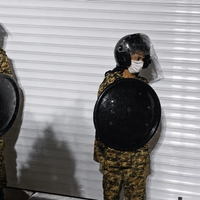
Riot police dispatched to quell protests in Tehran, on November 16, 2019
In 2019, a wave of nationwide protests in Iran, known as Bloody November, erupted following a fuel price hike. What began as economic grievances quickly escalated into demands for the overthrow of the government and Supreme Leader Ali Khamenei. According to various sources, security forces killed at least 1,500 protesters between November 15 and 17.
The Pezeshkian administration is caught between opposing pressures. While urged to ease US sanctions, it faces a firm ban on talks with Washington imposed by the Supreme Leader on Friday.
Since Khamenei’s rejection, Iran’s currency, the rial, has been in freefall, hitting a record low of 915,000 per US dollar on Sunday.
“Negotiating with such a government should not be done; it is neither wise, intelligent nor honorable,” said the 85-year-old cleric during a meeting with air force personnel in Tehran.“No problem will be solved through negotiations with the United States,” he added.
Also on Sunday, Gholam-Ali Haddad-Adel, a member of the Expediency Discernment Council and a close aide to Khamenei, said, “Those who support negotiations with Trump should clarify what they are willing to offer in a deal to persuade him to lift the sanctions.”
Iran's Supreme Leader Ali Khamenei (left) and Gholam-Ali Haddad-Adel
He added, “Mr. Khamenei presents arguments for his stance; those in favor of negotiating with Trump should also provide their reasoning.”
Sociologist Taghi Azad Armaki, in an interview with Etemad newspaper, also warned of potential protests, citing "high prices, the rising dollar rate, high rents, health problems, emigration, and absolute poverty" as key pressures on the population.
"These issues remain unresolved," he warned, "and if not addressed, will soon manifest as widespread protests." He criticized “extremist groups” opposed to negotiations for undermining the administration, stating that they must be controlled and act in the interests of the ruling establishment.
Referring to hardliners, Armaki added, "If extremism is not curbed in the current situation, it will continue to take the form of a widespread wave and will harm the entire system. Social crises should not be allowed to turn into security crises."
Prominent commentator Ahmad Zeidabadi also criticized Friday prayer leaders, accusing them of delivering contradictory and confusing messages.
During Friday prayers, chants opposing negotiations with the US and their supporters—including Vice President for Strategic Affairs Javad Zarif—echoed as Khamenei's representatives, the Friday prayer imams, denounced the idea.
Zeidabadi also condemned the attempts of hardliners who say there is no need for talks with the US because it would not solve Iran's financial crisis. "They routinely blame America for all of the country's cultural, social, and political problems," Zeidabadi wrote, "even though the US neither claims nor has the ability to create them. Yet, when it comes to economic issues, they attribute nearly all problems to internal mismanagement while dismissing the impact of America's extensive sanctions. The contradictions have become deafening."