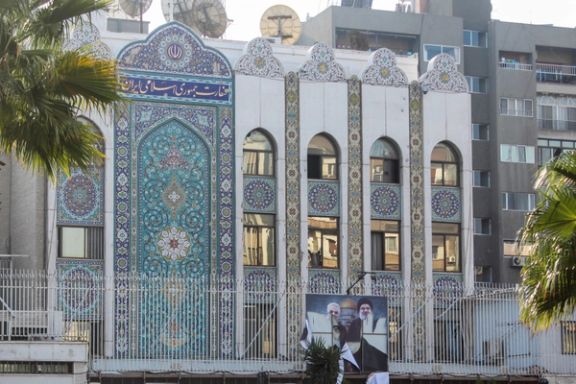
Torn posters of Hezbollah leader Sayyed Hassan Nasrallah and late Iran's Revolutionary Guards' top commander Qassem Soleimani hang at the Iranian embassy after Syrian rebels announced that they have ousted President Bashar al-Assad, in Damascus, Syria December 8, 2024.
Tehran says it is in talks to reopen its embassy in Damascus even after it was sacked by rebels who took over the country and a staff member was killed in murky circumstances.
“Our approach to the embassy matter is fundamentally diplomatic. Both sides are prepared, and we are actively engaged in consultations to facilitate the reopening of embassies in both countries,” government spokeswoman Fatemeh Mohajerani said during a Tuesday press conference.
Speculation had followed a statement by the foreign ministry spokesman Esmaeil Baghaei last week, raising questions around the reopening.
“I prefer not to use the word ‘imminent,’” Baghaei said. “This is on the agenda, and as soon as the necessary conditions are met—both in terms of security and politics—we will move forward with reopening the embassy.”
The delay came on the back of the killing of a local employee of Iran's embassy, Davood Bitaraf, killed in a shooting. Baghaei blamed "terrorists" for the attack and urged the Syrian transitional government to bring the perpetrators to justice.
“The Ministry of Foreign Affairs is seriously pursuing the matter through appropriate channels and various diplomatic and international avenues,” he added.
Video footage from earlier this month, on the day President Bashar al-Assad fled to Moscow, showed militants storming the Iranian embassy, ransacking documents, and vandalizing the premises.
Shattered glass and broken furniture was scattered throughout the building. Iranian media reported that the staff had evacuated before the takeover.
Syria’s new de facto leader, Ahmed al-Sharaa, said in an interview with Asharq Al-Awsat that Iran’s influence in the region has been significantly weakened. Sharaa’s group, Hayat al-Tahrir Sham (HTS), recently defeated Assad’s forces in a rapid takeover, marking a turning point in Syria’s relationship with Iran, which had supported Assad since 2011 in the face of civil war.
“The Iranian project in the region has been set back by 40 years,” Sharaa said, threatening a key military and economic hub for Iran which had bases and forces spread across Syria.
Prominent political activist Majid Tavakoli has been sentenced by an appeals court in Tehran to two years in prison, two years ban on social media activity, a ban on residing in Tehran, and a prohibition on leaving the country, his wife, Maryam Tabandeh, said on Tuesday.
Tavakoli, who was serving a six-year jail term since October 2023, was released on bail in July this year after his retrial request was accepted.
He was arrested in September 2022 at the outset of Iran’s nationwide Woman, Life, Freedom protests, sparked by the death in custody of Mahsa Amini, and was later released on bail on December 20, 2022.
Tavakoli was accused of attempting to "overthrow the Islamic Republic and establish a liberal system."
A scene of protests against gasoline price hikes in Tehran in 2019
Iran's energy-rich government is bracing for potential unrest amid rolling blackouts and rising gasoline prices, with judicial, security and intelligence services briefed to be ready for a response.
On Monday, the head of Iran’s judiciary instructed the Attorney General and provincial prosecutors to coordinate with intelligence, security, and law enforcement agencies to prevent unrest, sensing widespread public dissatisfaction over power and gas outages.
Speaking during a meeting of the Supreme Judicial Council, Gholam-Hossein Mohseni Ejei stated, “The Attorney General and prosecutors across the country, in direct cooperation with the intelligence, security, and law enforcement agencies, should take all appropriate measures and arrangements to stabilize and strengthen the security of the people and citizens, and, as in the past, and even with greater firmness, take the relevant measures so that the enemy's conspiracy to create insecurity…is neutralized."
Ejei, widely recognized as one of Iran’s most prominent human rights violators, warned President Masoud Pezeshkian's administration that the recent wave of nationwide shutdowns caused by air pollution and the government’s failure to meet energy demands could spell unrest. People are struggling to heat their homes in the bitter cold while the cost of living is soaring amid the worst economic recession in the Islamic Republic's history.
The government is bracing itself for action reminiscent of the 2019 and 2022 protests in which hundreds of Iranians were killed by security forces and tens of thousands were arrested.
Facing a 30% shortfall in natural gas supplies from its Persian Gulf fields, the Iranian government has turned to burning the highly polluting heavy oil mazut, shrouding Tehran and other cities in dense smog.
Years of under-investment in the energy sector, exasperated by technology sanctions by the West, has pushed Iran into a downward spiral in natural gas production.
Gas pressure is falling in its main production field in the Persian Gulf that it shares with Qatar. Only the largest Western oil companies have the technological capability to remedy the situation.
The Pezeshkian government has limited options to address the crisis, apart from a complete overhaul of the country’s foreign policy and opening its economy to global engagement.
The latest wave of economic and public sector shutdowns, which began on December 9, has led to widespread closures of schools, universities, and government offices across many provinces.
The electricity and fuel crisis, combined with a sharp decline in the national currency’s value since September, has fueled an increasingly volatile public mood.
Iranians are facing daily price hikes while also witnessing a series of regional setbacks for the government. The most unexpected blow was the rapid overthrow of President Bashar al-Assad, which forced Iranian forces to retreat from Syria, reportedly with Russian assistance.
Recent statements saying that the government is in touch with Syria's new ruling parties reflects possible concern about the perception of its diminishing authority and credibility among the population, both following the debacle in Syria and the deteriorating economic conditions at home.
On Sunday, Supreme Leader Ali Khamenei delivered a speech warning that those within Iran who align themselves with foreign powers, particularly the United States, would face severe consequences.
During the 2022 protests, triggered by the death in police custody of Mahsa Amini, arrested for not wearing her hijab properly, Khamenei blamed the US and foreign powers of having stoked the fires of protests.
"The fools smell the scent of kebab," Khamenei said on Sunday, using a metaphor to describe what he sees as misguided ambitions from those seeking to overthrow the Islamic Republic. "Anyone inside the country who chooses to serve the Americans, the Iranian people will trample them underfoot."
A eulogist kneeling before Khamenei at his meeting with eulogists on January 11, 2023
Iran has witnessed the rapid growth of a group known as ‘eulogists’ during the Supreme Leader Ali Khamenei’s three decades of leadership, playing a very prominent role not only in religious ceremonies, but also in the country's political sphere.
Khamenei has become a huge patron of the country's eulogists, inviting them to perform at ceremonies he holds at his residence for religious occasions such as commemoration ceremonies to mark the deaths of Shia saints. His predecessor, Ruhollah Khomeini who founded the Islamic Republic only used the services of clerics at such events.
Khamenei received a large group of eulogists who performed at his residence on Sunday. In his speech to the group, he spoke of the fall of Syrian President Bashar al-Assad and denied that Iran has proxy forces in the region, and said the eulogists were artists who “make jihad with words”.
"Eulogy is a real media tool ... for elucidation [of the truth],” he said.
Q. Are ‘eulogists’ clergymen?
Most ‘eulogists of the Prophet’s household’ (maddah-e ahl-e beyt) are laymen with no seminary training or place in the clerical hierarchy.
Q. What role do eulogists play in religious ceremonies?
Eulogists recite and sing verses in praise of the Prophet Muhammed and his household, particularly at ceremonies such as Ashura to mourn Shia Imams on the anniversary of their death. Professional eulogists have found a much more prominent role than clerics in these ceremonies in the past three decades.
Q. How many eulogists are there in Iran now?
Over 100,000 professional and amateur eulogists perform in Ashura and other religious ceremonies across Iran. However, there are no official figures on the number of professional eulogists who are members of large and small professional associations such as Khaneh-ye Maddahan (Eulogists' House).
Q. How do eulogists earn their living?
Professional eulogists earn their living mainly by performing at ceremonies for fixed fees alongside businesses they may run. Many others who may be considered amateurs have ordinary jobs or businesses and perform for free or a small ‘gift’ from the organizers of such events.
Some eulogists such as Mansour Arzi and Mahmoud Karimi, two of Khamenei’s favorites, have gained celebrity status in the past three decades. Iranian media have on many occasions alleged that ‘celebrity eulogists’ only attend ceremonies in return for very hefty fees.
In a recent online interview, Hamidreza Alimi, a eulogist who says earns his living by selling household appliances, claimed that some of his peers demand as much as two billion rials for a few hours of performance. He also alleged that these eulogists ask for cash payments to avoid paying taxes on their incomes.
Q. What benefits do eulogists receive from the government?
In 2015, Supreme Leader Ali Khamenei ordered the establishment of a foundation to provide government welfare services including health insurance to professional eulogists.
The foundation, named after Dibil bin Ali al-Khuzai, a seventh-century Shia poet, does not have a separate budget. However, it receives huge donations from various government and state bodies such as the Islamic Propaganda Organization and municipalities for “cultural activities”.
Professional eulogists also enjoy numerous perks from government and state bodies including priority in the allocation of housing and loans.
Q. What is the relationship between eulogists and political groups?
Most ‘celebrity eulogists’ have strong ties with ultra-hardline political parties and groups and often use religious ceremonies to campaign for them during parliamentary and presidential elections.
In their speeches and performances, these eulogists freely attack political rivals. Some are known for slandering top officials of the rival camp with immunity.
Mansour Arzi, a veteran eulogist known for his notorious attacks on several presidents including Mohammad Khatami, Mahmoud Ahmadinejad when he fell from Khamenei’s favor, and Hassan Rouhani, published his own list of candidates in the parliamentary elections of February 2024.
Arzi officially supported Saeed Jalili in the snap presidential elections of July and on several occasions publicly attacked Masoud Pezeshkian for criticizing the harsh enforcement of hijab.
Eulogists are also often invited as pre-sermon speakers at state-sponsored Friday prayer gatherings.
Q. Are all eulogists aligned with the ruling political establishment?
Some eulogists only perform at the behest of religious groups organized by ordinary citizens and refuse to get involved in politics. Some others support reformists or dissident clerics such as the Qom-based Ayatollah Sayyid Sadiq Shirazi who is highly critical of Khamenei's religious views and rule.
Since the disputed elections of 2009 that brought Mahmoud Ahmadinejad to power, some eulogists have used the story of the martyrdom of the Prophet’s grandson, Imam Hussain, to express their opposition to an interpretation of Islam that the Islamic Republic has been promoting for four decades during the Ashura ceremonies held in Imam Hussain’s memory.
In July 2023, during an Ashura ceremony in Dezful, the eulogists leading the ceremony fearlessly sang lyrics that openly criticized the political establishment and its insistence on enforcement of hijab, an issue which has seen the country thrown into revolutionary fervor since 2022's Women, Life, Freedom uprising.
Syria has suspended flights to and from Iran until January 22 amid regional tensions, the head of Iran's Civil Aviation Organization announced Tuesday.
Hossein Pourfarzaneh added that flights will remain suspended until after the New Year holidays.
He also noted, "Even during the tensions in Syria, Iranian flights continued with special permits," but he did not provide further details on these permits.
It remains unclear exactly when the suspension of flights was implemented.
Israeli news website Walla reported on Sunday that the new government of Syria had decided to prevent all Iranian planes - including civilian ones - from flying over Syrian skies.
Ismail Haniyeh meets Iran's Supreme Leader Ali Khamenei in Tehran
Israel's defense minister on Monday publicly admitted for the first time that the Jewish state assassinated Hamas leader Ismail Haniyeh in Tehran on July 31, 2024.
While Israel's role was already widely understood, its disclosure likely signals Israel is less concerned about provoking an Iranian response after the Islamic Republic and its allies in the region have been dealt harsh Israeli military blows in recent weeks.
"These days, when the Houthi terrorist organization is firing missiles at Israel, I want to convey a clear message to them at the beginning of my remarks: We have defeated Hamas, we have defeated Hezbollah, we have blinded Iran's defense systems and damaged the production systems, we have toppled the Assad regime in Syria, we have dealt a severe blow to the axis of evil, and we will also deal a severe blow to the Houthi terrorist organization in Yemen, which remains the last to stand," Israel Katz said during an evening honoring defense ministry personnel.
"We'll severely cripple the Houthis, damage their strategic infrastructure, and we will behead their leaders – just as we did to Haniyeh, Sinwar and Nasrallah in Tehran, Gaza and Lebanon – we will do it in Hodeidah and Sana'a," Katz added.
Haniyeh was a Palestinian politician who served as prime minister of the Palestinian National Authority for over eight years until 2014 and as chairman of the Hamas Political Bureau from May 2017 until his assassination in Tehran.
He had been attending the inauguration of newly elected Iranian President Masoud Pezeshkian when he was assassinated. At the time, Hamas said they were convinced Haniyeh was killed, along with one of his bodyguards, by an Israeli airstrike on his residence.
Iran's Islamic Revolutionary Guard Corps (IRGC), which was responsible for protecting Haniyeh, said in early August that Haniyeh was assassinated with a "short-range projectile with a warhead of approximately 7 kilograms".
"This action was designed and implemented by the Zionist regime and supported by the criminal government of America," the IRGC added.
Western media reports suggested that Haniyeh was killed by explosive devices planted well in advance in his room, possibly by agents recruited by Mossad, Israel's intelligence agency. A report by The Telegraphsays the devices were placed in three separate rooms of the guesthouse, pointing to a meticulously planned operation.
The assassination was carried out despite heightened security measures due to the inauguration which took place one day earlier, underscoring a severe breach in Iran's security apparatus.
A report by the New York Times said at the time that over two dozen individuals, including senior intelligence officers, military officials, and staff at the guesthouse, had been detained in connection with the incident.
Haniyeh's assassination was soon followed by a series of Israeli attacks killing other leaders of Iran-backed groups including Hezbollah chief Hassan Nasrallah on September 27 and Haniyeh's successor Yahya Sinwar on October 16.