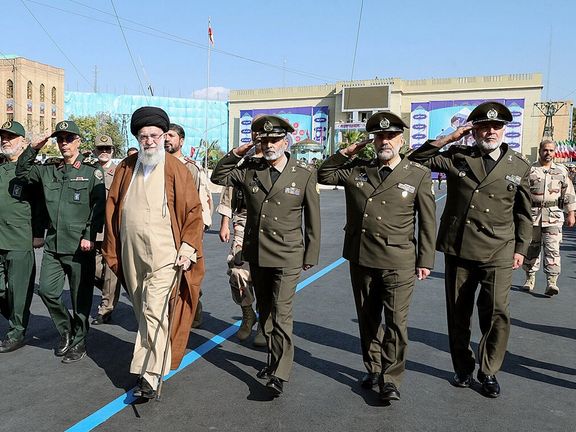
Khamenei with IRGC and army top brass in October 2023
On August 27, Ali Khamenei, the supreme leader of the Islamic Republic of Iran, told the newly elected president, Masoud Pezeshkian, and his cabinet that talking to the enemy may be useful.
In a thinly veiled reference to Iran’s engagement with the international community – and specifically the United States – Khamenei said Iran should not pin its hopes on such engagement, but that is no reason not to hold talks with the enemy.
This is the kind of green light that Pezeshkian needs to engage again with the International Atomic Energy Agency and Western countries on Iran’s nuclear program, and to engage with international interlocutors over its heightened tensions with Israel.
This statement seems to signal a desire to walk back from the brink of an all-out war with Israel over the assassination of Hamas political leader Ismail Haniyeh on Iranian soil in July and revert back to the mutual deterrence that had defined their relationship for years.
An undated photo showing Khamenei inspecting military hardware.
This, however, may not be an option given how much the region has changed over the past year.
In April of this year, Israel targeted Iran’s embassy complex in Damascus, killing members of the Islamic Revolutionary Guards Corps.
This led to a carefully choreographed Iranian response. Iran could not ignore the Israeli attack, which the authorities condemned as an assault on Iranian sovereign territory, but did not wish to go into war with Israel. As a result, Iran reportedly gave advance warning of its impending response, which allowed Israel and its allies to shoot down most of the 300-odd missiles and drone fired from Iran.
This response was nonetheless seen as a victory in Iran, as it demonstrated its technological capacity to reach Israel. It also marked a departure from Iran’s default position of talking tough, but not getting involved in direct confrontation.
Iran clearly crossed a threshold in April, but seems very uneasy about the consequences.
Then, on July 31, Haniyeh was assassinated while on a visit to Iran. Although Israel has neither confirmed or denied responsibility, it is widely believed to have been behind it.
This has put the Iranian leadership in a bind. There have been calls from hardliners for retaliation to restore Iran’s image as a country that can defend itself and avenge the killing of a close ally. Khamenei has also insisted Israel will be punished for its action, but the time would be of Iran’s choosing.
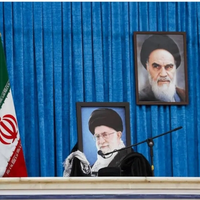
Khamenei praying at Haniyeh's funeral ceremony in Tehran on August 1, 2024
It is clear the Iranian leadership cannot afford to look weak and risk damaging their standing among their allies and proxies in the region, which include Hamas, Hezbollah in Lebanon, the Houthi rebels in Yemen and other Shi'a militant groups in Iraq and Syria. But there are also other considerations that weigh heavily on their mind.
A direct response to Israel could open a Pandora’s box. It would pave the way for further direct attacks by Israel, perhaps even targeted assassinations of Iranian leaders.
This is a real possibility. Israel has demonstrated its willingness to respond to any threat with force under the rubric of self-defense. It has also demonstrated its ability to carry out precision attacks in Iran, such as its retaliatory strike on a radar system in the city of Isfahan after Iran’s missile and drone attack in April.
Furthermore, such escalation presents the real risk of drawing the United States into the conflict.
The Iranian leadership has made an art of brinksmanship. Anti-Americanism is ingrained in the political discourse of the political elite and frames Iranian foreign policy. But Iran has so far avoided war with the United States, because that could risk everything.
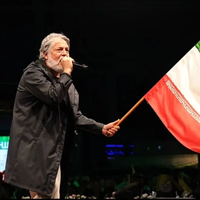
Iranian regime supporters burning American and Israeli flags in November 2021
The reason: Iran’s leaders are already nervous about their political future, and conflict with Israel and the US could seriously exacerbate the situation.
There is a major disconnect between large segments of society and the ruling regime at the moment. Two years ago, Iran was rocked by spontaneous anti-regime mass protests under the banner of “Woman, Life, Freedom”. They started in response to the death of Mahsa Amini in custody for not wearing her hijab properly, but soon morphed into an anti-establishment revolt that called for the “fall of dictatorship” and an end to the Islamic regime. The revolt was put down by force, arbitrary detentions and executions.
The death of President Ebrahim Raisi in a helicopter crash in May this year offered an opportunity for the ruling regime to seek a reconciliation with its reformist critics. Pezeshkian, a reformist parliamentarian, was vetted and approved to run in the election to replace Raisi with the intention of increasing voter turnout. Iran’s supreme leader has repeatedly pointed to the voter turnout rate as an indicator of the regime’s legitimacy.
Yet, the participation rate in the first round of the election was just 39.9% – the lowest in a presidential election in Iran’s history – and only reached 49.8% in the final round. This points to the depth of public disillusionment with the political system. Many reformists boycotted the election and dismissed the exercise as a sham and smokescreen for the ruling regime.
Iran’s crisis of legitimacy is at its highest point, making it ripe for another explosion. War with Israel or the United States can ignite this tinder box.
So the Iranian leadership faces a dilemma. It cannot walk back from its anti-Israel and anti-US rhetoric. Tehran has built its foreign policy and formed an extensive network, the so-called Axis of Resistance, based on it. It cannot betray this pillar of its identity.
But acting on it would risk the survival of the regime. So the leadership has been looking for an increasingly difficult-to-find balance.
Hezbollah’s recent exchange of fire with Israel may have been the answer. By supporting Hezbollah, Iran can claim to have inflicted pain on Israel without striking itself.
This is aimed at restoring the status quo that existed before April. This strategy outsources the fighting to Hezbollah and Iran’s other proxies to protect the ruling regime from a direct confrontation and ward off an existential threat to the leaders’ rule.
But this may be wishful thinking. This strategy could give Israel the justification it needs to strike Iranian targets again. And this, in turn, could serve as the spark for the public’s pent-up frustration aimed at the brutality of the ruling regime.
Iranian President Masoud Pezeshkian during a cabinet meeting on August 28, 2024
Concerns about how President Massoud Pezeshkian's cabinet has been operating since taking office are steadily increasing, especially regarding inequality in areas such as media, access to Internet and treatment of men and women in Iran.
In a commentary in Etemad newspaper on Monday, columnist Abbas Abdi argued that addressing inequality is the greatest challenge facing the Pezeshkian administration. He further cautioned that failing to tackle these disparities could push society into a dangerous imbalance.
Although Abdi belongs to the broader ‘reformist camp’ and is sympathetic to Pezeshkian, he felt necessary to warn the new president, during his political honeymoon, to become more sensitive to the urgent need for change. Although Pezeshkian sometimes sounds like a reformist, he also acts in a conservative manner with full deference to Supreme Leader Ali Khamenei.
He noted that these inequalities are evident in areas such as the economy, regional development, water supply, environmental issues, budget allocation, employment, and retirement. If left unaddressed, they are likely to strain the government's relationship with the public and widen social and political divides in society.
Abdi warned that these inequalities are becoming increasingly severe, and the government's frequent mismanagement of them is creating social and political problems. He further emphasized that many of these issues have straightforward solutions, but if mishandled, they risk spreading to other areas and exacerbating the situation.
Abdi reiterated that addressing these inequalities requires a coordinated effort from all branches of government, as they cannot be resolved single-handedly. He also blamed previous administrations, including the Raisi government, for contributing to these issues. According to Abdi, Raisi's Minister of Economy, Ehsan Khandouzi, mentioned that Raisi's ministers raised concerns, but their warnings went unheeded.
Abdi emphasized that the government is duty-bound to do its utmost to resolve these problems and restore the people's trust.
He wrote, "Pezeshkian's presidential candidacy and his promise to improve the country's situation by appointing experts to key positions gave Iranians a renewed sense of hope. However, the plans presented by the new government's economic ministers show no sign of change or a path out of the country's problems." He continued, "What we've heard so far is merely a repetition of the same flowery, run-of-the-mill statements with no sign of innovation on the horizon. We've been hearing these statements for decades, yet nothing has changed."
The entrepreneur advised that Pezeshkian's ministers should surround themselves with a team of experts in their respective fields to scrutinize decisions before they are announced or implemented. These experts, Bahrainian emphasized, should be recognized for their expertise and have a track record free of corruption.
This advice followed a series of appointments by the new government that appeared misaligned, seemingly made without consideration of individuals' expertise or track record.
The growing concerns among experts about Pezeshkian's government and its operations are alarming. If Pezeshkian continues to disregard these warnings, observers believe that Iran and its government could face a perilous situation.
Iranian President Masoud Pezeshkian during an interview with state broadcaster on August 31, 2024
In his first televised interview as President, Masoud Pezeshkian attempted to maintain the persona of a relatively candid politician but carefully sidestepped major issues and questions.
Pezeshkian made only brief mention of the Islamic Republic’s foreign policy, including its significant dispute with the West over its nuclear program—a conflict that has positioned Iran as a nuclear threshold power but has also impoverished the nation economically. The president merely acknowledged, in a single sentence, that the economic crisis was tied to both domestic and foreign factors.
Notably, Pezeshkian refrained from mentioning Israel, the United States, or the Middle East crisis, thereby avoiding the usual ideological rhetoric against "the enemies."
Five weeks into his presidency, Pezeshkian was somewhat candid in listing the symptoms of Iran's current challenges but stopped short of addressing the fundamental causes. He highlighted issues such as delayed payments to wheat farmers, energy shortages, environmental crises, and the underpayment of teachers and nurses—symptoms of the country’s deeper problems.
While he emphasized the need for national accord, Pezeshkian did not discuss the importance of media freedom or the release of political prisoners. He spoke of respecting diverse opinions but overlooked the harsh sentences handed out for even mild criticism of the clerical government.
Rouydad 24, a major reformist-leaning news website in Tehran, published a critical analysis of Pezeshkian’s interview, stating, "The president's first address to the public can hardly be described as a success in terms of appeal, though it wasn't a failure either. He candidly addressed some of the country's most pressing issues, focusing on justice, while skillfully avoiding topics related to problems surrounding the concept of freedom."
Pezeshkian also failed to mention the recent death of Mohammad Mir-Mousavi, an Iranian citizen who died from beatings while in police custody in Lahijan. He skirted around issues such as the hijab mandate and severe internet restrictions, insisting that such policy matters are under discussion and that experts will devise solutions. This led Rouydad 24 to conclude that the president’s remarks were "short on freedom."
On foreign policy, Pezeshkian largely avoided the topic, neglecting both its role as a primary cause of Iran’s economic woes and its reinforcement of the regime’s anti-Israel and anti-West rhetoric. Although Pezeshkian is scheduled to attend the UN General Assembly in New York later in September, he offered no hints about any specific diplomatic plans.
He did emphasize the importance of engaging the Iranian diaspora, who could potentially invest billions of dollars in the country, helping to alleviate the current fiscal crisis. However, he failed to address the regime’s policies that have driven millions of the most educated and financially capable Iranians out of the country.
This file photos shows Palestinians reacting during a protest against Israeli settlements near Nablus in the Israeli-occupied West Bank September 15, 2023.
Clashes erupted between Israeli forces and Palestinian fighters in the occupied West Bank on Saturday as Israel continued its military operation in the volatile city of Jenin amid fears of a "third front" emerging in Israel's war on Iran-backed militants.
Israeli troops conducted searches in areas surrounding Jewish settlements after two separate security incidents on Friday night. In Jenin, drones and helicopters circled above, while sporadic gunfire echoed through the city.
Since Wednesday, hundreds of Israeli troops have been carrying out raids in what is one of the most extensive operations in the West Bank in recent months.
Israel says the operation was launched to prevent attacks on its citizens by militant groups backed by Iran.
An Israeli official, speaking to Iran International, revealed on August 29 that "terrorists, with the support of the Islamic Republic," have established military bases in cities and refugee camps across the West Bank.
The official emphasized that Israel's ongoing operation, aimed at dismantling this Iranian-backed network, has no set end date.
So far, at least 19 Palestinians, including both armed fighters and civilians, have been killed since the operation began, according to Reuters. The Israeli military announced on Saturday that a soldier had also been killed during the fighting in the West Bank.
The Israeli forces are confronting Palestinian fighters from armed factions that have long maintained a significant presence in Jenin and the adjacent refugee camp, a densely populated area housing families displaced during the 1948 Middle East war, which coincided with the creation of Israel.
On Saturday, the Palestinian Red Crescent reported that a child in Jenin had been taken to the hospital with a bullet wound to the head.
This escalation in the West Bank occurs amid ongoing fighting between Israeli forces and Hamas militants in the Gaza Strip, nearly 11 months after the conflict began. Additionally, hostilities with the Iranian-backed Hezbollah movement along the Israel-Lebanon border have intensified.
Late Friday, Israeli forces reported that two men were killed in separate incidents near Gush Etzion, a large settlement cluster in the West Bank south of Jerusalem. The military believes both were attempted attacks on Israelis.
In the first incident, a car exploded at a petrol station in what the army described as an attempted car bombing. A man was shot dead after exiting the vehicle and attempting to attack soldiers.
In the second incident, a man was killed after the military said a car attempted to ram a security guard and infiltrate the Karmei Tzur settlement. The car was pursued by security forces, crashed, and then exploded, according to the military.
Palestinian health authorities confirmed the two deaths but did not provide details on how they occurred.
Troops scoured the area after the incidents, and security forces conducted raids in Hebron, where the two men were from.
Hamas praised what it termed a "double heroic operation" in the West Bank, stating that it was "a clear message that resistance will continue as long as the occupation's aggression against our people and land persists." However, the group did not claim direct responsibility for the attacks.
On Saturday, Israeli army chief General Herzi Halevi announced that Israel would intensify both defensive measures and offensive actions like the Jenin operation.
Amid the fighting, armored bulldozers searching for roadside bombs have torn up large sections of paved roads, damaging water pipes and causing flooding in some areas.
Since the Hamas attack on Israel last October, which sparked the Gaza war, at least 660 Palestinian combatants and civilians have been killed in the West Bank, according to Palestinian sources. Some were killed by Israeli troops, while others died in attacks by Jewish settlers on Palestinian communities.
Vintage and classic car whows attract Iranians of every walk of life
Lovingly restored luxury classic and vintage cars, often showcased at events across the country, evoke nostalgia for many Iranians, reminding them of the 'good old days' when a Western lifestyle was within easy reach.
Unlike Cuba where classic cars are almost exclusively American-made imports before the country’s 1959 Revolution, there are around 7,000 classic American, British, and other cars in Iran most of which date back to the 1960s and as late as the Islamic Revolution of 1979.
To the enthusiasts, these cars and vintage imported home appliances such as fridges evoke nostalgic memories of the 1970s oil boom and huge imports of luxury items.
While Western exporters and manufacturers rushed to get a market share in the 1970s Iran with a booming economy and open-door economy, things drastically changed in 1979 when a coalition of Islamist clerics and anti-West leftists took over the country.
In memory of Iran Transam event
Many classic and vintage cars have been meticulously restored and are often displayed in various cities at special events organized by enthusiasts’ clubs. Almost none, however, are in active use because of a 2007 pollution ban and fuel restrictions resulting from fuel rationing.
Owners of a few hundred of these cars have managed to obtain “historical” plate numbers that allow them to drive them at special events or to sell them on but many can neither be used nor sold.
A vintage Mustang displayed at classic car show in Iran
The Islamic Republic also has a Classic Car Museum where the luxury and several truly one-of-a-kind cars belonging to the former royal family are on display. These include a gilded Pierce Arrow A built for the founder of the Pahlavi Dynasty, Reza Shah, and a gilded Chrysler K-300 made for his son Mohammad-Reza Shah.
In the 1970s, the streets of major Iranian cities were lined with Cadillacs, Chevrolets, Mercedes, Jaguars, Alfa Romeos, and other luxury cars, while ordinary citizens drove their affordable, locally assembled Paykans (Hillman Hunters), purchased on credit with small monthly payments.
Cars belonging to the former royal family at the National Automobile Museum
Many luxury foreign cars pre-dating the Islamic Revolution were shipped to the country during the oil boom of the 1970s by students studying abroad and government officials. These people were allowed to ship a car home tax-free when they returned home, for personal use or to sell at a good profit. In the late 1970s, those who traveled to Europe could also buy a car and drive back to avoid full import taxes.
In May 2022, Iran's Motorcycle and Automobile Federation became the 30th country to register its vintage cars with the Federation International des Vehicules Anciens (FIVA), a partner of UNESCO with consultative status, making it possible for the owners to use the federation’s international identification facilities for global registration of vintage cars in Iran.
Traffic in Tehran circa 1960
But when it came to American cars, besides imports, several models of Cadillacs, Buicks, and Chevrolets were assembled in Iran by Iranian manufacturers in the 70s.
Buick Sky Lark sedan, for instance, was assembled by General Motors Iran (now Pars Khodro) between 1975 and 1979. The same company also rolled out its first Chevrolet Nova in 1976.
It was nearly two decades and a revolution later that Japanese, German, Korean, and French companies began producing Nissan, Mazda, Mercedes Benz, Kia, Hyundai, Peugeot, and Renault in Iran.
The UN sanctions imposed on Iran since 2005 brought these to a standstill. Despite the lifting of these sanctions in 2016, European and East Asian manufacturers have avoided investment in Iran and only Chinese car manufacturers have been active in the country.
Iranian blogger and proofread Hossein Shanbehzadeh
Iran's Judiciary on Saturday handed a total of 12 years in prison to Iranian blogger Hossein Shanbehzadeh who was arrested in June after posting a single dot in response to a tweet by Supreme Leader Ali Khamenei.
Shanbehzadeh posted the dot in May in a seemingly innocuous move but was arrested a few weeks later, after his reply garnered significantly more likes than Khamenei's original tweet, drawing widespread attention. His temporary detention order was extended in July for another month.
On August 31, his lawyer announced he has been sentenced to a total of 12 years in prison for spurious chargesthat are usually leveled by the Islamic Republic's Judiciary against activists to keep them jailed for long terms and intimidate others.
Shanbehzadeh, known for his candid critiques and social media presence, has been sentenced to five years in jail for "pro-Israel propaganda activity," four years for "insulting Islamic sanctities," two years for "spreading falsehoods" on social media, and one year for "anti-regime propaganda activity," his lawyer Amir Raisian told Shargh newspaper on Saturday.
Although sentenced to a total of 12 years, he is required to serve the longest term, which is five years, Raisian explained.
According to the lawyer, the Judiciary has not provided any evidence to prove that the defendant committed "pro-Israel propaganda activity". Raisian says the charge has been leveled against him based on his "private chats".
For his other charges, Raisian said the court cited his support for other political prisoners, portraying the country's situation negatively, using the hashtag "No to Execution," supporting the removal of mandatory hijab, creating a negative media atmosphere against Iran's elections, and expressing joy at the death of Iran's former president, Ebrahim Raisi, as evidence.
The lawyer says he will consider appealing the sentence after discussing it with his client in prison.
Shortly after his arrest in May, Shanbehzadeh's X account was deactivated, likely to prevent its misuse by security agencies, but his name trended on Persian-language X for hours as users highlighted his influence and fearless commentary.
Shanbehzadeh had previously been imprisoned in connection with the 2019 protests on charges of "insulting the sanctities and the leader of the Islamic Republic." His arrest this time led to accusations by IRGC-linked media, with reports claiming he was a "fugitive Mossad agent" with ties to Israeli intelligence and a history of insulting religious figures. The Ardabil prosecutor's office further alleged that Shanbehzadeh had been in contact with high-ranking Mossad officers and was arrested when trying to flee the country through northwestern borders.
In response to these accusations, Shanbehzadeh's family refuted the claims as "unjustifiable," emphasizing that he has always used his real identity on social media. They also pointed out that the charges were leveled just 24 hours after his arrest, without him having access to a lawyer.
The arrest has drawn outrage from social media users, many of whom link it directly to the viral comment Shanbehzadeh made under Khamenei's tweet. Chess grandmaster and Putin critic Garry Kasparov even responded to the news with a single dot on his X account.
Shanbehzadeh's case has raised alarms about Iran's history of using espionage charges against its critics, drawing comparisons to other high-profile cases, such as that of Maziar Ebrahimi, a businessman falsely accused of spying for Israel.