High Voter Turnout ‘Essential’ for Islamic Republic's Survival, Says Khamenei
Iran's Supreme Leader Ali Khamenei before making a speech on the occasion of Eid al-Ghadir—a Shiite holiday on June 25, 2024.
Iran’s Supreme Leader Ali Khamenei says high voter turnout in Friday's presidential election is crucial for the survival of the Islamic Republic, amid what many have long described as a crisis of legitimacy of the ruling establishment.
“We place great importance on high participation because the most significant effect of high participation is the honor of the Islamic Republic,” Khamenei stated in a speech on Tuesday.
In what some experts said was an attempt to rally Iranians behind the regime's rhetoric of 'foreign enemies', he said, “The Islamic Republic has enemies. One of the things that can defeat these enemies is the election. If high participation of the people is observed in this election, it will be a source of honor for the Islamic Republic.”
A recent poll by the Netherlands-based Gamaan Institutesuggest that at least two thirds of eligible Iranian voters have decided to abstain from casting a ballot.
In the 2021 presidential election in Iran, the voter turnout was notably low, recorded at around 48.8%, which was the lowest in the history of the Islamic Republic's presidential elections.
The upcoming election is expected to face similar challenges, with projections of low turnout due to increasing social repression and the ongoing economic crisis facing the country.
The country's snap presidential election is set to be held on June 28 following the sudden death of Ebrahim Raisi in a helicopter crash last month.
Khamenei’s speech, delivered on Eid al-Ghadir—a significant Shiite Islamic holiday—emphasized the connection between religious duty and civic participation. Many observers noted that this was a transparent attempt to reinforce Tehran’s faltering legitimacy amid increasing internal and external pressures. He asserted, "Iran's strength does not lie in possessing an array of missiles, but fundamentally in the active participation of its citizens in the electoral process."
Additionally, Khamenei subtly indicated his favored presidential candidate by firmly rejecting any negotiations with the United States. He stated, "Some of our politicians believe they must align themselves with one power or another, or that the path to progress necessarily leads through the US; this is a grave misconception. Those who look beyond our borders fail to recognize and value our inherent capacities; naturally, they lack the vision to utilize them."
This stance would potentially appear to disqualify three of the six approved presidential candidates, including Mohammad Bagher Ghalibaf, Mostafa Pourmohammadi, and Masoud Pezeshkian. Pezeshkian, in particular, is seen as disadvantaged due to his association with former Foreign Minister Mohammad Javad Zarif, the so-called architect of the 2015 nuclear deal (JCPOA), who advocates for dialogue with other countries, including the US, to lift current sanctions.
Khamenei's speech also suggested the Supreme Leader’s ongoing efforts to “purify” the political landscape by narrowing down the circle of trusted regime insiders. He even urged the future president to vow, "Make a solemn pledge before God that you will refrain from appointing individuals and agents who deviate even slightly from the revolutionary path.
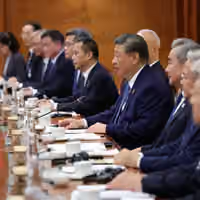
Despite mounting criticism of the country’s isolationist foreign policy, Khamenei appeared steadfast in his "Looking East" strategy, emphasizing relations with China and Russia over the West. He attempted to deflect any criticism saying, "Contrary to popular misconceptions, we are not pursuing isolation or severing our global ties. Except for a few nations, we are open to fostering connections with the broader international community."