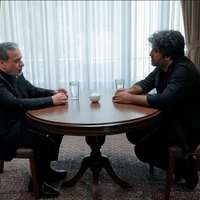
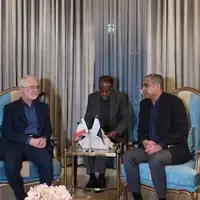
Iran's Ambassador to Azerbaijan Abbas Mousavi during an interview at Iran's embassy in Baku (March 2024)
Iran’s Ambassador to Azerbaijan, Abbas Mousavi, has been dismissed from his role, according to the IRGC-affiliated Tasnim news agency.
This news, just a mere two weeks after Iranian state media started a barrage of criticism against the now former Ambassador, following an interview he gave to a female reporter in Baku, who was not wearing a hijab.
A career diplomat, Mousavi served as spokesman for the Ministry of Foreign Affairs from 2019 to 2020 – most notably during the time of then-Foreign Minister Javad Zarif. Mousavi was appointed as Iran's ambassador to Azerbaijan in August 2020.
While not confirmed officially, it appears the controversy over this interview may have been the reason for Mousavi’s dismissal from his role as Ambassador.
Prior to the dismissal, the Tasnim news agency had made its case that the interview took place in the Iranian regime’s embassy in Baku, which is considered Iran’s territory under international law – and that Iranian diplomats worldwide are mandated to adhere to the principles of the Islamic Republic.
Furthermore, the agency claimed that the female reporter's presence without a hijab is viewed as a disregard for Iran's rules and regulations.
Tasnim argued that Gülməmmədova's “breach” of hijab codes is especially serious because it transpired within the confines of the Iranian embassy and in the company of the Iranian ambassador, insisting the Ambassador should resign "for the sake of Iran’s honor”.
Gülməmmədova, who has conducted interviews with various foreign officials, has not faced criticism for not wearing a hijab, even during interviews with Ambassadors from the UAE and Pakistan.
Meanwhile, BultanNews, aligned with regime hardliners, had asserted that the Azerbaijani reporter's attire violated diplomatic protocols and showed insufficient respect for Iranian officials. The media outlet emphasized that the interview took place beneath the portraits of Iran's former leader Ruhollah Khomeini, Supreme Leader Ali Khamenei, and Qasem Soleimani, the top Iranian military commander killed in a 2020 US drone strike in Iraq.
“The Ministry of Foreign Affairs should be held accountable [for this interview]. Why should Iran’s honor be tarnished on Iranian soil?” BultanNews added.
The regime imposes draconian hijab laws, severely punishing Iranian girls and women who fail to abide by the Islamic Republic’s strict codes.
One of the last victims of the Iranian regime’s repressive hijab policy was Armita Geravand. The 16-year-old girl passed away on October 28, 2023, after spending approximately a month in a coma due to brain damage inflicted during a violent altercation with the regime’s hijab enforcers.
A view from Iran’s pavilion at Doha International Maritime Defense Exhibition and Conference (DIMDEX) (March 2024)
The news of Tehran regime’s military-industry complex showcasing its “Gaza” drone at Doha International Maritime Defense Exhibition and Conference (DIMDEX) surprised few industry observers.
Until DIMDEX entered the stage in 2008, Turkey’s Istanbul International Defense Industry Fair, “IDEF” (1993-present), UAE’s Abu Dhabi International Defense Exhibition, “IDEX” (1993-present), and Pakistan’s Karachi International Defense Exhibition and Seminar, “IDEA S” (2000-present), did enjoy unrivalled seniority over Qatar’s DIMDEX as regional biennial military exhibition hubs. But Iran’s effective “show” of its military hardware at DIMDEX 2024, the Qatari military exhibition just took the whole concept of arms deals and commerce to a grand new level.
Certainly, this is not Iran’s first rodeo at DIMDEX as the Iranian military industrial complex has been an enthusiastic participant at Qatar’s military expo for quite a few years. Since 2014, Qatar and Iran have become increasingly aligned in a cold war against Saudi Arabia and their military and security cooperation and sponsorship of non-state antagonists such as Hamas has bonded them in an unprecedented way.
Iran Aircraft Manufacturing Industrial Company (HESA) Shahed 149 Gaza drone
Iranian generals at Doha International Maritime Defense Exhibition and Conference (DIMDEX) (March 2024)
DIMIDEX has served the Mullahs in Tehran, their praetorian IRGC, and their proxy henchmen across the Middle East by leaps and bounds. Whilst DIMIDEX helped establish the Tehran regime as a competitively “affordable” and “lethally” reliable supplier of military drones, as well as missiles, in the era of post-Cold War “asymmetrical warfare”. More importantly, it has established Tehran as a global middle power with far reaching destabilizing potentials like no other.
The tale of the recent rise of a regime like the Islamic Republic of Iran that has been frequently called“rogue” by various members of the Euro-American alliance over the past forty-five years to such lethal and de-establishing pre-eminence was authored with the enabling hand of the combined EU-US diplomatic appeasement or practical complacencies. Also, increasing US isolationism in the aftermath of Iraq War, and the economic upheavals inflicted upon the West by the 2008 Great Economic Recession played a role.
Intervening catastrophic events, namely, the Arab Spring and the rise of ISIS, acted as a catalyst to catapult the Iranian regime to its present hegemonically destabilizing status. The advent of the Arab Spring, in tandem with President Obama’s phased withdrawal of the US troops from Iraq and his administration’s hesitation to intervene in Syria in the face of the usage of unconventional warfare by the Syrian regime against civilians, marked the beginning of the rise of the Iranian regime to this high station.
A model of Iran's Shahed 149 Gaza drone at Doha International Maritime Defense Exhibition and Conference (DIMDEX) (March 2024)
As ISIS emerged in the wake of Iraq’s sectarian conflict and the worsening of the Syrian civil war, Iran joined Russia to keep Assad in power in Syria and reinforced its proxy militias in Iraq. The IRGC under Qassem Soleimani began developing all manner of military hardware suitable for application in asymmetrical warfare like one waged by anti-Assad militia in Syria and ISIS across the region. By 2018, the Iranian drones rivalled the Turkish ones in the skies of Syria and became an indispensable strategic arm of Iraqi militia forcesand Yemeni Houthi army. Certainly, rivalry with Saudi Arabia and the Gulf Cooperation Council states was a primary casus belli for the Iranian regime to ever fortify the Houthi arsenal with missile and drone technology.
Some could, and did, justify the Euro-American alliance’s appeasement and rapprochement with the Iranian regime that culminated to the 2015 JCPOA on grounds of “raison d’états”, namely, quelling ISIS. In fact, they went as far as likening such “expedient policies” to the Grand Alliance between the Anglo-American powers and Stalin’s USSR during WWII against Hitler. Yet, this invoked a bizarrely flawed historical analogy.
The Iranian regime was allied with Russia primarily to destroy anti-Assad Syrian rebellion, and ISIS was a bloody inconvenience that turned up amid such an intervention and was dealt with accordingly. In the course of their alliance, Iran and Russia partook in the massacre of hundreds of thousands of Syrian civilians and displaced millions of others, and they also quelled ISIS. The Russo-Iranian military alliance in Syria was thus not a benevolent humanitarian intervention. It was only akin to the Italo-German intervention on behalf of Franco’s fascists in the Spanish Civil War. In fact, such an exercise was precursor to, and did congeal, the later Italo-German military alliance as Axis against France and Britain in 1940.
Similarly, the collaboration between Iran’s IRGC and Wagner group during the Syrian Civil War consolidated the already deeply developed military industrial collaborations between the two countries; and drone development was one of many such collaborations. Against the backdrop of their earlier military collaboration in Syria, the Iranian drone contribution to Russia’s lethal operations against Ukraine was thus not an aid expected from a “client” of Russia but was an urgently needed assistance offered by “an ally” that had already showcased the usage of this technology against militants and civilians alike to their Russian partners in Syria.
Euro-American appeasement diplomacy vis-à-vis the Iranian regime continues to date despite the end of ISIS. EU and the US continued to subject the Iranian regime to “sanction regimes, threats and public chastening” but in effect have not deterred the regime effectively and concretely from its destabilizing practices.
Iran’s Shia Imperium have sent many shots across the Euro-American alliance’s bow in the region; some have even taken the life of US service members in the past six months. The recent March 19, 2024 Wall Street Journal’s reporting on EU-US rift over sanctioning Iran for weapons transfers in the Middle East is illustrious of the European pathological enabling of the Iranian regime’s military industrial complex; an enabling appeasement diplomacy that has imposed high energy costs for average European households with inflationary results and led to catastrophic consequences for millions from the Russo-Ukrainian war front to the troughs of Bab-al-Mandab and the Red Sea.
EU diplomacy, which might as well be dubbed “Borrell’s diplomacy”, is symptomatic of a deep-seated complacency in the attitude of the Euro-American alliance towards the Iranian regime. Whilst Biden administration turned a blind eye to Iran’s surging oil exports to China, both the US (under successive Obama, Trump, and Biden administrations) and EU were guilty of willful blindness towards Iran on the transfer of UAV parts and academic knowhow to Iran.
Following public outcry over allegations of financial embezzlement, one of Iran’s most prominent clerics will not be speaking at a significant Ramadan ceremony as previously planned.
Ultra-conservative Tehran Imam Ayatollah Kazem Sedighi is accused of stealing land worth $20 million – as exposed by journalist Yashar Soltani.
According to documents released by a whistleblower, Sedighi and his children obtained a 45,200 square foot garden in a prime location in the north of Tehran.
The Imam Sadiq University, affiliated with the regime’s hardliners, announced the cancellation of Sedighi’s speech citing “its interference” with the Ayatollah’s schedule.
Sedighi was set to speak there on the occasion of the Night of Destiny (Laylat al-Qadr), an important religious ceremony for Muslims in the month of Ramadan.
The original announcement of the speech however, was met with negative reactions from Iranians who denounced his inclusion in the program as offensive given the recent reports of the cleric’s alleged financial embezzlement.
Adjacent to a seminary established by Sedighi, the allegedly stolen land – originally under the seminary's ownership – was transferred to a privately-owned company controlled by the cleric and his two sons, as revealed by the documents.
Initially, Sedighi denied any knowledge of the transfer of ownership, claiming his signature had been forged by a trustee.
But, later reports indicated that it was Sedighi who had personally signed the transfer documents at a notary public.
Despite public outrage over the allegations, the Iranian judiciary has not taken any legal action against the cleric – who is known for his close ties to the country’s ruler, Supreme Leader Ali Khamenei.
Last week, in reaction to the allegations against the cleric, Iran International TV’s "Your Side of the Story" program received numerous messages from citizens.
They expressed their profound distrust of the Iranian regime – which they describe as "systematically corrupt" and beyond reform.
Many Iranians on social media have drawn comparisons between the leniency shown towards Sedighi's alleged "grand theft" and the regime's extreme harshness in dealing with other citizens accused of minor offenses.
Last month, the Oslo-based Iran Human Rights Organization (IHRNGO) reported that Iran’s judiciary amputated the fingers of a 35-year-old manfor allegedly stealing five sheep from a farm belonging to a member of the Islamic Revolutionary Guard Corps (IRGC).
Tens of thousands of Iranians have united in a resounding call for the impeachment of Iran’s Labour Minister due to concerns over the country’s minimum wage.
In a petition, 55,000 individuals have unequivocally stated that Minister Solat Mortazavi, over the span of two years, has “demonstrated that he has no concern for improving the livelihoods of the country's workers”.
Amidst Iran’s deepening economic crisis and acute financial constraints, the government implemented a wage increase that fell below the inflation rate, exacerbating the financial strain on citizens.
Addressed to the country’s Parliament, the signatories of the petition argue that these actions by the Minister are in conflict with Article 41 of Iran's Labor Law – which mandates that workers' wages should be adjusted annually in accordance with the official inflation rate.
Government-controlled sources estimate inflation at 43%, with food items experiencing even higher rates ranging from 80 to 100%.
The enforcement of economic sanctions by the US in 2019 sparked a surge in inflation, exacerbating the financial struggles experienced by Iranian wage earners.
Over the past six years, the Iranian rial has depreciated by a staggering 15-fold. The rial has fallen sharply since early January, losing around 20% in less than three months, further raising the specter ofhigher inflation in the coming months.
Notably,economists in the country have also long pointed out that the root of Iran’s economic woes lie in the regime’s non-developmental strategy – that prioritizes ideological and political agendas over economic progress. To the point that even the lifting of sanctions would not result in a quick recovery.
A regime-sponsored iftar ceremony in Ahvaz, southern Iran (March 26, 2024)
Iranian social media this week was abuzz with controversy over Ramadan events organized by the government and its affiliated entities, where free food was distributed to attract larger crowds.
Government officials and its media outlets then used these events, including a gathering of around 80,000 in a sports stadium, to claim popularity, while offering free Ramadan Iftar food on the streets.
Authorities have not released any figures on the costs of street iftar events but Iran International’s sources say the municipality this year allocated 2.7 trillion rials (around $5m) for distribution of 200,000 meals in the capital at iftar for ten nights beginning March 20, the day of the Iranian New Year, Norouz, which has coincided with the fasting month this year.
Tehran Municipality has spent only a fraction of the budget it has allocated to iftar events on food and used the remaining on propaganda billboards, banners, and online advertisements to encourage people to participate.
A regime-sponsored religious ceremony in Mashhad with a six-kilometer spread for 12,000 people (March 27, 2024)
Only 200 billion rials (around $370,000) was spent on the food, consisting of soup and other simple fare, with the remaining going to propaganda including renting 100 billboards, they say.
Tehran municipality also extensively advertised its plans for the preparation and distribution of a two-hundred-meter-long cake weighing two tons at Tehran’s Keshavarz Boulevard on the birthday of the second Shia imam, Imam Hassan.
Anti-regime activists and ordinary Iranians sharply criticized these events. Some claimed that the sports stadium was filled with bussing in people, including Afghans affiliated with the Fatemiyoun militia forces, their families and others affiliated with the regime.
This year’s iftar events are much larger than similar events in previous years.
A regime-sponsored religious ceremony in Tehran with a 200-meter cake (March 26, 2024)
The Islamic Propaganda Organization, for instance, held the iftar event hugely promoted by the state media for 150,000 at Tehran’s Azadi Stadium, which attracted the 80,000 crowd mentioned earlier. Authorities claim the costs were partly covered by donations.
Photos and videos published by the state media show many of the participants at the event waving flags of Palestine and Afghan Fatemiyoun Brigade born by its members and their families.
A Palestinian flag waving during a regime-sponsored religious gathering to commemorate the holy month of Ramadan at the Azadi Stadium in western Tehran, Iran, on March 26, 2024
Fatemiyoun Brigade is a militia recruited by Iran’s Revolutionary Guards (IRGC) since 2014 from Shia Afghans living in Iran to fight in Syria alongside government forces.
With the huge decline of popular support, as seen from the unprecedented low turnout in the elections of the past few years and participation in government-sponsored rallies, authorities have made various attempts to encourage citizens, particularly the younger generation, to participate in religious and state-organized rallies.
In June 2022, only a few months before the Woman, Life, Freedom protests were ignited by the death of Mahsa (Jina) Amini in the custody of morality police, authorities gathered students at the same stadium to sing ‘Hello Commander’, a pop genre religious and ideological song seen by the public as praising Supreme Leader Ali Khamenei. Similar events were held across the country in the following days.
‘Hello Commander’ being performed at Isfahan’s Naghsh-e Jahan Square
The massive promotion of the song by government agencies, such as the education ministry was unusual as pop genre is often frowned upon and has no place on Iran’s state media.
“Holding simple iftar events is Supreme Leader’s wish, the spokesman of Tehran municipality told the media Sunday, adding that the municipality intends to organize more street events on “religious holidays and national and revolutionary occasions”.
He added that holding these events is “much more than a bowl of soup or a piece of cake and claimed that the idea is “creating an atmosphere of collective happiness among people.”
Even more than previous years, however, authorities have tried to prevent people from gathering to celebrate the much-cherished ancient New Year festival, Norouz, which has coincided with Ramadhan this year, even resorting to violence against participants in popular gatherings.
Mohammad Bagheri, the Chief of Staff of Iran's Armed Forces (left) and Hamas leader Ismail Haniyeh (right) in Tehran on March 29, 2024
In a widely-watched encounter with Hamas' leader in Tehran, Iran's top military commander vowed unyielding support for the Palestinian cause, declaring Tehran's commitment to back it "with all its might."
Mohammad Bagheri, Iran's Chief of Staff of the Armed Forces, conveyed admiration to Hamas' leader Ismail Haniyeh and described Hamas' October 7 attack on Israel as "unprecedented, exceptional, and highly successful."
Bagheri congratulated Haniyeh for “having such planners and martyrdom-seeking fighters” further adding that Hamas’ operation “elevated the Palestinian cause to the forefront not only within the Islamic world but on a global scale".
The country’s top military commander also condemned US support for Israel, by saying that without Washington’s help, the “Zionist regime” would have already “collapsed” by now.
Haniyeh has been in Tehran since Tuesday, meeting with top Iranian officials. Among them was the country’s ruler, Supreme Leader Ali Khamenei, who assured the Hamas leader of Iran's steadfast commitment, stating, "the Islamic Republic of Iran will not hesitate in supporting the cause of Palestine”.
When Iran-backed Palestinian terrorist group Hamas attacked Israel on October 7th, 1,200 civilians were killed and 240 hostages were taken to Gaza. It marked the deadliest day for Jews since the Holocaust.
The Iranian regime swiftly praised the attack and orchestrated street celebrations, with large banners hung within hours. Some view this as a potential indication that Tehran had prior knowledge of the operation, a claim reported by the WSJ, although the US, Israel and Iranhave denied it.
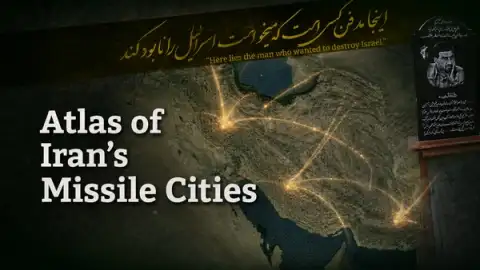
In 2015, the Supreme Leader declared that Israel must be eradicated within 25 years. The regime went as far as setting up a kind of “countdown clock” in Tehran and a few other cities.
Authorities have consistently emphasized the imperative of "Israel's destruction," a mantra used to justify Iran's extensive financial and military backing of militant groups like Hamas and Hezbollah – all the while, Iranians are confronted with mounting poverty and a bleak economic future for their country.