Iran's chronic mismanagement and rampant inefficiencies have led to severe economic challenges, to the extent that even lifting sanctions may not ensure a quick recovery, an economist says.
Warning of a worsening economy in the coming months, Tehran economist Morteza Afghah told local media that the roots of the problem lie in the regime’s non-developmental strategy that prioritizes ideological and political agendas over economic progress.
“The reality is that over the past three decades since the end of the [Iran-Iraq] war, the country's economy has been mismanaged. Economic problems have multiplied, and economic and social indicators have deteriorated,” he said. “The reason for this is deeper than even economic policies,” Afghah stressed.
He noted that the problems facing the country are primarily manifested through economic challenges, but their roots are non-economic, criticizing the government for wasting resources of the country with inefficient decision-making.
Despite having a large number of qualified, young, patriotic, educated, and skilled human resources, as well as valuable natural resources, Iran is suffering from poverty, unemployment, and inequality, leading to various social challenges such as addiction, child labor, unsupported women, and theft, he said.
“The main root of the current situation is philosophical and influenced by the non-developmental value system of the decision-makers,” Afghah noted, explaining that such an approach “prioritizes ideological, jurisprudential, and political issues, and does not give due importance to economic well-being and people's livelihood.”
Economist Morteza Afghah
He decried the current practices and government's attempts to address the symptoms rather than the root cause of multiple crisis.
"The Iranian government has used a variety of measures to cover its budget deficit, including selling bonds, state assets, and state-owned companies; eliminating subsidized dollars; spending the National Development Fund; raising taxes; increasing the prices of goods and services," and printing money.
Describing the US withdrawal from the 2015 nuclear deal as a heavy blow that exacerbated Iran’s economic problems, Afghah said that former US president Donald Trump’s decision was the result of Iran’s wrong policies. He also rebuked Iran’s hardliners for welcoming US and international sanctions and disregarding their impacts on the country. He quoted former president Mahmoud Ahmadinejad, who famously called UN resolutions “useless pieces of paper” and dared the Security Council to keep issuing them over Iran over its nuclear program.
The economist argued that the government has no choice but to negotiate with the US in order to lift the sanctions. Additionally, Tehran has to resolve its issues with the International Financial Task Force (FATF), which has kept Iran on its financial ‘blacklist’ in recent years for not adhering to transparency and international conventions against money laundering and financing of terrorism.
If the Iranian government is unable to reach an agreement to lift the sanctions and resolve the FATF issue, and regional tensions continue, the economic and social conditions in Iran will deteriorate significantly, he said.
“The hardline Principlists, who dominate the new parliament and the government, prioritize ideological and political issues over solving the economic and social problems of the country. The possibility of Donald Trump's re-election further increases the uncertainty and the economic risk. As a result, we can expect the Iranian currency to lose more value, rising prices and worse economic indicators, more emigration and brain drain, and the flight of capital,” the economist said.
However, he argued that even if the sanctions are lifted, the Iranian economy will not improve significantly. “In the best-case scenario, the situation will not get worse, but it will not get much better either."
Iranian lawmaker Masoud Pezeshkian echoed similar concerns on Monday, highlighting that the main reason for the government’s failure in fulfilling its economic promises is not employing experts for the jobs. “The administration had promised to reduce inflation to less than 10 percent, now it is hovering around 50 percent. It had promised to build one million housing units, but they cannot do it even if eight years at office."
Pezeshkian went on to say, “We always try to say everything is fine and not address the issues we have. As a result, when people protest about the problems, we claim that they are wrong, and we have achieved success."
A person stands in Pebdeh Cave, in the southern Zagros Mountains, Iran, in this undated photo obtained by Reuters on March 25, 2024. Pebdeh Cave was occupied by hunter-gatherers as early as 42,000 years ago, inferred to be Homo Sapiens.
A new study has unveiled the Persian Plateau as a pivotal geographic location serving as a hub for Homo sapiens during the early stages of their migration out of Africa some 70,000 ago.
After years of debate, the new study said the human species, who emerged in Africa more than 300,000 years ago and migrated out of the continent 60,000 to 70,000 years ago, have lingered for thousands of years in a geographic hub that spanned Iran, southeast Iraq and northeast Saudi Arabia. These bands of hunter-gatherers then went on to settle all of Asia and Europe starting roughly 45,000 years ago.
Their findings were based on genomic datasets drawn from ancient DNA and modern gene pools, combined with palaeoecological evidence that showed that this region would have represented an ideal habitat, because of its capacity to support a larger population compared to surrounding areas in West Asia.
Putative migration waves out of Africa and location of some of the most relevant ancient human remains and archeological sites.
"Our results provide the first full picture of the whereabouts of the ancestors of all present-day non-Africans in the early phases on the colonization of Eurasia," said molecular anthropologist Luca Pagani of the University of Padova in Italy, senior author of the study published in the journal Nature Communications, opens new tab.
Anthropologist and study co-author Michael Petraglia, director of the Australian Research Centre for Human Evolution at Griffith University, said the study "is a story about us and our history - our goal was to unravel some of the mystery about our evolution and our worldwide dispersal." "The combination of genetic and paleoecological models allowed us to predict the location where early human populations first resided as soon as they exited Africa," Petraglia added.
The International Atomic Energy Agency (IAEA) says it has no information about a purported Iranian nuclear site that was set on fire in Tehran’s Shadabad neighborhood in 2020.
This after Iran International’sinvestigative report revealed Tehran concealed an Israeli sabotage operation that targeted a covert nuclear facility owned by the Atomic Energy Organization of Iran.
Iran International's in-depth investigative report relied on authenticated documents obtained from both the judiciary and the Ministry of Intelligence. These resources were made available through Ali’s Justice – a network of hacktivists known for their ongoing disclosure of Iranian government documents.
In late July 2020, the destruction of the nuclear site swiftly escalated into a critical national security concern for Iran, prompting reports to reach Ali Khamenei, the Supreme Leader of the Islamic Republic.
Of particular note, mere weeks after the incident, the IAEA’s Director General, Rafael Mariano Grossi, made a visit to Iran – seemingly oblivious to the events.
International Atomic Energy Agency Director General Rafael Mariano Grossi (left) and Mohammad Eslami, the head of the Atomic Energy Organization of Iran, during a press conference in Tehran in March 2023
Following months of tension between Iran and the agency, Grossi had arrived in Tehran to negotiate access for inspectors to two suspected former atomic sites.
Though the IAEA did not identify the sites, Israeli intelligence officials pinpointed one as the Abadeh Nuclear Weapons Development Site.
Iran’s then-nuclear chief, Ali Akbar Salehi, lauded the talks with Grossi as "constructive," heralding a supposed "new chapter of cooperation" between Iran and the agency.
Fast forward about four years: This month, Grossi informed the IAEA Board that his agency has lost crucial "continuity of knowledge" regarding Tehran’s activities.
The IAEA concluded a meeting earlier this month without passing a resolution against the Islamic Republic for advanced work on its atomic program and its refusal to cooperate with the IAEA.
The facility, undisclosed to the IAEA, raises serious concerns about Iran's nuclear program and its compliance with safeguards obligations – and it prompts concerns about the existence of other undisclosed facilities and the extent to which Iran may be concealing other nuclear activities.
Israel And Iran’s Nuclear Program
According to judicial documents, the Islamic Republic considers the Israeli intelligence service, Mossad, as the main perpetrator of this sabotage operation.
Despite its belief that Israel was responsible, Tehran tried to conceal the sabotage.
Following Iran International’s reporting, a spokesman from the Israeli Prime Minister's Office simply stated, "No comment: "We have no comment."
Sabotage operations targeting Iranian nuclear facilities are not unprecedented.
From 2009 to 2011, five individuals associated with Iran's nuclear industry, whom the Islamic Republic regarded as scientists, were assassinated.
Tehran has consistently accused Israel of these assassinations.
Arguably the most prominent instance of sabotage within Iran’s nuclear program was the assassination of Mohsen Fakhrizadeh, the former head of the Ministry of Defense's Research and Innovation Organization, which occurred on November 27, 2020.
Israel had labeled Fakhrizadeh as a key figure within Iran's "nuclear weapons program" two years prior to his assassination.
The 2020 sabotage at the nuclear warehouse in Shadabad in Tehran occurred approximately five months before Fakhrizadeh's assassination.
In contrast, Israel did officially claim responsibility for the theft of Iran's nuclear documents from a warehouse in Tehran's Shourabad area in 2018 – with Benjamin Netanyahu revealing that Israel had obtained 55,000 pages and 55,000 digital files through an intelligence operation.
Iranian weapons smuggled into the West Bank captured by Israeli forces, in a handout image published March 25, 2024. (Shin Bet)
The Israeli security agency, Shin Bet, has foiled an attempt to smuggle Iranian weapons to terrorists in the West Bank.
The Shin Bet and Israel Defence Forces managed to intercept a “significant” cache of arms smuggled by Iran into the West Bank including fragmentation bombs, anti-tank mines, grenade launchers, explosives, shoulder-launched missiles, assault rifles, and handguns.
According to Shin Bet, the operation was orchestrated by Iran's Special Operations Division, Unit 4000, led by Jawad Ghafari, in collaboration with Unit 18840 of the IRGC's Quds Force, under the command of Asghar Bakri.
The plot came to light during interrogations of detained Palestinians suspected of terrorist activities. Shin Bet revealed the involvement of Munir Makdah, a senior Fatah official based in Lebanon's Ein el-Hilweh Palestinian refugee camp, describing him as a long-standing collaborator with Hezbollah and the IRGC.
During investigations, it emerged that Makdah had been recruiting Palestinians in the West Bank for terror operations, including smuggling Iranian weapons and providing financial support.
Iran has long backed militant groups in Palestine amid its shadow war against its arch-enemy, Israel. Hamas has a significant presence in the West Bank in addition to groups such as Lion’s Den.
Members of the United Nations Security Council meet on the day of a vote on a Gaza resolution that demands an immediate ceasefire at UN headquarters in New York City, March 25, 2024.
Iran has celebrated the UN's resolution calling for an immediate ceasefire in Gaza amid the war waged by Iran-backed militant group, Hamas.
"The resolution for an immediate ceasefire in Gaza, finally approved by the United Nations Security Council, signifies a crucial step towards ending the suffering of innocent civilians," reported state news agency, IRNA after an overwhelming 14 out of 15 Security Council members voted in favor of the resolution.
"The decisive action by the Security Council reflects the international community's commitment to peace and stability in Gaza,” added IRNA.
After vetoing three similar ceasefire resolutions in the past, Washington chose to abstain this time, enabling the resolution to pass without objection from permanent Security Council members, dealing a blow to its ally, Israel.
Hamas invaded Gaza on October 7, killing 1,200 mostly civilians and kidnapping over 250 more. It led to a relentless retaliation by Israel in a bid to wipe out Hamas and bring back the hostages. Until now, the US has supported Israel's right to defend itself, but pressure on the Biden government has grown in the wake of the humanitarian crisis in Gaza.
The Tasnim news agency, affiliated with the Iranian Revolutionary Guard Corps (IRGC), emphasized the shift in US policy, hailing the US's decision not to veto the ceasefire resolution and expressed satisfaction over Israeli Prime Minister Netanyahu's protest against the Biden administration by canceling an Israeli delegation's trip to Washington.
The US Ambassador to the United Nations, Linda Thomas-Greenfield, explained the US position, stating that while the latest resolution incorporated edits requested by the US, it still fell short of complete alignment with US priorities. "Any ceasefire must be coupled with the release of all hostages,” she stressed.
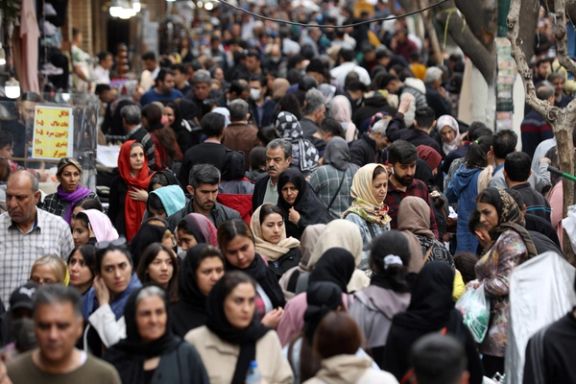
Iranians at the entrance of a subway station in Tehran on March 20, 2024
Iranian government bodies and affiliated institutions have collectively endorsed the use of cash fines as a means to enforce compulsory hijab, a lawmaker has revealed.
Amir-Hossein Bankipour, a member of the Supreme Council of Cultural Revolution and recently re-elected lawmaker, disclosed in an interview aired on the Esfahan channel of state-run television (IRIB) Saturday that the Supreme Council of the Cultural Revolution, Supreme National Security Council, judiciary, parliament, Guardian Council, and the administration of President Ebrahim Raisi, among others, jointly made the decision to implement cash fines.
According to Bankipour, the decision came about as a result of discussions on avoiding direct confrontations between the police and the public over hijab enforcement, as well as the potential burden on the judiciary from prosecuting numerous cases related to hijab violations.
Hardliners dominating the government and many clerics have been sounding the alarm at more signs of defiance by ordinary people to rigid religious restrictions. In addition to hijab, many Iranians publicly celebrated Norouz in the past week, by dancing and eating in public, while the New Year coincided with the Ramadan fasting month.
The hardliner lawmaker claimed that cash fines were only to be levied on women who appear in public in “very inappropriate and repulsive attire” and claimed that the public, including women who do not fully abide by hijab rules, are opposed to these women’s perceived indecency.
Lawmaker Amir-Hossein Bankipour
“There was a lot of discussion, and the best solution [that was suggested] was a deterrent fine … We decided to impose a deterrent fine for ringleaders of [moral] corruption,” he added.
Previously, lawmaker Mojtaba Karbasi had announced that first-time offenders would face a fine of 30 million rials (approximately $50), which would be deducted directly from their bank accounts without requiring their consent. Repeat offenders would face a fine of 240 million rials (around $400).
Authorities are currently utilizing footage from traffic and security cameras to identify hijab offenders, resulting in fines for tens of thousands of individuals caught "unveiling" in various public settings.
The proposed measure against hijab offenders is an amendment to a controversial bill, generally referred to as the “Hijab and chastity bill”, that the parliament approved in June 2023.
The constitutional watchdog, the Guardian Council, however, rejected the bill in October and sent it back to parliament for amendment and removal of verbal ambiguities.
Experts said at the time, that rejection of the bill was mainly for formal issues and had nothing to do with people’s objection to its provisions.
Hardliners have been looking for ways to strengthen the enforcement of hijab after their ‘morality police’ tactic of arresting women for “improper hijab” backfired with the death of Mahsa Amini in September 2022, triggering nationwide Woman, Life, Freedom protests that lasted for months and shook the Iranian regime to its core. More than 550 civilians were killed by security forces and around 22,000 arrested.
The morality police have largely disappeared from the streets since Amini’s death and the resulting protests as authorities feared further enraging people.
Many Iranians, including some women who wear the hijab themselves, believe that wearing or not wearing the hijab is a personal decision. Eighty four percent of the over 12,000 respondents to an online poll by the reformist Shargh daily in October said they were opposed to mandatory dress code and headscarves.
Since March 2023, hardliners have attempted to end women's increasing defiance of compulsory hijab and reclaim lost ground through various instructions to government bodies, but their efforts seem to have hugely backfired as the number of women who refuse to abide by the current rules has very noticeably increased since then.