Video Showing Cleric Beating Elderly Woman Goes Viral In Iran
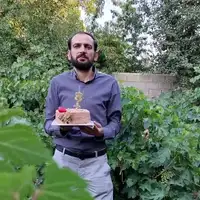
A screen grab from video showing a cleric beating an elderly woman in Iran.
A video showing a cleric in Iran assaulting and beating an elderly woman in a property dispute has gone viral on social media, prompting officials to respond.
Local judicial authorities have announced that the clergyman's case will be referred to the provincial court for clerics. However, they also tried to emphasize that the incident resulted from a family dispute over property.
The sharing of such videos on social media is a sensitive issue for Iran's clerical regime, as many Iranians resent the power the clergy have wielded in the past 44 years since the establishment of the Islamic Republic. In recent protests since last September, there have been numerous instances of young people verbally assaulting clerics or expressing their dissatisfaction with them. In many instances young people filmed how they tossed the turban of clericsin the streets.
A judicial official in Gilan Province, where the incident occurred, has threatened to pursue those who filmed the cleric attacking the woman and promised to prosecute them.
The measures or punishment that the clerical court will decide upon are not clear, as proceedings in these courts are kept secret. Clerical courts operate independently of the Judiciary administration and function outside the legal framework.
In addition to this, another scandal that emerged earlier in the week is still causing reverberations among Iranians. A video surfaced showing an official and staunch regime loyalist responsible for enforcing hijab regulations, engaging in a sexual act with a young man. He has been fired from his job, and authorities state that he is under investigation.
Iranian lawmaker and former nuclear chief Fereydoun Abbasi
Iran has been selling more oil and repatriating some of the money while it also conducts barter trade, a member of parliament’s energy committee has said.
Fereydoun Abbasi, who is also the former head of Iran’s nuclear agency, told a local news website that he believes in what oil minister Javad Owji says about more oil exports since 2021, but details should remain secret because of US sanctions.
Iran’s daily oil shipments fell to around 200,000 barrels, down from over 2 million when the United States withdrew from the JCPOA nuclear deal in 2018 and imposed oil export and banking sanctions. However, as the Biden administration began talks in early 2021 to revive the agreement, Iran’s oil exports began to increase, possibly due to less sanctions’ enforcement by Washington.
Although daily exports are said to have increased to 1.5 million barrels, Iran’s financial and economic crisis continue, with its currency falling by around 30 percent this year. This signals that Tehran is offering large discounts to mainly small Chinese refineries that buy its oil and is unable to repatriate all the proceeds in hard currency, due to US banking sanctions. Iran’s financial system is virtually cut off from the international banking network.
Abbasi said that Iran needs to keep all trade data secret, but his reference to barter trade is another indication that Tehran receives goods instead of cash for at least a significant portion of oil sales.
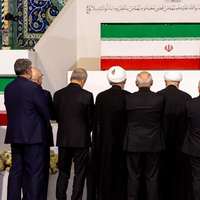
Ayatollah Ahmad Jannati (center) during an event in Tehran on June 26, 2023
Ayatollah Ahmad Jannati, a centenarian cleric has become the oldest official in Iran, who is often the subject of jokes about his natural and political longevity.
Jannati was reinstated as the Secretary of the Islamic Republic of Iran's Guardian Council on July 19, giving rise to questions about his ability to continue his career for yet another year after 31 years of holding the same office.
The Guardian Council is in charge of endorsing parliamentary legislation after ascertaining compliance with the Sharia [religious law]. The body also vets the candidates of parliamentary and presidential elections to make sure about their adherence to the rules of Islam and the articles of the Iranian constitution.
In fact, the Council has increasingly adopted just one criterion to judge the eligibility of candidates – complete obedience to Supreme Leader Ali Khamenei.
Jannati, a Khamenei confidant, is well known in Iran for having more than a dozen posts including the Chairman of the Assembly of Experts, a body that determines the country's next leader after Khamenei's death.
Ayatollah Ahmad Jannati (center) with Supreme Leader Ali Khamenei (right) and Ahmad Alamolhoda, Khamenei’s representative in Mashhad
According to Rouydad24, a relatively moderate news website in Tehran, Jannati, 97, is best known for his staunch opposition to the idea of reforms in Iran. He told Al-Ahram, Egypt's leading newspaper in 2000 that "reformism is an idea advocated by the British Empire, the United States and Israel."
The website added that many in Iran criticize Jannati's reinstatement, and believe that he should have been retired many years ago. However, conservatives in Iran know that his authority goes beyond his position as the Guardian Council Secretary.
Jannati is one of the most loyal Iranian politicians to Khamenei. Iranian reformists have said at times that he makes the 12-member Council's decision single-handedly and the clerics and lawyers at the council, are fronts for Jannati, who is himself a front for Khamenei who does not want to accept responsibility for disqualifying election candidates he does not like.
Although traditionally presidential candidates seek Khamenei's approval in private meetings, yet former presidents Akbar Hashemi Rafsanjani and Mahmoud Ahmadinejad were both disqualified by Jannati and his Guardian Council in 2009 and 2017 respectively. Jannati usually does not even bother to present a valid reason as to why his council bars a tested regime insider from running in an election. The two former presidents had committed no crimes according to Islamic Republics courts but were simply disliked by Khamenei.
Ayatollah Ahmad Jannati (right) and President Ebrahim Raisi during an event in Tehran in June 2023
Jannati who was several years older than Rafsanjani, disqualified him for being "too old," and barred Ahmadinejad from running arguing that he might be good for other posts, but certainly not for the President's office.
There are numerous jokes about Jannati and his old age, including the one that says he solemnized the marriage of Adam and Eve, and another one about God Almighty himself saying that when he created the world Jannati was already there! Jannati retold these jokes and several others on live TV a few years ago laughing loud. In fact, he is probably the only Iranian official who tolerates and even enjoys jokes about himself.
He was born in 1926 in a small town near Esfahan as the only son and only child in his family. He entered the Qom Seminary quite late when he was 19. Before the 1979 revolution he was jailed three times (altogether for three months) and was exiled for another 3 years. One of his sons, Hussain, was executed for reportedly being a member of Mojahedin-e Khalq opposition group. Another one of his four sons, Ali, was culture minister under President Hassan Rouhani, but was removed from his post after reportedly being involved in a scandal.
Apart from his post at the Assembly of Experts, he has never exposed himself to people's vote. And he owes his election to reformist former President Mohammad Khatami who put him and a couple of other hardliners on the reformists' election list based on a political deal.
In 2005 and 2009 he supported Ahmadinejad's presidency and told voters that he believed he was Khamenei's choice. This was years before Khamenei revealed during a sermon that his ideas were close to those of populist Ahmadinejad.
Jannati once made a fantastic claim that Iran's reformists received a one-billion-dollar assistance from the United States. When reformists asked him to present his evidence, he said he will submit it to the court, which he never did.
Some Iran watchers have said that Khamenei's interest in Jannati is because the Iranian leader wants the old man to endorse his son Mojtaba as the next ruler after his death. However, whether Jannati can outlive Khamenei is debatable. Jannati is 15 years older.
An Iranian woman without mandatory hijab on a street in Tehran (July 2023)
Political activists and women's rights advocates both inside and outside Iran strongly condemn the recent revival of morality police patrols in the country's streets.
Labeling this move as a “desperate attempt” by the regime to suppress women and impede the progress of freedom and equality, the joint statement published on Friday highlights the potential consequences of escalating repression and arrests.
The activists argue that the reintroduction of morality police patrols will only serve to “exacerbate the already mounting public discontent over inflation, soaring prices, and poverty, further fueling the people's anger.”
Recently, the hijab police patrols have reemerged in the capital city, Tehran, and other major urban centers, following a period of lying low, as authorities feared the potential for renewed anti-regime protests.
Notably, the timing of this development coincided with the anniversary of Mahsa Amini's death while in morality police custody, an incident that triggered widespread protests across Iran.
Despite facing brutal crackdowns, an increasing number of women in Iran have been defiantly flouting the mandatory hijab rules, which have been in place since the establishment of the Islamic Republic in 1979. This mass wave of hijab refusal has left the regime at a loss and revealed the failure of its measures.
The signatories of the joint statement emphasize that the Islamic Republic “must realize its repressive actions, especially during the summer break when universities and schools—the main pillars of the women's revolution—are in session, will be temporary and the regime will face a resolute and overwhelming backlash from the people, particularly women.”
Students protest at Iran's Babol University on November 15, 2023
As the anniversary of the Mahsa Movement in September approaches, Iran’s regime is worried about the possibility of unrest in universities spilling over to the streets.
“The enemy has not given up. They’ve said that universities are the first place where new riots should begin,” the official in charge of Supreme Leader Ali Khamenei’s representatives in universities across the country, Mostafa Rostami, said at a gathering.
In advocating for preventive measures, Rostami said, “They will completely be defeated if they can’t do something on the anniversary of last year’s riots.”
Iranian authorities always refer to anti-government protests, even peaceful demonstrations, as riots.
At the same gathering, Brigadier General Yadollah Javani, chief of the political bureau of the Revolutionary Guards (IRGC), said “vindication jihad” should be carried out in universities before the upcoming parliamentary elections in March.
In recent years, Khamenei has applied the phrase ‘vindication jihad’ (jihad tabyyin) to efforts both in the media and on social media platforms and has referred to supporters and employees active in social media as "soldiers of soft war." The term basically means propaganda efforts.
Brigadier General Yadollah Javani, chief of the political bureau of the Revolutionary Guards (IRGC)
“The enemy has invested its hope in the coming months until the end of the [Iranian calendar] year [March 21]. All their evil plans will fail if we can be present in universities carrying out vindication jihad and people create an epic in March [with their presence in the elections],” Javani said.
Iranian students had a very active role in the protest movement that was sparked by the death of 22-year-old Mahsa (Jina) Amini in the custody of morality police. Since then, hundreds of students have been expelled or suspended for their activities.
At the same time, activists both inside Iran and abroad have been discussing on social media the importance of the anniversary to show the regime that the protest movement is alive and strong.
Student sources say the Supreme National Security Council (SNSC) has recently bestowed extraordinary powers to university authorities and security forces to control students and their professors, including the power to suspend those who are known to be government critics. This week, two theology professors at Isfahan University were suspended for “opposing the government and Islam”.
In recent months, the anti-compulsory hijab movement has gained greater momentum, particularly in universities, with many students defying the rules as a form of civil disobedience, showing up on campuses without a headscarf and wearing ordinary cloths instead of the mandatory long coverings.
“It’s ten months since the Mahsa Uprising, during which we demanded our right to life. Today, [ensuring one’s] right to life depends on recovering [lost] civil rights. We have no exit path other than resistance … because passivity in the face of exclusion would only mean perishing,” students of Tehran University said in a statement last week.
“Under various pretexts, from [non-abidance to rules of] hijab to student activity, students are maliciously deprived of their right to study even if they manage to get in,” the statement said.
Students also criticized “dual standards” that allow members of Iraq’s Hashd al-Shaabi to study in Iranian universities by the virtue of belonging to proxy militia forces but blocks “ideological outcasts” and lower-class Iranians even if they are gifted.
Mohammad Safari, a member of the City Council of Bandar Anzali in northern
A member of the City Council of Bandar Anzali in northern Iran has been summoned after the release of two videos allegedly showing him engaged in illicit activities.
The videos depict a man resembling Mohammad Safari smoking opium and masturbating.
The distinguished reciter of the Quran denied being the person identified in the videos. Nevertheless, a Telegram channel that circulated the videos warned of releasing additional footage if he continues to deny the authenticity of the images.
In the first video, two individuals can be seen smoking opium naked, while the second video shows one person lying down, seemingly rubbing his genitals while watching images on a mobile phone.
As of now, there has been no official reaction from authorities or provincial officials regarding these videos. Iran International cannot independently verify the authenticity of the videos, but there have been past instances involving figures linked to the Islamic Republic.
These latest videos emerged shortly after the dismissal of Reza Seqati, the Director General of Gilan Culture Ministry Department, over a separate video showing him allegedly having sex with a young boy.
Another notable example is Saeed Tousi, a renowned Quran reciter and confidant of the Supreme Leader, Ali Khamenei. Despite numerous complaints and testimonies of sexual assault against his students, Tousi was acquitted.
Over the last two decades, various members of City Councils in different provinces have faced dismissal due to corruption allegations.