Political Activists Criticize Revival Of Morality Police In Iran
An Iranian woman without mandatory hijab on a street in Tehran (July 2023)
Political activists and women's rights advocates both inside and outside Iran strongly condemn the recent revival of morality police patrols in the country's streets.
Labeling this move as a “desperate attempt” by the regime to suppress women and impede the progress of freedom and equality, the joint statement published on Friday highlights the potential consequences of escalating repression and arrests.
The activists argue that the reintroduction of morality police patrols will only serve to “exacerbate the already mounting public discontent over inflation, soaring prices, and poverty, further fueling the people's anger.”
Recently, the hijab police patrols have reemerged in the capital city, Tehran, and other major urban centers, following a period of lying low, as authorities feared the potential for renewed anti-regime protests.
Notably, the timing of this development coincided with the anniversary of Mahsa Amini's death while in morality police custody, an incident that triggered widespread protests across Iran.
Despite facing brutal crackdowns, an increasing number of women in Iran have been defiantly flouting the mandatory hijab rules, which have been in place since the establishment of the Islamic Republic in 1979. This mass wave of hijab refusal has left the regime at a loss and revealed the failure of its measures.
The signatories of the joint statement emphasize that the Islamic Republic “must realize its repressive actions, especially during the summer break when universities and schools—the main pillars of the women's revolution—are in session, will be temporary and the regime will face a resolute and overwhelming backlash from the people, particularly women.”
Students protest at Iran's Babol University on November 15, 2023
As the anniversary of the Mahsa Movement in September approaches, Iran’s regime is worried about the possibility of unrest in universities spilling over to the streets.
“The enemy has not given up. They’ve said that universities are the first place where new riots should begin,” the official in charge of Supreme Leader Ali Khamenei’s representatives in universities across the country, Mostafa Rostami, said at a gathering.
In advocating for preventive measures, Rostami said, “They will completely be defeated if they can’t do something on the anniversary of last year’s riots.”
Iranian authorities always refer to anti-government protests, even peaceful demonstrations, as riots.
At the same gathering, Brigadier General Yadollah Javani, chief of the political bureau of the Revolutionary Guards (IRGC), said “vindication jihad” should be carried out in universities before the upcoming parliamentary elections in March.
In recent years, Khamenei has applied the phrase ‘vindication jihad’ (jihad tabyyin) to efforts both in the media and on social media platforms and has referred to supporters and employees active in social media as "soldiers of soft war." The term basically means propaganda efforts.
Brigadier General Yadollah Javani, chief of the political bureau of the Revolutionary Guards (IRGC)
“The enemy has invested its hope in the coming months until the end of the [Iranian calendar] year [March 21]. All their evil plans will fail if we can be present in universities carrying out vindication jihad and people create an epic in March [with their presence in the elections],” Javani said.
Iranian students had a very active role in the protest movement that was sparked by the death of 22-year-old Mahsa (Jina) Amini in the custody of morality police. Since then, hundreds of students have been expelled or suspended for their activities.
At the same time, activists both inside Iran and abroad have been discussing on social media the importance of the anniversary to show the regime that the protest movement is alive and strong.
Student sources say the Supreme National Security Council (SNSC) has recently bestowed extraordinary powers to university authorities and security forces to control students and their professors, including the power to suspend those who are known to be government critics. This week, two theology professors at Isfahan University were suspended for “opposing the government and Islam”.
In recent months, the anti-compulsory hijab movement has gained greater momentum, particularly in universities, with many students defying the rules as a form of civil disobedience, showing up on campuses without a headscarf and wearing ordinary cloths instead of the mandatory long coverings.
“It’s ten months since the Mahsa Uprising, during which we demanded our right to life. Today, [ensuring one’s] right to life depends on recovering [lost] civil rights. We have no exit path other than resistance … because passivity in the face of exclusion would only mean perishing,” students of Tehran University said in a statement last week.
“Under various pretexts, from [non-abidance to rules of] hijab to student activity, students are maliciously deprived of their right to study even if they manage to get in,” the statement said.
Students also criticized “dual standards” that allow members of Iraq’s Hashd al-Shaabi to study in Iranian universities by the virtue of belonging to proxy militia forces but blocks “ideological outcasts” and lower-class Iranians even if they are gifted.
A young woman in Karaj, west of Tehran, has been arrested and subjected to forced confession after a video of her not wearing a hijab surfaced online.
The incident came to light when a video of a man harassing the woman during a religious procession went viral on social media. In the video, the man accuses her of violating the procession's sanctity and insults her for not wearing the hijab. He further alleges that she insulted a security official and disturbed public opinion.
On Friday, the Judiciary released a short video of her forced confession, stating that she committed "blasphemy" during the religious procession in Alborz province. The circumstances surrounding the confession have raised concerns about potential coercion and violations of human rights.
Political activist Mahboubeh Moradi shared the arrested woman's original statements on social media, where she firmly declares her commitment to her beliefs and refuses to be intimidated. "I am a woman; Don't scare me. I stand by my beliefs.... The time when we were afraid of you is over," the woman declared in the video.
In recent weeks, the morality police have returned to the streets, and the judiciary has issued unusual and controversial rulings, such as mandating the washing of dead bodies and sending women to psychiatric centers.
Despite these measures, women's civil disobedience against compulsory hijab continues to spread throughout Iran.
Four teachers from Iran’s northern city of Rasht have been accused of "damaging the image of the regime" due to participating in a protest.
The Rasht Prosecutor's Office issued the summons and accused the teachers of participating in activities under the banner of the "Teachers' Association", which has now been declared illegal according to the decree.
The Coordination Council of Iranian Teachers' Trade Associations expressed deep concern, fearing that the accused educators might face imprisonment and lashing, as reported in a picture of the order issued on Friday.
Additionally, the order explicitly states that any form of activity under the title of the “Teachers' Trade Association” is considered unlawful, further restricting the rights and freedom of educators in Iran.
This incident follows a series of mass trials held over the past two months in different cities, including Shiraz, Ahvaz, and Yazd, where a total of 24 teachers faced similar charges and trials.
On June 27, the association publicly protested the mass trials and issuance of what they deemed "unfair sentences" for educators. They called upon the authorities of the Islamic Republic to discontinue the practice immediately.
In a powerful show of solidarity, thousands of working and retired Iranian teacherssigned a petition urging the regime to release their imprisoned colleagues and halt the harassment faced by educators.
The teachers launched the campaign last Friday, aiming to gather 100,000 signatures advocating for the release of detained educators and an end to the systematic harassment they face.
US Secretary of State Antony Blinken has spoken of the US repairing ties with the E3, united in a joint commitment to restricting the regime's nuclear capabilities.
Speaking at the Aspen Security Conference, Anthony Blinken also expressed concern regarding Iran's actions abroad and said the regime had "gone global" by taking action against dissidents around the world, in countries including in the United States, in addition to stepping up assassination attempts on the likes of Jewish and Israeli targets.
Blinken said recent nuclear discussions have brought the US closer to its E3 allies, the UK, Germany and France, with whom he acknowledged there had until recently, been "real division". "We’re working very closely together to deal with some of the excesses committed by the regime," he said.
He admitted he feels "real concern" over Iran's nuclear progress and told the conference: “We have the concern that after having put its nuclear program in a box with the JCPOA, with that agreement no longer in force, Iran has speeded ahead with the production of fissile material for a nuclear weapon.
Blinken also acknowledged the courage of Iranian women and girls leading what he called "extraordinary protests" and expressed concern over the measures taken by the regime to suppress them.
He also voiced concern about Iran's actions in the region, particularly its support for groups involved in destabilizing activities. Blinken highlighted the dangerous exchange of technology between Iran and Russia, with drones provided to Russia having a devastating impact in Ukraine.
Many Iranian activists and some US lawmakers, however, criticize the administration for its continuing contacts with Tehran to reach agreements, that could free billions of dollars in frozen assets further enabling the regime.
Iran's ruler Ali Khamenei casting his vote in the 2017 presidential election
Hardliners dominating Iran's parliament and others in the regime do not know what to expect from elections next March, with no signal so far from the Supreme Leader.
The fact that hardliners are Ali Khamenei’s preferred political force has been proven in the past, but others have to wait and see if the Supreme Leader will allow them to compete in the upcoming parliamentary vote.
Some are speculating that possible coalitions among relatively moderate groups could boost their chances success, but whether they will be approved by the Guardian Council controlled by Khamenei is entirely unclear.
If most political forces outside the hardliners are banned from running, the elections will turn into another low-turnout event, further eroding legitimacy.
Some are warning, however, that powerful groups of politicians do not want high voter turnout, so that conservatives and hardliners keep control of the legislature, despite deep public anger at multiple crises gripping the country.
While insiders wait to see in what direction the wind will blow, most ordinary Iranians have long given up on regime politicians and elections to shape a better future for them. One of the slogans in recurring nationwide protests has been, “No conservatives, no reformists.”
Moderate conservative Politician Mehrdad Lahooti told reporters in Tehran that politicians such as former parliament speaker Ali Larijani, who do not belong to the regime’s leading political factions, might form a coalition with moderate conservatives in a bid to increase their chance of being elected during the March 2024 parliamentary elections.
Lahooti is a relatively moderate politician and a former lawmaker
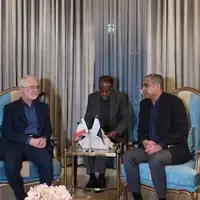
He called Larijani a national political figure whose influence goes beyond the boundaries defined by political factions. Lahooti added that both the moderate conservatives and the independents have already started their election campaigns. However, there is no indication in the media showing independent politicians starting electoral campaigns, while candidate registration for the March 2024 vote is still three months away.
In a recent interview with IRGC-linked Fars news agency, Mansour Haqiqatpoor a politician close to Larijani accused some conservative circles of trying to tarnish the former Speaker’s image by spreading the rumor that he has sougt political asylum in Scotland. Refuting the rumors, Haqiqatpoor said Larijani will certainly speak about the upcoming elections soon but reiterated that there is no indication yet that he is interested, although that can change in the coming months.
In fact, Larijani and other moderate, centrist, independent and proreform politicians are waiting to see a signal from Khamenei and his instruction to the Guardian Council.
Haqiqatpour said: "Larijani is the Supreme Leader's soldier. If he receives a signal that the leader does not want him to nominate himself as a candidate, he will certainly not put a step forward, but if he comes to the conclusion that the leader wants him to come forward, he will surely announce his candidacy."
Ali Larijani, former speaker of the Islamic Republic parliament
Meanwhile, former presidential candidate and pragmatist politician Mostafa Hashemi Taba told reporters that "some powerful groups do not want the people to go to the polls" in March. By "powerful people" Hashemi was likely alluding to officials at Khamenei's office, the top echelon of the IRGC and its intelligence service and last but not least, the mighty ultraconservative Paydari Party, that wants to hold all the political power and not share it even with other conservatives.
Hashemi Taba further explained that groups with a radical approach want to continue the rule of the all-conservative government. He added: "I see no indication of any effort on the part of the country's officials to hold a high-turnout election, and I do not believe that this situation is going to change during the coming months.
In another development, Bijan Moghaddam, a political analyst close to Khamenei's office told Nameh News website in Tehran: "Usually conservative groups have two objectives in every election: To win the election, and to ensure a high turnout." He added that high turnout can be an outcome of either a coalition between all the conservative groups, or competition."
So far, it appears that the regime's choice between the two options is to forge a major coalition rather than holding a competitive election.