• العربية
  • فارسی
Brand
  • Iran Insight
  • Politics
  • Economy
  • Analysis
  • Special Report
  • Opinion
  • Podcast
  • Iran Insight
  • Politics
  • Economy
  • Analysis
  • Special Report
  • Opinion
  • Podcast
  • Theme
  • Language
    • العربية
    • فارسی
  • Iran Insight
  • Politics
  • Economy
  • Analysis
  • Special Report
  • Opinion
  • Podcast
All rights reserved for Volant Media UK Limited
volant media logo

Iran Claims Two Nuclear Issues Raised By IAEA Are Resolved

Iran International Newsroom
May 30, 2023, 15:10 GMT+1Updated: 17:47 GMT+1
IAEA's Rafael Grossi (left) and Iran's nuclear chief Mohammad Eslami in Tehran on March 4, 2023

Iranian state media claimed Tuesday that two contentious issues raised by the UN nuclear watchdog, the International Atomic Energy Agency have been resolved.

The claim, not reported by the Agency or Western media, added that the resolution was the result of IAEA chief Rafael Grossi’s visit to Tehran in March. 

Grossi had paid a last-minute visit just before the IAEA board meeting in an apparent move to forestall a resolution condemning Iran’s lack of cooperation with the Agency. He Left Tehran with a paper resembling “peace in our times” claiming that an agreement to speed up cooperation had been reached. Since then, the agency has largely been silent about the results of the promised cooperation.

But Iranian officials have kept claiming progress with the IAEA since March, without any details or confirmation by the Agency.

The Tuesday report about progress came only days after Iran International reported that “the Islamic Republic is expected to show more flexibility on issues related to its nuclear program in exchange for the release of its frozen funds in Iraq, and free hostages with dual nationality in exchange for its assets in South Korea.” 

The logo of the International Atomic Energy Agency (IAEA) is seen at the organisation's headquarters in Vienna, Austria, March 6, 2023.
100%
The logo of the International Atomic Energy Agency (IAEA) is seen at the organisation's headquarters in Vienna, Austria, March 6, 2023.

A source had told Iran International last week that talks between Iran and the US on the release of Tehran's frozen assets could result in a deal soon. Earlier in the week, Israel’s state television channel Kan 11 also reported that a deal between Tehran and Washington will be finalized in the coming weeks. 

Citing unnamed sources with knowledge of the matter, a report by Mehr news agency close to Tehran’s hardliners said Tuesday that the latest case that has been resolved “through Tehran's goodwill and cooperation” pertained to Abadeh, one of the sites where the IAEA had detected traces of uranium related to Iran’s secret nuclear work more than 20 years ago. The report added that another case regarding traces of uranium particles enriched to 83.7 purity that emerged earlier this year has also been closed, without specifying any details. 

Sites not declared as part of Iran’s nuclear program where inspectors had discovered traces of uranium led to a resolution critical of Iran for lack of cooperation by the IAEA board of governors in June 2022. 

The resolution called on Iran to engage with the IAEA without delay and expressed “profound concern” at Iran’s failure to satisfy the agency over the traces of uranium. The resolution came with year-long talks to revive the nuclear deal collapsing over Iran’s strenuous demands beyond the original phrases of the accord. 

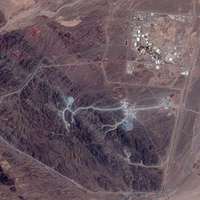
Now with another board of governors’ meeting this month, Tehran may be trying to claim progress, but the prospects seem dim in light of recent revelations about Iran developing a deep underground facility near the Zagros Mountains in central Iran, close to the Natanz nuclear facility, and dedicating hectares of land to increase the security buffer zone for Fordow nuclear plant -- another underground uranium enrichment facility northeast of the city of Qom. 

The IAEA is due to issue quarterly reports on Iran this week, ahead of a regular meeting of its 35-nation Board of Governors next week.

The UN watchdog has also kept expressing dissatisfaction with Iran’s response to the Agency’s questions and has not released any report indicating that the regime provided thorough explanations. In its official response regarding the Abadeh site, Iran said last year that the origin of the uranium particles is "unknown" and insisted the site was used for "the exploitation of fireclay through a contract with a foreign company decades ago" hence the IAEA’s “conclusion is absolutely false, unrealistic and biased.” 

Back in 2015, the IAEA concluded that Iran had operated an “organizational structure” carrying out “feasibility and scientific studies” in nuclear research before 2003, with some aspects continuing until 2009. When Iran agreed in the 2015 Joint Comprehensive Plan of Action (JCPOA) to drastically limit its nuclear program, the agency’s emphasis shifted towards monitoring its compliance with the agreement reached with the six world powers. 

But the pre-2003 work was revived as an issue by further agency investigations after Israel claimed in 2018 to have stolen a trove of documents from Iran, and by Tehran’s expansion after 2019 of its nuclear program beyond JCPOA limits. 

Such hypes about an impending agreement in the regime’s media are not unprecedented as Tehran keeps boasting about the IAEA’s confirmation of “the peaceful nature of its nuclear program,” something that has never happened in any report by the UN agency. 
Most Viewed

Iran diplomacy wobbles as factions compete to avoid looking soft on US
1
INSIGHT

Iran diplomacy wobbles as factions compete to avoid looking soft on US

2
VOICES FROM IRAN

Bread shortages, soaring prices strain households in Iran, residents say

3
ANALYSIS

The politics of pink: how Iran uses cuteness to rebrand violence

4

Scam messages seek crypto for ships’ safe passage through Hormuz, firm warns

5
EXCLUSIVE

Family told missing teen was alive, then received his body 60 days later

Banner
Banner

Spotlight

  • Diplomacy tolls at Hormuz as conflict returns to its doorstep
    OPINION

    Diplomacy tolls at Hormuz as conflict returns to its doorstep

  • Opposition to US talks grows in Tehran as ceasefire deadline nears
    INSIGHT

    Opposition to US talks grows in Tehran as ceasefire deadline nears

  • Tehran moderates see ‘no deal–no war’ limbo as worst outcome
    INSIGHT

    Tehran moderates see ‘no deal–no war’ limbo as worst outcome

  • The future has been switched off here
    TEHRAN INSIDER

    The future has been switched off here

  • Lights out, then gunfire: Witnesses recount Mashhad protest crackdown
    VOICES FROM IRAN

    Lights out, then gunfire: Witnesses recount Mashhad protest crackdown

  • Is Iran entering its Gorbachev moment?
    INSIGHT

    Is Iran entering its Gorbachev moment?

•
•
•

More Stories

Hack Of President's Office Shows Nuclear Expansion Continues

May 29, 2023, 22:41 GMT+1
•
Iran International Newsroom

A hacktivist group has broken into servers of the Iranian president’s office and leaked troves of sensitive data, proving corruption, conflicts and an ongoing nuclear expansion.

The hacktivist group ‘Uprising till Overthrow' claimed Monday that it breached 120 servers of the presidential office, getting access to internal communications, meetings minutes, President Ebrahims Raisi’s online conference platforms and about 1,300 computers inside the office.

In one of the documents, the security chief of Fordow nuclear plant -- an Iranian underground uranium enrichment facility located 20 miles (32 km) northeast of the Iranian city of Qom – had asked for about 150 hectares of public land to be given to the nuclear facility to increase its security buffer zone as work continues on Iran's nuclear capabilities.

Earlier in May, the group, affiliated with the Albania-based opposition Mojahedin-e-Khalq (MEK) group -- People's Mojahedin Organization of Iran, hacked into the Islamic Republic’s foreign ministry servers, disabling 210 sites and online services and leaking another large batch of documents.

In the new cyberattack, the group is said to have gained access to “tens of thousands confidential documents” but has so far released only a fraction of them. The number of the published documents is still so large that analyzing them will take days if not weeks.

A sample of the leaked documents (May 2023)
100%
A sample of the leaked documents

The group also claimed that their access to the internal systems of the president’s office was so unbounded that they sent e-mails to the office’s recipients address list with photos of the leaders of MEK and photos of Iran’s Supreme Leader Ali Khamenei and President Raisi with red crosses over them as well as slogans of “Death to Khamenei” and “Hail to Rajavi”, the current leader of the opposition group.

The president’s office immediately reacted, denying that “the official website of the president” was down due to any attack. However, the regime cannot win this on a technicality as the group had not claimed to hack the frontage of the site but the internal servers.

Among the released documents, there is correspondence between the president’s office and the office of the secretary of Iran’s Supreme National Security Council (SNSC) under besmirched chief Ali Shamkhani, confirming rumors that the regime's top security chief was forced out after the President said he had failed to do enough to quash riots, in spite of causing the death of 750 civilians and arresting 30,000 more.

In the letter addressed to Shamkhani, the chief of staff of the president, Gholam-Hossein Esmaili, criticized the security chief for a lack of insight into the wave of protests that engulfed Iran following the death in custody of 22-year-old Mahsa Amini. With a condescending tone, Esmaili rebuked Shamkhani’s office for “inconsistencies, deficiencies, and defects of the country's intelligence systems”. The letter tells the shamed security chief the regime “expected more.”

A sample of the leaked documents (May 2023)
100%
A sample of the leaked documents

There are numerous other documents that showed how the president’s office is trying to keep the government afloat in the face of bouts of incessant rallies without any practical strategy and tactic. Several of such documents pertained to sessions held to find ways to quell the protests inside Iranian universities.

A large number of the leaked documents provide evidence of the administration’s financial exploitation in cooperation with different organizations. One such example is a letter that shows the country’s armed forces sold 400 million euros to the central bank, while another document shows that the armed forces also sell foreign currency gained from export of oil in the black market.

In the letter addressed to the head of the General Staff of the Armed Forces, the head of the Central Bank of Iran, Mohammad-Reza Farzin, said the armed forces must supply the currency obtained from the sale of oil to the central bank, instead of selling the foreign currency to the cash-strapped bank. In March, Iran’s parliament approved legislation according to which the General Staff of the Armed Forces is allowed to export three billion euros worth of crude oil and oil products through small private refineries.

The ongoing brutal surveillance operations were exposed in another document, in which the commander-in-chief of the Revolutionary Guards asked Vice President Mohammad Mokhber to provide the financial means to revamp the surveillance cameras of the capital’s subway stations so that they can be used to quash the protests. In the letter, Hossein Salami said the CCTV cameras and the subway monitoring system in Tehran are old, leading to their limited functionality in the crackdown of the popular protests. The amount needed for new cameras is said to be over $32,000 for each station. Tehran has about 150 subway stations, which means spending nearly $5 million towards a security state.


Tehran Daily Says Hard To Revive JCPOA, Suggests Direct Talks With US

May 29, 2023, 08:44 GMT+1
•
Iran International Newsroom

Recent media reports in Iran indicate that local observers are increasingly convinced the revival of the 2015 nuclear deal (JCPOA) is impossible.

The latest report in reformist daily Shargh on the issue, which has also been carried by other media outlets such as Iran Diplomacy and Rouydad24, says some officials have been considering alternative solutions.

Shargh relying on recent statements by several Iranian politicians and pundits said that perhaps the best route to resolve the nuclear dispute is direct talks between Iran and the United States, something that Supreme Leader Ali Khamenei has forbidden.

While several Iranian and international observers are still considering Khamenei's latest reference to "heroic flexibility"as an allusion to the feasibility of an agreement with the West, his reference to the Shiite principle of Taqiyyah based on which Shiites can prudently hide their real beliefs and goals, and his explanation that heroic flexibility is "a way of circumventing a rock on the way of your progress" put an end to all hopes about a possible softening of Iran's stances.

In other words, for Khamenei nuclear talks are a means to neutralize foreign opposition while following his real objectives.

As a result, some observers characterized Khamenei's rhetoric as a double-edged guidance to Iranian diplomats. It is characteristic of Khamenei to make statements in order to evade responsibility if his suggestions lead to a failure and to claim victory if they happen to gain something for the Islamic Republic.

Iran's former foreign minister Mohammad Javad Zarif and US Secretary of State John Kerry as they met in 2014 to start nuclear talks
100%
Iran's former foreign minister Mohammad Javad Zarif and US Secretary of State John Kerry as they met in 2014 to start nuclear talks

In the meantime, Iranian officials including Foreign Minister Hossein Amir-Abdolahian make occasional statements about secret talks with the United States. The latter has repeatedly refuted such statements and labelled them as lies.

In one of the latest developments, five years since the collapse of the JCPOA nuclear talks, dozens of ex-US diplomats have called to end diplomatic overtures to Tehran.

The report in Shargh said that boosting of Iran's nuclear activities since 2021 is one of the reasons why observers believe that the JCPOA can no longer be revived. Another obstacle is Iran's insistence on its financial demands before returning to the negotiations. However, a key problem is that the deadlines to lift the embargo on Iran's missile development and nuclear activities respectively in October 2023 and 2025 are getting closer quickly.

Shargh noted that the current 5+1 has no similarity to the P5+1 in 2015. There is a vast divide between Russia and the four Western partners of the JCPOA and the relations between China and the United States are no longer friendly. Changes have even occurred between the four Western partners. Last March the three European partners demanded an IAEA resolution against Iran, but the United States disagreed with them, which was a reversal of roles compared to the past. In the meantime, Iran's involvement in Russia's war against Ukraine has also changed many things. No one in the West supports the lifting of sanction on Iran, and doing so will be costly for Western governments.

In this situation, the Biden Administration has said that "The JCPOA is no longer on the agenda, however, the problem with Iran can be solved only through diplomatic ways." The policy of "neither JCPOA, nor crisis" just gives Biden one less subject to worry about. At the same time, some Western officials have been talking about an interim agreement or "less for less," Iran has not yet agreed with that.

Meanwhile, Israel's insistence on posing a "valid military threat" against Iran's nuclear program and two joint military exercises with the United States in November 2022 and January 2023 have made the matter even more complicated.

Under the circumstances, according to experts quoted by Shargh, Iran's constant rhetoric about its readiness to return to the JCPOA and its continued efforts to boost its nuclear capabilities exert pressure on the West. At the same time, unwanted consequences are also probable in the absence of a dialogue.

Exclusive - US And Iran Can Reach A Deal 'Soon' On Release Of Frozen Funds

May 27, 2023, 17:44 GMT+1
•
Iran International Newsroom

Talks between Iran and the US on the release of Tehran's frozen assets could result in a deal soon, a source with direct knowledge of the talks told Iran International.

Apparently, the talks that have made progress focused on Iranian funds held in Iraq and South Korea. The money in Iraqi banks could be as much as $10 billion or more by most recent estimates mentioned by Iranian officials. Iraq imports natural gas and electricity from Iran but is barred by US sanctions to make dollar transfers to Tehran.

South Korea holds $7 billion, which it owes for importing Iranian oil prior to full US sanctions imposed in May 2019.

The implementation of the deal, however, will take time, the source told Iran International.

Iran is expected to show more flexibility on issues related to its nuclear program in exchange for the release of its funds in Iraq, and free hostages with dual nationality in exchange for its assets in South Korea. Currently there are three dual nationals with American citizenship and two individuals with US permanent residency held by Iran on trumped-up charges of espionage.

The three citizens are Siamak Namazi, Emad Sharghi and Morad Tahbaz, while Jamshid Sharmahd and Shahab Dalili are US permanent residents.

US citizens held hostage in Iran (L-R) - Emad Sharghi, Siamak Namazi and Morad Tahbaz
100%
US citizens held hostage in Iran (L-R) - Emad Sharghi, Siamak Namazi and Morad Tahbaz

Iran International asked specific questions from the US State Department regarding the information obtained from our source. The press office relayed the following general response:

"We remain committed to securing the freedom of all US nationals who continue to be wrongfully detained overseas, and we are working relentlessly to bring them home, including Siamak Namazi, Emad Shargi, and Morad Tahbaz. We will not stop until they are reunited with their loved ones, but we have nothing to announce.
We do not discus diplomatic efforts, and would caution any reporting that purports to do so, which is often false and misleading."

Whether this can be interpreted as a clear denial or a careful response trying to thread on the edges, is up to debate.

Iran International had received unconfirmed information earlier this year that a deal had been worked out by the State Department to secure the release of the American prisoners in exchange for the $7 billion held by Seoul, but that the White House had not given its green light.

It is not clear if release of hostages pertains only to US nationals or also to other Western prisoners held by Iran. On Friday, however, Iran and Belgium exchanged two prisoners - an Iranian diplomat and intelligence agent Asadollah Assadi held in Belgium on a terrorism conviction and a Belgian aid worker Olivier Vandecasteele.
Axios had reported in early April that the Biden administration had been entertaining the idea of a “partial nuclear deal” with Iran and had discussed it with allies. Axios referred to ten Israeli and Western sources in establishing the information.

In exchange for freezing Iran’s uranium enrichment at 60 percent the US would ease some sanctions. If true, Iran would have gained the advantage of being a few months away from producing 90-percent enriched uranium needed for a nuclear weapon and enjoy the benefits of sanctions relief.

Advanced Iranian centrifuges enriching uranium to near weapons-grade putiy
100%
Advanced Iranian centrifuges enriching uranium to near weapons-grade putiy

The report said Israeli officials told the Biden team that Iran would be treading on dangerous ground that could lead to an Israeli military strike if it enriches above the 60-percent level.

Iranian pundits, allowed to speak by the regime, and government-controlled media have also been discussing the possibility of a partial deal in recent months.

However, the US State Department at the time dismissed reports about considering a partial agreement.

Deputy Spokesperson Vedant Patel in response to a question by Iran International said that the talk of an interim nuclear deal was “rumors” that “tend to seldom be accurate.”

He added that President Joe Biden “has long said that he's committed to ensuring Iran never get to nuclear weapon, and we still believe diplomacy is the best way to achieve that goal. At the same time, we're preparing for all possible options and contingencies in coordination with our allies and partners.”

This was basically the same response given to Axios before it published its report, which did not categorically deny the information but tried to categorize it as a rumor that could be inaccurate.

Iran has accumulated enough uranium enriched to 20 and 60 percent purity that it could produce at least two nuclear bombs within months, most Western and Israeli officials and experts agree.

The Biden administration announced last October that pursuing talks for reviving the 2015 JCPOA nuclear deal abandoned by the Trump administration was not its priority anymore. Iranian delivery of drones to Russia and its deadly crackdown on anti-government protesters in the second half of 2022 were reasons to discourage the administration that had already spent 18 months in indirect talks with Iran.

France, US Accuse Iran Of Violating Nuclear Deal By Missile Test

May 25, 2023, 18:41 GMT+1
•
Iran International Newsroom

Hours after Iran unveiled its newest long-range ballistic missile, France condemned the move as a violation of the UN resolution that endorsed the 2015 nuclear deal.

"These activities are all the more worrying in the context of the continuing escalation of Iran's nuclear program", French foreign ministry spokesperson Anne-Claire Legendre told reporters at a daily briefing.

In response to Iran International, State Department spokesperson Matthew Miller said, “Despite restrictions on Iran’s missile-related activities under UN Security Council resolution 2231, Iran continues to seek a range of missile technologies from foreign suppliers and to conduct ballistic missile tests in defiance of the resolution.”

United Nations Security Council resolution 2231 was passed in 2015 to endorse the Iran nuclear deal -- the Joint Comprehensive Plan of Action (JCPOA), through which the Islamic Republic is obligated not to conduct “any activity” related to ballistic missiles capable of delivering nuclear weapons.However, the language of the resolution is ambiguous, leaving it open to interpretation.

Earlier in the day, Iran successfully test-launched the fourth generation of its Khorramshahr ballistic missile, called Kheibar, with a range of 2,000 kilometers (about 1242.74 miles).

A new surface-to-surface ballistic missile called Khaibar with a range of 2,000 km, unveiled by Iran, is seen in Tehran, May 25, 2023.
100%
A new surface-to-surface ballistic missile called Khaibar with a range of 2,000 km, unveiled by Iran, is seen in Tehran, May 25, 2023.

Miller warned that "Iran’s development and proliferation of ballistic missiles poses a serious threat to regional and international security and remains a significant nonproliferation challenge."

Western officials say that although the launches go against 2231, they are not a violation of the core nuclear agreement between Iran, Britain, China, France, Germany, Russia and the United States.

Since the US has withdrawn from the deal, it reneged its right to dictate any course of action and European countries have only months to do anything because UN Security Council restrictions on missiles and related technologies last only until October 2023, after which time Iran is free to pursue its ballistic missile activity.

The US state department spokesperson, however, told Iran International that Washington "continues to use a variety of nonproliferation tools, including sanctions, to counter the further advancement of Iran’s ballistic missile program and its ability to proliferate missiles and related technology to others."

The United States, France, and the United Kingdom are also arguing that Russia and Iran are violating UN Security Council Resolution 2231 by Tehran sending military drones to Moscow. While US spokesman Vedant Patel said in December that he was “not going to get ahead of the UN internal deliberations,” there has been chatter for months that the US wants to restore UN sanctions against Iran under a ‘snapback’ procedure in the JCPOA.

The JCPOA lifted international sanctions against Iran in return for strict limits on the Iranian nuclear program. Under the terms of the JCPOA, the sanctions can ‘snapback’ if Iran violates the agreement.

"Iran's activities pose serious and increased non-proliferation risks without any credible civilian justification," the French spokeswoman said."We expect Iran to respect its international obligations ... and carry out concrete and tangible progress before the Board of Governors meeting," Legendre added.

Iran began breaching JCPOA limits such as enriching uranium to 60 percent rather than the permitted 3.67 percent, and by using more advanced centrifuges, in 2019, the year after former President Donald Trump withdrew the US from the 2015 agreement and imposed ‘maximum pressure’ sanctions.

Legendre's reference to the escalation of Iran's nuclear program comes just 10 days before the International Atomic Energy Agency's 35-nation Board of Governors meets in Vienna.

Ahead of the last board meeting in March, the IAEA and Iran said they had agreed to make progress on various issues, including a long-stalled IAEA inquiry into uranium particles found at three undeclared sites in Iran. They also agreed to re-install all extra monitoring equipment, such as surveillance cameras, at nuclear sites that was put in place under the JCPOA, but then removed last year as the deal unraveled following the US withdrawal in 2018.

White House To Host Israeli Officials For Talks On Iran, Saudi Arabia

May 25, 2023, 12:54 GMT+1

A delegation of Israeli officials is expected to arrive in Washington next week to discuss Iranian nuclear progress.

Four Israeli and US officials told Axios that Minister for Strategic Affairs Ron Dermer and National Security Adviser Tzachi Hanegbi will also discuss other regional issues including a possible Israel-Saudi Arabia peace deal.

Meetings are said to be planned between Israeli officials and White House national security adviser Jake Sullivan as well as other senior State Department authorities, according to the Axios report.

According to the Israeli Prime Minister's Office, the date of the meetings has not been finalized yet. A spokesperson for the White House National Security Council said they could not confirm anything.

Recently, Israeli officials have escalated their rhetoric about Iran's nuclear program and the possibility of a military strike.

General Herzi Halevi, IDF Chief of Staff, said on Tuesday that Iran's uranium enrichment is more advanced than ever. He added that Israel is closely monitoring "other fields" necessary for nuclear capability, indicating Iran's possible weaponization efforts.

“There are possible negative developments on the horizon that could lead to action. We have capabilities and others have capabilities," Halevi stressed.

Separately on Tuesday, Hanegbi said Israel hopes non-military means can solve the Iranian nuclear crisis, but stressed Israel is preparing for the possibility of confrontation.

An Associated Press report Monday showed the regime is building a deep underground nuclear facility near the Zagros Mountains in central Iran, close to the Natanz nuclear site.