Several Killed In Iraq’s Clashes Between Pro-Iran And Rival Militias
Smoke billows from burning tires on the streets following clashes between Iran-aligned militants and followers of the influential cleric Moqtada al-Sadr in Iraq
Clashes between Iran-backed militants and followers of the influential cleric Moqtada al-Sadr in the southern Iraqi city of Basra continued overnight into Thursday, causing several casualties.
According to security officials, at least four people were killed in the center of Basra, Iraq's main oil-producing center, in the latest bout of violence as the country is struggling with a political crisis that pits followers of the influential Shiite cleric Moqtada al-Sadr against Iran-aligned parties and paramilitary groups.
According to Iran International’s correspondent, among those killed overnight was an Iraqi army commander who was shot dead by the militias of the Asa'ib Ahl al-Haq forces, affiliated with the Islamic Republic.
Urging the Iran-backed group to control their forces, Sadr’s spokesman warned Asa'ib Ahl al-Haq against reckless behavior.
Violence erupted in Iraq this week as armed supporters of Sadr fought with security forces and Iran-aligned gunmen in Baghdad in the fiercest street battles the capital has seen for years. Relative calm had been restored after Sadr urged all his supporters to leave the streets following the clashes that killed about 30 people. The unrest initially broke out on Monday, August 29, hours after Sadr announced he was quitting politics.
An intractable political deadlock between the two rival Shiite camps has left Iraq without a government since an October election, in which the Sadrist bloc won the most seats but was unable to gain its share of political power after months of haggling that has failed to produce a new administration. The Sadrists withdrew from parliament June 13, prompting supporters to storm the building in July and remain encamped outside ever since.
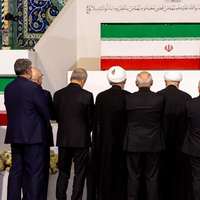
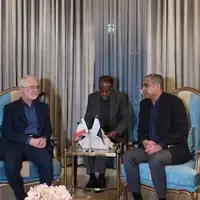
Large Russian and Iranian delegation meeting in Moscow on August 31, 2022
Moscow and Tehran are working on a 20-year strategic cooperation deal, foreign minister Sergei Lavrov said during a press conference with his Iranian counterpart.
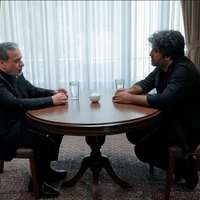
Tehran’s top diplomat, Hossein Amir-Abdollahian, met Lavrov in Moscow on Wednesday and discussed an array of foreign policy issues, but also more economic cooperation, as both are under international banking and energy sanctions.
Iran is currently negotiating with the West to resolve disputes around its nuclear program and emerge form crippling US sanctions, leading to concerns that Russia might use Iran to circumvent some international sanctions.
Despite a lot of rhetoric about close relations, bilateral trade between the two countries is quite small, only recently reaching $4 billion. The reason for this is that Russia until its invasion of Ukraine had a trade oriented toward the West and China, rather than Iran. Russian consumers could afford Western goods and China, Vietnam and others filled the void for cheaper merchandise.
But that can somewhat change. Lavrov mentioned plans to launch a free trade zone with Iran and the two allies have been holding talks with Azerbaijan to have a trade corridor from north to south. Still, Russia can benefit more from trade with Turkey since the latter has not joined Western sanctions.
Another project is for Iran to join Russia’s Mir payment system, launched in 2017 after the first Western sanctions following Moscow’s occupation of Crimea in 2014. The central bank launched the National Card Payment System after 2014, which issued the Mir payment system later. Both Russia and Iran are cut off from Mastercard and Visa, and Iran is completely banned from the Western banking communication system SWIFT, while also some Russian banks were disconnected from the fast money transfer service in March.
The Mir system itself is now contained, by around 100 million cardholders only having access to their Russian bank accountsand unable to do transactions with ecommerce websites elsewhere, except a few former Soviet Republics that are also members of the payment system.
But if Iran reaches a nuclear deal and US sanctions are lifted, its banking ties with other countries might gradually improve. In that case, Russians can use the Mir system to conduct international transactions via Iran.
Hadi Tizhush Taban, chairman of Russia Iran chamber of commerce in Tehran told a local website on Wednesday that Iran had only 0.5 percent of Russia’s international trade share before the invasion of Ukraine. He urged the development of trade infrastructure between the two counties, which itself might take a long time.
Taban expressed optimism that if a new nuclear deal is reached and sanctions lifted, Iran can have more non-oil exports to Russia.
But the biggest bonanza for Moscow would be its $10 billion deal with Tehran to expands nuclear power in Iran. The United States has reportedly agreed to allow Russia to continue with this project, which many think will be an opportunity for Moscow to circumvent Western sanctions.
Iran also has plans to import natural gas from Russia ostensibly as “swap” deal, but none of Iran’s neighbors except Turkey are Russian gas customers. In reality, Iran wants to use Russian gas to compensate for its domestic shortage and use the supply to sell more gas to Iraq and perhaps Pakistan as a new customer.
Despite all the talk about vastly expanding economic ties, Russia and Iran remain rivals in the oil market and their cooperation is more significant in political and military spheres.
The scene of an Israeli attack at the port of the coastal city of Latakia in western Syria on December 28, 2021
Israel conducted several airstrikes against the Aleppo International Airport in northwestern Syria, hours before its missiles struck targets southeast of Capital Damascus Wednesday night.
Syria’s state news agency (SANA) reported material damage at the airport, saying, "At around 20:00 hours (17:00 GMT), the Israeli enemy targeted Aleppo International Airport with missile fire, causing material damage at the heart of the facility.”
The UK-based war monitor, Syrian Observatory for Human Rights, said that four Israeli missiles had targeted the runway and depots at the airport.
According to Syrian military sources, air defense systems near Latakia, located southwest of Aleppo, were activated in an attempt to intercept the missiles headed towards Aleppo. Shortly after the strike in Aleppo, Israeli airstrikes targeted sites near Damascus International Airport and other targets south of Damascus, with Syrian air defenses downing “a number of missiles.”
Sabereen News, a channel close to Iran-backed forces in Syria reported that Israel targeted Aleppo airport to prevent a US sanctioned Iranian plane – belonging to the Yas Air cargo airline -- from landing as it appeared to be descending, adding that the plane changed course to Damascus so the Israeli aircraft returned and bombed Damascus airport.
Pouya Air – also known as Yas Air – is an Iranian cargo airline that has been owned by Pars Aviation Services Company (PASC), which the UN Security Council has identified as an entity affiliated with Iran's Revolutionary Guard (IRGC). According to the US Department of the Treasury, it has transported illicit cargo to Iranian proxies in the region on behalf of the IRGC Quds Force (IRGC-QF).
The Wednesday attack was the first alleged Israeli airstrike to target the Aleppo airport since 2019 and the second time Israel targeted a Syrian airport this year. On June 10, Israel bombed the Damascus International Airport, causing the airport to go completely out of service for a period of two weeks.
The airstrikes come less than a week after similar airstrikes targeted the Syrian Scientific Studies and Research Center (SSRC) in Masyaf, located southwest of Aleppo, reportedly destroying more than 1,000 Iranian-made missiles. The Observatory for Human Rights said the attack targeted a missile warehouse in the SSRC complex that stored thousands of medium-range, surface-to-surface missiles assembled under the supervision of Iran’s Revolutionary Guard’s “expert officers.”
The observatory added that 14 Syrian civilians sustained injuries with varying levels of severity during the Masyaf airstrike, in addition to casualties reported among Iranian-backed militias guarding the research center– which was heavily damaged during the attack.
In addition to the strikes attributed to Israel, the United States also engaged in a string of tit-for-tat attacks last week against Iranian militias in northern Syria who had targeted US forces with rockets and drones.
Iran-backed militias established a foothold in Syria while fighting in support of President Bashar al-Assad during Syria's civil war.
The airstrikes came just hours after Israeli Prime Minister Yair Lapid spoke with US President Joe Biden about the continuing efforts by the US, EU and Iran to revive the 2015 nuclear deal. During the conversation, Lapid also welcomed recent US strikes on Iran-backed militias in eastern Syria.
A member of the Ukrainian parliament says Russia is going to buy 100 more drones from Iran in addition to the drones it recently bought from the Islamic Republic.
Yuliya Leonidivna Klymenko, a member of the liberal party, told Iran International that she was “deeply shocked and saddened" by the fact that Iran sent drones to Russia to be used in its invasion of Ukraine.
US Defense Department spokesperson Todd Breasseale said on Tuesday that Russia has faced "numerous failures" with Iranian-made drones acquired from Tehran this month, adding that the United States assesses Russia has received the delivery of Mohajer-6 and Shahed-series unmanned aerial vehicles (UAVs) over several days this month. "We assess that Russia intends to use these Iranian UAVs, which can conduct air-to-surface attacks, electronic warfare, and targeting, on the battlefield in Ukraine," the official said.
In July, US National Security Adviser Jake Sullivan told reporters the US has information that shows Iran is preparing to provide Russia with up to several hundred drones.
The Biden administration last month released satellite imagery indicating that Russian officials visited Kashan Airfield on June 8 and July 5 to view the Iranian drones.
Iran's foreign minister, Hossein-Amir Abdollahian, never denying these reports, said last month that Tehran had "various types of collaboration with Russia, including in the defense sector."
Iran’s prosecutor-general Mohammad-Jafar Montazeri says since Tehran and Washington have no treaty on the expatriation of prisoners, such exchanges should be done through diplomatic channels.
In response to a question about earlier remarks by the country’s foreign ministry spokesman, who had expressed Iran’s readiness for prisoner swaps as part of the agreement to revive the 2015 nuclear deal, he did not rule out such a possibility.
“We have a duty to follow up on the problems of our citizens anywhere in the world and support them, but relations between countries can be very effective in this field. The level of relationships and the quality of relationships are effective in this field,” he said.
He noted that such exchanges work much more easily with Islamic countries and neighboring countries, especially with countries with whom Tehran has agreements in this regard, but “these relations and contracts do not exist with a country like the United States, and things must be done diplomatically.”
Earlier in the month, foreign ministry spokesman Nasser Kanaani said Iran is ready for swift agreements for prisoner swaps with the US, regardless of the result of talks to restore the JCPOA.
A few days earlier, the spokesman for the Iranian parliament's National Security and Foreign Relations Committee Mahmoud Abbaszadeh Meshkini said, "I don't know specifically whether there is going to be an exchange of prisoners between Iran and the United States, but in international relations this is customary and it is not unusual for some prisoners to be exchanged between the two countries.”
Israeli Prime Minister Yair Lapid and former Prime Minister Benjamin Netanyahu have rebuked each other after their Monday meeting over the Iran nuclear deal.
The two leaders held a meeting Monday evening at the prime minister's office to discuss the restoration of the 2015 Iran nuclear deal, officially known as the Joint Comprehensive Plan of Action (JCPOA), and the talks between Iran and world powers which appeared to have advanced in the past week.
After the briefing with Lapid,opposition leader and Likud Party head Benjamin Netanyahu said he was "more concerned about Iran” than before the meeting. He accused Lapid and Defense Minister Benny Gantz of failing to prevent a “disastrous Iran nuclear deal” and wasting time by not campaigning in the United States against The Islamic Republic.
“I have a clear message for the ayatollahs in Tehran: On November 1, we’ll bring strong and decisive leadership to Israel that will ensure that with or without a deal, they will never have nuclear weapons,” Netanyahu said, referring to Israel’s upcoming parliamentary elections.
Lapid’s Yesh Atid party also attacked Netanyahu in a tweet, accusing him of endangering the security of Israeli citizens. “While Netanyahu continues to produce and direct tone-deaf videos, the Israeli government led by Lapid will do everything to guard national security interests,” the party said in its tweet Monday evening.
The Prime Minister, however, said in a statement that he doesn't want a feud with Netanyahu over Israel’s positioning vis-a-vis the prospect of a restored Iran nuclear deal.
“There is great importance in a united Israeli stance against the Iranian effort to obtain a nuclear weapon. I call on the opposition leader and everyone not to let political considerations harm our national security,” Lapid said in a statement.
The two Israeli leaders had exchanged barbs before the Monday briefing.
In a statement before his meeting with the Prime Minister, Netanyahu had accused Lapid and Ganz of falling asleep on the watch and letting Iran "finalize a deal which jeopardizes our future…Lapid and Gantz' incompetence will be remembered in history as the Iranian nuclear fiasco.”
Responding to Netanyahu’s accusations, Lapid had said all Netanyahu had done when he was prime minister was giving press conferences and presentations. “The damage he caused during his tenure to Israel's two most important strategic issues — the fight against the Iran nuclear weapon and relations with the US — is serious and deep and we are still repairing it,” he said.
Iranian officials have not commented on the argument between Israeli leaders but in a press conference Sunday, President Ebrahim Raisi dismissed Israeli threats against Iran and referring to theassassination of Iran's nuclear scientists said no matter what Israel does, it cannot stop Iran and deprive the Iranian nation of "its inalienable right to access peaceful nuclear technology”. He also insisted that the Islamic Republic is not pursuing nuclear weapons.
The IRGC-linked Fars news agency on Sunday said analysts in Tehran believe that Israel and the United States are strategic partners and Tel Aviv's positions on the Vienna talks plays a complementary role to Washington's policy.
"Whenever the US is in trouble in negotiations with Iran and has failed to fulfil its purpose, the Zionist regime steps onto the scene to play a complementary role," senior analyst Seyed Mostafa Khoshchesm told Fars. “"The Israeli regime plays the role of a bad cop and conducts terror operations, cyber and sabotage attacks against Iran to serve the US interests," he said.