Former President Accused Of Ignoring Law To Curb Iran’s Nuclear Commitments
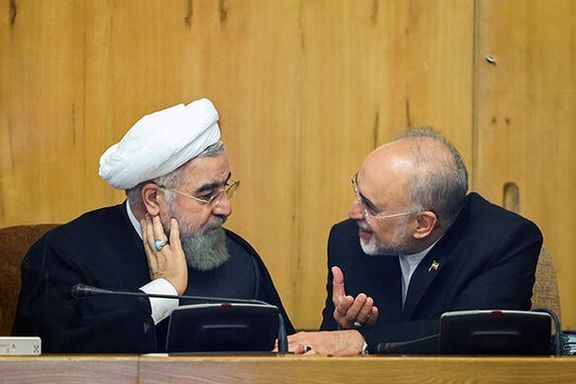
Iran’s former president Hassan Rouhani and the former head of the Atomic Energy Organization Ali Akbar Salehi
The Iranian parliament has accused the former president and former head of the Atomic Energy Organization (AEOI) of refusing to implement legislation for reducing Iran's JCPOA commitments.
The Article 90 Committee -- a parliamentary body mandated by the Constitution to pursue complaints concerning the work of government institutions -- presented a report on Wednesday, claiming that Hassan Rouhani and Ali Akbar Salehi deliberately ignored a December 2020 legislation entitled "Strategic Action To Eliminate Sanctions and Defend Iranian Nation's Interests.”
The committee said that since the refusal of these two former officials to implement the law on several occasions has been proven, the case will be "sent to the judicial authorities".
Former president Rouhani and his ministers have been threatened before with prosecution for a host of alleged mistakes and shortcomings by hardliners dominating the parliament.
The parliament passed the legislation following the assassination of nuclear scientist Mohsen Fakhrizadeh, arguing that Iran had gained nothing from the 2015 deal and even blamed it for the assassination.
A desert launch pad at Imam Khomeini Space Center southeast of Semnan
After satellite photos revealed Iran’s preparations for a rocket launch, the country announced Wednesday that it plans two tests for its Zuljanah rocket.
Satellite images from Maxar Technologies showed Tuesday activity at a desert launch pad at Imam Khomeini Space Center southeast of Semnan, prompting Iranian authorities to react and acknowledge plans for tests.
The state-run IRNA news agency quoted Defense Ministry spokesman Ahmad Hosseini as confirming the tests for the new solid-fueled rocket at the site of frequent recent failed attempts to put a satellite into orbit.
He said Iran will launch its satellite-carrying Zuljanah rocket twice more after conducting a previous launch, but he did not elaborate on a timeframe for tests nor said when the previous launch occurred.
Asked about the preparations, State Department spokesman Ned Price told reporters in Washington on Tuesday that the US urges Iran to de-escalate the situation, saying that Iran “has consistently chosen to take provocative actions.”
A Pentagon spokesman, Army Maj. Rob Lodewick, said the American military “will continue to closely monitor Iran’s pursuit of viable space launch technology and how it may relate to advancements in its overall ballistic missile program.” The United States says that space launches by Iran could be a cover to develop intercontinental ballistic missiles that would be able to deliver nuclear warheads.
Former US national security adviser John Bolton says restoring the nuclear deal between Iran and world powers increases the likelihood of a war between Iran and Israel.
Bolton told Iran International’s Fardad Farahzad on Tuesday that if the Biden administration returns to the 2015 nuclear deal with Iran, it will make a big mistake because Israel will feel threatened, intensifying the proxy conflict between the Islamic Republic and Israel to a full-fledged war.
The possibility of reviving the JCPOA is very low, and if the Vienna talks fail, on the one hand, "Israel or others" may take covert or overt action to stop Iran's nuclear program, and on the other hand, sanctions against the Islamic Republic will increase.
In response to a question about the joint naval drills between the US Navy and the United Arab Emirates in the Persian Gulf, he noted that the Iranian threat in the region has reached a very serious point but the possibility of a full-blown war in the short term is still very low, adding that there is no real possibility of a war between Iran and the US because it is tantamount to “suicide” for the Islamic Republic.
US Central Command said on Tuesday that the naval forces of the US and the UAE have started a 10-day drill, codenamed Iron Defender.
Earlier on Tuesday, Connecticut Democrat Senator Chris Murphy told Iran International that "It would be tragic if we didn't get back into the nuclear agreement. I have yet to hear Republicans present a plausible alternative for how we keep the region and the world safe from nuclear weapons without this diplomatic agreement."
In response to Iran International, US State Department said if Iran is ready to drop demands beyond the JCPOA, Washington can return to the deal “very swiftly”.
Answering a question by our correspondent Samira Gharaei at the State department briefing on Tuesday about claims by Iranian Foreign Minister Hossein Amir-Abdollahian that the Islamic Republic has proposed new initiatives aimed at reviving the nuclear deal, spokesman Ned Price implicitly confirmed the news but avoided directly commenting on Iran's proposals.
Price reiterated that Washington and its European partners are ready to conclude an agreement in Vienna for the mutual compliance with the JCPOA, noting that for that to happen, “Tehran needs to decide to drop demands that go beyond the scope of the JCPOA”, suggesting that the new proposals by Tehran include demands extraneous to the 2015 accord.
He confirmed that Tehran and Washington are engaged in indirect regular contact via Enrique Mora, the European Union coordinator for the Iran nuclear talks, saying, “We await a constructive response from the Iranians, a response that leaves behind issues that are extraneous to the JCPOA.”
Iran International’s correspondent Samira Gharaei during a press briefing of US State Department Spokesperson Ned Price on June 14, 2022
Earlier in the day, Iran's Atomic Energy Organization released a copy of its answers to IAEA questions about origins of uranium found at three undeclared locations, saying “sabotage” is the only explanation.
Iran agreed March 5 to provide written explanations by March 20 of long-standing issues in its nuclear work before 2003, and to clear up remaining queries by June 21. The latest quarterly report by the UN watchdog expressed dissatisfaction with Iran’s response to agency over sites not declared as part of the nuclear program where inspectors detected traces of uranium. This led to a resolution critical of Iran’s nuclear cooperation by the agency’s board of governors on June 8.
In its answers, Iran maintained that the only plausible explanation for such traces is probably sabotage by foreign elements at Marivan, Varamin and Turquzabad sites, pointing out that the Varamin center, near the capital Tehran, was "never" used for nuclear activities.
Iran said the IAEA’s claims about storage of nuclear material and/or conduct of nuclear-related activities, at Varamin are not supported by valid proofs and are misleading, noting that “the initial activities conducted in this location had been exploitation of sodium sulphate from the soil and water of the surrounding region.”
For Marivan, which is a misnomer as the site is located near the city of Abadeh in the southwestern Fars province, Iran said the origin of the particles is "unknown" and insists the site was used for "the exploitation of fireclay through a contract with a foreign company decades ago" hence the IAEA’s “conclusion is absolutely false, unrealistic and biased.”
Iran claims it carried out its own investigation in Turquzabad and "did not find the origin of the particles" reported by the IAEA.
Later on Tuesday, the head of the Atomic Energy Agency of Iran, Mohammad Eslami, said that Iran’s contacts with the International Atomic Energy Agency are still underway, reiterating that Iran will act based on the safeguards protocol.
Following the resolution, Iran retaliated, telling the IAEA it plans to remove more monitoring equipment, but intends to maintain a basic level of monitoring and inspectors’ access as required under the Nuclear Non-Proliferation Treaty (NPT).
The resolution comes with year-long talks paused since March between Iran and five world powers aimed at reviving the 2015 Iran nuclear deal, the JCPOA (Joint Comprehensive Plan of Action).
Leaders of the UAE, Egypt and Israel in March summit in the Negev
Israel intensified pressure on Iran by calling for a military front with US leadership in the Middle East ahead of a visit to the region by President Joe Biden.
Israel and Arab countries that share its worries about Iran should build up their military capabilities under Washington's aegis, the Israeli defense minister said on Tuesday.
Biden's July 13-16 tour will include Israel, the Palestinian territories and Saudi Arabia, a US official said. According to Saudi state television, Biden will attend a summit with the leaders of Gulf states, Egypt, Jordan and Iraq.
A summit of foreign ministers was held in Israel in March with the participation of the United States, United Arab Emirates, Bahrain, Morocco and Egypt. Israel highlighted the event as a show of unity against Iran.
"This new architecture -- the shared capabilities we are building -- intimidates and deters our common enemies, first and foremost Iran and its proxies," Lapid said alongside his counterparts from the other countries at the Negev summit on March 28.
Iran's nuclear program, and so-far fruitless international negotiations to revive a 2015 deal capping it, are among issues likely to be on the agenda of Biden’s visit and meetings he will held.
In a speech, Defense Minister Benny Gantz cited Israel's security ties with Gulf Arab states that drew closer to it under a 2020 U.S.-sponsored diplomatic drive, as well as Egypt and Jordan, and said there were efforts to expand such cooperation.
"In the face of Iranian belligerence ... what is needed is not just cooperation, but also a regional force build-up, with American leadership, which would strengthen all parties involved," he said, according to an official transcript.
"On this, we are working continually, for the sake of the security of Israel's citizens," Gantz said.
Saudi Arabia signaled its backing for the so-called Abraham Accords under which the United Arab Emirates and Bahrain forged relations with Israel two years ago. But Riyadh has stopped short of formally recognizing neighboring Israel.
Israel has voiced willingness to work militarily with its new Gulf partners, which have been more publicly reticent about such a prospect.
Biden’s visit to the region and specially Saudi Arabia is a major attempt to improve frayed ties with the leading Sunni Arab country in the region, with an eye to boost the kingdom’s oil production in the wake of the Russian invasion of Ukraine and the resulting high fuel prices.
Riyadh and its Arab allies who had close ties with the Trump administration, were concerned with Biden’s policy of restoring the 2015 Iran nuclear agreement and lifting sanction, without provisions to curtail Tehran’s interference in Arab countries and support for militant groups.
Speaking at an event on Tuesday evening, Bennett said Israel "will not hesitate to activate its power anywhere in the world to protect its citizens", alluding to a travel advisory to Istanbul because of what Israel said was a threat of Iranian attempts to kill or abduct vacationing Israelis.
"Israel's security arms are doing everything to thwart such attacks, and to preemptively neutralize those dispatching the terrorists, and the dispatchers’ dispatchers too," Bennett said.
Imprisoned political activist Keyvan Samimi Behbahani
About 240 Iranian civil activists have called the “inhumane treatment” of political activist Keyvan Samimi Behbahani a "gradual assassination attempt", calling for his immediate release.
In a statement on Tuesday, the activists also called for the release of all political and ideological prisoners, and urged the Islamic Republic’s authorities to stop manufacturing political charges for journalists based on baseless allegations.
Condemning the new cases brought against Samimi, the statement referred to his "various illnesses", and stressed that "the responsibility for any negligence and unfortunate incident will fall on the senior judicial, security and political officials of the Islamic Republic."
According to the statement, authorities have recently filed a new case against the 74-year-old journalist -- among the oldest prisoners of conscience in Iran -- "merely for publishing his views on a personal telegram channel."
He was arrested again following a furlough in May after being summoned to the Evin prison and was sent to Semnan Prison.
In a letter from prison, Samimi expressed support for the popular protests that are growing across the country, saying, "Non-violent rallies are aimed at restoring the lost rights of the nation, which will lead to structural change."