Meat, cream, rice: Food becomes loot as prices soar in Iran

Soaring food prices in Iran are increasingly reflected in reports of theft, with groceries appearing in cases ranging from first-time shoplifting to warehouse raids and armed robbery.
Iran International

Soaring food prices in Iran are increasingly reflected in reports of theft, with groceries appearing in cases ranging from first-time shoplifting to warehouse raids and armed robbery.
A butcher in Karaj told Iran International that some customers now ask for their meat to be placed in black bags so it does not attract attention.
He described an elderly woman who had just bought meat when a man on a motorbike snatched the bag from her hand, causing her to fall and suffer injuries.
Police and judicial authorities do not publish detailed statistics on food theft, making it impossible to establish its scale or whether such crimes have increased. But basic groceries feature repeatedly in recent media reports of theft.
Some cases appear to involve people with no previous history of crime.
Meat, rice, cream
State news agency IRNA reported the case of a woman caught hiding two tubs of cream under her chador. When stopped by a security guard, she said her children were hungry. Her husband, described as a day labourer, reportedly knew nothing about the theft.
In a review of similar cases, IRNA said some of those accused, including housewives, had no criminal record and were facing theft charges for the first time. Cheese, yoghurt, cream and cooking oil were among the goods being stolen, it said.
The newspaper Jahan-e Sanat has separately reported thefts of cheese, butter and meat from shops.
The reports come as the cost of basic food has risen far faster than overall prices.
According to the Statistical Center of Iran, year-on-year inflation for food and drink reached 127.5 percent in the month to late August, meaning average prices in the category had more than doubled in a year.
Some staples rose considerably faster. Solid vegetable oil increased by more than 383 percent, eggs by nearly 294 percent, chicken by around 177 percent and red meat by 148 percent.
Iranian media reported last month that a kilogram of beef fillet cost around 42.7 million rials, about $19. At that price, one kilogram was equivalent to roughly seven and a half days of earnings at the minimum daily wage of 5.54 million rials, or about $2.50.
Armed robberies
But food is also appearing in crimes that have little apparent connection to immediate hunger, suggesting that sharply higher prices have made groceries more attractive to thieves.
In eastern Tehran, members of a gang who police said confessed to more than 10 house burglaries were stealing rice alongside gold, dollars and coins.
Police have also reported larger thefts, including around 1.5 tons of rice and other groceries from a storeroom in Tehran and approximately 15 tons of rice from a private warehouse in Rey.
Local media reported two armed robberies of shops in Iranshahr, in Sistan and Baluchistan province. In one, attackers took six sacks of rice, around 12 bottles of cooking oil, tinned food and pulses. In another, robbers fired shots before taking rice and cooking oil.
The cases cannot establish that food theft is increasing, nor do they point to a single motive. Shoplifting by someone struggling to feed a family is plainly different from a gang stealing rice alongside gold or raiding a warehouse.
What connects them is the changing value of food after years of inflation, particularly the steep price rises of recent months. Basic groceries have become increasingly difficult for many Iranians to afford — and valuable enough to steal.


Tehran’s governor has called for schools used by other state bodies to be returned before students begin the new academic year, months after military and security forces deployed at schools during the US-Israeli war.
Mohammad-Sadegh Motamedian did not identify which institutions were using the schools or disclose how many educational facilities had yet to be returned to the Education Ministry.
“These educational spaces must be handed over to the Education Ministry before the start of the school year, and where there are challenges, the relevant institution should inform the province so alternative space can be provided and the issue resolved,” Motamedian said.
The Revolutionary Guards, Basij paramilitary force and police used schools to station personnel during and after the war.
Dozens of schools used during war
An Iran International investigation published in March found that security and military forces moved personnel, weapons and equipment into at least 70 civilian sites across 17 provinces during the US-Israeli strikes from March 2 to 14.
Nearly half of the locations – 34 – were primary or secondary schools. Other sites included hospitals, stadiums, universities, mosques, parks and government offices.
Footage from several cities showed security vehicles, personnel or military equipment on school grounds.
‘Schools offered greater security’
Journalist Ali Hossein Ghazizadeh said schools offered forces large courtyards, numerous rooms and locations among residential buildings at a time when military bases were being targeted.
“Being in schools provides greater security for them,” Ghazizadeh told.
Schools were particularly useful for relocating personnel after bases and other facilities were struck, and their location among civilian buildings provided additional protection, Ghazizadeh said.
The use of educational facilities did not necessarily end with the fighting, Ghazizadeh said, adding that Iran International had received information indicating that some institutions sought to retain schools for longer-term use.
Civilian protection concerns
Schools are generally protected as civilian objects under international humanitarian law but can lose that protection if their use makes them military objectives. Attacking forces remain bound by rules including distinction, proportionality and precautions to limit civilian harm.
Iranian officials have denied using civilians as shields and accused Israel of targeting civilian infrastructure during the conflict.
The Israeli military confirmed to Iran International in March that it had identified Iranian forces deploying personnel and weapons at civilian sites, including schools, mosques and stadiums.
An Iranian protester shot in the leg during January’s demonstrations remains unable to walk after 23 operations, with further treatment ahead, medical bills mounting and concerns for his safety persisting months after the shooting.
“Despite all these surgeries, I am still confined to my home,” the protester, whose identity and place of residence are being withheld for security reasons, told Iran International. “I am married, and during this time we have faced many problems paying for my treatment.”
His family eventually sold their car to help cover his medical bills, the protester said. Doctors have told him that regaining the ability to walk could take at least another year.
The account reflects the prolonged physical and financial consequences facing some people wounded during the protests, with Iran International receiving multiple accounts of injured demonstrators struggling to obtain treatment and pay medical expenses months later.
23 operations and more treatment ahead
The gunshot caused extensive damage to the protester’s leg, requiring doctors to perform muscle and skin grafts during a series of operations.
“About a month has passed since the skin graft, and the Ilizarov device that was fitted to my leg at the beginning of treatment is due to be put back on for about three months,” the protester said.
An Ilizarov apparatus is an external bone-fixation system using metal rings, rods and wires to gradually reposition sections of bone. It can be used to treat severe damage or the loss of part of a bone.
Doctors also attached a vacuum-assisted device to the wound for several months to promote new tissue growth, the protester said.
Infection, nerve damage and numbness later forced doctors to remove some of the repaired tissue and perform a muscle graft about six months after the shooting, according to the protester.
“I asked people who were able to help, but in the end, with great difficulty and even by selling our car, we tried to cover the costs,” he said.
Security fears complicate hospital treatment
Fear of arrest or identification at hospitals has complicated treatment for some protesters wounded during demonstrations, prompting some to seek medical care covertly or at home.
“After one of the surgeries, because there were many security officers in the emergency department, the doctor helped me leave the hospital,” the protester said.
Hospital staff recorded the cause of his injuries as a traffic accident, and his doctor later helped take him to Tehran to continue undergoing surgery, the protester said.
“I really do not know how to thank the medical staff,” he added. “They cooperated extensively and tried to make sure nothing else happened to me.”
Protester recounts January 8 shooting
Security forces initially fired pellets toward demonstrators before a live round struck his leg at close range on the evening of January 8, the protester said.
“My whole body is covered with pellet marks. The bullet hit my leg from close range,” he said. “When I was shot, they dragged me along the ground while I was in a very bad condition. I will never forget that night.”
Security personnel insulted him and tried to remove his clothing after he was wounded, according to his account.
“I held tightly onto my trousers, and they struck my hands with their boots,” he said. “My entire body was bruised, and I even thought my ribs were broken.”
The officers then put him on a motorcycle, the protester said.
“One of them said, ‘Don’t hit him here, take him farther up,’” he said. “I thought they meant they were going to finish me off. I passed out from fear.”
The protester said he regained consciousness alone in a dark alley, where an elderly couple found him and helped him reach a hospital.
“At first, I thought I was dead,” he said. “Then an elderly woman and man found me. They were like angels to me and helped me get to the hospital.”
The protester said he had joined the demonstrations knowing that doing so could put his life at risk.
“That night, I went out like many others, and I knew I might lose my life, but for me it was about Iran,” he said.
Six months after the shooting, the protester remains unable to walk, with further procedures ahead and no certainty over when he will regain mobility.
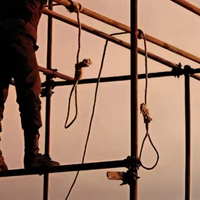
Iran is putting two faces of its justice system on display: highly publicized acts of compassion for thousands of prisoners, alongside an execution campaign that has killed hundreds and continues to put protesters on death row.
Iran’s leadership recently approved pardons or reduced sentences for 2,577 prisoners. The announcement came with the usual ceremonial packaging: a religious occasion, a request from the head of the judiciary and a generous act of compassion from above.
It is an impressive number. Large enough to make headlines and perhaps create the impression that something in Iran is becoming softer.
At almost the same time, the Revolutionary Court in Isfahan sentenced ten people arrested following the January protests to death. So much for the softer side.
These ten sentences are shocking, but they are not an isolated story. They were handed down in the middle of an execution campaign that has already taken hundreds of lives this year.
Iran Human Rights recorded at least 532 executions in the first eight months of 2026, including 82 in August alone. Only 77 of those 532 executions were announced by official sources. The rest were documented through the organization’s network and verified using independent sources.
In other words, while the Islamic Republic publishes its pardons, most of its executions happen with considerably less enthusiasm for publicity.
Iran Human Rights recorded at least 1,639 executions in 2025, a 68 percent increase from the previous year and the highest annual figure the organization has documented since 1989.
Many were sentenced to death for murder or drug-related offenses, often after proceedings criticized for serious violations of due process. But that distinction does not make the wider execution spree irrelevant to political repression.
The gallows create their own atmosphere. When a state executes people on such a scale, often without public acknowledgment, every new death sentence against a protester carries a very clear message.
At least 31 protesters had been executed by the end of August, according to Iran Human Rights. Twenty-nine of them had been arrested in connection with the January protests.
Amnesty International has also warned that dozens of protesters and dissidents remain under death sentences or at risk of execution.
The ten defendants in Isfahan are therefore not the entire story. They are the latest names added to a much larger campaign.
The case is known as the “Isfahan Shohada Square case.” According to matching reports by HRANA and Hengaw, those sentenced to death are Taraneh Rahimi, Navid Elyasi, Abolfazl Dadgostar, Mehdi Mansouri, Ahmadreza Saeidi, Mehrdad Boveyri, Mohammad Mehdi Asadi, Armin Gholami, Parsa Jafari and Mehdi Jafari, also known as Mehdi Jafari Khosravi.
All ten were also sentenced to 11 years in prison. Six other defendants received terms ranging from 16 to 36 years. Together, the prison sentences imposed on the 16 defendants amount to 256 years.
The charges include moharebeh, usually translated as “waging war against God,” allegedly through carrying bladed weapons, as well as destruction of public property, assembly and collusion, and propaganda against the state.
Two people died during the events around Shohada Square: a member of the Islamic Revolutionary Guard Corps and a homeless man. Yet the indictment reportedly did not charge the defendants directly with killing either of them.
According to HRANA and Hengaw, no documented evidence was presented establishing their responsibility for those deaths.
One detail is especially difficult to forget. A video found on the phones of some defendants reportedly shows Taraneh Rahimi, the only woman among the ten sentenced to death, trying to stop people from beating the homeless man.
She was reportedly attempting to prevent violence. The court sentenced her to death.
The defendants’ lawyers were denied access to significant parts of the case files and were not given sufficient time to review the evidence, according to the two organizations. The hearing was held inside Dastgerd Prison rather than an ordinary public courtroom.
During the proceedings, Ahmadreza Saeidi told the judges that an investigator had tortured him with electric shocks to his neck and genitals. There is no public indication that the allegation led to an independent investigation or caused the court to reconsider evidence obtained during his interrogation.
The full judgment has not been published, leaving no way for independent observers to examine the evidence or understand how the court justified ten death sentences without directly charging the defendants over the two deaths at the center of the case.
The verdicts are preliminary and can still be appealed. For the families, it offers limited comfort. They now have to wait while the same judicial system accused of denying the defense proper access to the case decides whether their loved ones should live.
This is what makes the pardon announcement so revealing.
Clemency is real for those who receive it. A prisoner returning home is not a public relations statistic to the family waiting at the door. A reduced sentence can restore years of someone’s life, and none of that should be dismissed.
But selective clemency should not be mistaken for a change in direction, especially while executions continue at this scale.
The 2,577 pardons offer the public one image of the state. The hundreds of executions offer another, one that receives considerably less official attention. Political defendants are being placed inside a system of capital punishment already operating at extraordinary speed.
The Isfahan case shows how that machinery can be directed against protest. A broad charge such as “waging war against God,” limited access to evidence, an allegation of torture and a closed hearing inside a prison can lead all the way to the gallows.
The pardons are meant to be seen. Most of the executions are not. Behind the official display of mercy, the machinery has not slowed down. Ten more people have now been placed in its path.
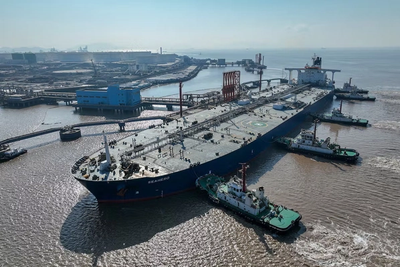
Iran is seeking to turn the US maritime blockade back on Washington by expanding its retaliation beyond the Strait of Hormuz, threatening shipping across a wider area after US attacks on Iranian tankers.
Nour News, a website close to Iran’s Supreme National Security Council, said Wednesday that the latest escalation showed signs of reversing the logic of the blockade.
“The US naval blockade was supposed to target Iran’s economic resilience by cutting or restricting its export routes,” it said.
But with both sides now attacking tankers and military vessels and traffic through Hormuz again sharply reduced, “the cost of the blockade is no longer distributed solely on the Iranian side.”
The Revolutionary Guards (IRGC) said Wednesday that Iranian forces had responded to US attacks on five Iranian tankers by targeting two US warships and eight oil tankers, as well as 10 “violating vessels” attempting to pass through Iran’s restricted zone in Hormuz.
The US denied that its warships had been hit.
‘An eye for an eye’
Iran is now threatening to widen that confrontation geographically.
IRGC spokesman Hossein Mohebbi said a new restricted area would extend from the direction of Chabahar through parts of the Gulf of Oman and Arabian Sea along routes leading towards Hormuz. Its precise coordinates have yet to be announced.
The IRGC has also warned tankers and other vessels at ports and anchorages in Kuwait and Bahrain to leave, threatening those that remain.
Ships entering without Iranian permission would be placed on a sanctions list and denied maritime, insurance and other services, Mohebbi said, including during future passages through Hormuz.
Conservative political activist Amir Chizari, who is close to parliament speaker Mohammad-Bagher Ghalibaf, advocated going further, calling for Iran to prevent ships from using ports in Persian Gulf countries hosting US military bases.
“Head for head, eye for eye—that means all these ports will be blockaded by Iran,” he wrote on X.
Nour News said the significance lay not simply in creating another restricted zone but “in changing the logic of confrontation with the blockade.”
“Tehran does not necessarily need to seize a ship to change the behaviour of an actor; it is enough for the cost of interacting with a vessel or network to rise so that the other side retreats in advance,” it said.
Diplomacy narrows
The increasingly expansive strategy comes as prospects for reviving diplomacy appear to be shrinking.
Foreign Minister Abbas Araghchi said Tuesday that a US return to its commitments and the Islamabad understanding would “pave the way for a return to normality.”
But Middle East Eye reported Wednesday, citing two sources close to the Iranian government, that President Donald Trump had conveyed through Pakistani and Qatari officials that Washington would not return to the previous understanding.
The absence of a diplomatic route raises the stakes of Iran’s strategy: Tehran is betting that making the blockade more expensive for Washington, commercial shipping and regional states will eventually create pressure to ease it.
A costly gamble
Inside Iran, critics warn that the same strategy could inflict enormous damage on the country itself.
Heshmatollah Falahatpisheh, a conservative former chairman of parliament’s National Security and Foreign Policy Commission, accused hardliners of risking Iran’s tanker fleet.
“The National Iranian Tanker Company is the largest tanker company in the world. They are setting the country’s unparalleled wealth on fire. This Iran-burning must end,” he wrote on X.
Hardliners counter that such economic calculations make little sense when they believe Iran faces an existential threat.
One user responding to Falahatpisheh asked what guarantee Iran had that peace would last if it compromised now, or that the United States would not attack again months later.
The costs of escalation are already becoming apparent. Brent crude rose above $100 a barrel Wednesday, while flows through Hormuz fell as low as two million barrels a day after reaching eight to nine million before fighting resumed.
In Iran, the dollar rose above 2.33 million rials on the foreign exchange market, another record low for the national currency.
Iran’s strategy amounts to a gamble that widening the geographic and economic costs of the blockade will eventually make it harder to sustain. But the deeper Tehran extends the confrontation beyond Hormuz, the greater the risk that those costs return to Iran itself.
Moderate and reformist figures in Tehran are increasingly warning that the country cannot sustain a prolonged war, challenging hardline calls for Iranians to accept further economic hardship as the price of resistance.
Their warnings come amid rising tensions in the Persian Gulf and Strait of Hormuz and growing concern that renewed military confrontations could escalate into a broader conflict.
Conservative lawmaker Gholamreza Tajgardoon on Tuesday urged Iranians to be prepared to “pay a price for their resistance.”
But several moderate and reformist figures have argued that years of sanctions, inflation and now war have left ordinary people with little capacity to absorb further economic pressure.
“Right now, in certain border and maritime regions, we are witnessing tension, conflict and military engagements,” veteran reformist figure Mohammad Atrianfar told Khabar Online on Tuesday. “One of the public’s serious concerns is whether these conflicts will lead to a full-scale war.”
Atrianfar said preventing a return to widespread war was an “unavoidable necessity” and called for clear red lines and emergency communication channels to help manage the conflict.
His comments come amid US strikes on Iranian tankers and Iranian attacks on American bases and warships in the region.
Atrianfar argued that diplomatic compromise should not automatically be treated as capitulation, saying the distinction between an honourable compromise and a damaging retreat depended on whether an agreement served national interests and restored stability.
Moderate political figure Mansour Haghighatpour made a similar argument, pointing to inflation and what he described as growing public exhaustion.
While Iran should maintain its ability to defend itself against foreign threats, he said, “the priority should remain securing a peace that guarantees national interests.”
His comments appeared to respond directly to Tajgardoon’s appeal for Iranians to accept the costs of resistance. Expecting people to endure continuing hardship without diplomatic progress was becoming untenable, Haghighatpour said.
Reformist politician Mahmoud Mirlohi focused on the physical and economic risks of a drawn-out conflict, warning that critical infrastructure, including power and petrochemical facilities, could become targets.
“Prolonged war and harsh sanctions have pushed Iranian society to its limits,” he said, arguing that Iranians needed “a chance to breathe.”
Mirlohi also criticised what he described as “extremist rhetoric and maximalist behaviour” at home, saying portraying Iranian political figures as advocates of continued war or nuclear escalation made diplomacy more difficult.
The increasingly public warnings reflect a broader argument within Iran over not only how the war should end, but how much more economic and social pressure the population can reasonably be expected to bear.
Hamidreza Jalaeipour, a reformist political figure generally supportive of the existing system, said Iranians had already endured more than two decades of sanctions, high inflation and stagnant economic growth.
He claimed more than 40% of the population was now below the poverty line and warned that “prolonging a war of attrition exacerbates this severe economic strain and risks severe public fatigue.”
“Iran needs realistic governance rather than radical idealism,” Jalaeipour said, accusing hardliners and partisan media of obstructing the flexibility needed for diplomacy and risking greater social unrest.