US vows 'indefinite' blockade as Iran signals offensive posture
An illustration released by US Central Command depicts one-way attack drones operating across air, surface and subsurface domains.
The US-Iran standoff is hardening around the Strait of Hormuz, with Washington saying it can sustain maritime pressure indefinitely and Tehran signaling readiness for a prolonged confrontation and more offensive operations.
The United States is preparing to send the USS George Washington to the Middle East in a previously scheduled rotation, while Defense Secretary Pete Hegseth said Thursday that rotating ships would allow the US Navy to maintain its blockade for as long as necessary.
“Indefinitely the United States Navy can maintain a blockade like that because we'll rotate ships in and out, as we have, and we'll continue to,” Hegseth told reporters.
The George Washington is expected to replace the USS Abraham Lincoln, the Wall Street Journal reported, citing US officials. The Lincoln was redirected to the Middle East in January ahead of the US war against Iran and has now spent more than 250 days deployed.
CENTCOM also announced Thursday the creation of its first multinational, multi-domain attack drone task force, building on the use of one-way unmanned systems during Operation Epic Fury and strikes on Iranian port facilities in July.
Task Force Falcon Strike will use one-way attack drones in the air, on the surface and below it, with US Special Operations Command Central personnel leading the unit and regional partners being formally invited to join.
Iran signals offensive posture
In Tehran, Mohammad Mokhber, an adviser to Supreme Leader Mojtaba Khamenei, said Thursday that Khamenei’s strategy was to shift the war to an offensive posture if Iran’s conditions were not met.
That emphasis was also reflected in Khamenei’s appointment of six senior military commanders earlier this week.
His decree naming Ahmad Vahidi commander-in-chief of the IRGC instructed him to strengthen the force’s capabilities for “maximum deterrence” and maintain readiness for “powerful offensive operations against the enemy.”
IRGC Navy commander Ali Azmaei, also formally appointed this week, said Thursday that the Strait of Hormuz remained closed and that no movement through it escaped the force’s notice.
Rasoul Sanaei-Rad, a senior military official, said Iran was preparing for “worst-case” war scenarios and needed offensive capabilities alongside defensive ones. “Our fighters have their fingers on the trigger,” he said, adding that Iran would seek to impose a much heavier defeat if attacked again.
All about Hormuz
Hormuz remains the immediate test of those competing claims of endurance.
Iran’s Khatam al-Anbiya Central Headquarters said Thursday that no commercial ship or oil tanker could safely pass through the waterway without Tehran’s permission and oversight.
The United States, meanwhile, says its blockade remains in force. CENTCOM said that as of Wednesday, US forces had redirected 59 commercial vessels, disabled three and boarded two others while enforcing what it calls its “steel wall blockade” against Iran.
Off the water, diplomatic contacts have continued despite the military buildup.
Foreign Minister Abbas Araghchi warned Washington Thursday against what he called a “bigger miscalculation” over the Strait of Hormuz, while Vice President Majid Ansari said war and negotiations were “complementary” and that Iran would pursue its objectives in the waterway and the wider region.
The parallel military and diplomatic tracks have yet to produce a breakthrough over Hormuz. Instead, Thursday’s statements suggested both sides are preparing for the possibility that the standoff will last.
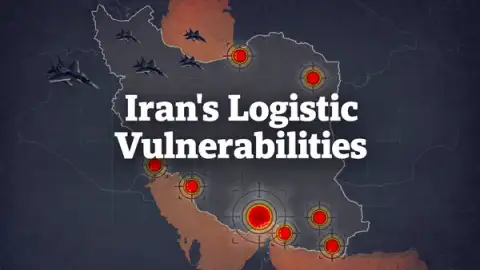
Replacing a single ship carrying essential goods to Iran would require about 2,500 trucks, a Chamber of Commerce official warned, saying land routes cannot offset the US maritime blockade and negotiations are the only realistic way to restore trade.
Davoud Rangi, vice chair of the chamber’s Import Management Committee, said Iran receives around 400 to 500 ships carrying essential goods each year, making any attempt to replace maritime imports with overland transport impractical.
“Mobilizing this number of trucks is far-fetched for us, and even if they were mobilized, transportation costs would rise sharply,” Rangi told Eghtesad News on Thursday.
He said Iranian authorities should not count on land corridors as a substitute for the country’s southern ports because neighboring states could restrict border traffic at short notice and the routes lack the capacity to handle the necessary volume of goods.
Neighboring governments could close a border “with a single order,” he said, adding that the justification would not necessarily have to be political or military and could instead involve quarantine or veterinary restrictions of the kind Iran has faced before.
Rangi said land routes through countries such as Turkey or Pakistan might accommodate around one million tons of cargo annually, but could not come close to replacing Iran’s maritime trade.
“At a small scale, perhaps one million tons of cargo a year could be brought in through Turkey or Pakistan, but 23 million tons, or even half of that, is simply inconceivable,” he said.
The warning comes as Iran’s southern ports remain under pressure from the war. IRGC attacks on commercial vessels in the Strait of Hormuz have escalated regional tensions in recent weeks, while the United States intensified economic pressure on Tehran through a maritime blockade.
The outlook for negotiations between Tehran and Washington over reopening the Strait of Hormuz remains uncertain, with concerns also growing over a possible expansion of the regional conflict.
Negotiations seen as only viable way out
Rangi said negotiations and a reduction in military tensions were the only practical route to lifting the blockade and restoring the regular flow of essential goods into Iran.
Attempting to rely instead on overland corridors would impose heavy losses on importers, he said, because of both limited capacity and sharply higher transportation costs.
The blockade is also complicating Iranian exports, particularly containerized trade.
Rangi said vessels carrying bulk commodities could more easily be allowed to pass, while container ships pose a greater problem because individual containers cannot practically be separated from the rest of a ship’s cargo.
“We are extremely vulnerable on the southern route, in Bandar Abbas and Chabahar, but along the northern and western corridors the situation is much better for exports than for imports,” he said.
Iran’s economy has already come under mounting pressure in recent months from the continuing conflict, tighter sanctions and a sharp decline in the value of the rial.
Surging inflation and falling purchasing power have further strained household finances, making essential goods increasingly difficult to afford for a large part of the population.
The P4 offshore platform at Iran’s Reshadat oil field in the Persian Gulf, completed in June 2026.
OPEC oil production continued its sharp post-war recovery in July, but Iran remained a notable exception, with output still around a quarter below pre-war levels and its oil revenues taking an even steeper hit.
Iran produced 2.478 million barrels per day (bpd) in July, up just 26,000 bpd from June, according to OPEC’s latest monthly report.
By contrast, Saudi Arabia increased output by about 590,000 bpd, Iraq by 665,000 bpd and Kuwait by 393,000 bpd. Combined crude production among OPEC members rose by about 1.66 million bpd in July to 23.63 million bpd.
Iran’s export revenues have recovered even more slowly.
Commodity intelligence firm Kpler told Iran International that daily deliveries of Iranian crude to Chinese refineries fell from more than 1.7 million bpd in March and April to less than 500,000 bpd in July.
Kpler said Iran offered its crude at a discount of more than $5 a barrel in July, while transportation costs exceeded $10 a barrel. Once payments to intermediaries were included, it estimated that at least 25% of the nominal value of Iran’s oil sales was lost before the proceeds reached the country.
At July’s export volumes, Kpler estimated that crude delivered to China had a nominal value of about $1.2 billion. That compares with average monthly oil revenues of about $3.8 billion last year, according to OPEC estimates.
China has long been overwhelmingly the largest destination for Iranian crude, leaving Tehran particularly exposed to changes in purchases by Chinese refineries.
Iran struggles to restore output
Iranian production fell by nearly 1 million bpd between the beginning of the Middle East war and May, according to OPEC figures.
Over the following two months, it recovered by only about 200,000 bpd, reaching 2.478 million bpd in July. The pace of that recovery slowed sharply last month, with the 26,000-bpd increase leaving production roughly a quarter below pre-war levels.
The figures contrast with the much faster restoration of production elsewhere in the Persian Gulf following the severe disruptions caused by the war.
Saudi Arabia, Iraq and Kuwait accounted for much of OPEC’s July increase as producers took advantage of the temporary ceasefire to restore output. Despite the rebound, regional production remains well below levels before the conflict, with large volumes of Persian Gulf supply still offline.
The contrast is even sharper with the United Arab Emirates, which left OPEC in May and has since sharply expanded production. OPEC continues to track UAE output in its monthly report despite its departure from the group.
OPEC estimates that UAE crude production reached around 3.78 million bpd in July, approximately 882,000 bpd above its level in the months preceding the war.
Venezuela also continued its recovery, with production reaching about 1.12 million bpd in July, up from around 940,000 bpd in January.
For Iran, however, the combination of depressed production, sharply lower deliveries to China and the costs associated with selling and transporting its crude means the financial recovery has lagged even further behind the rebound in output.
People drive past an anti-U.S. billboard depicting U.S. President Donald Trump and the Strait of Hormuz, in Tehran, Iran, May 17, 2026.
A US strike on a container ship approaching an Iranian port has complicated Tehran’s narrative of a strategic victory against Washington over the Strait of Hormuz.
A US Navy MH-60 helicopter carried out a strike on the Panama-flagged containership M/V Vela Nova in the Gulf of Oman on Tuesday.
President Donald Trump later said the United States now had “total control” over the Strait of Hormuz and warned that if Iran acted, “they get blown away.”
Iranian officials remained relatively quiet on the incident through Wednesday afternoon. Foreign Ministry spokesman Esmaeil Baghaei, speaking to Press TV, instead denounced the wider US blockade as “dishonorable and illegal.”
Much of the Iranian media also focused heavily on the new defense agreement between Saudi Arabia, Pakistan and Turkey, with several outlets portraying the so-called Mecca Pact as politically inflated and of limited relevance to the regional balance.
Competing narratives over Hormuz
Hardline newspaper Vatan Emrooz sought to turn the location of the US strike into evidence of Iranian deterrence rather than American dominance.
The paper argued that the attack, carried out well outside the Strait of Hormuz, showed that US forces remained reluctant to operate within range of Iran’s coastal defenses.
It portrayed Washington’s decision to strike a merchant vessel farther out at sea as a sign of tactical caution and urged Iran to stand by the demands it has set for any reopening of the strait.
The argument reflects a broader theme in Iranian commentary over the past week.
Several outlets and officials have portrayed the confrontation over Hormuz as evidence that Tehran has succeeded in shifting the center of negotiations away from the nuclear issue and toward control of the waterway.
Some commentary also interpreted a temporary easing in Trump’s rhetoric and talks with Oman over shipping arrangements as signs that Washington was adjusting to new realities in the strait, even as Iranian commanders insisted there could be no simple return to pre-war conditions.
Trump’s latest remarks cut directly against that interpretation. His assertion of “total control” over Hormuz and threat of further military action suggest Washington continues to see coercive pressure, rather than accommodation, as central to its approach.
Economic costs remain
Iranian economic outlets have meanwhile focused on the growing cost of disruption to regional shipping.
Donya-ye Eghtesad noted that rising oil prices and maritime war-risk premiums were feeding through into domestic and regional markets, while air travel across the Persian Gulf continued to face suspensions and rerouting.
Recent attacks near Bab el-Mandeb have added to concerns that maritime disruption is no longer confined to Hormuz, increasing risks for shipping across a wider stretch of regional trade routes.
Those costs complicate triumphalist claims on either side. Washington continues to demonstrate its ability to use military force around Iran’s coast, while Tehran retains the capacity to keep maritime insecurity at the center of regional calculations.
The latest developments therefore leave the contest over Hormuz far from settled.
A recent letter to Supreme Leader Mojtaba Khamenei from Iran’s new security chief, Mohsen Rezaei, calling for expanded military capability and activity, suggests Tehran is also preparing for the possibility that the confrontation will continue rather than end through a quick diplomatic settlement.
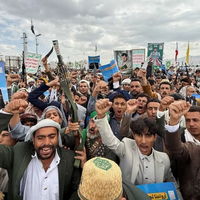
A protester with a poster featuring the late Iranian Supreme Leader Ali Khamenei on his head joins a demonstration with Houthi supporters in solidarity with Iran and Lebanon, amid the U.S.-Israeli conflict with Iran, in Sanaa, Yemen, on March 6, 2026. Khaled Abdullah/Reuters
Six people were killed when Iran-backed Houthis attacked a vessel in Bab el-Mandeb, an escalation experts say reflects not a second front in the Iran war but two conflicts converging, as the Houthis pursue their own interests while adding pressure on Iran’s adversaries.
Analysts disagree over how directly Tehran is involved and what is driving the Houthis back into action after largely sitting out the Iran war. But whether Tehran is directing them or benefiting from decisions they make independently, renewed Houthi activity puts additional pressure on Iran's adversaries, particularly Saudi Arabia.
On Tuesday, the Houthis fired missiles at the Tanzania-flagged cargo ship Tihamah in the Bab el-Mandeb strait, killing four crew members and two members of the government-allied National Resistance Forces, according to Yemeni authorities.
Later on Tuesday, the Houthi-affiliated Al-Masirah network said the group targeted another vessel carrying what it described as Saudi “military equipment” in the Bab el-Mandeb.
Houthis pursue their own war
The Houthis' return to action appears rooted first in their own calculations inside Yemen.
Kamran Bokhari, a senior resident fellow at the Middle East Policy Council and strategic forecaster, describes Iran's so-called Axis of Resistance as a corporate brand in which some groups operate more like Iranian-controlled subsidiaries, while the Houthis resemble an independent franchise.
“They'll come in and participate in a conflict and they'll act as and when they see that it's in their interest to do so,” Bokhari told Iran International. “They're not like, you know, Iran says jump and they say how high?”
For months, that interest appeared to lie in staying out of the Iran war while its trajectory remained uncertain.
The calculation began to change following a confrontation involving an Iranian aircraft bound for Houthi-controlled territory. Saudi Arabia struck a Yemeni airfield after the aircraft attempted to land, helping trigger a renewed cycle of attacks between the Houthis and Riyadh.
The escalation also comes amid growing activity by Saudi-backed government forces and UAE-backed southern separatists inside Yemen.
“It's all domestic, is what I'm trying to say. It has nothing to do with Iran,” Bokhari said of the immediate Houthi calculation.
But that domestic struggle is unfolding in a regional environment transformed by the Iran war.
Iranian disruption around the Strait of Hormuz has already increased pressure on Saudi Arabia and other Persian Gulf states. Renewed Houthi activity around Bab el-Mandeb means Riyadh increasingly has to contend with threats around two critical waterways.
Saudi Arabia is also trying to build a stronger security architecture around itself. The recently signed Saudi-Pakistani-Turkish defense pact could give the kingdom greater regional support as it confronts those threats.
That may give the Houthis an incentive to press Riyadh now.
“The Houthis want to be able to extract concessions from the Saudis before the grid goes up, if you will,” Bokhari said.
Their ultimate objective, he argues, remains establishing themselves as Yemen's dominant political and military power and forcing Riyadh to accept that they cannot simply be eliminated.
Iran benefits
But the Houthis' pursuit of their own objectives does not mean Tehran is a bystander.
Fatima Al-Asrar, a Yemen and Iran specialist, sees the renewed Houthi pressure as increasingly intertwined with Iran's broader strategy against the United States.
“Of course, they [Iran] see it as an extension to them. They're no longer hiding it,” Al-Asrar told Iran International, pointing to Iranian rhetoric linking pressure around the Strait of Hormuz and Bab el-Mandeb.
She said Tehran is closely watching growing US fatigue with the Iran war and sees the approaching midterm elections as an opportunity to increase pressure on Washington.
“They're very transparent, very calculating, and they're using the Houthis on that front in order to press their advantage,” she said.
New reporting from Saudi-owned Asharq Al-Awsat raises the possibility of a more direct Iranian operational role.
Citing Yemeni security sources, the newspaper reported on Tuesday that IRGC officers are overseeing aspects of the Houthi escalation and that an Iranian official, Ali Mohammad Rezaei, is supervising an operations room managing military and security affairs in Houthi-controlled territory. Iranian officers have also helped establish additional missile and drone launch positions, according to the report.
Iran International has not independently verified the claims.
What will this lead to?
In July of this year, US President Donald Trump has warned Washington would hold Tehran responsible for renewed Houthi attacks, describing the group as an Iranian “Surrogate and/or Proxy” and threatening military punishment against both.
But retired Royal Navy Commander Tom Sharpe, who served for 27 years and commanded four warships, told Iran International that he doubts Trump will want to launch another major military campaign against the Houthis.
“He definitely doesn't want to be embroiled on a second tangent here,” Sharpe told Iran International.
Bab el-Mandeb also does not carry the same strategic weight as the Strait of Hormuz, Sharpe said, because ships have alternative routes, albeit at considerably greater cost and distance.
Yet Iran can still benefit.
Greater Houthi disruption could complicate shipping and potentially force the United States and its partners to devote resources to another strategic waterway.
“I think they'll be pleased,” Sharpe said of Tehran. “If it does draw away resources, US resources from the Gulf of Oman, then that's in Iran's favor.”
File photo shows commercial vessels near the Strait of Hormuz amid ongoing shipping disruptions.
The maritime confrontation around Iran widened Tuesday as US forces struck an Iran-bound vessel and Tehran-backed Houthis attacked a ship in Bab el-Mandeb, even as Pakistan and Qatar signaled progress in mediation over the Strait of Hormuz.
Pakistan’s Interior Minister Mohsin Naqvi met President Masoud Pezeshkian and Foreign Minister Abbas Araghchi in Tehran as Islamabad continued its mediation efforts.
Pakistan’s Defense Minister Khawaja Asif separately said signals from recent days suggested the US and Iran were close to “some sort of an arrangement,” while Qatar said Iran-Oman negotiations had reached an advanced stage.
The diplomatic push came as Washington escalated enforcement of its naval blockade. US Central Command said a Navy helicopter fired two Hellfire missiles at the Panama-flagged Vela Nova after its crew ignored repeated warnings and continued toward an Iranian port, disabling the vessel’s steering gear.
CENTCOM said the blockade remained “in full effect,” adding that US forces had redirected 55 commercial vessels, disabled three and boarded two as of Tuesday.
A deck cargo ship was also attacked by Yemen’s Iran-backed Houthis in the Bab el-Mandeb Strait on Tuesday, killing three crew members, Reuters reported, citing Yemeni coast guard sources and government military officials.
Asharq Al-Awsat reported the same day, citing Yemeni security sources, that IRGC officers were overseeing the Houthis’ escalating military operations in Yemen. Iran’s envoy to the group, Ali Mohammad Rezaei, was personally supervising an operations room managing military and security affairs in Houthi-controlled areas, according to the report.
Tehran, meanwhile, maintained that progress on shipping arrangements with Oman would not by itself reopen the strait. Supreme National Security Council Secretary Mohsen Rezaei said Hormuz would remain closed unless Washington changed its behavior and accepted Iran’s conditions, and that any agreement with Oman on a transit route would be separate from the broader closure.
Mohammad Mokhber, an adviser to Supreme Leader Mojtaba Khamenei, reinforced that position, saying the strait “will not be reopened until Iran’s conditions are met.”
Pressure on shipping also persisted. The Joint Maritime Information Center said IRGC attacks, attempted attacks and harassment continued in the strait, including UAV overflights, hailing and targeted surveillance of merchant vessels.
IRGC spokesperson Hossein Mohebi also warned that energy networks, power plants and global internet-linked infrastructure could be at risk if Iran were threatened again. He said the US had “30 to 40 warships in the region” before the recent 40-day war but that “not even one US warship” remained in the Persian Gulf.
Despite the continuing confrontation, oil flows showed signs of recovery. US Energy Secretary Chris Wright said the seven-day average for oil leaving the Strait of Hormuz had risen to nearly 9 million barrels per day, with total regional flows averaging about 15 million barrels per day when pipeline and export-facility shipments were included.