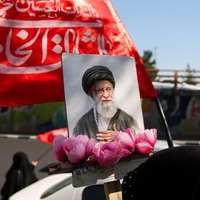
FILE PHOTO: Mohsen Rezaei at a farewell ceremony for Iran's late Supreme Leader Ayatollah Ali Khamenei, July 3, 2026.
Mohsen Rezaei’s appointment as Iran’s new security chief has opened a battle over its political meaning, with ultra-hardliners portraying the removal of his predecessor as evidence that the balance in Tehran has shifted against advocates of negotiations with Washington.
Supreme Leader Mojtaba Khamenei appointed Rezaei as his representative on the Supreme National Security Council (SNSC), after which President Masoud Pezeshkian named him secretary of the body at the center of Iran’s security and foreign policy decision-making.
Rezaei replaces Mohammad Bagher Zolghadr after only about five months in the job, an unusually short tenure for a position whose previous occupants typically served for years.
Opponents of negotiations have welcomed the change and sought to link Zolghadr’s departure to disagreements surrounding the ceasefire, negotiations with Washington and the Islamabad memorandum.
Reformist and government-aligned voices have cautioned against concluding that the harder-line camp has prevailed.
A battle over Zolghadr’s departure
Raja News, an outlet associated with the ultra-hardline Paydari camp, said Zolghadr’s replacement showed that, contrary to claims by supporters of negotiations, “not everything was coordinated with the Supreme Leader.”
Amir-Hossein Sabeti, a hardline member of parliament and prominent critic of negotiations, went further, accusing Pezeshkian of resisting the Supreme Leader’s wishes over replacing Zolghadr with Rezaei.
He warned the president that unless he changed course and followed the leader’s direction, “the people will replace him.”
Accounts circulating among hardliners have claimed that Pezeshkian initially resisted appointing Rezaei as SNSC secretary and did so only after Khamenei named Rezaei as his representative on the council.
No official explanation has been given for Zolghadr’s departure, and the claims do not establish that disagreements over negotiations caused his removal.
The reformist-leaning Rouydad24 website said opponents of negotiations were seeking to build a political narrative around the reshuffle: that divisions had emerged during the ceasefire and negotiations and that the balance had now shifted toward the harder-line faction.
Nour News, which is considered close to the SNSC, also said Rezaei’s appointment could signal “the beginning of a new approach to the country’s strategic governance,” but rejected attempts to portray it as evidence of a confrontation between Pezeshkian’s government and the leadership.
Rezaei’s record fuels hardline hopes
Rezaei’s own previous statements have added to speculation over what his appointment could mean for negotiations.
Ultra-hardliners have recirculated comments in which he interpreted an earlier message from Mojtaba Khamenei saying that “in principle, I had a different view” of the path taken by the SNSC.
Rezaei said the phrase meant “the path he had in mind was better than the path taken by the Supreme National Security Council,” remarks critics of the Islamabad memorandum have cited as evidence that Khamenei had reservations about the council’s approach.
But Rezaei has not opposed negotiations outright.
In an earlier interview with the Iranian Labour News Agency (ILNA), he said talks should take place but argued against maintaining a ceasefire while they continued, saying a pause in fighting would give the enemy an opportunity to rebuild its forces.
The distinction suggests the emerging argument may be less about whether to negotiate than about the conditions under which talks take place and the role of military pressure alongside diplomacy.
What comes next
The conservative Farhikhtegan newspaper similarly argued against reducing the choice to either concessions or continued war.
It criticized those who believe the conflict could be turned into peace through concessions, including handing over management of the Strait of Hormuz, but also those who view the conflict solely through a military lens and see war as the only solution.
Hesamoddin Ashena, a former adviser to President Hassan Rouhani, meanwhile appeared to caution against the risks of miscalculation at the SNSC without explicitly naming Rezaei.
“Because you are not allowed even one analytical mistake, you must be very careful,” he wrote on X. “Because a nation will pay the cost of your mistake, you must be very careful.”
For now, Rezaei’s appointment has become a proxy for the larger argument over Iran’s direction.
Ultra-hardliners see Zolghadr’s departure as evidence that the political ground has shifted toward them, but Rezaei’s own record points to a more complicated position: support for negotiations combined with a greater emphasis on maintaining military pressure while they take place.
Piles of historic cobblestones torn from central Tehran’s streets sit stacked beside traffic.
Tehran's municipality is tearing up the cobblestones of the capital's historic pedestrian zones and laying asphalt, a change officials call traffic management and that architects and urban sociologists read as something older: the redesign of a city to make protest harder.
The work, underway in District 12, Baharestan Square and 30 Tir Street, is presented by municipal officials as a routine measure to ease congestion, carried out at the request of the traffic police.
Critics in architecture and urban sociology argue it cannot be read as a merely technical decision, and belongs instead to a long historical tradition: the use of urban design as an instrument of control.
When the city takes away the barricade
The link between redrawing a city's body and engineering its security is not new. Its most famous case is the great reconstruction of nineteenth-century Paris, carried out by Baron Haussmann on the orders of Napoleon III.
Until the 1850s, Paris was a city of narrow, winding, organic streets that let protesting citizens pry up the paving stones, throw up barricades and take control of their own neighborhoods, the world Victor Hugo drew so vividly in Les Misérables.
By demolishing the old fabric and driving broad, straight, uniform boulevards through it, Haussmann pursued two entwined goals: to strip the public of the ability to barricade the streets, and to ease the rapid movement of troops and heavy artillery for the suppression of unrest.
Later theorists built the insight into the foundations of urban thought. Walter Benjamin in The Arcades Project and David Harvey in his work on the "right to the city" traced how space itself becomes a tool for reproducing ruling power and erasing the protester's presence from it.
Physical disarmament of public space
The replacement of segmented paving blocks with continuous asphalt functions, in effect, as the physical disarmament of the urban environment. Unlike uniform asphalt, cobblestones can be pried loose in a street confrontation, handing demonstrators ready material for barricades or for holding back advancing security forces.
Beyond removing potential projectiles, the smooth surface answers the operational needs of motorized units. Pedestrian infrastructure, with its uneven paving, varying widths, benches and street furniture, slows vehicles down. Coating these zones in asphalt creates uninterrupted corridors for special forces, water cannons and high-speed motorcycle patrols.
Pedestrians stroll along a cobblestone walkway in central Tehran.
Eradicating gathering points
The repaving projects coincide with heightened enforcement against public gathering spaces in central districts, including the sealing of outdoor cafes and the removal of street furniture.
Pedestrian-friendly designs naturally create pause points where citizens congregate, engage in conversation, and form initial nodes of public assembly.
Converting pedestrian hubs into vehicular thoroughfares prioritizes rapid transit over civic presence, reshaping central public areas into channels designed for continuous traffic flow.
The removal of seating and outdoor dining areas reinforces this operational shift by eliminating physical spaces that encourage citizens to linger.
Reclaiming the street
Public thoroughfares have consistently served as primary arenas for civil expression during periods of political tension in Iran.
Highlighting the symbolic and practical weight of public space, prominent Iranian actress Hedieh Tehrani addressed security forces in a public message during the 2022 nationwide protests, writing, "My only way of communicating with the people is the street."
Similarly, exiled Prince Reza Pahlavi emphasized the importance of public thoroughfares during his calls for widespread demonstrations in January 2026, framing the reclamation of street spaces as a central objective for people.
Replacing historical pedestrian infrastructure with asphalt prioritizes security deterrence and vehicular velocity over civic life and urban heritage. By converting public gathering hubs back into high-speed transit corridors, municipal authorities reduce public space from a venue for civic engagement into an infrastructure designed to prevent assembly.
People drive past an anti-U.S. billboard depicting U.S. President Donald Trump and the Strait of Hormuz, in Tehran, Iran, May 17, 2026.
A US strike on a container ship approaching an Iranian port has complicated Tehran’s narrative of a strategic victory against Washington over the Strait of Hormuz.
A US Navy MH-60 helicopter carried out a strike on the Panama-flagged containership M/V Vela Nova in the Gulf of Oman on Tuesday.
President Donald Trump later said the United States now had “total control” over the Strait of Hormuz and warned that if Iran acted, “they get blown away.”
Iranian officials remained relatively quiet on the incident through Wednesday afternoon. Foreign Ministry spokesman Esmaeil Baghaei, speaking to Press TV, instead denounced the wider US blockade as “dishonorable and illegal.”
Much of the Iranian media also focused heavily on the new defense agreement between Saudi Arabia, Pakistan and Turkey, with several outlets portraying the so-called Mecca Pact as politically inflated and of limited relevance to the regional balance.
Competing narratives over Hormuz
Hardline newspaper Vatan Emrooz sought to turn the location of the US strike into evidence of Iranian deterrence rather than American dominance.
The paper argued that the attack, carried out well outside the Strait of Hormuz, showed that US forces remained reluctant to operate within range of Iran’s coastal defenses.
It portrayed Washington’s decision to strike a merchant vessel farther out at sea as a sign of tactical caution and urged Iran to stand by the demands it has set for any reopening of the strait.
The argument reflects a broader theme in Iranian commentary over the past week.
Several outlets and officials have portrayed the confrontation over Hormuz as evidence that Tehran has succeeded in shifting the center of negotiations away from the nuclear issue and toward control of the waterway.
Some commentary also interpreted a temporary easing in Trump’s rhetoric and talks with Oman over shipping arrangements as signs that Washington was adjusting to new realities in the strait, even as Iranian commanders insisted there could be no simple return to pre-war conditions.
Trump’s latest remarks cut directly against that interpretation. His assertion of “total control” over Hormuz and threat of further military action suggest Washington continues to see coercive pressure, rather than accommodation, as central to its approach.
Economic costs remain
Iranian economic outlets have meanwhile focused on the growing cost of disruption to regional shipping.
Donya-ye Eghtesad noted that rising oil prices and maritime war-risk premiums were feeding through into domestic and regional markets, while air travel across the Persian Gulf continued to face suspensions and rerouting.
Recent attacks near Bab el-Mandeb have added to concerns that maritime disruption is no longer confined to Hormuz, increasing risks for shipping across a wider stretch of regional trade routes.
Those costs complicate triumphalist claims on either side. Washington continues to demonstrate its ability to use military force around Iran’s coast, while Tehran retains the capacity to keep maritime insecurity at the center of regional calculations.
The latest developments therefore leave the contest over Hormuz far from settled.
A recent letter to Supreme Leader Mojtaba Khamenei from Iran’s new security chief, Mohsen Rezaei, calling for expanded military capability and activity, suggests Tehran is also preparing for the possibility that the confrontation will continue rather than end through a quick diplomatic settlement.
The photo shows Persian-language textbooks used in Iranian elementary schools.
The child understands every word her grandmother says in Persian. She answers in English. She can ask what's for dinner in her parents' language, but not describe her anxiety, her love or her future in it. She calls herself Iranian. Persian is no longer the language of her life.
In the study of migration and bilingualism, Persian is, for many children of Iranian immigrants, a heritage language: a language passed down through family and cultural background while another language dominates their schooling and social world.
The term is not the same as mother tongue. A mother tongue is usually the first language learned in childhood; a heritage language may lose its dominant place very early, sometimes before the child can read a word of it.
For Iranians, this is not merely a question of language teaching. More than four decades of political, social and economic emigration have built a multigenerational society outside Iran, one now entering its third generation.
The question is no longer how many Persian words the children know. It is how much of the language, the family memory and the direct connection to Iran will reach the generations after them.
One generation weakens a language; the next can lose it
Starting school is one of the deepest turning points in a child's linguistic life. The host country's language is not just the language of lessons; it becomes the language of friendship, play, jokes, music, the internet and most of the child's social world. Even in a family where the parents speak Persian at home, the real share of Persian in the child's day shrinks, steadily and without anyone deciding it should.
Studies of Iranian families abroad find the same gap from the parents' side. In interviews conducted by sociolinguist Khadij Gharibi and her colleagues with Iranian households in the United Kingdom and New Zealand, and in similar research in the Netherlands, parents express a deep commitment to passing Persian on; one parent in the UK study put it simply: "You are Iranian even if you were born on the moon." Yet the same studies document a persistent distance between what parents believe and what daily practice at home actually delivers.
The shift rarely happens suddenly. First the child understands Persian and answers in Persian. Then she still understands her parents but replies in the dominant language. Later, Persian narrows to family matters and daily routine, while feelings, schoolwork and personal disputes migrate to the other language.
Nor are understanding, speaking, reading and writing a single skill. A person may understand Persian almost completely yet grope for words when speaking, or speak fluently yet be unable to read a simple text. At that point, direct access to Persian literature, media, history and much of the written world of the language closes too.
The experience of other immigrant communities shows how deep the shift can run within two or three generations, a pattern sociolinguists have described since Joshua Fishman's classic model of three-generation language loss.
In the United States, 89 percent of first-generation Latino youth and 79 percent of the second generation report speaking Spanish well; in the third generation the figure falls to 38 percent, and only 26 percent report strong reading and writing.
Canadian data show the shift happening inside the family itself: in households where both immigrant parents shared the same non-official mother tongue, 24.4 percent of children used only English or French at home, against 2.5 percent of their parents.
These numbers are not about Iranians and cannot be transferred to them directly. But the pattern they draw is unambiguous: a language's strength in the first generation is no guarantee it will reach the third.
When the shared language shrinks, the hard conversations shrink with it
The consequences are not only cultural. One of the most consequential facts of immigrant family life is the gap that can open between the linguistic reach of parents and children.
A child usually learns the host country's language faster and deeper than her parents do. A father or mother may handle the new language perfectly well for work and errands, yet still feel a memory, an emotion or a complicated thought most precisely in Persian. The child may lack sufficient Persian in exactly those places.
In childhood the gap barely shows. School, food and tomorrow's plans need only a narrow band of language. Adolescence demands other conversations: anxiety, love, identity, discrimination, gender, politics, the future, the family's own disputes.
A shrinking common language does not by itself produce a family crisis, and the difficulties of immigrant families cannot be reduced to language. Economics, the migration experience itself, generational difference and social pressures all play their part. But the more complicated the conversation, the more the linguistic ceiling makes itself felt.
In Iranian families, the bond with the older generation carries its own weight. A child with limited Persian can manage daily talk with her grandparents. Hearing the story of a life, the memory of an emigration, an argument about history, is harder.
For a community whose modern experience is knotted together with revolution, war, repression, protest and wave after wave of departure, this is not only about preserving literature and culture. Language is one of the principal carriers of family and historical memory. The narrower it becomes, the more the next generation's access to its own family's lived experience will depend on summaries, and on translation.
The third generation: who will teach Persian, and with which Iran?
About the coming generations there is still no comprehensive data. Nobody knows how many Iranian children abroad understand Persian, how many speak it, how many can read and write it. Even the size of the diaspora resists precise measurement, because countries classify people differently, by birthplace, citizenship, ancestry, ethnicity or language.
Yet the third generation's challenge is already visible in outline. The first generation typically carried complete Persian out of Iran. The second may hold a reduced version: strong comprehension, weaker speech, little literacy. When that generation becomes parents, its narrower Persian is no longer a private matter; it directly constrains what can be passed to the next child.
For Iranians, teaching the language carries a political complication too. Many immigrant families are caught between the need to preserve Persian and their distrust of institutions that are official, or tied to the Islamic Republic. Not everyone has access to a Persian school, and some parents refuse to let their child's language lessons come bundled with religious instruction, ideological content or the state's official narrative of Iran's history and identity.
So the question is not only how Persian should be taught. It is who teaches it, with what content, and with which image of Iran.
A few hours of weekend class will not carry a language on their own. A language survives when a child has reasons to use it: books and media made for her age, friendships with other Persian speakers, and the ability to talk in Persian not only about home and food, but about her own world.
For part of the second generation, Persian is still the language of home but no longer the language of life. For the third, the question is more fundamental: will Persian remain the language of home at all?
That question is not only about the survival of a language. Its answer will decide how directly generations who may never live in Iran can reach their family's memory, their people's modern history and the Iranian experience itself; whether Iran, for them, will be a land whose language they know, or a story that always arrives in translation.
The Tuesday front page of state-run newspaper Hamshahri features Mojtaba Khamenei at the center and his latest appointments, along with the headline: The new lineup of power
Iran's latest military appointments are consolidating its command structure after the recent war, with hardliners portraying the reshuffle as a shift toward a more unified and offensive posture.
Six veteran military and security figures have been given key positions across the General Staff of the Armed Forces, the Islamic Revolutionary Guard Corps (IRGC), the IRGC Navy and the Basij, in changes that Iranian media and political figures have described as a reorganization of the country's security architecture.
Mehr News Agency said the appointments did not represent the emergence of an entirely new generation at the top of the armed forces, but argued that the changes in commanders' roles and positions were significant.
Their central message, it said, was the "reorganization of the command structure in line with the country's new security environment," combining the experience of veteran commanders with Iran's new defense requirements.
Ibrahim Rezaei, a member of parliament's National Security and Foreign Policy Committee, said the appointments would make the armed forces more offensive and increase "synergy between the armed forces and other state and governmental structures."
Hardliners see message to Washington
Hardline media and political activists have largely interpreted the appointments through the language used in the new commanders' mandates. In particular, the instruction to newly appointed IRGC commander-in-chief Ahmad Vahidi to prepare for "powerful offensive operations against the enemy" has been presented as a message of defiance to the United States.
Ehsan Salehi, a political analyst writing in the hardline Hamshahri newspaper, said the appointments would make Iran "harder for Trump, more difficult to resolve and more unpredictable."
He also linked the appointment of Mohsen Rezaei as secretary of the Supreme National Security Council to a broader message to Washington, arguing that escalation or continued threats and violations of agreements would make Iran's foreign policy and defense posture more aggressive and its influential decision-makers more hardline.
Hardline politician Mohammad-Mehdi Esmaili said the appointments had "consolidated the resistance camp against compromise."
Journalist Nizameddin Mousavi similarly described the reshuffle as a "firm response" to Donald Trump's claim that Iran's senior military commanders had been eliminated. Most of the newly appointed military and security officials, he said, were experienced commanders dating back to the Iran-Iraq war, demonstrating Khamenei's ability to rebuild and reorganize Iran's military leadership.
Reshuffle may strengthen negotiating position
The appointments, however, do not necessarily signal outright opposition to negotiations with Washington.
The emergence of senior military figures in key command and security positions could instead shift the balance toward officials willing to negotiate from what they regard as a position of greater military strength, rather than toward those opposed to negotiations altogether.
Vahidi, who represented the IRGC on the Supreme National Security Council at the time, supported the Islamabad agreement, as did nearly all the other members of the council.
Some Iranian commentators have therefore argued that the reshuffle could ultimately strengthen the case for an understanding with Washington rather than close the door to diplomacy.
Political science professor Morteza Nemati-Zargaran wrote on X that "the appointment of the military commanders appears to be tipping the balance in favor of an understanding with the United States."
Military command structure consolidated
One of the most consequential changes is the further integration of the General Staff of the Armed Forces and the Central Headquarters of Khatam al-Anbiya, a process that appears to have entered a new stage with the appointment of Ali Abdollahi as chief of the General Staff.
Khamenei's decree appointing Abdollahi specifically called for completing the integration process. The Khatam al-Anbiya headquarters has traditionally directed joint military operations, while the General Staff has been responsible for strategic planning.
According to Iranian media and government-aligned analysts, the restructuring, reportedly under consideration since last year on Khamenei's orders, is intended to streamline the chain of command, reduce duplication and bring strategic planning and battlefield operations closer together.
The Student News Network (SNN) said closer integration of the two functions would "shorten the chain of command and minimize the distance between strategic decision-making and operational implementation."
Rouydad24 described the appointments and restructuring as the beginning of "a profound review of the country's defense structure and doctrine" following the recent military confrontations.
The changes, it added, could allow Tehran to increase the resilience of its military structures, reduce parallel functions and rely on more unified command to maximize its defensive and offensive capabilities while preserving Iran's bargaining power and strategic deterrence.
Taeb appointment puts focus on internal security
The appointment of Hossein Taeb as head of the Basij has raised a different concern: the possibility that Iran will increasingly treat domestic unrest as part of a broader security threat linked to foreign adversaries.
Khamenei's decree emphasized "people-based defense," expanding the public intelligence network, using new technologies and organizing neighborhoods.
The language has prompted speculation that future domestic protests could be viewed more explicitly through the lens of threats posed by external enemies.
Conservative politician Abdolreza Davari said the appointment showed that the Basij would no longer serve merely as the IRGC's reserve force, but could become a nationwide social network for the country's security apparatus, extending into neighborhoods and villages.
According to Davari, Khamenei had sent someone close to him to lead an organization whose mission was to "turn people's capabilities into a security network."
Hardline journalist Hossein Kazerouni wrote on Telegram that the emphasis showed that "the domestic front is also considered part of the battlefield of the future."
Pro-Islamic Republic commentator Mohammad-Sadegh Alizadeh said the Basij's new mandate suggested the organization would become more military and intelligence-oriented, with an expanded information-gathering network and greater use of new technologies.
"We should expect new developments in the expansion of the intelligence network and new equipment," he wrote on X.
An Islamic Republic supporter holds a photo of Supreme Leader Mojtaba Khamenei during a state-run rally. / Photo by IRNA
Iran's unseen supreme leader has issued his first military decrees, raising a central question about the emerging order under Mojtaba Khamenei: is he tightening his grip on power, or relying on the old security establishment to shore up his authority?
The six decrees named Ali Abdollahi chief of staff of the armed forces, with Kioumars Heydari as his deputy; Ahmad Vahidi commander-in-chief of the Revolutionary Guards, with Mostafa Izadi as his deputy; Ali Azmaei commander of the Guards' navy; and Hossein Taeb, the feared former intelligence chief of the Guards, head of the Basij.
Separately, Mohsen Rezaei, the former Guards commander named Khamenei's military adviser in March, became secretary of the Supreme National Security Council and the leader's representative on the body.
The appointments put veterans of the Guards, intelligence services and Iran-Iraq war generation across the upper reaches of the security establishment. But rather than marking a wholesale changing of the guard, they draw heavily on figures who built their careers under Ali Khamenei — leaving open whether the new supreme leader is imposing his authority on the system or assembling an experienced security bloc whose support he needs to exercise it.
Khamenei's directives suggest the changes are not simply about personnel. In his appointment decree for Vahidi, he called for strengthening the force's capabilities for “maximum deterrence” and maintaining readiness to carry out “powerful offensive operations against the enemy.”
Lawmaker Ebrahim Rezaei described the appointments as “basically an indication of the fact that the Islamic Republic is moving toward a more offensive military structure.”
War commanders move to the top
The clearest sign that Khamenei may be changing how the military is run, rather than merely replacing its commanders, lies in the elevation of Abdollahi and Heydari from the Khatam al-Anbiya Central Headquarters to the two highest positions in the Armed Forces General Staff.
The General Staff is Iran's highest military coordinating body, while Khatam Central Headquarters has a more operational wartime role, coordinating military activity across different branches.
There has been no confirmed announcement that the two bodies have formally merged, but pro-establishment commentator Mohammad-Sadegh Alizadeh said the appointments confirmed a process of centralizing Iran's military command.
“The merger of Khatam al-Anbiya Central Headquarters and the Armed Forces General Staff means concentrating the country's wartime, military and offensive activities,” he wrote on X, adding that Abdollahi's decree explicitly tasked him with completing the process.
Abdollahi previously served as coordination deputy of the General Staff and deputy commander of Iran's police. Heydari commanded the regular Army Ground Forces for more than seven years before moving into Khatam's command structure in late 2025.
Heydari's appointment also preserves a senior regular Army presence near the top of a leadership heavily populated by Revolutionary Guards veterans, suggesting that greater centralization does not necessarily amount to straightforward IRGC domination of the command structure.
Taeb’s return puts domestic security in focus
If the Abdollahi and Heydari appointments point to tighter wartime command, Taeb's return to the Basij reveals the domestic-security side of Khamenei's emerging structure.
Taeb commanded the Basij during the unrest following Iran's disputed 2009 presidential election and later spent more than a decade heading the IRGC Intelligence Organization before his removal in 2022.
Khamenei's decree calls for strengthening what it describes as the Basij's “popular intelligence network,” drawing attention to the surveillance and internal-security component of Taeb's mandate.
New York-based journalist and Middle East writer Séamus Malekafzali said Taeb's return was particularly significant given his intelligence background.
“Taeb spent 13 years after leaving the Basij as the head of IRGC intelligence,” he wrote on X on August 10. Referring to Khamenei's directive for a “grassroots confrontation with enemy threats,” he added that it “certainly sounds like making sure the January protests never happen again.”
Taeb has also long been identified with Mojtaba Khamenei's security network. When he was removed as IRGC intelligence chief in 2022, Jason Brodsky, policy director at United Against Nuclear Iran, described the move as “an earthquake in Iran's intelligence community,” noting his close relationship with both Ali Khamenei and his son.
His return therefore restores a longtime Khamenei confidant to command of an organization embedded across universities, workplaces, neighborhoods and state institutions, and which has played a central role in surveillance, political mobilization and the suppression of protests.
Journalist Morteza Kazemian linked the appointment to worsening economic conditions and public discontent, arguing that Taeb had become one of Khamenei's trusted instruments of security and governance and that the Basij under his command was intended to embody the leadership's “iron fist.”
Rezaei comeback underscores reliance on old guard
If Taeb's return highlights Khamenei's reliance on trusted security figures, Rezaei's comeback makes the generational continuity harder to miss.
Rezaei commanded the Revolutionary Guards from 1981 to 1997, including through most of the Iran-Iraq war, before moving into politics and holding a succession of senior state positions.
He later served at the Expediency Council, repeatedly ran for president and became vice president for economic affairs under Ebrahim Raisi. Khamenei appointed him military adviser in March before naming him secretary of the Supreme National Security Council and his representative on the body less than five months later.
Journalist Ahmad Zeidabadi questioned why Mohammad Bagher Zolghadr had been replaced by Rezaei and what substantive change the appointment was intended to bring.
“What does the appointment of Mohsen Rezaei in place of Mohammad Bagher Zolghadr as secretary of the Supreme National Security Council mean, and what change is it supposed to bring to the way this position operates?” he wrote on X.
Some Iranian social-media users responded with mockery, reviving jokes surrounding Rezaei's repeated presidential campaigns and decades-long circulation through senior state positions.
The criticism reflected one of the broader themes surrounding the reshuffle: that Khamenei's first major appointments have elevated not a new generation of officials, but men who have occupied the Islamic Republic's military and political establishment for decades.
Vahidi promotion highlights hardline continuity
Vahidi's promotion adds another dimension to that continuity: the elevation of a commander whose record spans Iran's external military operations and domestic repression.
Vahidi had served as acting Guards commander following Mohammad Pakpour's death during the war with the United States and Israel. Khamenei formally installed him as commander and promoted him to major general.
He previously held senior roles in the Quds Force and served as defense minister under Mahmoud Ahmadinejad and interior minister under Ebrahim Raisi.
Argentine prosecutors have sought Vahidi in connection with the 1994 bombing of the AMIA Jewish community center in Buenos Aires, which killed 85 people. Iran denies involvement.
Israel's foreign ministry focused its response to the reshuffle on Vahidi and Rezaei, linking both men to allegations surrounding the AMIA case and accusing Tehran of elevating figures associated with attacks abroad.
“The Iranian regime worships terror, rewards its architects and promotes them to the highest levels of power,” the ministry said on X.
The United States has also sanctioned Vahidi over his role as interior minister during the suppression of protests following Mahsa Amini's death in custody in 2022.
But the wartime record of Vahidi, Abdollahi and Taeb also complicates the idea that their elevation simply represents Khamenei extending his personal control over the security apparatus.
President Masoud Pezeshkian accused Vahidi and Abdollahi of taking unilateral military actions that undermined efforts to secure a ceasefire, Iran International reported in April. The report also described a heated confrontation involving Taeb.
All three men now occupy senior positions in the military-security structure under Khamenei, raising the possibility that the new leader has elevated figures whose institutional power was already considerable before he formally appointed them.
Khamenei’s first imprint on security establishment
Several major international outlets interpreted the reshuffle as an early indication of how Khamenei intends to shape the security establishment after succeeding his father.
The Wall Street Journal portrayed the appointments as Khamenei putting his stamp on the national-security system and signaling a tougher approach toward Washington.
“Iran's mysterious ruler signals a hard line on Trump with new leadership,” the newspaper wrote.
The Financial Times focused on the promotion of loyalists and the possibility that Rezaei's return could point toward a harder line on the United States, while Reuters described Rezaei as a close ally of Khamenei and highlighted his recent opposition to extending a ceasefire and his skepticism toward negotiations with Washington.
Those readings emphasize Khamenei's role in choosing the new hierarchy. But the identities of the men he chose point just as strongly to continuity with the security establishment inherited from his father.
Iran International analysts had raised that tension even before the latest decrees.
The deaths of Ali Khamenei and other senior officials created a leadership gap in which his successor was still working to consolidate his position, Kazemian said in May.
After the appointments were announced, journalist Kamyar Behrang argued that the death of Ali Khamenei, who had served as the system's final arbiter, had given the Revolutionary Guards greater room to shape the political order that followed him.
The appointments can therefore be read in both directions. Khamenei is placing his own stamp on the military and security hierarchy, centralizing command and restoring trusted figures to key posts.
But he is doing so largely through men formed under his father's rule — veteran commanders and intelligence officials whose institutional weight may be as important to his authority as their loyalty to him.
The first map of power under Mojtaba Khamenei is taking shape. What remains unclear is whether these men are primarily instruments of his control, or the establishment on which that control depends.