Iran keeps Ejei as judiciary chief, preserving hardline course
Gholamhossein Mohseni Ejei was recently reappointed as judiciary chief for another five-year term, reinforcing the Islamic Republic’s security-focused judicial system and offering an early indication of how Supreme Leader Mojtaba Khamenei intends to manage power.
The appointment, issued under Article 157 of Iran’s constitution, leaves one of the Islamic Republic’s longest-serving judicial and intelligence figures at the head of an institution that has played a central role in prosecuting dissent, overseeing political cases and implementing the state’s domestic security policies.
Mohseni Ejei, 69, has spent more than four decades moving between the Revolutionary Courts, the Intelligence Ministry and the judiciary, making him one of the few senior officials with experience across all three pillars of Iran’s security establishment.
Gholamhossein Mohseni Ejei was recently reappointed as judiciary chief for another five-year term, reinforcing the Islamic Republic’s security-focused judicial system and offering an early indication of how Supreme Leader Mojtaba Khamenei intends to manage power.
The appointment, issued under Article 157 of Iran’s constitution, leaves one of the Islamic Republic’s longest-serving judicial and intelligence figures at the head of an institution that has played a central role in prosecuting dissent, overseeing political cases and implementing the state’s domestic security policies.
Mohseni Ejei, 69, has spent more than four decades moving between the Revolutionary Courts, the Intelligence Ministry and the judiciary, making him one of the few senior officials with experience across all three pillars of Iran’s security establishment.
Unlike many first-generation clerics who rose through purely religious institutions, Mohseni Ejei also earned a master's degree in private international law. That legal education, however, has done little to shape his public image, which has instead been defined by security cases, political prosecutions and harsh judicial policies.
His rise began during the 1980s, when he served as an investigator in the case against Mehdi Hashemi, the brother-in-law of the late Grand Ayatollah Hossein Ali Montazeri. The prosecution helped weaken Montazeri's political standing before he was removed as the designated successor to the Islamic Republic's founder, Ruhollah Khomeini.
That early role established Mohseni Ejei as an official closely associated with politically sensitive investigations, forced confessions and cases that blurred the boundary between judicial procedure and national security.
Security insider
Official biographies highlight his studies at the Haqqani Seminary and his involvement in prominent corruption prosecutions during the 1990s, including cases involving businessman Fazel Khodadad and former Tehran mayor Gholamhossein Karbaschi.
His career expanded further when he became intelligence minister under President Mahmoud Ahmadinejad before being dismissed in 2009. He was subsequently appointed prosecutor general, later became first deputy judiciary chief and assumed the judiciary's top post in 2021.
The combination of intelligence, prosecutorial and judicial experience has made Mohseni Ejei one of the Islamic Republic's most trusted officials for handling politically sensitive files involving opposition figures, corruption allegations and national security matters.
Supporters portray him as an experienced administrator familiar with every layer of Iran's judicial system. Critics argue his career reflects the increasing integration of intelligence agencies and the courts, turning judicial institutions into instruments for enforcing political control.
Mohseni Ejei has also maintained an unusually low public profile outside official duties. Unlike many senior Iranian politicians, he rarely projects a personal image or family life through the media, appearing primarily in court proceedings, official meetings and state broadcasts.
'The man who bites'
Among many Iranians, Mohseni Ejei's public reputation extends beyond his judicial decisions.
One of the most enduring stories surrounding him dates to 2004, when journalist Isa Saharkhiz accused Mohseni Ejei of throwing a cube-sugar bowl and biting his shoulder during a dispute at a meeting of Iran's Press Supervisory Board. The account became one of the defining anecdotes associated with his public image.
His international profile, however, has been shaped more by human rights concerns than by personal controversies.
The United States Department of the Treasury sanctioned Mohseni Ejei in September 2010 over his role in serious human rights abuses following Iran's disputed 2009 presidential election. The sanctions placed him alongside other senior Iranian security officials accused of involvement in post-election repression.
The European Union also imposed human rights sanctions on him, citing his role in unfair trials and severe prison and death sentences against political activists and protesters.
Judiciary under scrutiny
During his first term as judiciary chief, Mohseni Ejei said wants to promote themes including judicial reform, anti-corruption efforts and reducing court delays.
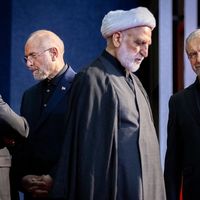
Judiciary Chief Gholamhossein Mohseni Ejei, recently appointed to a new five-year term, attends a ceremony alongside President Masoud Pezeshkian (left) and Parliament Speaker Mohammad Bagher Ghalibaf (center).
Human rights organizations, however, have argued the judiciary became more deeply involved in suppressing political opposition, particularly following the 2022 Woman, Life, Freedom protests triggered by the death of Mahsa Amini in morality police custody.
Mohseni Ejei publicly defended death sentences imposed on some protesters after those demonstrations.
Amnesty International said in September 2025 that Iran had executed more than 1,000 people that year, describing it as the highest annual total recorded by the organization in at least 15 years. The group said authorities had increasingly relied on capital punishment following the Woman, Life, Freedom protests.
The Iran Human Rights annual report recorded at least 1,639 executions during 2025, saying more than 93% were never officially announced and that Revolutionary Courts handed down 852 execution sentences during the year.
Following the recent conflict involving Israel and the United States, rights groups have also accused Iranian authorities of accelerating political prosecutions under wartime conditions.
Amnesty International said in May 2026 that Iranian authorities had intensified mass arrests, expedited trials and politically motivated executions, documenting at least 42 executions on political charges since late February after proceedings it described as unfair.
Mohseni Ejei's reappointment follows days of speculation that Iran's new leadership might replace him to demonstrate a change of direction. Instead, retaining him suggests continuity rather than restructuring at the judiciary.
The decision shows that, at least in the early phase of Mojtaba Khamenei's leadership, judicial authority will remain closely aligned with Iran's security institutions, reinforcing a model in which the courts continue to play a central role in maintaining political control rather than signaling a broader opening of the country's legal system.
The latest Statistical Review of World Energy published by the Energy Institute paints a troubling picture of Iran’s energy sector: a country with some of the world’s largest oil and gas reserves is increasingly struggling to meet its own energy needs.
The report shows a sharp slowdown in the growth of electricity generation and natural gas production at a time when Iran faces widening shortages of both.
Iran’s energy demand has continued to rise, driven by population growth, industrial consumption and heavily subsidized domestic prices. Analysts estimate the country needs annual increases of around 7% in electricity generation and 5% in natural gas production simply to keep pace with demand.
Years of underinvestment, delayed infrastructure projects and international sanctions, however, have left supply lagging behind consumption, creating electricity and gas shortages exceeding 20% during peak periods.
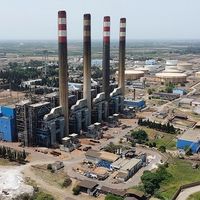
An aerial view of Shahid Salimi power plant near the northern town of Neka, which generates around 4 percent of Iran's electricity, taken November 2023
The latest Statistical Review of World Energy published by the Energy Institute paints a troubling picture of Iran’s energy sector: a country with some of the world’s largest oil and gas reserves is increasingly struggling to meet its own energy needs.
The report shows a sharp slowdown in the growth of electricity generation and natural gas production at a time when Iran faces widening shortages of both.
Iran’s energy demand has continued to rise, driven by population growth, industrial consumption and heavily subsidized domestic prices. Analysts estimate the country needs annual increases of around 7% in electricity generation and 5% in natural gas production simply to keep pace with demand.
Years of underinvestment, delayed infrastructure projects and international sanctions, however, have left supply lagging behind consumption, creating electricity and gas shortages exceeding 20% during peak periods.
According to the Energy Institute, Iran generated nearly 399 terawatt-hours (TWh) of electricity last year, an increase of only 1% from the previous year. Natural gas production rose by just 1.3%, reaching approximately 265 billion cubic meters (bcm).
The figures represent a sharp break from the previous decade, when Iran’s natural gas production expanded by more than 5% annually and electricity generation grew by roughly 4% a year.
But recent growth of only 1–2% has widened the country’s structural energy deficit and accelerated a remarkable reversal in its regional energy position.
From exporter to importer
As electricity demand reaches its summer peak, Iranian authorities estimate the country faces a power deficit of 15–20%, despite lower industrial consumption following recent military strikes on several petrochemical and steel facilities.
The shortage has become so severe that Iran’s deputy energy minister traveled to Turkey on June 2 to discuss electricity imports.
According to Iran’s Energy Ministry, the country recorded net electricity imports of 1.1 TWh last year—the first time imports exceeded exports. A decade earlier, Iran exported roughly 8 TWh of electricity annually on a net basis and viewed itself as a regional power supplier.
Natural gas exports reveal a similar contradiction. Despite domestic shortages that repeatedly force power plants and industries to reduce consumption during winter, Iran exported 15.4 bcm of natural gas last year.
The future of those exports is increasingly uncertain. Iran’s 25-year gas export agreement with Turkey expires this month, and unless renewed, Iraq will remain Tehran’s only major gas customer.
Even Iraq has faced repeated disruptions in Iranian gas and electricity supplies and is pursuing alternative sources through regional energy connections.
Renewable targets out of reach
The Energy Institute’s report also highlights Iran’s struggle to diversify its electricity sector.
The government planned to add between 5,000 and 7,000 megawatts of new solar and wind capacity during the past year. Only around 1,000 MW entered operation.
As a result, renewable energy has been left with a marginal role in Iran’s power mix despite the country’s significant potential. Iran’s only nuclear power plant, Bushehr, generated 5.4 TWh of electricity last year, accounting for just 1.3% of total generation.
Hydropower has declined even more sharply.
For a second consecutive year, severe drought reduced hydroelectric output, which fell 36% to just 12 TWh. The scale of the decline is striking: Iran generated around 34 TWh of hydropower in 2019 and 23 TWh in 2023.
With reservoir levels continuing to fall and water shortages expected to worsen, hydropower is likely to remain under pressure, increasing reliance on fossil-fuel power plants.
Greenhouse gas emissions rise
Another major finding of the report is the rapid rise in Iran’s greenhouse gas emissions.
For the first time, Iran overtook Japan to become the world’s fifth-largest greenhouse gas emitter, behind only China, the United States, India and Russia.
The comparison is striking. Germany and Turkey—countries with populations similar to Iran’s and economies roughly 18 times and 4.5 times larger, respectively—each emit only about half as much greenhouse gas as Iran.
Iran’s emissions exceeded one billion tonnes for the first time last year.
Chronic natural gas shortages have forced wider use of heavy fuel oil (mazut) in power plants and industrial facilities, while slow renewable deployment, falling hydropower output and limited nuclear capacity have kept Iran heavily dependent on carbon-intensive fuels.
The result is a deepening contradiction: even as Iran faces worsening energy shortages, its greenhouse gas emissions have risen by 31% since 2015, reflecting an increasingly inefficient and carbon-intensive energy system.
An IRGC speedboat sailing in Iran's southern waters
Iranian hardliners have accused the country's negotiators of compromising Tehran’s authority over the Strait of Hormuz, claiming a recent understanding with the United States has pushed international shipping toward what they call a US-backed Omani route.
Opponents of the Iran-US understanding have launched a fierce campaign against Parliament Speaker Mohammad-Bagher Ghalibaf, described as the agreement's chief negotiator, and President Masoud Pezeshkian, accusing them of surrendering Iran's authority over the Strait of Hormuz, thereby allowing the establishment of an Oman-American shipping corridor.
The criticism intensified after a televised interview with Ghalibaf aired on Tuesday, during which he appeared to reject calls by hardliners to close the strategic waterway.
"We must not turn the Strait against itself. The Strait is valuable only if traffic through it increases day by day, not decreases," he said.
His remarks were interpreted by conservative critics as a signal that Tehran has accepted Washington’s preferred arrangements governing maritime traffic through the Strait.
Focus shifts to Omani route
The controversy was fueled by satellite-based vessel tracking videos recently published by Kpler, which appeared to show that many non-Iranian commercial vessels have recently transited the Omani side of the Strait apparently accompanied by US naval vessels, while only a limited number of Iranian vessels were using the Iranian side. Hardliners argue that this reflects a de facto shift away from Iran's jurisdiction.
Ehsan Hosseini, editor-in-chief of the conservative economic website Khat-e Energy, claimed in a video posted online that both "the naval blockade and the Omani corridor are products of negotiations with the United States."
"At this very moment, groups of ships are passing through this corridor under US military escort. Your grave mistake is unforgivable."
In a separate social media post, Hosseini wrote that Iran's diplomats had "not only failed to collect any fees, but also created the conditions for establishing an Omani corridor through the Strait." He questioned whether Iran lacked the military capability to prevent the arrangement or whether "someone has tied the hands of the armed forces."
Military issues warning
Amid the growing debate, the Khatam al-Anbiya Central Headquarters issued a strongly worded statement on Thursday amid hardliner pressure, without explicitly referring to the alleged Omani corridor.
The military command said all commercial and oil tankers were required to navigate through routes designated by Iran and warned that any vessel departing from those routes or disregarding “Iranian navigation protocols” in the Strait would face "an immediate and decisive response by the armed forces," placing the security of non-compliant ships at risk.
Several Friday prayer leaders also addressed the issue.
Hassan Ameli, Friday prayer leader of Ardabil, claimed the United States had violated the agreement by establishing "a new waterway alongside Oman."
Mohammad-Nabi Mousavifard, the Friday prayer leader of Ahvaz, issued an even stronger warning.
"If any ship passes through this waterway without permission and without observing the laws of the Islamic Republic, it will be sunk in the depths of the Persian Gulf."
Dispute over Strait management fees
According to The Wall Street Journal, US officials proposed during talks in Doha earlier this week that Iran abandon its demand to collect transit charges from ships crossing the Strait in exchange for access to frozen Iranian assets abroad. Tehran reportedly continues to insist on charging vessels for passage.
Hardliners argue that revenue generated from shipping fees could rival Iran's oil income.
They also accuse Ghalibaf of keeping parliament inactive to allow the agreement with Washington to proceed without interference from lawmakers affiliated with the ultra-hardliner Paydari (Steadfastness) Party, who are reportedly preparing draft legislation on a new legal framework for administering the Strait.
Iranian officials have maintained that the payments would be "management fees" rather than transit tolls, which could raise legal objections under international maritime law.
In his interview, Ghalibaf said ships would be allowed to pass without charge for only 60 days under the signed understanding, although he did not specify the type or amount of the fees that would eventually be imposed.
Social media backlash
Hardliner social media users also directed their criticism at Ghalibaf and the Pezeshkian administration.
One X user, Reza Valizadeh, referred to the Kpler tracking footage and wrote: “This is the doing of Ghalibaf and Pezeshkian. Nobody is passing through the Iranian section of the Strait of Hormuz."
Another user, Mohammad-Hossein Chavoshi, claimed that "part of the Strait of Hormuz has effectively slipped out of Iran's control" because international vessels were using a route designated by Oman.
He argued that the sovereign rights over the Strait emphasized by Supreme Leader Mojtaba Khamenei had effectively been abandoned and warned that "no one knows what will happen in two months if this continues."
A screengrab from a handout video showing a missile launched by Iran, released on June 28, 2026.
Intermittent US-Iran escalations are giving Iran's anti-US hardliners fresh ammunition, strengthening their case against diplomacy and putting the country's pro-negotiation camp under growing pressure.
The latest exchange of strikes has allowed opponents of the Tehran-Washington memorandum of understanding (MoU) to argue that even a limited agreement cannot prevent conflict or deliver the economic relief promised to ordinary Iranians.
A majority of members of the Assembly of Experts seized on the renewed tensions over the weekend by issuing an unusually political statement questioning key elements of the MoU.
They criticized the reopening of the Strait of Hormuz, insisted Iran's nuclear rights must remain outside negotiations and called for those responsible for the killing of former Supreme Leader Ali Khamenei—including US President Donald Trump and Israeli Prime Minister Benjamin Netanyahu—to be punished, saying anyone with access to them had a religious duty to kill them.
The statement was followed by a commentary in the hardline newspaper Kayhan, whose editor Hossein Shariatmadari echoed calls for retaliation against Trump.
The intervention marked one of the clearest signs yet that recent military exchanges have emboldened factions that have long opposed negotiations with Washington.
At the same time, hardliners renewed attacks on President Massoud Pezeshkian and chief negotiator Mohammad Bagher Ghalibaf, arguing that diplomacy has failed to produce either a durable ceasefire or meaningful economic relief.
Throughout the past month, outlets such as Kayhan and Raja News, along with ultrahardline factions including the Paydari Party, have steadily intensified their criticism of the 60-day framework agreement.
Kayhan has described the MoU as "diplomatic capitulation under Western pressure," while Raja News has portrayed it as a retreat from Iran's red lines without securing comprehensive sanctions relief.
By linking economic hardship directly to continuing military pressure, these groups have shifted the domestic debate from how best to implement the agreement to whether negotiations with an adversary still engaged in military action can produce any meaningful benefit.
From their perspective, each exchange of strikes reinforces the argument that Washington cannot be trusted and that diplomacy merely gives the United States and Israel time to regroup.
Renewed maritime incidents and the slow pace of sanctions relief have become central to that narrative.
Hardline lawmakers including Kamran Ghazanfari and Mahmoud Nabavian have likewise criticized provisions allowing the resumption of commercial shipping through the Strait of Hormuz, arguing that Iran has reopened one of its most important strategic levers without securing sufficient concessions in return.
More pragmatic conservatives and state-aligned outlets, including the Ghalibaf-affiliated Khorasan newspaper, have found themselves defending the agreement as a state-approved tactical pause rather than a final settlement—an indication that the political debate is increasingly being fought on hardliners' terms.
The latest military exchanges have not fundamentally altered the balance of power inside the Islamic Republic, but they have strengthened the political position of those who opposed negotiations from the outset.
Whether that advantage proves temporary or enduring will depend largely on whether the ceasefire holds and whether the negotiations begin producing tangible results.
For the government, the immediate challenge extends beyond managing relations with Washington. It must also persuade skeptical political and clerical constituencies that diplomacy can still improve Iran's security and economic position.
Failure to do so could further strengthen arguments that negotiations have produced neither stability nor prosperity, narrowing the political space available to diplomats such as Foreign Minister Abbas Araghchi and others advocating continued engagement with the United States.
Whether the current ceasefire ultimately survives may prove less significant than what the latest escalation has already changed inside Iran's domestic debate. Each renewed exchange of fire gives opponents of diplomacy another opportunity to argue that negotiations cannot deliver either security or economic relief.
Unless the ceasefire becomes durable and visible economic benefits begin to emerge, the balance of political momentum is likely to continue shifting toward those advocating a more confrontational course.