On the rugged slopes of the Zagros, amid rocky plots and felled oak trees, opium poppy is no longer merely an illegal crop. It has become a sign of the economic deadlock facing villages where wheat, chickpeas and lentils no longer cover the costs of farming and daily life.
A few kilometers from the road, deep in the Zagros mountains, a small plot of land emerges from among cut-down oaks. Access to it is difficult, and it is barely visible from the village. Its owner prefers to watch over it from a distance.
He told Iran International that if authorities find the plot, it would be difficult for them to prove who owns the land.
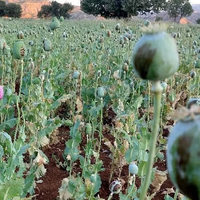
Opium poppy plants have grown quietly in the Zagros, a crop now seen more often than before in some villages across the region.
Lancing season on the Zagros slopes
It is now the season for lancing poppy capsules in the Zagros range. Before the sun grows harsh over the plains, farmers make cuts in the poppy bulbs.
Hours later, a white sap seeps from the wounds, a substance that turns into opium once dried.
Farmers say poppy is usually planted in the region in two seasons. Some fields are cultivated in the first month of autumn, around September and October, and others in the second month of winter, around January and February. Harvesting continues from mid- to late-spring, roughly from April to late May.
'Poppy is our only hope'
Iran International’s investigations show that poppy cultivation in the Zagros has been expanding for more than 10 years.
Most poppy growers prefer to plant the crop on mountain slopes and in hard-to-reach areas, where the risk of detection is lower.
One farmer said poppy is suited to the region’s climate and can be grown even on rain-fed and rocky land.
“Planting in the heart of the mountain is hard, but we have no other choice,” he said. “Poppy is our only hope.”
Wheat no longer covers the costs
For years, wheat, chickpeas and lentils formed the backbone of village economies in the Zagros. But farmers tell Iran International rising production costs, consecutive droughts, declining land productivity and delays in government payments have changed the farming equation.
“Wheat no longer covers the cost of the land,” one farmer said. “Costs have risen so much that in the end, nothing is left for us — and that is if the government pays for the wheat on time.”
Academic research and international studies in poppy-producing regions confirm that drought, falling agricultural income and the lack of alternative economic options are among the main factors pushing farmers toward poppy cultivation.
The United Nations Development Program has also stressed that combating poppy cultivation will be difficult without creating sustainable economic alternatives.
The opium economy: A more profitable crop
The value of the opium market has risen in recent years. Some Iranian media outlets reported in April that the retail price of each gram of opium was about 250,000 tomans, roughly $1.6.
According to data from the United Nations Office on Drugs and Crime, poppy fields in climates similar to Iran’s typically produce between 20 and 30 kilograms of pure opium per hectare. In some regions, the figure exceeds 50 kilograms.
A comparison between income from poppy and wheat, one of the main agricultural products of western Iran, helps explain why some farmers have turned to the crop.
With wheat priced at about 49,500 tomans per kilogram and average production of 3.5 tons per hectare, the value of wheat from 1 hectare is estimated at around 173 million tomans (almost $1,081).
By contrast, a hectare of poppy producing 20 to 30 kilograms of opium could generate an estimated 5 billion to 7.5 billion tomans, or roughly $31,000 to $47,000, based on the reported retail price.
In higher-yield areas, where output can exceed 50 kilograms per hectare, the value could rise to about 12.5 billion tomans, or roughly $78,000. That means the estimated value of opium from 1 hectare could be about 29 to 72 times higher than wheat grown on the same area.
Cultivated area grows more than threefold
Signs of the spread of poppy cultivation can even be seen in remarks by some officials.
According to Mohammad Jamalian, a member of parliament’s Health and Medical Commission, the area under poppy cultivation in Iran has reached about 32,000 hectares — a figure he said is more than 3 times higher than in previous years.
Accurately estimating the total area under cultivation is difficult, because many poppy fields are set up in remote lands and places outside public view.
However, a review of reports published in recent years shows that the names of Zagros provinces appear more often than other regions in news about the discovery and destruction of poppy fields. These are provinces that are simultaneously grappling with drought, unemployment and livelihood crises.
Afghanistan’s shadow over the regional market
The story of poppy does not end in the Zagros fields. Hundreds of kilometers away, in Afghanistan, an unprecedented decline in poppy cultivation following the Taliban’s return to power has altered the dynamics of the market across the region.
Iran’s Drug Control Headquarters has said the sharp fall in poppy cultivation in Afghanistan has led to a noticeable decline in the entry and seizures of opium in Iran, and has even created problems in supplying raw materials for some medicines.
The recent war has added to these pressures and worsened Iran’s medicine supply crisis, with health officials reporting shortages of nearly 1,000 types of medication across the country.
Meanwhile, Iran remains one of the world’s largest opium consumer markets.
According to Health Ministry officials, in addition to the hidden number of drug users, about 3 million people in Iran are officially registered as addicts, and opium remains their main drug of use.
Western Iran is also located near one of the region’s key routes for the trafficking of opiates, a route that passes through Iraq and the Kurdistan Region and continues toward Turkey and Europe.
Although there is no evidence that the crop produced by poppy farmers in the Zagros is exported, the existence of a consumer market and the region’s sensitive geography are among the factors that could create fertile ground for the phenomenon to expand.
The blade drawn today across poppy capsules on the slopes of the Zagros reveals the trace of a crisis that began with drought and rising costs — and has now changed the path of livelihood in some of Iran’s villages.