• العربية
  • فارسی
Brand
  • Iran Insight
  • Politics
  • Economy
  • Analysis
  • Special Report
  • Opinion
  • Podcast
  • Iran Insight
  • Politics
  • Economy
  • Analysis
  • Special Report
  • Opinion
  • Podcast
  • Theme
  • Language
    • العربية
    • فارسی
  • Iran Insight
  • Politics
  • Economy
  • Analysis
  • Special Report
  • Opinion
  • Podcast
All rights reserved for Volant Media UK Limited
volant media logo

Haley claims seized ship linked to China–Iran missile supply chain

Apr 21, 2026, 03:03 GMT+1

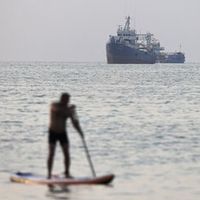
Former US ambassador to the United Nations Nikki Haley said a ship seized by the United States in the Strait of Hormuz was traveling from China to Iran and was linked to chemical shipments used for missiles.

“The ship the U.S. seized in the Strait of Hormuz this weekend was headed from China to Iran and is linked to chemical shipments for missiles,” Haley wrote on X with no further explanation.

Haley argued the incident was another sign of China’s support for Iran that “can’t be ignored.”

Most Viewed

Hardliners accuse negotiating team of ignoring Supreme Leader's objections
1

Hardliners accuse negotiating team of ignoring Supreme Leader's objections

2

Israel reveals Iranian-designed Hezbollah ‘terror tunnel’ with large drone cache

3
OPINION

MoU's forgotten casualty is the Iranian people

4
INSIGHT

Iran's postwar rallies become flashpoint in diplomacy debate

5

Lebanon 'deconfliction cell' emerges after intense Switzerland talks

Banner
Banner
Banner

Spotlight

  • Relief or resistance? Tehran dailies offer diverging readings of talks
    INSIGHT

    Relief or resistance? Tehran dailies offer diverging readings of talks

  • Will the Islamic Republic trade with the 'Great Satan'?
    INSIGHT

    Will the Islamic Republic trade with the 'Great Satan'?

  • Iran's postwar rallies become flashpoint in diplomacy debate
    INSIGHT

    Iran's postwar rallies become flashpoint in diplomacy debate

  • MoU's forgotten casualty is the Iranian people
    OPINION

    MoU's forgotten casualty is the Iranian people

  • Iran may get a lifeline, but major obstacles remain
    ANALYSIS

    Iran may get a lifeline, but major obstacles remain

•
•
•

More Stories

Iran diplomacy wobbles as factions compete to avoid looking soft on US

Apr 21, 2026, 02:02 GMT+1
•
Behrouz Turani
Iran diplomacy wobbles as factions compete to avoid looking soft on US
100%
Iran's parliament speaker and chief negotiator Mohammad Bagher Ghalibaf argues with MPs in this prewar file photo

Apparent divisions over negotiations with the United States may have strengthened the most confrontational elements within Iran’s political landscape and facilitated the rise of new hardline actors.

Backed by the more uncompromising faction within the senior ranks of the Islamic Revolutionary Guard Corps (IRGC), these emerging hardliners have been testing their ability to disrupt talks that already face significant obstacles.

Within the IRGC itself, commanders appear to be split into at least two camps. One faction, associated with IRGC Commander Ahmad Vahidi and Supreme National Security Council (SNSC) Secretary Mohammad Bagher Zolghadr, is widely described by Iranian observers as favoring continuation of the conflict.

The opposing faction aligns more closely with former IRGC Air Force commander and current Majles Speaker Mohammad Bagher Ghalibaf. He is believed to retain influence within the IRGC’s aerospace branch and to maintain ties to the household of Iran’s slain leader Ali Khamenei, including his son Mojtaba.

Despite their rivalry, both factions share a core objective: ensuring the survival of the Islamic Republic. Their disagreement lies in the methods and strategic direction needed to achieve that goal.

Similar infighting existed before the latest war and under Ali Khamenei, but the absence of a figure with comparable authority appears to have widened the field to rival forces.

Among civilian political actors, many have attempted to distance themselves from the ultraconservative Paydari Party, which has been the loudest anti-American voice in Tehran for some time. Yet their ideological and personal links to Paydari figures remain evident.

Even Ghalibaf, now seen by many as the de facto leader of Iran’s “pragmatic” camp, has referred to these actors as a radical militia. He has also hinted at their connections to Paydari-aligned figures such as former nuclear negotiator Saeed Jalili and hardline lawmaker Amir Hossein Sabeti, both of whom journalists in Tehran accuse of enticing anti-talks rallies.

Over the weekend, an X account identifying itself as “Fans of Saeed Jalili” sharply criticized Ghalibaf and Foreign Minister Abbas Araghchi, accusing them of falsely suggesting that their more moderate positions toward Washington had been endorsed by Mojtaba Khamenei.

The account demanded that Mojtaba appear publicly—or at least release an audio or video message—to clarify his political intentions. The post was deleted within an hour, and Jalili later distanced himself from its content, though he did not deny links to the account.

Ghalibaf has also criticized calls to continue the war, referring to the large crowds of mostly young Iranians who have taken to the streets nightly to demand renewed attacks on the United States and Israel.

In an unprecedented televised address on Sunday, he told the nation that Iran “controls the battlefield,” but acknowledged that “the US and Israeli militaries are far stronger and more experienced than Iran’s.”

Meanwhile, several members of parliament—including Ali Khezrian, Hamid Rasai and Morteza Mahmoudi—have been reported to be encouraging efforts to unseat Ghalibaf as speaker and to push for the impeachment of Foreign Minister Abbas Araghchi.

Whether these pro-war factions are strong enough to derail the Islamabad talks remains uncertain. The deeper issue is that while Ali Khamenei often managed factional rivalries to maintain control, the emerging leadership—what President Trump has referred to as the “new regime in Iran”—has yet to demonstrate the same ability to balance competing forces.

Under Khamenei, domestic politics remained a relatively contained arena in which rival factions competed but ultimately operated within boundaries he enforced.

The new leadership now faces a far more volatile environment: major military powers are directly engaged in the region, and the Middle East remains perched on a geopolitical powder keg.


Vance expected to head to Islamabad for Iran talks — Axios

Apr 21, 2026, 01:53 GMT+1

US Vice President JD Vance is expected to depart for Islamabad by Tuesday morning for talks with Iran over a potential deal to end the war, Axios reported, citing three U.S. sources.

The trip would mark another attempt to revive negotiations aimed at ending the conflict as the fragile ceasefire approaches its deadline.

Iran's lead negotiator Mohammad Bagher Ghalibaf rejected talks "under threat" from the United States earlier.

Trump unlikely to extend Iran ceasefire — WSJ

Apr 21, 2026, 01:49 GMT+1

President Donald Trump is not inclined to extend the Iran ceasefire beyond Wednesday evening when it expires, the Wall Street Journal reported, citing a White House official.

According to the report, the United States and Iran are planning to hold peace talks in Islamabad this week as the deadline approaches.

While Tehran has not publicly confirmed it will participate in the meetings in Pakistan, it has told regional mediators that it intends to send a negotiating team, according to people familiar with the matter.

Iran says rebuilding key bridge hit by US would cost $23m

Apr 21, 2026, 01:22 GMT+1
Iran says rebuilding key bridge hit by US would cost $23m
100%

The head of the company overseeing construction of the northern Karaj freeway said rebuilding a major bridge damaged in US attacks could cost about 3.5 trillion tomans (roughly $23 million).

“We are trying to proceed with reconstruction under the current conditions by demolishing parts of the structure and redesigning it so it can be preserved as a symbol in the country,” said Abolfazl Rahmani, chief executive of the North Karaj Freeway Construction Company

Rahmani added that the B1 bridge had been built “without foreign involvement” and reconstruction cost could end up higher than the initial estimate.

The politics of pink: how Iran uses cuteness to rebrand violence

Apr 21, 2026, 00:38 GMT+1

Pink missiles, pink drones and pink firearms. Women with uncovered hair—braids, ponytails, short bobs—stood beside weapons, waved flags and smiled for cameras in scenes broadcast across Iranian media. Tehran appears willing to try almost anything to preserve power.

Critics say the imagery forms part of a new Islamic Republic campaign that pairs missiles with fashion, war with pop culture and force with softness.

Liora Hendelman-Baavur, author of Creating the Modern Iranian Woman, told Iran International the visuals resemble Japan’s “kawaii” culture — imagery built around cuteness — but applied here to rockets and war.

“I think it is trying to make violence look cute,” Hendelman-Baavur said. “It is trying to appeal to the youth, to Gen Z.”

Read the full article here.