• العربية
  • فارسی
Brand
  • Iran Insight
  • Politics
  • Economy
  • Analysis
  • Special Report
  • Opinion
  • Podcast
  • Iran Insight
  • Politics
  • Economy
  • Analysis
  • Special Report
  • Opinion
  • Podcast
  • Theme
  • Language
    • العربية
    • فارسی
  • Iran Insight
  • Politics
  • Economy
  • Analysis
  • Special Report
  • Opinion
  • Podcast
All rights reserved for Volant Media UK Limited
volant media logo

US says Trump will only accept an Iran deal that 'puts America first'

Apr 10, 2026, 17:38 GMT+1

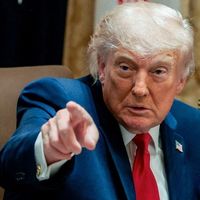
"President Trump has a proven track record of achieving good deals on behalf of the United States and the American people, and he will only accept one that puts America first," White House Deputy Press Secretary Anna Kelly said on Friday.

"The President is optimistic that a deal can be reached that can lead to lasting peace in the Middle East," Kelly said in a statement ahead of Saturday talks with Iran in Pakistan.

The White House deputy press secretary said the US delegation to Islamabad will include Vice-President JD Vance, Special Envoy Steve Witkoff, and Jared Kushner and they will be supported by officials from the National Security Council, the State Department and the War Department.

Most Viewed

State media slam Araghchi's Hormuz tweet, say it let Trump claim victory
1

State media slam Araghchi's Hormuz tweet, say it let Trump claim victory

2
OPINION

The Hormuz get out of jail card turned to a grave

3
INSIGHT

How Tehran bends its own red lines to boost state rallies

4

Iran International says it won’t be silenced after London arson attack

5

US arrests Iranian national over alleged Basij-linked visa fraud

Banner
Banner

Spotlight

  • Too early to tell who is winning Iran war, experts say
    PODCAST

    Too early to tell who is winning Iran war, experts say

  • How Tehran bends its own red lines to boost state rallies
    INSIGHT

    How Tehran bends its own red lines to boost state rallies

  • Iran blackout cripples freelancer, small business incomes
    VOICES FROM IRAN

    Iran blackout cripples freelancer, small business incomes

  • Ideology may be fading in Iran, but not in Kashmir's ‘Mini Iran'
    INSIGHT

    Ideology may be fading in Iran, but not in Kashmir's ‘Mini Iran'

  • US blockade enters murky phase as tankers spoof signals and buyers hesitate
    ANALYSIS

    US blockade enters murky phase as tankers spoof signals and buyers hesitate

  • Why the $100 billion Hormuz toll revenue is a myth
    ANALYSIS

    Why the $100 billion Hormuz toll revenue is a myth

•
•
•

More Stories

Trump says US warships rearmed for Iran strikes if talks fail - NY Post

Apr 10, 2026, 16:53 GMT+1

President Donald Trump said on Friday that US warships are being reloaded with “the best ammunition” to continue airstrikes on Iran in case peace talks in Islamabad fail.

“We’re going to find out in about 24 hours. We’re going to know soon,” he told The New York Post in a phone interview when asked if he thought the talks would be successful.

“We have a reset going. We’re loading up the ships with the best ammunition, the best weapons ever made — even better than what we did previously and we blew them apart,” he added.

“But we’re loading up the ships. We’re loading up the ships with the best weapons ever made, even at a higher level than we use to do a complete decimation. And if we don’t have a deal, we will be using them, and we will be using them very effectively.”

“You’re dealing against people that we don’t know whether or not they tell the truth,” Trump added. “To our face, they’re getting rid of all nuclear weapons, everything’s gone. And then they go out to the press and say, ‘No, we’d like to enrich.’ So we’ll find out.”

Engaged but uncommitted: China watches Iran and US fight and talk

Apr 10, 2026, 15:34 GMT+1
•
Andrea Ghiselli

As US and Iranian envoys prepare to meet in Pakistan to explore a path out of the war, China is watching from further east—an influential but cautious actor that helped move diplomacy forward but is unlikely to become the guarantor Tehran would like.

The truce that emerged after six weeks of war remains fragile, even as diplomatic signals from Washington, Tehran and Islamabad suggest the meeting is likely to go ahead.

Amid the uncertainties and the mistrust, it was perhaps unsurprising that Iran’s ambassador to China, Abdolreza Rahmani Fazli, publicly expressed hope that Beijing could act as a guarantor of the process. The suggestion followed reports that China maintained contact with both Washington and Tehran during the diplomatic push that helped produce the ceasefire.

Yet when asked directly about such a role, China’s foreign ministry avoided any commitment, saying only that Beijing hopes “all parties can properly resolve disputes through dialogue and negotiation” and will maintain communication with those involved.

This episode reflects a broader pattern in China’s response to the war: exerting influence while avoiding commitment.

Beijing is engaged, but only up to a point. It maintains economic ties with Iran, continues to purchase its oil, and provides forms of support that help sustain the Iranian economy under pressure. Yet none of this amounts to the kind of backing Tehran would need in an existential conflict. There are no security guarantees, no military involvement, and no willingness to absorb significant strategic risks.

China’s limited readiness to intervene reflects both its capabilities and its priorities. Its actions are ultimately directed toward ensuring that the conflict does not disrupt its broader strategic agenda at minimal cost. Contributing to de-escalation can serve that objective, but only insofar as it advances clearly defined interests.

When the conflict began on February 28, Beijing was relatively well positioned to absorb the initial shock with the strategic reserves it had built up throughout 2025, the increasing electrification of its economy, and its vast domestic coal resources. It also soon became clear that Tehran could withstand the initial decapitation strikes.

At the same time, China’s regional strategy has increasingly shifted toward the monarchies across the Persian Gulf, reinforcing its preference for a balanced and non-committal posture.

The conflict also presents certain strategic opportunities. As the United States diverts military resources and political attention to the Middle East, pressure on China in the Indo-Pacific decreases. The war also offers insights into US military capabilities and operational patterns.

These advantages, however, depend on the conflict remaining limited. A prolonged war—such as the one that loomed when President Donald Trump warned that a “whole civilization will die”—poses significant risks.

China is poorly positioned to weather a global recession with ease. Exports remain essential for sustaining industrial output, growth and employment. A decline in external demand, combined with disruptions to key industrial and agricultural inputs, would therefore undermine a critical pillar of its economy.

Beijing wants stable relations with Washington, not least to buy time to strengthen its economy against future US pressure. In addition, the question of how to protect or evacuate the hundreds of thousands of Chinese nationals in the region would become increasingly urgent if the conflict escalated further.

It was under these conditions that China chose to act. On the one hand, it vetoed a Bahrain-sponsored resolution at the UN Security Council that—even in revised form—could have provided legal cover for further attacks against Iran. On the other, it helped create a diplomatic off-ramp to a US president in clear need of one.

China’s role in the crisis thus highlights both the reach and the limits of its influence. Beijing has demonstrated an ability to shape outcomes at critical junctures, but it remains unwilling to assume the responsibilities of a security provider. Its actions are highly context-dependent: had Washington shown no interest in de-escalation, or had diplomatic openings not emerged, China’s ability to intervene would likely have been far more limited.

The Chinese leadership, in other words, is not seeking to resolve the conflict as much as to manage its consequences. It intervenes not to build a lasting order, but to prevent outcomes that would damage its broader strategic agenda.

As long as that calculation holds, Beijing will remain an influential—but ultimately cautious and constrained—actor in Middle Eastern security.


'Finger on the trigger': Iran's military ramps up threats ahead of US talks

Apr 10, 2026, 15:09 GMT+1

Iran's Khatam al-Anbiya Central Headquarters said the country’s armed forces have a "finger on the trigger", signaling heightened military readiness ahead of negotiations with the United States in Pakistan.

The military command warned that any continued attacks on Lebanon's Hezbollah would be met with a “crushing” and “painful” response.

It also said Iran will take its management of the Strait of Hormuz into a “new phase,” vowing to maintain initiative and not back down from what it called its rights.

Rift in Iran over negotiating team’s makeup and mandate

Apr 10, 2026, 13:43 GMT+1

Senior Iranian officials are locked in a dispute over the composition and authority of the delegation set to negotiate with the United States in Islamabad, sources with knowledge of the matter told Iran International.

IRGC commander-in-chief Ahmad Vahidi is seeking to curb the authority of Mohammad Bagher Ghalibaf and Foreign Minister Abbas Araghchi in the talks, according to the sources.

Vahidi has also pushed for the inclusion of Mohammad-Bagher Zolghadr, secretary of the Supreme National Security Council, in the negotiating team — a move opposed by current members, who consider him lacking experience for strategic negotiations, the sources said.

At the same time, Vahidi and the IRGC Aerospace Force commander have stressed that the delegation must avoid any negotiations over Iran’s missile program.

Vance warns Iran not to 'play' America in Islamabad talks

Apr 10, 2026, 13:33 GMT+1

US Vice President JD Vance said on Friday he is looking forward to negotiations with Iran, adding that President Donald Trump has provided clear guidelines for the talks. He said he believes the negotiations will be positive.

"As the president ‌of ⁠the United States said, if the Iranians are willing to negotiate in good ​faith, ​we're ⁠certainly willing to extend the open hand," ​Vance said. "If they're ​going ⁠to try to play us, then they're going to ⁠find ​the negotiating ​team is not that receptive."