Strikes hit Iran bridges, rail links as Israel warns against trains
Strikes hit bridges and rail-linked infrastructure across Iran on Tuesday after Israel warned civilians to avoid trains and Donald Trump threatened to destroy bridges and power plants if a deal is not reached.
In central Iran, a railway bridge near Kashan was hit, along with another bridge near Qom, while a key road bridge on the Tabriz-Zanjan highway in northwest Iran was also struck.
The attacks followed Israel’s warning to stay away from trains and railway lines, citing risks to civilians.
In and around Tehran, strikes hit multiple districts including Yusefabad, areas near Mehrabad Airport and Tehranpars, while nearby Karaj and surrounding towns were also affected.
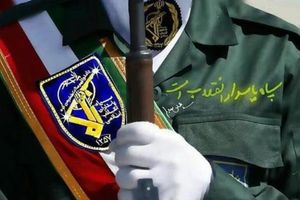
Iran’s Revolutionary Guards warned on Tuesday their response to the United States could extend beyond the region and target energy infrastructure, saying previous restraint had ended.
“From now on, all these considerations have been lifted,” the Islamic Revolutionary Guard Corps said in a statement.
It said it would act against US and partner infrastructure in a way that would deprive them of the region’s oil and gas resources for years.
Regional partners of the United States should know Iran had exercised restraint due to good neighborly relations, it said, but that those considerations no longer applied.
The Guards added that if US forces crossed what it called red lines, “our response will go beyond the region.”
Iran’s army said it carried out large-scale drone attacks on targets linked to the United States and Israel in response to strikes on its energy infrastructure.
In a statement, the army said it targeted a petrochemical power unit and fuel storage site near Dimona in southern Israel, as well as a US naval maintenance facility at Jebel Ali Port.
It also said it struck radar systems and housing facilities for US forces at Ahmad al-Jaber Air Base.
The statement said the attacks were in response to US and Israeli strikes on Iran’s petrochemical and other infrastructure.
Iran has rejected any temporary ceasefire with the United States and set conditions for talks on “a lasting peace,” Reuters reported, citing a senior Iranian source.
The source said Tehran’s preconditions include an immediate halt to US and Israeli strikes, guarantees that attacks will not be repeated, and compensation for damages caused during the conflict.
The source added that under a permanent peace deal, Tehran is demanding fees for ships passing through the Strait of Hormuz, a key global oil transit route.
The transit fees for ships passing through the Strait of Hormuz would vary depending on vessel type, cargo and prevailing conditions, according to the source.
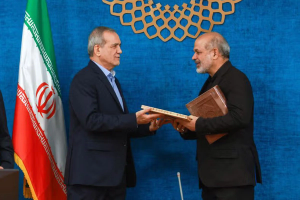
President Masoud Pezeshkian (left) and IRGC chief commander Ahmad Vahidi
A deepening rift at the top of the Islamic Republic has spilled into an unusually sharp confrontation, with President Masoud Pezeshkian accusing senior Guards commanders of unilateral actions that have wrecked ceasefire prospects and pushed Iran toward disaster.
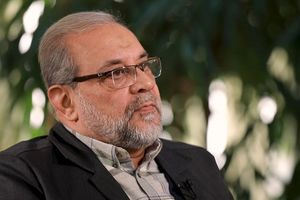
Two sources close to the presidential office said a tense exchange took place on Saturday, April 4, between Pezeshkian and Hossein Taeb, a powerful figure close to Supreme Leader Mojtaba Khamenei. Those present described the conversation as unusually difficult and highly charged.
During the meeting, Pezeshkian accused IRGC chief commander Ahmad Vahidi and Ali Abdollahi, commander of Khatam al-Anbiya Central Headquarters – the country’s armed forces' unified command, of acting unilaterally and driving escalation through attacks on regional countries, especially against their infrastructure.
According to the sources, Pezeshkian said those policies had destroyed any remaining chance of a ceasefire and were steering the Islamic Republic directly toward “a huge catastrophe.”
He also warned that, based on what he described as precise assessments, Iran’s economy would not be able to withstand a prolonged war for much longer and that full economic collapse was inevitable under current conditions.
The confrontation comes amid mounting evidence of a broader power shift inside the Islamic Republic, with military and intelligence networks increasingly displacing both the elected government and the traditional clerical order.
A regional source familiar with internal developments told Iran International in February that the model of velayat-e faqih (guardianship of the jurist) that has defined the Islamic Republic for more than four decades is now undergoing a fundamental transformation and even an “ideological collapse.”
According to that source, the appointment of Mojtaba Khamenei to the leadership, despite lacking the traditional qualifications and legitimacy associated with the position, took place through an opaque process that in practice amounts to the sidelining of the traditional clergy and the consolidation of full control by the Guards’ military-intelligence apparatus.
The source said this process has strengthened what many insiders describe as the Islamic Republic’s “hidden state.”
Iran International has previously reported growing tensions between Pezeshkian and senior IRGC commanders, particularly Vahidi, over how the war should be managed and over its destructive impact on people’s livelihoods and the economy.
On March 28, informed sources said Pezeshkian had criticized the Guards’ approach to escalating tensions and continuing attacks on neighboring countries, warning that without a ceasefire the economy could collapse within three weeks to a month.
Subsequent reporting by Iran International showed that the president’s authority has continued to shrink.
Sources said the Guards have resisted Pezeshkian’s appointments and decisions, effectively stripped the government of executive control and erected a security barrier around the core of power.
According to those reports, Pezeshkian’s attempt to appoint a new intelligence minister collapsed under direct pressure from Vahidi, who rejected all proposed candidates, including Hossein Dehghan, and insisted that all key wartime positions must, for now, be chosen and managed directly by the Guards.
Alongside the political infighting, fresh field reports received by Iran International point to a worsening human and logistical crisis inside the Guards and the Basij.
Sources said that over the past 72 hours, operational forces have faced acute shortages of basic supplies, including edible food, hygiene facilities and places to sleep.
Recent strikes on infrastructure and bases have left many Guards and Basij personnel sleeping in the streets, and in some areas they have had access to only one meal a day.
According to informed sources, some personnel were forced to buy food from shops and restaurants with their own money after expired rations were distributed.
At the same time, disruptions affecting Bank Sepah’s electronic systems have reportedly delayed the salaries and benefits of military personnel, fueling fresh anger and mistrust within the ranks.
Iran International had previously reported similarly dire conditions in field units, including severe shortages of ammunition, water and food, as well as growing desertions by exhausted soldiers.
Even in the Guards’ missile units, which have historically received priority treatment, sources reported serious communications failures and food shortages. They said commanders were continuing to send only technical components needed to keep missile systems operational, rather than food or basic individual supplies for personnel.