Iran and the United States may prefer an end to the war, but the gap between the minimum terms each side could accept is so wide that a deal remains unlikely for now.
What we are more likely to see instead are continued displays of power intended to shape the terms of any eventual agreement.
For now, negotiations speak the language of war more than diplomacy. When Washington talks about “progress” or “flexibility,” it is not simply describing talks; it is projecting the idea that military pressure is forcing Iran toward an American framework for ending the conflict.
Tehran’s denial of negotiations serves a similar purpose. Rejecting reports of talks helps prevent any existing contacts from being interpreted as evidence of weakness or submission.
Nor will the outcome depend only on Washington and Tehran. Regional actors will seek a role in shaping any settlement, and any country or coalition attempting to reopen the Strait of Hormuz will attach its own demands to the process.
Washington’s rhetoric reflects this struggle over narrative as much as over territory. In the second week of the war, the US defense secretary said that “at every stage, the conditions of the war will be determined by us.” Similar language echoes in Donald Trump’s repeated threats to send Iran “back to the Stone Age.”
Yet military power becomes a real victory only when it can be translated into a political settlement. When US officials speak about “progress in negotiations,” they are attempting to move from delivering blows to defining the outcome.
The very need to emphasize negotiations suggests that this transition remains incomplete. If battlefield superiority had already produced a decisive political result, Washington would have little reason to stress mediation and contacts.
The rhetoric also serves audiences beyond Tehran: financial markets, domestic politics, and allies trying to assess the war’s trajectory.
Israeli objectives further complicate the picture. US officials have acknowledged that Washington’s goals differ from those of Israel, which appears more focused on weakening Iran’s leadership.
Tehran’s definition of victory is also different. For the Islamic Republic, success means preserving the regime while reshaping the balance of power in the Strait of Hormuz.
Admitting negotiations under intense military pressure and under Washington’s conditions would risk appearing politically subordinate. Denial therefore becomes part of the struggle over legitimacy.
At the same time, Iran’s leadership—its military weakened and many senior figures killed—also needs a way out of the conflict. It must keep communication channels open while ensuring those contacts cannot be portrayed as retreat.
Iran’s strategy is therefore less about proving it has won than about preventing the United States from presenting its victory as complete. Tehran may not be able to claim triumph outright, but it seeks to ensure Washington cannot dictate the outcome alone.
Trump’s push for negotiations may also serve another purpose: testing where real power lies inside Iran. Every reported contact, denial, or proposed channel becomes a way of probing who still has the authority to make decisions.
Reports of fractures inside Iran’s leadership since the war began suggest uncertainty over that question. In wartime conditions, however, the Revolutionary Guards appear to hold the strongest position within the system.
Meanwhile, mediators are beginning to shape the diplomatic landscape. Turkish Foreign Minister Hakan Fidan recently suggested that neither Washington’s nor Tehran’s demands will remain at their current levels, and that the task of mediators is to bring those positions closer to political reality.
But mediators are not neutral actors. Any settlement will also reflect their own interests in the region’s future energy and security order.
These states are caught between two fears: they do not want the Gulf to become a permanent instrument of Iranian pressure, yet they are also wary of confronting Tehran alone if Washington eventually disengages.
For now, mediation reflects less a drive for peace than a shared effort to contain instability.
Diplomacy has become another arena in the struggle to shape the balance of power emerging from the battlefield. As long as both Washington and Tehran continue to claim the upper hand, escalation remains more likely than compromise.
For now, what passes for diplomacy is the management of collapse, not the architecture of peace.
The B1 Bridge near Karaj, Iran, was struck twice by the United States on April 2, 2026.
President Trump’s threat to bomb Iran’s infrastructure and “send it back to the stone ages,” followed by strikes that reportedly included a not-yet-opened bridge, has sparked anger among Iranians at home and abroad.
Iran’s president Masoud Pezeshkian condemned the remarks, writing: “Does threatening to send an entire nation back to the Stone Age mean anything other than a massive war crime? … History is full of those who paid a heavy price for their silence in the face of criminals.”
Ground Forces commander Ali Jahanshahi, warned to send US troops “not to the Stone Age but to pre-Stone Age.”
International reactions have also been critical. Former IAEA chief Mohamed ElBaradei accused Trump and Israel’s prime minister Benjamin Netanyahu of “employing horrific methods” and quipped, “I truly don't know who belongs to the Stone Age!”
Former Swedish prime minister Carl Bildt also weighed in, saying Iranians want “a decent and representative government” not being bombed back to the Stone Age.
‘War crimes’
Anger also surged among ordinary Iranians and diaspora communities—many of whom oppose the government but object strongly to threats against national infrastructure and civilian sites.
Strikes on health facilities such as the Pasteur Institute of Tehran have heightened sensitivities about civilian harm.
Hadi Partovi, a technology investor with Iranian roots, framed the issue in moral terms: “Many Iranians supported your war because your plan was to liberate Iran. Instead, you celebrate sending a civilization to the Stone Age. Great leaders build, not destroy… I weep to see America like this.”
London-based human rights lawyer Shadi Sadr accused Western governments of hypocrisy, arguing that initial justifications under the “Responsibility to Protect” have given way to actions that “send those same people back to the Stone Age, committing war crimes on a massive scale.”
Tehran-based journalist Yashar Soltani wrote: “You first spoke of ‘liberating Iran.’ Then you bombed a school in Minab and took the lives of children. And today you speak of dragging Iran back to the ‘Stone Age’.”
“Iran is a land that, when many nations were still in the Stone Age, was building cities, writing laws, and creating civilization,” he added.
Rift over costs of war
Despite widespread criticism, reactions among Iran’s opposition have not been uniform.
Some supporters of regime change argue that damage to infrastructure, while painful, can ultimately be repaired. They point to historical precedents such as the Iran–Iraq War, when key facilities including oil refineries and export terminals were rebuilt after extensive destruction.
Others contend that the Islamic Republic’s long-term impact on governance, the economy and human capital outweighs the immediate damage caused by military strikes. For them, the focus should remain on political repression, including executions and internet shutdowns.
One social media user questioned priorities: “How can your infrastructure and the Stone Age be your priority before you even mention the executions and internet shutdowns!”
Another argued that reconstruction would follow regime change, writing: “Don’t worry about iron and concrete; worry about a homeland occupied by incompetence… after that, a free Iran will build infrastructure worthy of the name Iran.”
Some commentators have also suggested that Trump’s rhetoric was directed primarily at Iran’s ruling establishment rather than the public. “When he says… ‘we’ll hit you and send you back to the Stone Age,’ he’s talking to the clerics, not the people,” one user wrote.
Students and pedestrians walk through the Yard at Harvard University in Cambridge, Massachusetts, US, March 10, 2020
I have learned as an Iranian-American scientist that war and politics rarely remain outside the laboratory for scholars from the Middle East, following us into our visas, our collaborations and even our ability to concentrate on our work.
To be born a scientist in the Middle East, and particularly in Iran, is to inherit constraints that shape your education, your mobility and often your sense of belonging long before you publish your first paper.
For many students, the obstacles begin early. Access to higher education can depend on geography, religion, ethnicity or family background. Certain research topics are restricted. Background checks are routine. Resources are uneven.
These constraints do not extinguish ambition. Many of the most driven students I have met from the region have worked relentlessly to overcome barriers that would discourage others. A significant number succeed in gaining admission to leading universities abroad, often ranking among the strongest in their cohorts.
But leaving does not mean leaving politics behind.
Students from Iran and other parts of the Middle East frequently undergo additional security screening when applying for visas or research permits in Western countries. Even when governments recognise the vulnerability of marginalised groups, the bureaucratic process can be prolonged and uncertain. Delays disrupt research timelines, funding and family life.
For a graduate student on a fixed stipend, uncertainty is not an abstraction. It is rent, tuition and the ticking clock of a degree.
Once abroad, the challenges evolve rather than disappear entirely. Family, friends and history bind students to their countries of origin. Political upheaval, internet shutdowns, military escalation or widespread protests reverberate across continents.
During periods of unrest, many students feel a moral obligation to support loved ones financially and emotionally. They spend hours each day checking the news, supporting movements on social media, translating information, sending money and making calls at odd hours.
Research suffers. Sleep suffers. Concentration suffers. The entire laboratory feels the impact when one member is under acute stress.
Political manipulation and disinformation can deepen divisions within diaspora communities, leading to heated disputes that further isolate students already under strain.
I have lived through several such cycles as a graduate student and now as a professor. Today I receive daily messages from students—via email, on social media or during meetings—asking for advice. My guidance is simple, though not easy to follow: help where you can, avoid corrosive debates and focus on your research and your long-term goals.
This tension between civic conscience and scientific focus is what I think of as a form of geographic discrimination. Events far beyond one’s control can disrupt internet access, travel, funding and collaboration, affecting thousands of scientists across the globe simply because of where they were born.
The current conflict involving Iran, Israel and the United States illustrates this clearly. Universities and schools have closed. Conferences and workshops have been postponed or cancelled. Laboratories face interruptions, whether from direct damage, security restrictions or the displacement of staff and students.
Even when military actions are described as targeted, research institutes and surrounding civilian infrastructure are not immune to the shock.
Recent strike damage near civilian educational facilities in Iran, which cost the lives of 160 students, and the previous attack on the Weizmann Institute of Science in Israel are reminders that scientific ecosystems are fragile. Rebuilding infrastructure takes years. Rebuilding trust and a sense of safety can take longer.
The long-term cost is not measured only in damaged buildings or delayed experiments. It is measured in lost collaborations, abandoned projects and the quiet departure of talented young people who decide that stability matters more than prestige.
Science thrives on openness, mobility and sustained concentration. War undermines all three.
When we speak about geopolitical conflict, we often focus on borders, strategy and power. We speak less about research teams fractured by forces entirely outside their control.
If we value scientific progress, we must recognise how deeply it depends on the human beings who carry it forward. For many scientists from the Middle East, war is not a distant headline. It is an interruption that follows them into the laboratory and into the quiet hours when research demands clarity of mind.
Protecting science, in times of conflict, means protecting them as well.
The Burj Khalifa building peaks through the skyline as the sun sets over Dubai, United Arab Emirates, September 9, 2023.
The war pitting the United States and Israel against Iran is being fought across airspace and shipping lanes, but one of its most consequential economic effects may be unfolding elsewhere: the fragile commercial relationship between Tehran and the United Arab Emirates.
A series of recent economic measures taken by the UAE following Iranian attacks on Emirati infrastructure has exposed how deeply Iran’s external trade depends on Dubai’s role as a financial and logistical gateway.
The steps—ranging from restrictions on Iranian nationals to disruptions in financial and trade channels—highlight both the extent of interdependence between the two economies and the vulnerabilities that accompany it.
Iran’s consulate in Dubai confirmed that more than 1,200 Iranians were repatriated through indirect routes via Armenia and Afghanistan after direct travel links were suspended.
More consequential than these immediate measures, however, is the disruption of bilateral trade flows. The UAE is Iran’s second-largest trading partner after China and serves as a critical gateway for imports.
No container ships have been seen crossing from Emirati ports to Iran since the start of the conflict, according to Rebecca Gerdes, an analyst at data company Kpler.
According to official data, Emirati exports to Iran rose from about $5.2 billion in 2018—when the United States withdrew from the nuclear deal—to roughly $23 billion in recent years, accounting for more than one-third of Iran’s total imports.
Iran’s non-oil exports to the UAE have also grown, rising from $5.7 billion to nearly $8 billion.
Data from Kpler, seen by Iran International, indicates that Iran exports about 160,000 barrels per day of fuel oil (mazut) to the UAE, along with smaller volumes of other petroleum products such as LPG.
Services trade constitutes another vital channel. Iran imports roughly $23 billion in services annually—including logistics, engineering, insurance and trade facilitation—of which the UAE accounts for about 22 percent.
A substantial portion of this economic relationship also operates outside formal channels. Iran is estimated to import more than $20 billion worth of smuggled goods each year, much of it routed through the UAE.
Dubai has also served as a key node for currency exchange networks, document falsification related to oil shipments and other mechanisms used to circumvent international sanctions. Iranian exchange houses have played a central role in facilitating these activities.
Recent reports suggest that dozens of exchange operators with alleged links to Iran’s Islamic Revolutionary Guard Corps have been detained in the UAE as tensions escalated. While the full scope of these actions remains unclear, they point to a broader effort by Emirati authorities to tighten enforcement and limit illicit financial flows.
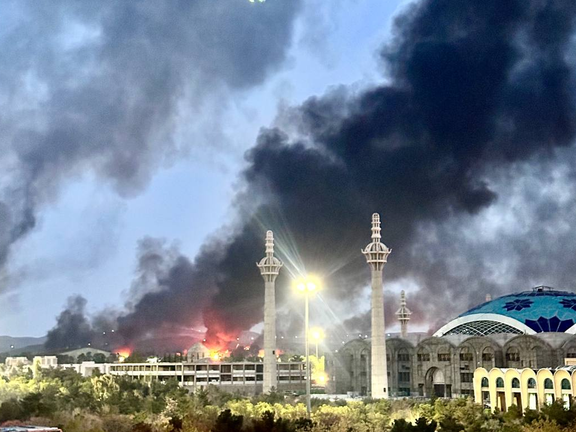
Iran’s recent military actions have targeted multiple locations in the UAE, including Fujairah—the country’s only oil export terminal outside the Strait of Hormuz—raising concerns about energy security and trade continuity.
A recent Goldman Sachs report warned that a prolonged closure of the Strait of Hormuz could reduce the UAE’s GDP by as much as 6 percent in April alone, underscoring the broader regional economic risks posed by the conflict.
Yet the same dynamics also expose Iran’s vulnerabilities. The UAE’s role as a commercial, financial and logistical hub makes it difficult to replace in the short term.
Few countries possess the infrastructure, geographic proximity and established trade networks required to replicate Dubai’s function in Iran’s economic ecosystem.
Whether the UAE’s response becomes a decisive pressure point for Iran will depend on both the duration and the breadth of the restrictions.
In the short term, disruptions to trade, finance and logistics are likely to raise costs and complicate supply chains for Iranian importers. Over the longer term, sustained constraints could push Tehran to diversify routes and partners, though replacing the UAE’s role would be neither quick nor straightforward.
For now, the trajectory of tensions suggests that friction with the UAE may emerge as one of the most consequential external challenges to Iran’s trade architecture long after the current conflict subsides.
A woman gesture to emergency workers from a window of a damaged building in Tehran, hit by US-Israeli strikes, March 28, 2026
A heated online dispute over photographs showing civilian victims of strikes in Iranian cities has exposed both the deep mistrust many Iranians feel toward official information and a widening rift among the public itself over how to interpret images emerging from the war.
As photos of wounded civilians circulated widely on social media, some users accused photographers and authorities of staging scenes for propaganda, claiming that individuals depicted in widely shared images were actors and that injuries, dust and distress visible in the photos had been artificially created using makeup and staged scenes.
The accusations spread quickly across Persian-language social media, with skeptics pointing to perceived similarities between people appearing in images linked to separate incidents as supposed evidence.
Even the Persian-language account of Israel’s foreign ministry weighed in on the controversy by reposting one of the disputed images and writing: “If they call the Gaza filmmaking industry ‘Pallywood’, what do they call this?”
But the claims were soon challenged by fact-checkers and other users, and in some cases the accusations were later withdrawn.
Iran’s independent fact-checking platform Factnameh said a review of several of the controversial images found no evidence supporting claims that they had been staged or taken at different times and locations as alleged.
“Given the presence of debris and victims, the idea that actors were staged in such a scene is highly unlikely,” the platform said, noting that the individuals in the images show clear differences in facial features and body structure despite some similarities.
Mehdi Ghasemi, one of the photographers whose work came under scrutiny, rejected the allegations and defended his work.
“I’m 47 years old, and it’s been 33 years since I received my first documentary photography award, and I haven’t taken a single reconstructed or manipulated frame,” he wrote on X.
One user who had asserted that a woman in a widely circulated photograph was an actress later deleted the post and issued an apology after acquaintances identified the woman and her husband as real individuals whose home had been destroyed in the strikes.
The controversy has unfolded amid tight wartime restrictions on reporting and photography in Iran.
Critics argue that permits to document sensitive scenes are tightly controlled and often granted only to photographers seen as aligned with the authorities, making independent documentation of chaotic strike sites difficult.
Combined with broader limits on information flow during the conflict, those restrictions have left social media as one of the primary arenas for competing narratives about events on the ground.
The dispute reflects how deeply distrust of official narratives has taken root in Iranian society after decades of censorship and propaganda. In such an environment, even genuine documentation can quickly become the subject of suspicion.
“The issue is exactly like the story of the boy who cried wolf,” one user wrote online.
“When a government lacks legitimacy to this extent and has always chosen to lie at every step, eventually no one believes the truth either. Now factor in cutting off communication channels on top of that, and you end up with the situation we are in.”
For others, however, the rush to dismiss images of civilian suffering as staged propaganda risks deepening divisions at a moment when the war itself is already reshaping daily life across the country.
Investors are seen at the Dubai International Financial Market in Dubai, UAE February 7, 2018. REUTERS/Satish Kumar Purchase Licensing Rights
The arrest of dozens of IRGC-linked money changers in the United Arab Emirates is one of the most serious blows yet to Tehran’s sanctions-evasion network, laying bare how heavily the Islamic Republic has depended on Dubai as an economic lifeline.
Sources familiar with the matter told Iran International that UAE authorities detained dozens of money changers tied to financial entities linked to Iran’s Revolutionary Guards, shut down associated companies and closed their offices.
The crackdown follows days of mounting regional tensions and comes after other measures targeting Iranian nationals, including visa revocations and tighter travel restrictions through Dubai.
For years, Dubai has served as Iran’s main offshore financial artery, where oil proceeds, petrochemical revenues and rial conversions were turned into dollars, dirhams and euros beyond the reach of the country’s battered domestic banking system.
“This is going to be a real problem for Tehran because Dubai was an economic lung for the Iranian regime,” Jason Brodsky of United Against Nuclear Iran told Iran International.
“That is economic pressure and diplomatic isolation in a way that the UAE is able to employ against the Iranian regime, and it will have a very considerable impact.”
'Most critical hub'
According to Miad Maleki, a former senior US Treasury sanctions strategist and now a senior fellow at FDD, the UAE is not just one sanctions-evasion hub among many.
“The UAE is the single most critical jurisdiction in the Iranian regime’s sanctions-evasion architecture,” Maleki said.
Dubai’s exchange houses have long given the IRGC and the Quds Force access to the hard currency needed to finance proxy groups including Hezbollah, Hamas, the Houthis and militias in Iraq.
The detention of trusted IRGC-linked money changers threatens networks that took years to build.
“These trust-based sarraf (money changer) relationships, bank accounts and corporate structures are not quickly replaceable,” Maleki said.
He added that even exchange houses untouched by the crackdown were now likely to think twice before processing Iran-linked transactions, sharply raising both the cost and the risk of doing business with the Guards.
The pressure comes as Iran’s domestic economy is already under severe strain.
Foreign reserves, once estimated at around $120 billion in 2018, had fallen below $9 billion by 2020, leaving Iran increasingly reliant on offshore currency channels.
Mohammad Machine-Chian, a senior economic journalist at Iran International, said the UAE remains Iran’s most important economic conduit after China.
“The UAE is Iran’s most critical economic lifeline after China,” he said.
He said Dubai’s free zones host hundreds of Iranian-linked shell companies used to mask oil and petrochemical sales, launder proceeds and channel hard currency back to Tehran.
Bilateral trade has hovered between $16 billion and $28 billion in recent years, with Iranian non-oil exports alone reaching roughly $6 billion to $7 billion annually, according to Machine-Chian.
A sustained crackdown could cost Tehran tens of billions of dollars in revenue streams while severing what he described as Iran’s “USD cash lifeline.”
Dubai has also functioned as a transit point for illicit Iranian funds moving onward to North America, including transfers routed to the United States and Canada through correspondent banking and hawala networks.
As Maleki put it, “Dubai is the washing machine: Iranian oil proceeds and rial conversions go in, sanitized dirham and dollar transactions come out.”
From diplomacy to backlash
Beyond the financial damage, analysts say the crackdown reflects a broader political rupture between Tehran and the Persian Gulf states.
Brodsky said Iran’s attacks on neighboring countries had transformed the strategic environment in the region.
“The relationship between Iran and the GCC countries is not going to go back to the way it was before Operation Epic Fury,” he said.
Where Persian Gulf states had once pushed for diplomacy, Iran’s retaliation has instead driven them closer to Washington and Israel.
For years, Tehran sought to encircle Israel in what it called a “ring of fire” through regional proxies.
Now, Brodsky said, the Islamic Republic has reversed that dynamic.
“They wanted to encircle Israel in a ring of fire,” he said. “Now they are basically encircling themselves in a ring of fire because they’ve been angering their neighbors with all of their attacks.”
He said that reversal could carry long-term consequences, including deeper Persian Gulf-Israel security coordination and new openings for the Abraham Accords.
“The missile threat and drone threat have become paramount in this conflict,” Brodsky said. “That could drive these countries even closer to the US and Israel.”
'Collapse within weeks'
The UAE crackdown comes as signs of mounting economic distress are mounting inside Iran.
Sources previously told Iran International that President Masoud Pezeshkian had warned senior officials that without a ceasefire, the economy could face collapse within weeks.
Across major cities, ATMs have been running short of cash, banking services have faced intermittent disruptions and government workers have reported months of delayed salary payments.
With inflation in essential goods already above 100 percent before the war, the loss of Dubai’s financial channels could deepen the regime’s crisis.
For Tehran, the arrests in the UAE are more than a financial disruption.
They may signal that one of Iran’s most dependable external pressure valves is starting to close.