Trump not taking the rope thrown by Iran to him, ex-foreign minister says
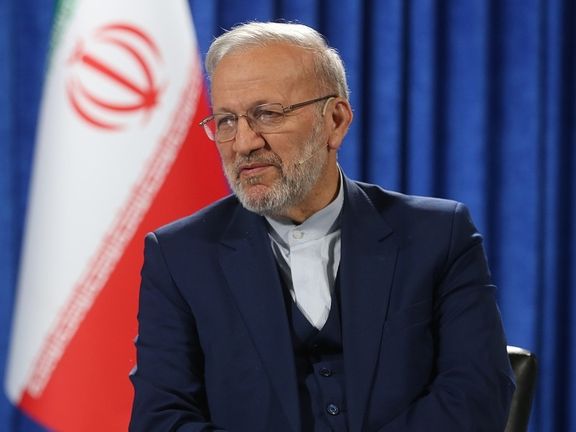
Iranian lawmaker and former foreign minister Manouchehr Mottaki said Tehran’s demands in negotiations with the United States include the right to enrich uranium, the full lifting of sanctions, and the right to self-defense.
“We are throwing a rope to Trump, but he is not taking it," he said.
Mottaki said “if the US does not enter into war after possible failure of negotiations, the current situation will continue and we will go on managing our country."
However, he warned, "if it moves toward military action, our response will take less than 10 minutes.”



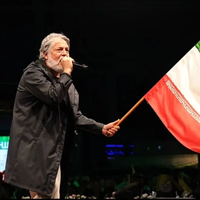


More than 40 days after the mass killing of protesters in Iran, students held large rallies on Saturday in Tehran and Mashhad, chanting pro-monarchy and anti-Khamenei slogans at Sharif and Amirkabir universities of technology and the universities of medical sciences in Tehran and Mashhad.
Protests at Sharif University were met with force, as Basij paramilitary forces affiliated with the IRGC were deployed to crack down on the demonstrators.
Iran’s Foreign Ministry said on Monday it would take reciprocal measures against the navies and air forces of European Union member states following a decision by the bloc to designate the Islamic Revolutionary Guard Corps (IRGC) as a terrorist organization.
In a statement on Saturday, the ministry called the IRGC a branch of Iran’s official military structure, adding that Tehran would respond based on what it described as the principle of reciprocity and under a 2019 law adopted after the United States designated the IRGC as a terrorist organization.
The statement added that the naval and air forces of EU member states would be treated as falling under the scope of that law, and that Iran would identify and announce them as terrorist organizations as part of its countermeasures.
Tehran’s posture increasingly resembles that of an embattled state that sees greater odds of survival in confrontation than in compromise—one that views a decisive clash not as catastrophe, but as a potential turning point.
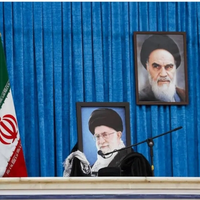
On February 17, while Iran’s negotiating team was in Geneva for talks with US officials, Supreme Leader Ali Khamenei delivered a stark warning in Tehran that reflected this outlook. “More dangerous than the aircraft carrier,” he said, “is the weapon that can send it to the bottom of the sea.”
Soon afterward, state-aligned poets circulated verses declaring, “We are leaves; we will fall at the foot of this tree.”
Even as negotiations continue abroad, the establishment in Tehran—and its media ecosystem—appear intent on preparing the public not for agreement, but for the possibility of a decisive confrontation.
Tehran’s posture increasingly resembles that of an embattled state that sees greater odds of survival in confrontation than in compromise—one that views a decisive clash not as catastrophe, but as a potential turning point.
On February 17, while Iran’s negotiating team was in Geneva for talks with US officials, Supreme Leader Ali Khamenei delivered a stark warning in Tehran that reflected this outlook. “More dangerous than the aircraft carrier,” he said, “is the weapon that can send it to the bottom of the sea.”
Soon afterward, state-aligned poets circulated verses declaring, “We are leaves; we will fall at the foot of this tree.”
Even as negotiations continue abroad, the establishment in Tehran—and its media ecosystem—appear intent on preparing the public not for agreement, but for the possibility of a decisive confrontation.
A shift in expectations
One striking difference between the current talks and previous rounds is the fading expectation of peace.
Earlier negotiations were framed by officials as diplomacy conducted from a position of strength—what Iranian leaders described as being “peace-seeking but capable of war.” Today, many voices close to the establishment express doubt that talks will produce an agreement.
Officials present negotiations primarily as a means of managing escalation and avoiding uncontrolled regional conflict. But in state-aligned media, a parallel narrative has taken hold—one that increasingly treats war as both plausible and potentially advantageous.
Some commentary focuses on technical readiness, discussing force posture and missile deployment. Other voices frame the situation in theological terms, arguing that divine providence will guide Iran to victory. Compromise, in this telling, is not pragmatic diplomacy but strategic defeat.
The comparison frequently invoked is Libya. In this account, Muammar Gaddafi’s decision to abandon his weapons programs paved the way for foreign influence, internal weakening, and eventual collapse. Agreement, within this framework, is seen as the beginning of the end. War, by contrast, could reset the strategic balance—producing ceasefire, deterrence, and renewed legitimacy.
War as mission and test
This outlook draws on a broader ideological shift that has intensified in recent years. The Islamic Republic’s political language has long contained religious and messianic elements, but such themes have grown more prominent following recent conflicts.
Within this framework, confrontation is as civilizational as it is geopolitical. Resistance, even at high cost, is framed as a test of faith in a larger struggle between opposing moral forces.
State-aligned commentators and officials increasingly describe the confrontation in existential terms. Military figures have shifted their rhetoric from deterrence to preparedness, suggesting Iran is ready not only to withstand conflict but to prevail. Structural weaknesses or social tensions are interpreted not as vulnerabilities, but as trials to be endured.
This perspective reflects a theological logic deeply embedded in the system’s ideological foundations. Victory, in this view, depends not solely on material advantage but on steadfast adherence to divine principles. Even loss or sacrifice can be reframed as spiritual triumph.
Such thinking also intersects with apocalyptic and messianic narratives present in segments of the regime’s ideological landscape, where the state is cast as an actor in a larger historical and religious mission.
The survival trap
Underlying these narratives is a stark strategic calculation. From the leadership’s perspective, compromise carries existential risks.
An agreement with the United States could require limits on Iran’s missile program, nuclear activities, or regional posture. Such constraints, Iran’s rulers appear to believe, would weaken the system’s core pillars and ultimately threaten its survival.
War, paradoxically, may appear less dangerous.
Proponents of this thinking frequently cite what they see as lessons from past confrontations, arguing that external conflict did not produce collapse or widespread internal revolt. Some even maintain that wartime conditions can strengthen internal cohesion and reinforce legitimacy.
This does not mean that Tehran seeks war for its own sake. Rather, it reflects what might be called a survival trap: a situation in which both diplomacy and confrontation carry risks, but only confrontation preserves the possibility of strategic recovery.
Iran’s military doctrine emphasizes asymmetric warfare and regional escalation, expanding conflict beyond its borders to impose costs on adversaries and create leverage. Such a strategy could transform a limited strike into a broader crisis, forcing negotiations under more favorable terms.
The paradox is stark. Negotiation is intended to prevent war. Yet the very act of negotiating—and the concessions it might entail—can appear more dangerous to the system than war itself.
A video shared on social media shows the moment the daughter of slain protester Fatemeh Soltani learns of her mother’s death during the January protests in Esfarayen, northeastern Iran.
Fatemeh, 32, was the mother of 6-year-old Gissou and 9-month-old Rastin.
“I’m going out tonight for my children, because they deserve to have a good life,” she wrote in a message before joining the protests.