• العربية
  • فارسی
Brand
  • Iran Insight
  • Politics
  • Economy
  • Analysis
  • Special Report
  • Opinion
  • Podcast
  • Iran Insight
  • Politics
  • Economy
  • Analysis
  • Special Report
  • Opinion
  • Podcast
  • Theme
  • Language
    • العربية
    • فارسی
  • Iran Insight
  • Politics
  • Economy
  • Analysis
  • Special Report
  • Opinion
  • Podcast
All rights reserved for Volant Media UK Limited
volant media logo
ANALYSIS

Netanyahu’s hasty US visit signals Israel’s bid to shape Iran policy

Shahram Kholdi
Shahram Kholdi

International Security and Law Analyst

Feb 10, 2026, 16:14 GMT+0
Israeli prime minister Benjamin Netanyahu and US president Donald Trump

Israeli Prime Minister Benjamin Netanyahu’s hastily advanced trip to Washington this week underscores the rising stakes surrounding renewed diplomacy between Iran and the United States.

Originally scheduled for February 18, the visit was brought forward by a week following fresh indirect talks in Oman that both sides have indicated could resume in the coming days.

Netanyahu is expected to press President Donald Trump to impose firm constraints on Iran’s ballistic-missile program and its support for armed groups in the region. But the urgency of the meeting appears to reflect more than immediate tactical concerns, pointing to a blunter effort by Israel to shape US policy rather than simply align with it.

Trump has repeatedly signaled his preference for a "deal with Iran." But Netanyahu remains wary that negotiations might focus narrowly on the nuclear file and leave unaddressed what he sees as Tehran broader threat ecosystem.

That gap was evident during the previous round of US–Iran talks in the spring of 2025.

While Trump conveyed optimism about diplomatic openings and outlined prospective nuclear proposals, reporting suggested Netanyahu remained unconvinced, ultimately awaiting the expiration of Washington’s 60-day deadline before launching strikes that became the 12-Day War.

Even after US bombers joined strikes on Iran’s Natanz and Fordow nuclear sites, Washington reportedly urged Israel to scale back operations as Israeli forces moved closer to senior figures following the killing of top Revolutionary Guards commanders.

Israeli and Western officials say Iran has since moved to restore damaged ballistic-missile infrastructure, in some cases prioritising missile sites over nuclear facilities. Iranian officials have also publicly pointed to renewed—even enhanced—missile capabilities, reinforcing Israeli concerns about Tehran’s readiness to deploy them in a future confrontation.

It is against that backdrop that Israel has watched recent diplomatic signals from Tehran and Washington with growing unease.

Iran has reintroduced senior figures into the diplomatic arena, including Ali Larijani, a longtime adviser to Supreme Leader Ali Khamenei, who has held consultations alongside the Muscat talks. His reappearance has been read in Israel as a sign that Tehran is seeking to project flexibility while resisting constraints on missiles and regional networks.

Those moves have coincided with messaging from within Trump’s political orbit emphasizing diplomatic opportunity.

Remarks by J.D. Vance, cautioning against escalation and underscoring the potential for a negotiated outcome, have been noted closely in Jerusalem, where officials have long worried that talks could narrow toward the nuclear file alone.

Taken together, these developments appear to have heightened Israeli concern that its core security priorities could be sidelined as diplomatic momentum builds—helping explain Netanyahu’s decision to advance his Washington visit rather than wait.

Netanyahu’s publicly stated red lines, particularly Iran’s arsenal of more than 1,800 ballistic missiles, align not only with Israeli threat assessments but with those of key Arab states.

Saudi Arabia and the United Arab Emirates have borne the costs of Iran’s regional tactics firsthand. Iran-supplied Houthi drones and missiles struck Saudi Aramco’s Abqaiq processing facility in 2019 and later targeted infrastructure near Jeddah in 2022.

Israel’s September 2025 strike on Hamas leaders in Doha strained but did not sever quiet channels with Qatar.

Despite public friction, Persian Gulf states involved in the Abraham Accords and Qatar continued to participate in US-led security discussions in which Israeli intelligence on Iran was reportedly shared, underscoring the resilience of regional threat coordination.

At the same time, Iran’s Arab neighbors have actively sought to contain escalation and, in some cases, helped create the conditions for diplomacy.

While they share Israel’s assessment of the missile and proxy threat, they have often favored de-escalation and engagement as a means of managing it—highlighting a divergence not over the nature of the threat, but over how best to reduce it.

Netanyahu’s visit to Washington reflects an effort to push back against that regional pull toward accommodation, pressing for a harder line on Tehran that addresses Israel’s security concerns. He appears to view Iran’s nuclear latency, missile expansion and regional outreach as a single, interlocking challenge.

Israel’s objective, therefore, is not episodic deterrence but the steady erosion of the capabilities that allow Tehran to sustain an existential threat posture—a logic shaping Netanyahu’s diplomacy in Washington as much as Israel’s readiness to act alone.

Most Viewed

Iran negotiators ordered to return after internal rift over Islamabad talks
1
EXCLUSIVE

Iran negotiators ordered to return after internal rift over Islamabad talks

2
ANALYSIS

US blockade enters murky phase as tankers spoof signals and buyers hesitate

3
ANALYSIS

Why the $100 billion Hormuz toll revenue is a myth

4

US tightens financial squeeze on Iran, warns banks over oil money flows

5
ANALYSIS

US blockade targets Iran oil boom amid regional disruption

Banner
Banner

Spotlight

  • Hardliners push Hormuz ‘red line’ as US blockade tests Iran’s leverage
    INSIGHT

    Hardliners push Hormuz ‘red line’ as US blockade tests Iran’s leverage

  • Ideology may be fading in Iran, but not in Kashmir's ‘Mini Iran'
    INSIGHT

    Ideology may be fading in Iran, but not in Kashmir's ‘Mini Iran'

  • War damage amounts to $3,000 per Iranian, with blockade set to add to losses
    INSIGHT

    War damage amounts to $3,000 per Iranian, with blockade set to add to losses

  • Why the $100 billion Hormuz toll revenue is a myth
    ANALYSIS

    Why the $100 billion Hormuz toll revenue is a myth

  • US blockade targets Iran oil boom amid regional disruption
    ANALYSIS

    US blockade targets Iran oil boom amid regional disruption

  • Iran's digital economy battered by prolonged blackout
    INSIGHT

    Iran's digital economy battered by prolonged blackout

•
•
•

More Stories

Tehran talks soft abroad, tough at home

Feb 10, 2026, 14:44 GMT+0
•
Behrouz Turani

Tehran appears to be speaking in two voices about diplomacy with Washington: one calibrated for foreign capitals, the other aimed inward, shaped by fear, factionalism, and propaganda.

The widening gap between the two suggests not tactical ambiguity but strategic confusion—and it is most visible in the conduct of Iran’s foreign minister and chief negotiator, Abbas Araghchi.

Days after returning from Muscat, where he exchanged messages with US envoys in indirect talks, Araghchi embarked on an extended media tour at home, laying out rigid red lines that either were not conveyed to the Americans or were deliberately softened in private.

At home, Araghchi insists that Iran “will not stop enrichment,” that its stockpile of enriched uranium “will not be transferred to any other country,” and that it “will not negotiate about its missiles, now or in the future.”

Abroad, he has described the Muscat talks as “a good beginning” on a long path toward confidence-building.

The two messages are difficult to reconcile. Together, they suggest an intention to stretch out negotiations—an approach the United States under President Donald Trump has shown little interest in accommodating.

Even if these positions were not stated directly to US interlocutors, they have now been aired publicly. The question is no longer what Iran’s red lines are, but which audience Tehran believes matters more.

Other senior officials have reinforced the same internal message. Iran’s nuclear chief, Mohammad Eslami, said Tehran would be prepared to dilute its 60-percent enriched uranium only if all sanctions were lifted first—a familiar posture of maximum demands paired with minimal, reversible concessions.

This hardening rhetoric contrasts sharply with Iran’s underlying position.

Tehran enters these talks economically strained, diplomatically isolated, and politically shaken by the bloody crackdown on protests in January. Sweeping arrests of prominent moderates over the weekend have further narrowed the state’s already diminished base.

Still, for domestic audiences, defiance remains the preferred language. Hossein Shariatmadari, the hardline editor of Kayhan, warned after the Muscat talks that “the United States is not trustworthy” and urged officials to “keep our fingers on the trigger.”

State-affiliated outlets have amplified that tone, declaring the Oman talks a “political victory for Iran” without explaining what was won. State television has gone further, airing AI-generated footage portraying Supreme Leader Ali Khamenei as having “defeated” the United States.

More extreme claims have circulated as well. Ultraconservative lawmaker Mahmoud Nabavian asserted on state television that Trump had “begged” Iranian commanders to allow a limited strike—echoing earlier efforts to recast confrontations with the US as evidence of dominance.

Taken together, these messages point to a leadership struggling to reconcile its external need for sanctions relief with its internal reliance on confrontation. Diplomacy abroad requires flexibility; legitimacy at home, the system appears to believe, still demands bravado.

It is the Supreme Leader who must ultimately arbitrate between these competing narratives. Ali Khamenei has long proven adept at sustaining both at once—and at bearing responsibility for neither. Whether he can repeat that balancing act one more time remains an open question.

Iran says US must accept domestic enrichment for nuclear talks to succeed

Feb 8, 2026, 11:08 GMT+0

Iran’s foreign minister said on Sunday that Tehran’s right to enrich uranium on its own soil must be recognized for nuclear talks with the United States to succeed, two days after the two sides held indirect discussions in Muscat aimed at testing whether diplomacy can be revived.

Foreign Minister Abbas Araghchi told reporters at a foreign policy conference in Tehran that Friday’s Muscat talks were limited to the nuclear file and that Iran would not negotiate on missiles or regional issues.

“Zero enrichment can never be accepted by us,” Araghchi said, adding that talks should focus on arrangements that allow enrichment in Iran.

“We need to focus on discussions that accept enrichment inside Iran while building trust that enrichment is and will remain for peaceful purposes.”

Araghchi said results of the Muscat round were being reviewed and that both sides were waiting for decisions in their capitals on whether to proceed, with any next round expected to remain indirect and potentially be held outside Oman.

“The results of the talks are under review,” Araghchi said. “The overall approach of both countries is to continue the talks, and we are waiting for decision-making in the capitals.”

He added that Iran would not negotiate its missile program or regional policies, pushing back against US calls to widen the agenda.

“The missile issue and regional issues have not been on the agenda and are not on the agenda,” Araghchi said.

Tehran’s top diplomat described the first Muscat meeting as a test of seriousness, adding that talks would continue only if Iran concluded the United States was acting in good faith.

“The first session was a trial of how much we can trust the other side.”

He also said Iran had increased consultations with regional states compared with past nuclear diplomacy, and that Tehran had kept Russia and China informed of the process.

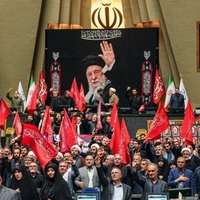
A scene from a foreign policy event in Tehran on February 8, 2026
100%
A scene from a foreign policy event in Tehran on February 8, 2026

Speaking at the same event, Kamal Kharazi, head of Iran’s Strategic Council on Foreign Relations and a former foreign minister, said Tehran’s foreign policy should prioritize ties with neighboring countries while maintaining what he called resistance to coercive pressure from adversaries.

Ali Akbar Salehi, a former foreign minister and senior nuclear official, argued that Iran faced a broader governance challenge in translating its revolutionary ideals with practical policy tools, adding that strengthening the domestic economy and modern capabilities would make Iran’s foreign policy more sustainable.

Saeed Khatibzadeh, head of the Foreign Ministry’s political and international studies center, said the conference aimed to bridge academia, industry and the foreign policy establishment.

Araghchi framed enrichment as tied to sovereignty, saying no outside power could dictate what Iran may possess, and argued that diplomacy could work only if Iran’s rights were respected.

The Muscat talks came amid high regional tensions and an expanded US military posture in the region.

Iran’s President Masoud Pezeshkian said on Sunday that the talks were a “step forward,” adding that Tehran wanted its rights under the Nuclear Non-Proliferation Treaty to be respected.

Despite talks, analyst sees US strikes on 'paper tiger' Iran as likely

Feb 8, 2026, 01:12 GMT+0

Middle East analyst Elizabeth Tsurkov says people close to President Trump believe he is likely to strike Iran, arguing the Islamic Republic’s failure against Israel revealed a “paper tiger” abroad — even as it remains ruthlessly lethal toward its own citizens.

Speaking to Iran International in Washington, Tsurkov, a senior non-resident fellow at the New Lines Institute, said the recent US military buildup in the region is the largest since the 2003 invasion of Iraq and has raised expectations that force may ultimately be used.

“People who know the president personally have told me they believe he will attack,” she said, adding that talks are unlikely to succeed because “the maximum that the Iranian regime is willing to offer is less than what the US is willing to accept.”

Continue reading

Reports of deaths in custody in Iran raise fears of quiet repression

Feb 7, 2026, 20:22 GMT+0
•
Shahed Alavi

Human rights activists are sounding the alarm over reports of secret and extrajudicial executions in Iran, warning that the authorities may be moving toward retaliating against detainees after the deadly crackdown on protests in January.

Domestic accounts—fragmentary and difficult to verify under heavy censorship—suggest that killings may be continuing beyond those reported during the nationwide unrest of January 8 and 9, when security forces opened fire on demonstrators in cities across the country.

One case frequently cited by rights activists involves Mohammad-Amin Aghilizadeh, a teenager detained in Fooladshahr in central Iran.

According to activists who followed the case, judicial authorities initially demanded bail for his release. Days later, his family was instead given his body, bearing signs of a gunshot wound to the head.

In another case, Javad Molaverdi was wounded by pellet fire during protests in Karaj, detained by security forces, and transferred to Ghezel Hesar Prison. His family later discovered his body in a cemetery, rights activists said.

Such cases have prompted warnings from international monitors. The United Nations special rapporteur on Iran, Mai Sato, has said she is closely following reports suggesting that executions and deaths in custody may be used to instill fear.

‘Doesn’t add up’

One of the most striking accounts received recently by Iran International comes from a journalist inside the country who described a conversation with a ritual washer working at a cemetery in Tehran province.

The journalist met the worker on January 27 and described him as visibly shaken, despite years of professional exposure to death. The washer told the journalist that the official reports “didn’t add up” for some bodies delivered to the cemetery.

“They bring a body that was clearly killed less than two days ago,” the worker said, “but say it has been in storage for 15 days because it was unidentified.”

“We have seen every kind of body for years—traffic accidents, heart attacks,” the worker added. “We can tell the difference. We know.”

Professionals working in forensic medicine and cemetery washing facilities often develop, over time, the ability to estimate time of death based on physical signs, even without laboratory tools.

Worrying precedents

The significance of the testimony lies not only in its emotional impact but in what it suggests about discrepancies between official explanations and physical evidence.

Such accounts cannot, on their own, establish a nationwide pattern. But taken together with reported cases of deaths in custody, they have intensified fears among activists that the authorities may be sending a broader message to protesters: that survival is no longer assured once dissent reaches detention centers.

Those fears are shaped in part by historical precedent.

Documented cases of extrajudicial killings in Iranian prisons—most notably in the early years after the 1979 revolution and during the 1988 mass executions—have heightened sensitivity to any signs that repression may again be moving out of public view.

The evidence gathered so far remains incomplete and uneven. But rights activists say it is sufficient to raise serious concern that deaths in custody and quiet executions may be occurring after protests have been suppressed.

Iran power centers signal doubt just as talks with the US begin

Feb 6, 2026, 18:10 GMT+0
•
Behrouz Turani

As Iranian and US negotiators met in Oman on Friday to discuss the framework for renewed talks, Friday prayer leaders across Iran used their sermons to dismiss the process, expressing near-uniform pessimism about the prospects for diplomacy.

The messaging was unlikely to be accidental, as Friday prayer sermons are drafted by a central headquarters overseen directly by the office of Ali Khamenei and distributed nationwide to imams, often a day in advance.

In Mashhad, Ahmad Alamolhoda, Khamenei’s representative in the city, told worshippers that negotiations conducted “with weapons and warplanes hanging over the table” were part of “America’s political game,” dismissing the process as futile.

In Rasht, Rasoul Falahati said Iranian negotiators would not retreat “a single step.” In Karaj, Hossein Hamedani warned that “trusting the enemy is a strategic mistake,” while in Isfahan, Ahmad Mahmoudi said Iran’s adversaries were frustrated because “their hands have been cut off from Iran’s resources.”

None of the sermons struck an optimistic note.

Military officials reinforced the message, with army spokesman Mohammad Akraminia asserting that Iran had “easy access to US bases” in the region. If war broke out, he warned, “its scope will engulf the entire geography of the region.”

The same line was echoed by senior lawmaker Fada Hossein Maleki, who described the talks as part of Washington’s pressure campaign.

“We are not optimistic about these negotiations, given the previous history of talks and the recent US military deployment to the region,” he told the news website Didban Iran on Friday.

“When they bring their military to our region, they are placing a gun to Iran’s head and calling it negotiation,” he added, stressing that many members of parliament shared his pessimism.

A sharply different view came from Iran’s moderate camp.

Fayyaz Zahed, a former adviser to President Masoud Pezeshkian who resigned over what he described as mismanagement in the presidential office, predicted that Tehran would ultimately be forced to make sweeping concessions.

Speaking to Khabar Online hours before the Muscat talks began, Zahed said Iran would have to hand over its stockpile of enriched uranium and freeze enrichment for an extended period. “Anything else would make entering negotiations pointless,” he said.

Zahed, however, holds no official role in the negotiations, and his remarks stood in contrast to the line coming from clerical, military, and conservative political institutions that dominate decision-making in Tehran.

Maleki’s defiant tone underscored that divide, echoing the skepticism voiced from Iran’s pulpits and military platforms earlier in the week.

“Iran is not like Venezuela, which announces its readiness to negotiate the moment the US fleet approaches its shores,” Maleki said—suggesting that even as diplomats engaged across the table in Oman, the political establishment at home was preparing the public for talks that fail, or for confrontation that follows.