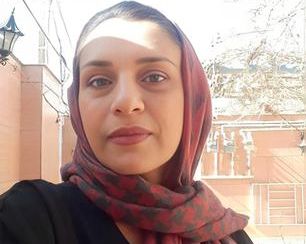
The family of Iranian activist Pouran Nazemi says they have had no contact with her since she was violently arrested alongside Nobel Peace Prize laureate Narges Mohammadi and other activists during a memorial service on Friday.
Nazemi was detained during a memorial service in the northeastern city of Mashhad for Khosrow Alikordi, a former political prisoner and lawyer for dissidents whose sudden death left supporters suspicious of state involvement, which Tehran denies.
At the ceremony, security forces used force to dispersed mourners and arrested 39 people, including activists, lawyers and civil society figures.
Nazemi’s sister Mahshid told Iran International she was on a live video call with Pouran when security forces stormed the mosque where the commemoration was being held.
“The security officers opened the mosque’s doors and attacked the people with batons and knives,” Mahshid said. “They threw tear gas inside the mosque," Mahshid said.
Mahshid was able to record portions of the incident by capturing the live video call with her sister, though she was unable to document the alleged knife and baton attacks she described.
She did, however, provide photos showing what appear to be knife wounds and a bloodied scene.
Screenshot of Iranian protester describing being hit on the head and bloodied by baton from Iran's security forces. Photo of what appears to be a knife attack during the ceremony of rights lawyer Khosrow Alikordi.
Videos reviewed by Iran International show Pouran describing the crackdown in real time before the feed was abruptly cut. Screams and loud bangs were audible.
Mahshid said she watched plainclothes officers beat women inside the mosque and drag people away. “They attacked them very badly. We could only hear screaming and see the camera shaking,” she said.
Iran International was not immediately able to verify all aspects of her account of the raid.
Defiance, fear of death
“It was terrifying,” Mahshid said. “But I also felt proud because I saw a group of brave women, without the hijab, in a mosque, in a religious city, shouting ‘Death to the dictator’ and ‘Woman, Life, Freedom."
The Woman, Life, Freedom movement marked one of the most serious challenges the Islamic Republic has faced, with protests erupting nationwide in 2022 after the death of Mahsa Amini in morality police custody and calling for an end to clerical rule.
Nazemi's sister says they still do not know where she is being held or which security body is responsible for her detention, though they fear the case may be under the authority of the Islamic Revolutionary Guard Corps.
“We don’t know which prison she is in or which organization is holding her,” Mahshid said. “And when there is no official information, the risk of torture and fabricated charges increases,” she added.
The family is also concerned about Nazemi’s health. She has a history of stomach cancer, severe respiratory problems and life-threatening anaphylactic reactions caused by medical negligence during a previous detention, according to her sister.
During an earlier imprisonment, Nazemi suffered allergic shock after being given an antibiotic she was known to be sensitive to while undergoing surgery, Mahshid said.
“Since then, her condition has never been stable. Now I don’t know if she is receiving any medication at all,” she told Iran International.
There is also an open case against Nazemi in the southeastern city of Kerman, which her family fears could be used to impose harsher charges.
“They have already given her 14 years in prison in one case,” Mahshid said. “They don’t answer us, they don’t give court documents, and they argue with our lawyers,” she told Iran International.
Several detainees have since made brief phone calls to their families, but relatives say information about their condition and whereabouts remains limited.
In a message relayed by her family, Mohammadi said she was severely beaten during her arrest, suffering repeated blows to the head and neck with batons, and was later accused of “cooperation with the State of Israel.”
Human rights groups say the arrests followed a violent crackdown on mourners at the memorial, which had become a flashpoint amid growing controversy over Alikordi’s death.
Alikordi, a lawyer known for defending political prisoners and bereaved families, was found dead in his office in Mashhad on December 5. Authorities say he died of a heart attack, but his family and colleagues have questioned the official account, citing the removal of surveillance cameras and inconsistencies in the investigation.
Calling on the international community to act, Mahshid urged governments and rights groups to demand accountability.
“When names and locations are hidden, people are tortured and silenced,” she said. “Be a voice. Raise the cost for the Islamic Republic and demand transparency — for my sister and for the suspicious death of Khosrow Alikordi,” she told Iran International.
Hana Alikordi, daughter of Khosrow Alikordi, gestures at her father’s funeral service in this photo obtained from social media..
A prominent UK-based rights barrister has called for an independent investigation into the sudden death of Iranian lawyer Khosrow Alikordi this month after the case stoked outrage and rowdy protests at his memorial service.
“There should be an independent, impartial and transparent investigation into his death,” Tatyana Eatwell, an international human rights barrister at Doughty Street Chambers in London told Eye for Iran.
Eatwell has worked extensively on Iran-related cases including the detention of Nazanin Zaghari-Ratcliffe, a British-Iranian woman who was detained in Iran for six years on widely disputed charges while visiting family.
She later became one of the most high-profile cases of Iran’s detention of dual nationals, in a policy critics of Tehran have blasted as hostage diplomacy.
Alikordi’s body was discovered in his office in Mashhad on December 8, 2025.
Iranian authorities attributed his death to a cardiac arrest, citing alleged forensic evidence, even as unconfirmed reports emerged of head injuries, blood at the scene and the removal of security cameras.
Eatwell said the circumstances surrounding Alikordi’s death cannot be separated from the years of persecution he faced at the hands of Iranian authorities. He was a former political prisoner and had represented many dissidents throughout his career.
“Mr. Ali Kordi was imprisoned, he was disbarred from practice, subject to travel bans, simply for doing his job, for representing his clients without fear nor favor. This is part of our professional obligation," Eatwell told Eye for Iran.
“The first question one asks is whether in the light of allegations of state involvement, the state institutions themselves are sufficiently robust and independent to provide the family with the answers to the questions that they must have,” she said.
Alikordi was a prominent figure among Iran’s community of human rights defenders. He represented political dissidents, bereaved families and people arrested during the Women, Life, Freedom protests in 2002, including Fatemeh Sepehri, a well-known Iranian political activist and outspoken critic of Supreme Leader Ali Khamenei who has been repeatedly imprisoned for her opposition to the Islamic Republic.
A group of 81 lawyers inside Iran issued a public statement on December 9 demanding full transparency regarding the circumstances of Alikordi’s death and pledging support for his family in what they described as a necessary truth-seeking process, according to the Center for Human Rights in Iran.
Provincial officials in Razavi Khorasan in Northeastern Iran insist his death was natural, even as reports indicated a heavy security presence around the scene.
One of the lawyers who signed the statement told the Center for Human Rights in Iran that a key aim was to create a safe environment for Alikordi’s family.
A source familiar with the situation in the eastern, holy city of Mashhad said security agents warned civil and political activists arriving in the city not to give speeches at Alikordi’s funeral.
Following Alikordi’s burial, his brother, lawyer and academic Javad Alikordi said he had been summoned by the Mashhad Revolutionary Court.
Eatwell said Alikordi’s persistence in continuing to practice law despite sustained pressure stood out, saying that lawyers who defend dissidents and protesters operate in an increasingly hostile environment.
“The impact that it’s designed to have is to discourage other lawyers from practicing in this way, to discourage people from speaking out, to discourage people from asking questions,” she said.
Eatwell said Iran’s repeated failures to conduct credible investigations make it unlikely that Alikordi’s family will receive answers through domestic channels alone.
She said the international community must be prepared to act, pointing to the United Nations Human Rights Council’s International Fact-Finding Mission on Iran, established in 2022 to investigate serious human rights violations.
US President Donald Trump (center), Azerbaijan's President Ilham Aliyev (left), and Armenia's Prime Minister Nikol Pashinyan shake hands during a trilateral signing event at the White House, in Washington, DC, August 8, 2025.
Iran opposes US President Donald Trump’s plan for a proposed transit corridor through southern Armenia linking two parts of Azerbaijan as a threat to its security, a senior advisor to Iran's Supreme Leader told Armenia’s ambassador in Tehran on Monday.
“The so-called Trump plan regarding the Caucasus is no different from the Zangezur Corridor, and the Islamic Republic is completely opposed to it,” Ali Akbar Velayati said during a meeting with Armenia's Ambassador to Tehran Grigor Hakobyan.
Velayati is foreign policy advisor to Supreme Leader Ali Khamenei. The corridor, he added, creates “conditions for NATO’s presence north of Iran" and "presents the security of northern Iran and southern Russia with a serious threat."
His remarks come as Armenia and Azerbaijan move ahead with a US-brokered peace deal signed at the White House in August, which includes plans for the new transit corridor.
The planned route — formally named the “Trump Route for International Peace and Prosperity” — will run through Armenia’s Syunik region, linking Azerbaijan to its Nakhchivan exclave and on to Turkey and Europe.
By bypassing Iranian territory, it undercuts Tehran’s land link between Azerbaijan and Europe and gives Washington a new foothold in the South Caucasus.
Velayati warned that the plan for a new transit corridor in the Caucasus is, in Iran’s view, the same as the Zangezur Corridor—a project Iran has long opposed because it could change borders and increase foreign military influence near Iran.
Velayati said the plan is “practically the same project whose name has merely been changed and is now being pursued in the form of the entry of American companies into Armenia.”
Velayati accused Washington of using economic projects as a doorway to expand its military presence in the region.
“Experience has shown that the Americans first enter sensitive regions with seemingly economic projects, but gradually their presence expands to military and security dimensions," he said.
"The opening of America’s presence at Iran’s borders in any form has clear security consequences.”
Two Iranian women stand next to each other in this file photo.
An annual cultural celebration of women and mothers in Iran falling on the birthday of the Prophet Muhammad's daughter Fatimah has galvanized critics of the theocracy's rights record for women even as supporters come to its defense.
After the 1979 revolution, the holiday replaced the pre-revolution tradition of observing Mother’s Day on December 15 as well as March 8, International Women’s Day.
The official website of Iran’s Supreme Leader published a message praising Fatimah as a model of “piety, justice-seeking, jihad, guidance, wifehood and motherhood.”
Across the country this year, state schools and government offices held ceremonies honoring Fatimah’s virtues and celebrating mothers and women, complete with religious speeches. The Social Security Organization also distributed a small cash gift—worth roughly $10—to women covered by retirement support programs.
But many women — and some men — responded to the government’s pageantry with sharp criticism.
'Absurd without rights'
A woman named Homa Dokht challenged the very premise of the day, pointing to Fatimah’s childhood marriage in a video posted on X.
Congratulating Mother’s Day on Fatimah’s birthday is absurd, she argued, because it is tantamount to endorsing child marriage, referring to accounts that place Fatimah’s marriage at age nine and childbirth around age ten.
“For the smallest things — like enrolling children in school, opening a bank account for them, or even getting their exam results — only the father is qualified (legally),” she said. “And if a child needs surgery, only the father’s or paternal grandfather’s signature is valid.”
For activists, the contrast between state-sanctioned celebrations and daily lived realities encapsulates a central grievance: symbolic reverence for motherhood does not translate into legal equality.
Iran mandates women wear the Islamic face veil, even as enforcement had slackened in recent year. A young woman named Mahsa Amini whose death in morality police custody stoked mass protests in 2022. The unrest was quashed with deadly force.
Iranian law, which Islamic authorities say is based on religious precepts, systematically prioritizes men in criminal, family and financial cases.
Gender equality activist Leila Forough Mohammadi wrote on X: “On a day named for women, a single woman, a divorced woman, a woman without children simply does not exist — as if she is incomplete.
"Here, the system defines the woman only as spouses, and bestows the highest status on a woman whose reproductive role serves the population policy,” she added.
Iran ranks 143 out of 146 countries in the latest World Economic Forum Global Gender Gap Report.
Amnesty International has documented systemic gender discrimination in Iran in its 2024 report, including up to 74 lashes for defying hijab rules and frequent impunity for honor killings.
Mansoureh Hosseini Yeganeh, a women’s rights activist based in the UK, wrote: “We want not just Mother’s Day, but child custody rights, the right to obtain a birth certificate for our children, the right to leave the country, government support, citizenship respect, and all the things mothers enjoy in other civilized countries. And we want gifts too!”
“What Mother’s Day?” journalist Maryam Shokrani asked: “when mothers and women in this country are deprived of their most basic rights, when you don’t even include their names on their children’s birth certificates, when they have no custody … You should be ashamed!”
Men in solidarity
A post on X by Khamenei this month highlighting income inequality between women and men in the West stoked criticism by users who pointed to the Islamic theocracy's record on women's rights.
The nearly 50-year-old system over which Khamenei presides views the veil as an emblem of Islamic identity and chastity.
Some Iranian men voiced support for the current holiday amid the criticism.
Mehrshad Ahmadian, CEO of a steel company, wrote: “Go sit with your father after you’re done congratulating Mother’s Day, ask him why your mother has no right to divorce? Why doesn’t she have custody of the child she gave birth to? Why does she need permission to obtain a passport?”
Supporters of the government’s agenda defend the official celebrations and the religious framing.
“Whenever we speak of women in the Islamic view, we speak of dignity, not a show," a user on X asserted.
"Islam defines women by the Fatimah model, not by the standards of capitalist markets. Today’s Iranian woman is an example of this great truth.”
A view from the Imam Reza Shrine, the mausoleum of the eighth Imam in Shi’ite Islam, in Mashhad, the province of Razavi Khorasan
A senior Iranian cleric said the northeastern city of Mashhad should be treated primarily as a religious destination rather than a leisure tourism hub, arguing that recreational tourists should visit other provinces such as northern province of Mazandaran instead.
Ahmad Alamolhoda, the Supreme Leader’s representative in Razavi Khorasan province and Friday prayer leader in Mashhad, said the city’s identity was rooted in pilgrimage to the shrine of Imam Reza, one of Shi’ite Islam’s holiest sites.
“Mashhad is not a city for tourists; it is a city for pilgrims,” he was quoted as saying by Iranian media.
He cited comments attributed to some Arab visitors from Iraq who he said had indicated they might travel to Tehran and then head to the Caspian coast for leisure, which he said showed Mashhad’s role as a pilgrimage destination and the need to distinguish between religious tourism and recreational or historical tourism in other cities such as Isfahan or Shiraz.
Alamolhoda also addressed women’s attendance at sports stadiums, saying he had no religious objection in principle but favored designated seating areas for women separate from men to prevent behavior he said could lead to social “abnormalities.”
On the enforcement of Islamic dress codes, he cautioned against confrontational approaches toward women not wearing the hijab. Instead, he urged a compassionate approach, likening it to caring for an ill loved one, saying: “This is not good for you; don’t do it.”
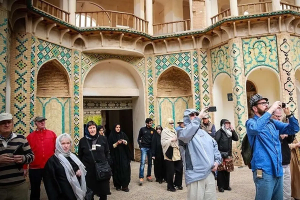
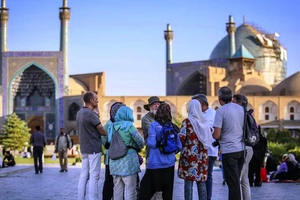
Iranian tourism and media officials said reshaping the country’s international image, particularly after the 12-day war, has become a central challenge for the tourism sector, expressing the need for a coordinated and credible narrative to support recovery and growth.
The message emerged at a joint meeting between media and tourism officials hosted by the strategic council of Iran’s Ministry of Cultural Heritage, Tourism and Handicrafts and the media affairs department of the Ministry of Culture and Islamic Guidance, according to ISNA.
Participants said tourism increasingly depends on professional narrative-building to counter negative perceptions and present Iran’s security and cultural capacity to foreign audiences.
Officials argued that media should move beyond a passive role and become an active partner in promoting tourism and related industries.
Mohammadreza Norouzpour, deputy media affairs minister, said tourism cannot gain visibility without media engagement and that effective communication requires sustained, credible storytelling.
He said developing a participatory model between media and tourism actors was essential to reposition the sector domestically and internationally.
Speaking at the meeting, Mohsen Haji Saeid, head of the tourism working group and chairman of the national association of tour guides, said restoring Iran’s image abroad – especially following the recent conflict – was now the core issue facing the tourism industry.
He criticized traditional promotional approaches and called for a comprehensive information bank to present data on safety and tourism potential.
Other speakers emphasized the role of private-sector participation, health tourism, visual content, and the use of tour guides as cultural ambassadors.
Officials also discussed leveraging major international events, such as the World Cup, to amplify Iran’s narrative.
The meeting concluded with agreement to continue the tourism working group’s activities on a permanent, issue-driven basis, aimed at strengthening media-tourism coordination and improving perceptions of Iran among domestic and international audiences.