Iran denies plot to assassinate Israeli ambassador to Mexico
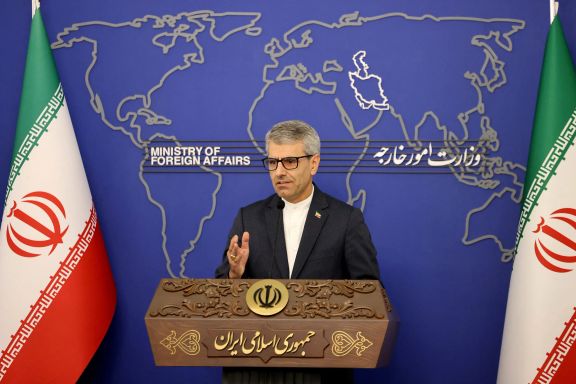
Iran's Foreign Ministry Spokesman Esmail Baghaei
Iran's foreign ministry spokesman on Monday denied Tehran plotted to assassinate Israel's ambassador to Mexico after Western media reports citing US and Israeli officials said Mexican security officials foiled the plan earlier this year.
The allegation was “so absurd and baseless that our embassy initially saw no need to respond,” Foreign Ministry Spokesman Esmaeil Baghaei said on Monday, adding that both the Mexican foreign ministry and its intelligence agencies had confirmed there was no such case.
“This is part of the Zionist regime’s ongoing effort to destroy Iran’s friendly relations with other states,” he told reporters at his weekly press briefing in Tehran.
Trump ‘confession’ filed at UN
Baghaei also said Iran has officially submitted US president Donald Trump’s recent comments to the United Nations as evidence of Washington’s involvement in Israeli military actions against Iran.
“This admission of a crime establishes the full responsibility of the US government,” he said. Iran is working with its judiciary and the president’s legal office to pursue international proceedings, Baghaei added.
Last week, Trump said he directed Israel’s strike on Iran during the June conflict. “Israel attacked first. That attack was very, very powerful. I was very much in charge of that,” US president told reporters last week.
Tehran, Baghaei said, is also documenting what it calls US and Israeli aggression for future legal use.
“We are seriously pursuing the documentation of the military aggression by the Israeli regime and the United States, and we are also examining all available international mechanisms to seek justice and file a complaint against the US,” he added.
Iran on agenda for IAEA meeting
On the nuclear file, Baghaei said it was not unusual for Iran’s nuclear activities to appear on the agenda of the International Atomic Energy Agency’s next Board of Governors meeting, adding that Western powers may seek to use the session to renew political pressure.
He also dismissed NATO Secretary General Mark Rutte’s recent comments accusing Iran and Russia of undermining international rules.
“Most of the actions carried out by NATO members themselves are the very ones they accuse others of committing. This requires no analysis – one only needs to look at the facts to see which side has violated international law and the UN Charter: Iran or the NATO member states,” he said, adding that the alliance’s interventions in Afghanistan and beyond had repeatedly breached international law.
Inspectors visit nuclear sites
IAEA inspectors, Baghaei said, visited several Iranian nuclear facilities last week, including the Tehran Research Reactor. Any further inspection requests, he added, would be reviewed “in coordination with the Supreme National Security Council.”
His remarks followed IAEA chief Rafael Grossi’s statement to France 24 that Iran still holds highly enriched uranium and the technical capacity to build a nuclear weapon despite recent Israeli and US attacks on its facilities.
Sanctions relief
Asked about Trump’s separate remark that Iran had requested the lifting of sanctions from Washington, Baghaei said lifting sanctions remains a “legitimate demand of the Iranian people” rather than a gesture of goodwill by Washington.
“These sanctions have been unjustly imposed on every Iranian for decades, and their humanitarian impact amounts to a crime against humanity,” he said.
Iran continues to insist on the removal of what it calls “unlawful restrictions” as a prerequisite in any future negotiations with Western powers, he added.
A file photo of the AS21 Redback advanced infantry fighting vehicle made by South Korean company Hanwha Defense for the Australian Army
An Iranian-backed hacking group has published classified plans for Australia’s new $7 billion Redback infantry fighting vehicles online, following a series of cyberattacks on Israeli defense companies, Sky News Australia reported on Sunday.
Cyber Toufan, a group believed to be linked to the Iranian state, claimed responsibility for the breach and released 3D renderings and technical blueprints of the Redback vehicles on Telegram.
The hackers said the data was obtained during a broader campaign that targeted 17 Israeli defense contractors after infiltrating supply-chain firm MAYA Technologies last year.
Among the affected companies was Israel’s Elbit Systems, which supplies weapons turrets for the Redback fleet under a separate $920 million contract.
The leaked material includes internal Australian Defense Force discussions about potential purchases of Israel’s Spike NLOS anti-tank missiles.
It remains unclear how much information was stolen or whether the data could be used to compromise the Redback’s systems.
The Redback project, developed with South Korea’s Hanwha Defense, will deliver 129 next-generation combat vehicles to the Australian Army, with construction taking place in Geelong, southwest of Melbourne.
Defense Industry Minister Pat Conroy, who announced the project last week, defended Elbit’s role despite criticism over Israel’s war in Gaza. “We make no apology for getting the best possible equipment for the Australian Defense Force,” he said.
The breach highlights an escalating pattern of cyberattacks on global defense networks.
The Australian Signals Directorate warned in its 2025 Cyber Threat Report that government and military data remain key targets for state-sponsored actors.
Photo from UK Foreign Secretary Yvette Cooper’s X account, taken at the Manama Dialogue Conference in Manama on November 1, 2025.
A senior advisor to Iran's Supreme Leader accused Britain of directing this year’s Manama Dialogue conference in Bahrain, saying the event was used as a platform for attacks on Tehran by governments that themselves back armed groups in Sudan and Yemen.
Ali-Akbar Velayati, international affairs adviser to Ali Khamenei, said Britain played a leading role in shaping the tone of the discussions.
“England was behind the scenes of the Manama events,” he told Tasnim news agency, saying London is “in the final breaths of power.”
The Manama Dialogue -- an annual regional security forum launched in 2004 and organized by the London-based International Institute for Strategic Studies -- drew senior officials from across the Middle East, Europe, and the West.
He accused the UK of fueling conflicts elsewhere, including the war in Ukraine, to weaken rivals.
“It was England that pushed Ukraine into this deep pit and provoked NATO to intervene,” he said, arguing that Britain’s influence has declined sharply as the United States under Donald Trump sidelined its former ally.
Ali-Akbar Velayati, international affairs adviser to Supreme Leader Ali Khamenei
Western officials target Iran
Velayati did not name the officials he accused of making anti-Iran remarks, but at the Manama Dialogue conference, senior Western ministers singled out Tehran’s behavior as a regional threat.
“We know that Iran has been obviously a long-term threat to the stability and security across this region, but also more widely,” UK Foreign Secretary Yvette Cooper said at the forum. “In the UK, we have had Iran-backed threats on our streets too.”
German Foreign Minister Johann Wadephul said Berlin, Paris, and London had “to trigger, unfortunately, the snap-back mechanism,” adding that “the behavior of Iran here in the region, and of course also the missile program” would remain central to future talks.
Tehran rejects accusations
Velayati dismissed such remarks as baseless, saying some of the same states criticizing Iran have a record of “supporting killers and terrorists” in Sudan and Yemen. “Those who, with British weapons, assist in the massacres in Sudan cannot speak about Iran’s peaceful role in the region,” he said.
He described Iran as a historic force for stability and solidarity among its neighbors, adding that “small states of the region have always been supported by Iran” and that Tehran has never sought domination over others.
Defeating the authoritarian rule requires learning from democratic societies, dissident activist Masih Alinejad said on Saturday, calling for unity among the opposition groups of Iran, Russia and China against the three allied countries' dictatorships.
The dissident activist made the remarks in Berlin on the sidelines of the annual forum of the World Liberty Congress, a movement she co-founded in 2022 along with Russian activist Garry Kasparov and Venezuelan opposition leader Leopoldo López.
“We intend to increase pressure on dictators by uniting opposition movements from different countries," she said.
Alinejad compared Iran’s compulsory hijab laws and political repression to the Berlin Wall, telling Iran International that Iranians are destroying this wall through their defiance.
The World Liberty Congress is holding its second annual gathering on the sidelines of the Freedom Week marking the 36th anniversary of the fall of the Berlin Wall.
The gathering has brought together 180 participants from 60 countries including opposition figures, lawmakers, and rights activists from Iran, Russia, Venezuela, and China.
The event aims to coordinate global strategies to defend democracy and counter the spread of autocracy.
Practicing democracy in exile
Alinejad said the three founders of the World Liberty Congress had decided not to stand in this year’s internal elections to demonstrate democratic accountability.
“Mr. Leopoldo López, Garry Kasparov and I oppose Khamenei, Maduro and Putin, and to prove we are not like the dictators, we told the Berlin parliament that in the World Liberty Congress elections we will step aside so others can present themselves as the congress’s president, vice president and secretary this year.”
“This is an exercise to show democratic countries that we can hold elections and free ourselves from dictators,” added Alinejad.
The activist previously defined the World Liberty Congress as an alternative to the United Nations, which she said "has become a place to unite dictators."
File photo: An Israeli flag flutters at the embassy of Israel in Berlin, Germany, October 20, 2024.
Iran's Islamic Revolutionary Guard Corps sought to kill the Israeli ambassador to Mexico but the plot was thwarted over the summer by Mexican security forces according to US and Israeli officials cited by Axios on Friday.
The plot to assassinate ambassador Einat Kranz-Neiger began at the end of 2024, Axios cited a source with knowledge of the matter as saying, and was led by a member of the IRGC Quds Force's secretive Unit 11000.
The operative, according to the source, spent several years overseeing agents from Iran's embassy in Venezuela.
"The plot was contained and does not pose a current threat," the outlet quoted a US official as saying.
"This is just the latest in a long history of assassination attempts by Iran around the world targeting diplomats, journalists, dissidents, and anyone who disagrees with them — something that should deeply concern every country where there is an Iranian presence," the US official added, according to Axios.
Israel and Iran have been arch-enemies since the 1979 Islamic Revolution made enmity to the Jewish State a key element of state ideology.
Their confrontation had mostly been contained to indirect fighting between Israel and Iran-backed Islamist armed groups in the Middle East including Hezbollah in Lebanon and Hamas in the occupied Palestinian territories.
The October 7, 2023 attacks on Israel led by Hamas helped propel the conflict into a direct showdown which culminated in a 12-day war in June.
Israel launched an air strike on Iran's embassy in Damascus in April 2024 killing several senior IRGC personnel and was widely believed to have carried out the assassination of Hamas senior official Ismail Haniyeh in Tehran in July last year.
A US federal court last week handed out lengthy sentences to two men convicted of seeking to kill US-based Iranian dissident Masih Alinejad in a plot prosecutors said was orchestrated by the IRGC.
Israel, Axios added, thanked Mexico for foiling the plot.
"The Israeli intelligence and security community will continue to work tirelessly, in full cooperation with security and intelligence agencies around the world, to thwart terror threats from Iran and its proxies against Israeli and Jewish targets worldwide," Axios quoted Israeli Foreign Ministry spokesperson Oren Marmorstein as saying.
Shi'ite fighters look at smoke rising from clashes during a battle with Islamic State militants at the airport of Tal Afar west of Mosul, Iraq November 18, 2016.
Washington has warned Baghdad that it will not recognize Iraq’s next government if any ministries are handed to armed factions linked to the Islamic Republic, a source in Iraq’s Kurdistan region told Iran International on Friday.
The message was delivered to Iraqi officials as political negotiations over the formation of a new cabinet intensified ahead of the November 11 parliamentary elections, the source said.
“If any ministry is given to militias affiliated with Iran, the United States will refuse to recognize the government.”
Disputes over presidency and premiership
Responding to comments by some Sunni leaders about the presidency, the source said Shiite and Kurdish blocs had already agreed that the post would go to the Kurds, with Tehran also approving the arrangement. However, he said the possibility of appointing a Sunni figure as prime minister “would raise concern in Tehran.”
All Shiite factions, according to the source, oppose another term for Mohammed Shia al-Sudani as prime minister, though Mark Safaya, US President Donald Trump’s representative for Iraq, “has a personal relationship with Sudani and may influence the process.”
Unlike in previous election cycles, the source added, the Islamic Republic “no longer holds the same sway” in deciding Iraq’s leadership. “This time, the United States and European countries are far more determined to shape the outcome.”
Election dynamics and foreign pressure
Reuters reported on November 4 that Sudani has entered the campaign with growing public support, seeking to portray himself as capable of maintaining balanced ties with both Washington and Tehran. The 55-year-old prime minister has focused his campaign on improving public services and hopes to secure the largest bloc in parliament.
As the country moves toward the vote, Sudani’s government faces mounting US pressure to curb Iran-backed militias.
Sudani has said previously that disarming these militias would be impossible as long as the US-led coalition remains in Iraq.
Iran supports Iraqi groups through financing, training, and arms, primarily focusing on Shia militias that are often integrated into the official Popular Mobilization Forces (PMF). This support helps groups like the Badr Organization and Kata'ib Hezbollah exert military and political influence, though some factions like Harakat Hezbollah Al-Nujaba have focused more on military operations. The support allows Iran to pursue its regional objectives, gain influence, and destabilize Iraqi politics while coordinating attacks against US forces.