Tehran’s main dam holds less than two weeks of water supply
A view from Amir Kabir Dam near Tehran
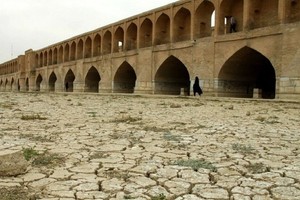
Tehran’s main water reservoir has enough supply for less than two weeks, a senior official warned on Sunday, as prolonged drought and plunging rainfall leave the capital facing one of its worst shortages in decades.
Behzad Parsa, head of Tehran Regional Water Company, told IRNA that the Amir Kabir Dam now holds just 14 million cubic meters of water -- only 8% of its capacity, down from 86 million cubic meters a year ago.
He said water inflow to Tehran’s dams has fallen 43% from last year due to a “100% drop in rainfall” compared to long-term averages.
Parsa urged residents to cut consumption, warning that without “urgent conservation and changes in usage patterns,” the city could face serious challenges in providing safe drinking water to millions of people.
Iran’s deepening water crisis has reached a critical point in Isfahan, where officials warn the city could run out of drinking water within weeks.
Once sustained by the Zayandehrud River, the city now faces near-empty reservoirs and severe groundwater depletion after years of drought, mismanagement, and unchecked extraction.
The crisis reflects a broader national emergency: rainfall has dropped up to 45% below seasonal averages, and 19 major dams are below 20% of capacity.
Around 60% of Iran’s wetlands have dried up as the country endures one of its driest years in two decades, with rainfall down by 20% compared to the long-term average, according to a report by Tasnim news agency on Sunday.
The outlet said the 2024 summer was “the driest season in twenty years,” turning rivers into “lifeless channels” and leaving many wetlands -- including Lake Urmia, Bakhtegan, Gavkhouni, and Hamoun -- either completely dry or severely depleted.
Official data from the Ministry of Energy cited by Tasnim showed that the country received 36 millimeters less rain than usual, with all nine major watersheds recording significant drops in precipitation. Southern provinces such as Sistan-Baluchestan, Hormozgan, and Bushehr saw rainfall decline by as much as 90%.
Water reservoir levels have also plummeted. Total storage in Iran’s dams has fallen to 39 billion cubic meters, about 15% lower than last year, while more than 60% of major dams are operating below half capacity, the report said.
Environmental authorities warned that wetlands across the country are on the brink of collapse due to a combination of drought, overextraction of groundwater, and mismanagement of water resources.
Experts quoted in the report said Iran’s worsening water crisis is no longer a temporary drought but a structural challenge caused by decades of poor management, overuse of groundwater, and unchecked dam construction.
They urged a shift in water governance and consumption patterns, warning that without urgent reforms, “Iran will sink deeper into a permanent state of water scarcity.”
A senior Iranian economist warned on Saturday that annual inflation could exceed 60% by the end of the year (March 2026), as the government struggles to contain soaring prices and widening poverty amid renewed sanctions and fiscal strain.
Official data show point-to-point inflation nearing 50%, while food costs have surged far faster, underscoring what analysts describe as a severe stagflation gripping the country.
“If the Pezeshkian administration fails to calm economic tensions, Iran will face a major stagflation crisis,” said Morteza Afghah, an economist at Ahvaz University, quoted by the Khabar Online website.
Afghahsaid the crisis was the result of years of “right-wing economic policies” and warned that hundreds of thousands of Iranians no longer earn enough to cover basic nutrition. He urged the government to cut unnecessary spending and overhaul the tax system so that “large-scale earners shoulder the burden” instead of further squeezing low-income families.
The remarks came as Iranian media reported that food inflation and basic living costs have sharply outpaced general prices, with many middle- and working-class families now below the poverty line. Parliament’s Research Center previously estimated that 30% of Iranians lived in poverty; new assessments put that figure closer to 36%.
According to lawmaker Rahmatollah Norouzi, even workers earning 450 million rials (around $400 at today’s market rates) “live below the poverty line” if they rent their homes.
Official labor data show the base monthly wage is less than 110 million rials, rising to about 150 million with benefits (about $100 to $150) -- far below the estimated 230 million needed for basic subsistence, according to the Supreme Labor Council.
Government spokeswoman Fatemeh Mohajerani recently said the poverty line per person stands at 60 million rials, prompting sharp criticism from unions and economists who called the figure “divorced from reality.”
Economic hardship has already taken a toll on health and education. The Health Ministry estimates poor nutrition contributes to about 35% of annual deaths in Iran, with tens of thousands dying each year from dietary deficiencies, including lack of fruits, grains, and essential fatty acids.
A report last week by Iran’s Statistical Center showed food inflation at nearly 64% -- a rate far higher than the overall 48% inflation estimate. Agricultural output has shrunk by more than 7% amid drought and a shortage of foreign currency for food imports.
Analysts say the situation risks worsening as renewed UN sanctions and a potential fuel price hike add further pressure.
A new report by Iran’s Statistical Center (ISC) reveals a sharp acceleration in food inflation, hitting millions of families where it hurts most.
According to the report, food prices in September rose by nearly two-thirds compared to the same month last year, with the cost of grains, bread and fruits nearly doubling.
For millions of low-income Iranians—estimated to make up over half the population and whose living conditions have consistently worsened each year—this surge in inflation is nothing short of catastrophic.
It remains unclear why food inflation has reached 64 percent while the overall inflation rate stands at 48 percent, but severe drought, water shortages and the government’s failure to allocate sufficient foreign currency for food imports appear to be the main drivers.
The Parliament Research Center estimated that agricultural output had shrunk by over 7 percent during the summer of 2025.
Sweeping sanctions along with years of corruption, opaque budgeting and mismanagement of already strained resources have deepened the crisis.
‘Nutrition crisis’
As the national currency collapses and inflation spirals, Iranian households’ dining tables are shrinking every year, and the country’s food security is facing an increasingly dire crisis.
According to data from the Food and Agriculture Organization (FAO), per capita meat consumption in Iran has dropped by 40 percent and dairy consumption by 30 percent over the past decade.
A field study conducted by a group of trained volunteer social workers—published two months ago by the reformist daily Shargh—paints an alarming picture of the nation’s nutrition.
It found that only 2 percent of Iranian children consume dairy daily, while 50 percent receive none at all.
The same survey, conducted across 14 provinces, showed that just 1.7 percent of households consume protein daily, while 26.9 percent do not consume any protein products whatsoever.
School dropouts
The crisis extends beyond food shortages and soaring prices.
The ISC reports that education costs jumped by nearly 23 percent in September—a major blow to families just as the new school year began, further aggravating dropout rates already at alarming levels.
Last September, the parliament’s Education Committee revealed that about two million students had not enrolled for the 2024 academic year, largely due to worsening economic hardship that prevented families from completing registration.
Education in Iran is free in theory, but private schools have mushroomed over the past decade, while public schools routinely charge families under various labels such as “donations” or “maintenance fees.”
Fear of unrest
This wave of inflation and skyrocketing prices comes as United Nations sanctions— reimposed at the request of the three European signatories to the 2015 nuclear deal (Britain, France, and Germany)—have further destabilized Iran’s economy.
Western countries, alongside the United States, accuse Iran of refusing to cooperate with the International Atomic Energy Agency (IAEA) and of concealing elements of its nuclear activities.
The IAEA’s reports have repeatedly confirmed Iran’s lack of transparency and urged Tehran to answer its questions and allow broader access to nuclear facilities.
With the return of international sanctions, inflation in Iran is expected to worsen, especially when the long-anticipated fuel price hike takes effect.
Based on President Masoud Pezeshkian’s recent remarks, it seems only a matter of time—a decision delayed mainly out of fear of renewed public unrest.
An outlet linked to Iran’s Revolutionary Guards on Thursday conceded that life is getting harder for Iranian families, in a sign that economic malaise has become too severe to ignore even by the ruling establishment.
Javan newspaper, which rarely acknowledges public hardship, wrote at length about the near-daily rise in grocery prices.
“Life has become more difficult and more expensive for Iranian families,” the daily wrote, citing examples of dairy, fruit, and bread skyrocketing.
According to the Statistical Center, food and beverage prices rose more than any other category during the month of Mehr (September 23–October 23). Bread prices increased by 98%, fruit by 94% and vegetables by 77%.
Not surprisingly, the paper laid the blame entirely on President Masoud Pezeshkian and his administration, whose mandate falls well short of tackling the domestic and foreign policy failures that have undermined Iran’s economy in recent years.
“He says at least three times a week that he never intended to become Iran’s president,” Javan wrote, accusing Pezeshkian of shirking responsibility.
The relative moderate is opposed by the hardline conservative Islamic Revolutionary Guard Corps.
Soaring inflation
The paper also criticized his supporters, including former President Mohammad Khatami, for focusing on abstract debates such as “the tension between religion and freedom” or “celebrity scandals” instead of economic realities.
The Statistical Center reported that point-to-point inflation from late September to late October reached 48.6%, with the Consumer Price Index climbing to 403.8 relative to 2021—meaning prices have quadrupled since.
Iran’s economy has been battered by sweeping international sanctions targeting its oil revenues, banking, and shipping sectors.
Years of corruption, opaque budgeting, and mismanagement of resources already strained by those sanctions have deepened the crisis and fueled public anger, as evidenced by the collapse of a major retail bank this week.
Despite mounting pressure on households, the government recently approved steep price hikes for vehicles produced by state-owned companies, ignoring the ripple effects on other goods and services.
Growing concern
Javan also attacked moderates for not speaking up against the administration they favor, singling out journalist-turned-politician Mohammad Ghoochani.
Ghoochani once warned of a “meat’s rebellion” when the dollar stood at 500,000 rials and meat cost 1.5 million rials per kilogram ($3), Javan jibed. “Now, with the dollar at one million rials and meat priced at 10 million rials per kilogram ($10), he remains silent.”
Junior hardliners in parliament received a brief rebuke too, scolded by the IRGC outlet for “challenging senior politicians” merely to boost their social media profiles.
The latest wave of price increases has forced many families to cut consumption, with some essential items disappearing entirely from household shopping baskets.
Even Iran’s tightly controlled media, including outlets owned by the government and armed forces, are now reporting on the growing hardship.
The United States has reinstated a sanctions waiver allowing India to operate Iran’s Chabahar Port, weeks after Washington revoked the exemption as part of its so-called maximum pressure campaign on Tehran.
“We have been granted an exemption for a six-month period,” Indian foreign ministry spokesperson Randhir Jaiswal told reporters in New Delhi, confirming the decision that enables India to continue running the strategic port on Iran’s southeastern coast along the Gulf of Oman.
Reuters cited an unnamed Indian official as saying the waiver had taken effect on Wednesday.
The decision follows US President Donald Trump’s recent comments that he hoped to reach a new trade deal with India after years of tension over tariffs and energy purchases from Russia.
Relations between India and the United States, the world's two largest democracies, have soured lately over the imports of discounted Russian oil and Trump's insistence that his intercession averted a nuclear war between India and Pakistan this year.
The waiver restores a 2018 exemption under the Iran Freedom and Counter-Proliferation Act (IFCA) that had allowed India to develop and use the port for Afghanistan’s reconstruction and regional trade.
The US state department withdrew that waiver effective September 29, warning that anyone operating Chabahar could face sanctions.
The renewed approval lets India proceed with its 10-year agreement signed last year with Tehran to develop and manage the port, viewed by New Delhi as a vital trade corridor linking India with Afghanistan and Central Asia while bypassing Pakistan.
For Iran, whose economy remains under heavy US sanctions, the waiver offers a rare opening.
Chabahar remains one of the few international projects connecting the country to global trade routes.