US says won't let Iran possess nuclear arms after Khamenei's defiant remarks
The United States will not allow Tehran to possess nuclear weapons, a White House official told Iran International on Monday, hours after Iran's Supreme Leader suggested Washington has no authority to decide what Tehran does with its nuclear capabilities.
"President Trump has always been clear: the world’s number one state sponsor of terror can never be allowed to possess a nuclear weapon," the White House official told Iran International in reaction to Ali Khamenei's remarks.
In his comments on Monday morning, Iran's 86-year-old ruler said the United States is in no position "to dictate whether a country should or should not have a nuclear industry."
"What does it have to do with America whether Iran has nuclear facilities or not? These interventions are inappropriate, wrong and coercive," Khamenei said.
The Supreme Leader also rejected an offer of renewed talks from US President Donald Trump, saying, “He claims to be a man of deals, but if a deal is accompanied by coercion and its outcome is predetermined, it is not a deal but an imposition and bullying. The Iranian nation will not bow to such impositions.”
In response to Khamenei's defiant remarks, the White House official told Iran International, "As the President stated, 'even to Iran, whose regime has inflicted so much death on the Middle East, the hand of friendship and cooperation is always open.'"
“There's nothing that would do more good for this part of the world than for Iran's leaders to renounce terrorists...and finally recognize Israel's right to existence," the official said, quoting Trump's remarks in his recent speech at the Israeli parliament.
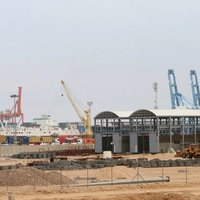
Satellite image of Iran’s Taleghan 2 site on September 27, 2025, showing advanced construction of the new arched structures, released by the Institute for Science and International Security on October 20, 2025.
New construction has been detected at an Iranian nuclear site once suspected of links to a weapons program and destroyed in an Israeli airstrike last year, a Washington-based think tank said on Monday, citing satellite imagery.
The site, located within the Parchin military complex southeast of Tehran, was hit in an Israeli airstrike on October 25, 2024, but was not struck during the June conflict.
The Institute for Science and International Security (ISIS) said rebuilding at the site—identified as Taleghan 2—began before the country’s 12-day war with Israel in June and continued afterward.
“The purpose of the new construction at this location cannot be discerned from the imagery; a multitude of other non-nuclear purposes are also possible,” the report said.
“It is deeply concerning that construction is occurring at a former AMAD Plan nuclear weapons development site, raising considerable questions as to the true purpose of the facilities there.”
AMAD was a secret scientific project allegedly aimed at developing nuclear weapons. It began in 1989 and ended in 2003, according to the International Atomic Energy Agency (IAEA).
Satellite imagery from May 20, 2025, showed a black temporary cover hastily installed over the destroyed building, the report said.
By June 12, groundwork and foundations had been laid, and by late August, a new arch-roofed structure about 45 by 17 meters was under construction over the temporary cover, with two smaller buildings nearby.
ISIS said imagery from September 27 showed a third arched structure and further progress on the others. It added that the smaller side buildings appeared to include “blast traps” if later bunkered with earth.
A support facility about 200 meters east of the main complex was also identified, with construction first noted in May and still ongoing.
The institute said that although there is no current evidence to support any nuclear-weapons-related purpose, efforts should be made to determine whether Iran is attempting to reconstitute either the high-explosive test chamber facilities originally part of the AMAD program or the more recently reported PETN plastic-explosive manufacturing capability.
It added that the structures’ arched roofs could later be covered with earth to enhance survivability in the event of future airstrikes and said it will continue to monitor developments at the site.
It added that the structures’ arched roofs could later be covered with earth to enhance survivability in the event of future airstrikes and said it will continue to monitor changes at the site.
Iran’s Supreme Leader Ali Khamenei meets hundreds of national sports champions and winners of international science Olympiads at the Imam Khomeini Hussainiya in Tehran, October 20, 2025.
Iran’s Supreme Leader Ali Khamenei dismissed US President Donald Trump’s claim that Washington had destroyed Iran’s nuclear program, adding that the United States has no authority over Tehran’s nuclear activities.
The US president’s comments were “nonsense spoken to console disheartened Israeli officials after unexpected defeat in the 12-day war,” Khamenei said on Monday in Tehran during a meeting with Iranian sports and science champions.
"The US president proudly says they bombed and destroyed Iran's nuclear industry. Very well, keep dreaming!" he added.
“The United States is in no position to determine what countries should or should not possess nuclear capabilities,” he said, adding that Iran’s youth-built missiles had already “penetrated and destroyed sensitive Israeli facilities.”
Speaking before the Israeli Knesset last week, President Donald Trump said, “We dropped 14 bombs on Iran’s nuclear facilities, which has been confirmed to have obliterated those facilities, and together we helped stop the world’s number one state sponsor of terrorism from making nuclear weapons. If we didn’t do that, there would be a dark cloud over this [Gaza] deal. This was our last shot.”
However, Khamenei said, “The Zionists never imagined that an Iranian-made missile, created by the hands of young Iranians, could reduce parts of their strategic centers to ashes, but it happened.”
“These missiles are ours, built by our youth, not borrowed or bought from anyone. They remain ready and will be used again if necessary,” he added.
The US president’s visit to Israel, Khamenei said, was an attempt to “revive morale among a defeated regime.”
He described Washington’s comments as “foolish and theatrical behavior,” asserting that such language “reveals how disillusioned the enemy has become.”
“These words were spoken to people who have lost confidence,” he said. “Their 12-day war humiliated them, and the American president went there only to give them spirit.”
Khamenei also accused Western leaders and media of distorting Iran’s progress. “They amplify our shortcomings and conceal our achievements,” he said.
“They want to convince our youth that Iran is dark and stagnant, but every success in sports, science, or technology proves the opposite.”
US accused of partnership in Gaza war
American weapons, logistics, and other resources were provided to Israel and were used against civilians in Gaza, Khamenei said.
He rejected US statements that its actions were aimed at combating terrorism, pointing to civilian casualties.
“They say they fight terrorism. More than 20,000 children and infants were killed in these attacks. Were they terrorists?” he asked.
Khamenei went further, calling the United States itself a producer of terrorism in the region: “You produced ISIS, you unleashed it on the region, and you have kept it as an instrument to use later.”
He accused Washington of direct complicity in the Gaza conflict and in the targeted killings of Iranian scientists, saying, “America is the main partner in this crime.”
Members of the UN Security Council vote against a resolution that would permanently lift UN sanctions on Iran at the UN headquarters in New York City, US, September 19, 2025.
The provisions of UN Security Council Resolution 2231 have officially expired, Iran’s Foreign Ministry spokesman Esmail Baghaei said on Monday, adding that the framework that endorsed the 2015 nuclear agreement came to an end.
Speaking at his weekly press briefing, Baghaei said Iran had notified the United Nations that “with the end of Resolution 2231 on October 18, its provisions have officially terminated.”
Iran’s nuclear rights, he said, remain valid, including the right to enrich uranium and pursue nuclear research and development.
“The rights gained under this resolution, such as enrichment and the expansion of peaceful nuclear activities, continue to stand,” Baghaei added, describing the 2015 Joint Comprehensive Plan of Action (JCPOA) as “a temporary and conditional understanding.”
Baghaei also accused the United States of violating international law by withdrawing from the deal in 2018 and criticized European governments for following Washington’s lead and failing to meet their own obligations.
In a letter to the secretary-general and the president of the Security Council on Saturday, Araghchi said Resolution 2231 had expired “in full accordance with its explicit provisions” and that all restrictions on Iran’s nuclear program had lapsed, ending the Council’s oversight of Tehran’s activities.
"Iran had implemented the JCPOA in good faith and with full precision, while the United States had grossly violated international law by reimposing unilateral sanctions," Araghchi said.
Russia and China back Iran’s stance at UN
Iran’s position on the termination of Resolution 2231, Baghaei said, was supported by Russia and China, two permanent members of the Security Council that opposed efforts by the United Kingdom, France, and Germany to trigger the snapback of UN sanctions.
This outcome, he added, reflected “months of sustained diplomatic engagement,” particularly following talks in New York and the Cairo accord reached with the International Atomic Energy Agency.
“Moscow and Beijing both made clear that the European powers lacked the legal standing to use the mechanism, since they had already violated the JCPOA.”
Contacts through intermediaries not formal negotiations
Addressing speculation about indirect communications with Washington, Baghaei said contacts through intermediaries “do not signify the start of official negotiations.”
While countries such as Egypt have sought to use their channels to ease tensions, he said, “real dialogue can only occur when both sides reach a shared understanding based on mutual respect.”
Recent discussions between Iran and Egypt centered on the Gaza conflict and the need for an immediate ceasefire, Baghaei said, adding that Tehran’s engagement with Cairo “has focused solely on humanitarian and regional stability issues.”
Joint letter with Russia and China sent to UN
Iran, Russia, and China reiterated their shared position in a joint letter sent to the UN Security Council on Sunday, emphasizing that Resolution 2231 had expired in accordance with its terms, the spokesman added.
“The letter reaffirmed that no valid decision had been adopted to reinstate the previous sanctions and that the legal confusion caused by the European powers’ action holds no bearing on Iran’s rights or its future nuclear activities.”
“The attempt to misuse international institutions for political ends” has created what he called a legal and procedural deadlock, for which “the responsibility lies entirely with the three European governments, not Iran.”
International Atomic Energy Agency (IAEA) Director General Rafael Grossi
The UN nuclear watchdog's inspectors do not believe that Iran has hidden large quantities of its highly enriched uranium at different locations, International Atomic Energy Agency (IAEA) chief told the Swiss daily Neue Zürcher Zeitung.
Rafael Grossi said information available to the agency indicates that most of the material is stored at known nuclear facilities in Isfahan and Fordow, and to a lesser extent in Natanz, though a small amount could have been taken elsewhere.
In the interview published on Saturday, he said inspectors would gain access to these sites only “when Iran perceives a national interest” in allowing it.
The IAEA estimates Iran possesses more than 400 kilograms of highly enriched uranium — enough for several nuclear weapons if further refined.
Grossi added that the three facilities had been severely damaged in Israeli and US strikes in June.
While Tehran denies pursuing nuclear weapons, the UN nuclear watchdog's chief said concerns over its potential capabilities “have not been fully dispelled.”
He urged renewed diplomacy, saying, “Sitting together at one table would save us the danger of another round of bombardments and attacks.”
Israel and the United States attacked Iranian nuclear sites in a 12-day June war, setting back the nuclear program but leaving its fate unresolved.
Tehran has since declined to allow IAEA inspectors to resume their inspections.
Last month, foreign minister Abbas Araghchi said Iran's inventory of highly enriched uranium is buried under rubble following US and Israeli strikes on the country's nuclear facilities.
US President Donald Trump said the killing of Iranian commander Qassem Soleimani in 2020 and US strikes on Iran’s nuclear sites in June paved the way for the Gaza peace deal between Israel and Hamas.
“It started probably with Soleimani. He was a mastermind who did a lot of bad things,” Trump said in a Fox News interview, referring to the late Quds Force commander.
“He’s the father of the roadside bomb that would blow up and maim so many of our great soldiers,” he added.
Soleimani was killed in a US drone strike near Baghdad International Airport in January 2020 on Trump’s orders.
The US president said the turning point that paved the way for the Gaza peace earlier this month came in June when US B-2 bombers carried out what he called a “beautiful military operation” against Iran’s nuclear facilities.
“They flew for 37 hours, went into Iran’s airspace, and bombed the hell out of it,” he said. “When we destroyed their nuclear capability, they no longer became the bully of the Middle East.”
He said the US operation, along with Israeli strikes on Iran, made possible what he described as peace beyond Gaza.
“We wouldn’t have been able to make the deal we just made, which is basically peace in the Middle East beyond Gaza,” Trump said.
The ceasefire mediated in early October by the United States, Egypt, Turkey and Qatar put an end to over two years of Israeli attacks on Gaza, which started in response to Hamas's October 7 attack.